Key Takeaways
1. Shadows Reveal the Voluminous Depth of the Animate World
The actual shadow does not reside primarily on the ground; it is a voluminous being of thickness and depth, a mostly unseen presence that dwells in the air between my body and that ground.
Beyond flatness. We often perceive shadows as flat, two-dimensional shapes projected onto surfaces. However, a shadow is a three-dimensional volume of darkness, a tangible absence of light that extends from the object casting it. This volumetric nature reveals a deeper, more substantial reality to the world around us.
Living presence. Shadows are not mere consequences of light but "qualitative attributes of the bodies that secrete them." They are time-dependent realms that change with the hour and season, quietly enveloping and gathering other bodies under their sway. To step into a mountain's shadow is to enter its "private life," feeling its manifold influence.
Earth's own shadow. Night itself is the colossal shadow of the Earth, a vast, brooding presence that swallows all other shadows. As this immense darkness overtakes us, it carries us out of ourselves into Earth's own awareness, revealing the cosmos and its myriad stars as Earth's habitat, not ours. Sleep, then, is the Earth's shadow seeping into our skin, dissolving our individual will into the planet's larger body.
2. Gravity as Eros: Our Body's Innate Yearning for Earth
This gravitational draw that holds us to the ground was once known as Eros—as Desire!—the lovelorn yearning of our body for the larger Body of Earth, and of the earth for us.
Forgotten desire. Modern life, with its chairs, beds, and vehicles, lifts us away from direct contact with the ground, causing us to forget the erotic nature of gravity. We perceive gravity as a burden, a downward pull, rather than the mutual attraction between our body and the Earth, a deep source of physical replenishment and even conscious desire.
Artifacts' earthiness. Even our built structures, though they hold us aloft, partake of the Earth's solidity. From the beams of a house to the rubber tires of a bicycle, all materials retain a trace of their ancestry in the "wombish earth," a dark resonance that sustains and feeds things. This pulse can be felt in the thickness of a mattress or the grain of a wooden desk.
Ancient affinity. Our body shares an ancient, irrefutable eros with the sensible presences around us—a kinship that transcends the modern distinction between animate and inanimate matter. This mute layer of bare existence, shared with mountains, forests, and stones, is a constant, often unnoticed, source of nourishment and connection.
3. The Animate Earth: All Things Possess an Expressive Sentience
The inwardly felt sentience of the child is a correlate of the outwardly felt wakefulness of the sky and the steadfast support of the ground, and the willfulness of the caressing wind; it is a concomitant of the animate surroundings.
Child's wisdom. A child's spontaneous affinity with the world reveals that awareness is a ubiquitous quality, not an exclusively human trait. Trees, stones, and birds are not inert but active, expressive subjects, mirroring the child's own developing sentience. This early collusion, if nurtured, deepens into a nuanced respect for the world's manifold life.
Beyond inertness. The modern assumption that rocks are inanimate is a conceptual construct, not a direct sensory experience. To our animal senses, a rock is another body engaged in the world, a "stubborn persistence" against entropy, displaying "wild activity" by its simple presence. It organizes space, calls to other beings, and shelters life.
Van Gogh's vision. The paintings of Vincent van Gogh vividly illustrate this animistic perception. In his canvases, nothing is inert; the landscape breathes, and every presence—cypresses, billiard tables, pebbles, stars—is in vibrant dialogue with its surroundings. His art, born from an inability to abstract his intellect from his body's reality, loosens our senses and re-animates our vision of the world.
4. Reciprocity of Perception: We Are Touched as We Touch
Sensory perception is this ongoing interweavement: the terrain enters into us only to the extent that we allow ourselves to be taken up within that terrain.
Mutual engagement. Perception is not a one-way street where we passively observe. It is a reciprocal exchange: when we touch a leaf, the leaf also touches us; when we gaze at a hillside, we feel ourselves seen by it. This vulnerability to the world is the very structure of sensory experience.
Embodied listening. Our bare feet on the soil receive directives from the ground, and in turn, the ground feels our steps. Our skin, porous and permeable, is constantly sampled by the breeze, which also takes a mold of our shifting shape. This ongoing, improvised dance with the sensuous medium that enfolds us leads to a new elegance in our actions.
Gift economy of life. As omnivores, we are entwined in a great gift economy where each life partakes of others and gives of itself in return. If we ingest the land's nourishment through our mouths, it is because we, too, are edible. The mosquito drawing blood is a humbling reminder of our membership in this web of interdependence, as both eater and eaten.
5. Mind as Earth's Atmosphere: An Encompassing, Planetary Intelligence
What if mind, rightly understood, is not a special property of humankind, but is rather a property of the Earth itself—a power in which we are carnally immersed?
Beyond the brain. The Cartesian dualism, and its modern iteration of a sentient brain versus a mechanical body, is insufficient. Mind is not an attribute of an isolated brain or body, but emerges from the ongoing encounter between our flesh and the rhythms of the world. It is a creativity proper to the body as a whole, arising from the tension between organism and terrain.
Spinoza's audacity. Baruch de Spinoza, centuries ago, argued that mind and matter are two attributes of one substance: "God, or Nature." He posited that every material body has its mental aspect, and the human mind is the specific sentience of the human body. This radical view suggests that intelligence is an attribute of nature in its entirety, not just our species.
Immersed in awareness. We are born into mind as into an unseen layer of the Earth, a fluid medium that permeates our bodies, much like the air. This "awakened atmosphere," charged with sunlight, is the very stuff of awareness. Our individual awareness is a unique participation in this encompassing intelligence, shaped by our particular body and its engagement with the Earth.
6. Earth's Moods: Weather as the Shifting Psyche of Place
Each place, that is to say, is a unique state of mind, and the many powers that constitute and dwell within that locale—the spiders and the tree frogs no less than the humans—all participate in, and partake of, the particular mind of the place.
Local intelligence. Each region, with its unique topography and ecosystem, possesses its own particular awareness and style of intelligence. The atmosphere, infused with local scents and rhythms, imparts its vibrance to all who partake of it, shaping the collective psyche of the place.
Weather as mood. Changes in local weather are not just objective phenomena but shifts in the disposition of the land, altering the palpable mind of the place.
- Torpor: Humid, hazy days induce mental lethargy, blurring thoughts.
- Lucidity: Crisp, clear days bring mental clarity and ease, making plans flow smoothly.
- Stillness: Snowfall creates a hushed purity, dissolving worries and melting words.
- Wind: A versatile element, from the anonymous rigor of winter blasts to the exhilarating challenge of spring gusts, or the haunted whispers of autumn.
- Thunderstorm: A sudden, shattering rage that grips all creatures into an electric present, followed by the release of rain.
Beyond projection. Our "interior" moods are not merely projected onto the landscape but are anciently intertwined with the capricious Earth itself. Our sense of anger, clarity, or release is fed by ancestral experiences of thunderstorms, clear skies, and rainfall. The Earth's moods are not external but deeply resonant with our own.
7. The Speech of Things: Language Beyond Human Words
To the fully embodied animal any movement might be a gesture, and any sound may be a voice, a meaningful utterance of the world.
Primary language. Our encounter with other species, like sea lions or moose, reveals a primary language deeper than words—a carnal zone of articulations shared across species. The body itself speaks through tonality, rhythm, gestures, and poise, conveying intent at a palpable, visceral level.
Everything speaks. The animate Earth expresses itself in myriad ways beyond human verbal language.
- Rustling grasses, moaning trunks, laughing birch leaves.
- The silent eloquence of blossoming apple trees.
- The patterned movements of animals, the gurgling of water, the shifting hues of stone.
All things have the capacity for speech, influencing and informing our breathing bodies.
Bird discourse. Birds, as agile navigators of the unseen air, possess extensive knowledge of the atmosphere's fluid structures. Their five basic calls—song, companion, begging, aggression, and alarm—provide a detailed "news" service for the entire forest, relied upon by numerous creatures, including humans. This "language of the birds" is a crucial survival skill and a source of wisdom.
8. Shapeshifting Reality: The Body's Capacity for Metamorphosis
The human body is precisely our capacity for metamorphosis.
Fluid form. Our flesh is not a fixed, finite form but a volatile, metamorphic presence, a "portable place" open to the same currents, waters, and winds that cascade across the Earth. It is a sensitive threshold through which the world experiences itself, constantly transforming and being transformed.
Everyday magic. Metamorphosis is not exotic but endemic to our experience.
- James Bond films can possess our bloodstream, making us slink through shadows.
- Reading a novel can disorient our sense of time.
- A written text transforms when read by another, revealing new flaws and elegances.
- Our voice inadvertently takes on the accent of our interlocutor.
These mundane examples reveal our body's inherent porosity and susceptibility to external influences.
Shamanic shapeshifting. Traditional magicians, like the Sherpa jhankri Sonam, cultivate this metamorphic capacity. By intensely observing and mimicking another animal's movements, they bind their attention to its ways, gaining a "stereoscopic access" to the world. Sonam's transformation into a raven, aided by precise timing and perceptual manipulation, demonstrates this deep engagement with the fluid magic of nature.
9. The Written Word's Spell: Detachment from the Living Land
By writing all this relational knowledge down on the page, we tore these teachings from the actual earth that once taught them to us, detaching them from the particular climates and seasons that first provoked such insights.
Shrinking the wild. The written word possesses an eerie magic to shrink the elemental power of a place. A simple sign can deflate the daunting immensity of a landscape, domesticating its wild agency and drawing our attention back to a human-made, civilized world.
Loss of voice. Alphabetic literacy, by focusing on human-made sounds and symbols, gradually divorces language from the animate earth. Words become representational labels for a mute cosmos, rather than invocational powers. This severs our senses from the land, making us increasingly blind and deaf to its eloquence.
Uprooting wisdom. Transcribing oral traditions into books, while preserving them, uproots these teachings from the living land that once embodied them. Place-specific intelligence, once infused in rivers, mountains, plants, and animals, is lost. The book replaces the sensible landscape as the primary mnemonic, rendering storytellers and the land itself superfluous.
10. Re-storying the Earth: Renewing Our Embodied Connection
Our greatest hope for the future rests not in the triumph of any single set of beliefs, but in the acknowledgment of a felt mystery that underlies all our doctrines.
Beyond technology. Renewing our visceral experience of the world requires leaving abundant space for unmediated interchange with our surroundings, free from screens and digital allurements. This doesn't mean renouncing technology, but recognizing its limits and its potential to short-circuit our instinctive reciprocity with the Earth.
Oral culture's return. Oral, storytelling culture, inherently local and place-based, is the forgotten ground supporting more abstract layers of civilization. It fosters a palpable intimacy between language and land, where stories sprout from fields and forests, and human speech carries the textures and tones of the local topography.
- Telling stories rooted in the local land.
- Listening to tales told by palpable persons, not screens.
- Rejuvenating local festivals and ceremonies.
- Cultivating local food systems and farmers' markets.
Embodied faith. This renewal taps into a primordial wellspring of culture: the human body's implicit faith in the steady sustenance of air, the renewal of light, and the enduring support of the ground. This is a faith needing no priests or intermediaries, as we are carnally immersed in the "big mystery" of the breathing planet. By re-animating our senses and re-storying the Earth, we transform the collective texture of the real.
Last updated:
Review Summary
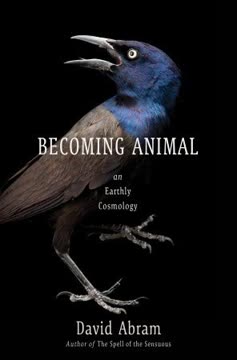
Becoming Animal receives polarizing reviews averaging 4.17 stars. Supporters praise Abram's poetic prose and ability to heighten sensory awareness of nature, calling it transformative and beautifully written. They appreciate his phenomenological approach to reconnecting humans with the animate Earth. Critics find the writing overly ornate, self-indulgent, and lacking scientific rigor. Many object to his anti-literacy stance and rejection of scientific instruments. Even positive reviewers note the dense, meandering style can be exhausting, though they find value in his call to recognize humanity's animal nature and ecological embeddedness.
Similar Books