

Key Takeaways
Study consciousness by explaining experience, not by dodging the mystery.
Start with experience. Consciousness means that there is something it feels like to be a creature. Anil Seth calls the scientific task the real problem: explain, predict, and control the qualities of experience by identifying the brain and body processes that shape them. This differs from explaining only behavior, and from asking why physical processes produce experience at all, the traditional hard problem. Anesthesia gives the distinction personal force: a person can return from a period with no remembered experience, while the brain remains the physical basis of the change.
Break the mystery apart. Seth compares consciousness with life, once thought to require a special vital force. Biology advanced by explaining distinct features of living systems rather than waiting for one grand answer. He likewise separates conscious level, conscious content, and selfhood into researchable questions.
The methodological shift is powerful because it makes first-person experience a scientific target without treating it as supernatural. It also gives researchers testable intermediate goals, much as explaining memory systems does not require solving every question about what a mind is. The analogy with life encourages patience: mechanistic explanation can transform a mystery without satisfying every metaphysical intuition. A limitation remains. Explaining the structure and variation of experiences may narrow the hard problem, but it does not logically prove that subjective feeling has been reduced to mechanism.
A brain's complexity can reveal awareness when behavior cannot.
Wakefulness is not awareness. A sleeping person can dream vividly, while someone in an unresponsive wakefulness state may show arousal without outward signs of experience. Brain activity matters less as a total quantity than in how widely and intricately brain regions communicate. In the perturbational complexity index, researchers briefly stimulate the cortex with magnetic pulses and measure the brain's electrical response. During conscious states, the response tends to spread in complex patterns; during anesthesia or dreamless sleep, it is simpler.
A clinical safeguard. The index helped distinguish levels of awareness among some brain-injured patients. In one case, a young man thought to be unresponsive showed a high score. He responded when a relative spoke to him in Arabic, suggesting that language had obscured his awareness. Researchers also use brain imagery tasks to detect covert consciousness. Such measures are promising, but no single number captures every dimension of experience.
This work matters beyond theory: it shows why judging inner experience by visible movement can lead to grave clinical errors. The broader lesson is familiar from disability research: an absent output channel does not establish an absent inner capacity. Complexity measures offer a way around that problem, though they remain indirect indicators, not windows into another person's experience. Clinical use therefore calls for combining neural evidence, repeated assessment, and careful uncertainty rather than turning a promising index into an infallible consciousness meter.
Treat perception as a brain's best guess, constrained by the world.
Build a perceptual hypothesis. Bayesian inference is a way of updating a hypothesis by combining prior expectations with the reliability of new evidence. Seth argues that the brain continually uses this kind of process: it predicts the likely causes of sensory signals, then adjusts those predictions when incoming signals do not fit. We experience the brain's interpretation, not raw sensory data. The phrase controlled hallucination captures both sides: perception is constructed, yet the world constrains it.
Context changes what appears. In the viral photograph known as The Dress, the same image looked blue and black to some viewers, and white and gold to others. In a checkerboard illusion, two physically identical gray squares appear different because the brain infers that one is in shadow. These examples do not make reality imaginary. They show that perception depends on both external causes and the brain's learned assumptions about them.
This account links perception to a general problem faced by organisms: sensory inputs are incomplete, so useful behavior requires inference. It also explains why confident perception is not the same as objective access. The view encourages intellectual humility, especially when people disagree about what they saw. Still, predictive models should not be mistaken for a claim that expectation overrides sensation at will. The account depends on an ongoing exchange between expectations and sensory evidence, and the details of that exchange vary across senses and situations.
Attention and action help decide which predictions become your world.
Attention changes the evidence. Precision weighting is the brain's adjustment of how much influence to give a sensory signal. Paying attention raises the signal's effective reliability; competing inputs receive less weight. In a famous basketball video, viewers focused on counting passes often fail to notice a person in a gorilla suit crossing the scene. The gorilla is visible, but attention makes its signals less influential in perception.
Perception moves with action. Active inference means reducing prediction errors by acting to change incoming sensations, rather than only revising predictions. Searching for keys involves shifting the eyes and changing the scene until the expected object appears. Actions also help explore and learn, while perception guides which actions seem useful. Experience of duration may likewise draw on changing perceptual contents, rather than a dedicated internal clock.
The account recasts perception as a feedback loop rather than a one-way delivery of information. That connection is useful in design: a sign, warning, or interface can be physically present yet functionally unseen if attention is elsewhere. It also resonates with embodied approaches in robotics, where sensing becomes meaningful through an agent's ability to move and test its surroundings. The framework is broad, however. Not every failure to notice is necessarily an attention problem, and the brain's predictive operations are not always neatly divided into top-down expectations and bottom-up corrections.
See the self as a layered process, not a hidden inner pilot.
Selfhood has parts. Seth distinguishes bodily ownership, a first-person point of view, agency, personal memories, and the social sense of how others see us. These strands usually feel unified, but they can come apart. In the rubber hand illusion, seeing a fake hand stroked in synchrony with a hidden real hand can make the fake one feel partly one's own. Brain injury can also disturb body ownership or the feeling that one's actions belong to oneself.
Continuity can fracture. Clive Wearing, a musician with severe memory damage, could not reliably form new autobiographical memories and seemed to live in brief present moments. Yet his musical skill and love for his wife remained. Seth's mother's delirium temporarily altered her grip on reality and identity. Such cases suggest that no single, unchanging self sits behind experience. The feeling of being one person is assembled from interacting processes.
Treating selfhood as layered helps explain why disruptions can be selective: memory may fail while skill, emotion, or bodily perspective persists. This model also has practical value in medicine, where a person's identity cannot be reduced to memory tests or outward responsiveness. The claim does not make the self trivial or unreal. A constructed process can still be stable, consequential, and central to a person's life. The harder question is how these strands combine into the felt unity of experience, which remains an open scientific challenge.
Understand yourself as a living machine whose body builds consciousness.
Look inward for the roots. Interoception is the perception of the body's internal condition, including signals related to heartbeat, breathing, and digestion. Interoceptive inference is the brain's prediction-based interpretation of those signals. Seth argues that emotions and moods depend on these bodily predictions: feelings are not merely labels added after bodily changes, but part of how the brain estimates and regulates the body's condition.
Regulation shapes experience. Allostasis means maintaining stability through change, by anticipating what the body will need. Fear, for example, involves predictions about the body in a threatening situation and helps prepare action. Seth's beast machine theory places this biological regulation beneath selfhood and consciousness. The free energy principle offers a broad mathematical account of how living systems remain in states compatible with continued existence, but it is a framework for consciousness research, not a finished explanation of experience.
This view gives the body a foundational role often neglected by theories that treat the brain as a detached information processor. It connects feelings to practical regulation: an emotion can prepare an organism to respond before it can articulate what is happening. The approach also helps explain why bodily conditions can change the character of thought. Yet it should not be inflated into proof that only biological tissue can be conscious. Seth argues for the explanatory importance of living processes in human experience, while leaving the possibility of conscious machines unsettled.
Free will means flexible, reasons-responsive control, not magic.
Drop the supernatural version. Free will need not mean that an immaterial self interrupts physical causation. In Benjamin Libet's experiments, brain activity associated with movement appeared before participants reported the conscious urge to move. Aaron Schurger proposed that this signal may reflect ongoing brain activity that sometimes reaches a threshold, rather than a hidden command that initiates action. The results challenge a simple story in which conscious intention starts every movement.
Keep practical agency. Voluntary action involves selecting what to do, choosing when to do it, and sometimes inhibiting it. A person acts freely in a useful sense when behavior can flexibly follow their goals and reasons, rather than being immediately forced by the body or surroundings. The feeling that another choice was possible can help people learn from outcomes, even if the exact same physical situation would not produce a different action.
This account preserves agency without requiring an exception to the laws of nature. It shifts the debate from an abstract contest between determinism and freedom toward observable capacities: planning, inhibition, learning, and resistance to coercion. That shift can improve both neuroscience and legal discussion. It also cautions against treating responsibility as all-or-nothing, since injury and circumstance can impair control. A remaining tension is that describing the mechanisms of choice does not by itself settle how societies should assign blame or design accountability.
Look for animal experience beyond human intelligence and familiar senses.
Do not use humans as the only template. Seth considers consciousness likely in mammals because they share brain features and patterns related to waking, sleep, and anesthesia. But experience can differ radically across species. Octopuses have many neurons distributed through their arms, can camouflage with remarkable precision, and sense the world through unfamiliar combinations of sight, touch, and taste. Their minds may not organize body and self as human minds do.
Separate sentience from sophistication. Mirror tests probe one form of self-recognition, but failing them does not establish an absence of consciousness. Nor should language or high intelligence be required: an animal may have experiences, including pain, without humanlike reasoning. Evidence for awareness beyond mammals is less certain, so Seth argues for careful, species-sensitive investigation and caution about possible suffering, rather than declaring every living thing conscious.
The octopus is a useful corrective to the assumption that minds must be built around a centralized brain and a familiar body plan. More broadly, the account encourages researchers to design tests around an animal's sensory world, not simply adapt human tasks. That principle matters ethically as well: uncertainty about experience should not become a license to ignore possible suffering. At the same time, caution cannot mean equating every adaptive response with conscious pain. Better evidence requires converging measures of behavior, biology, and the animal's way of interacting with its environment.
Do not mistake fluent machines for minds, or postpone AI ethics.
Intelligence does not settle consciousness. Today's language systems can produce fluent text without demonstrating an inner point of view. Seth questions two assumptions behind predictions of conscious AI: that consciousness depends only on a system's function, and that advanced intelligence is enough to produce experience. Neither is established. A machine that convincingly imitates a person may reveal more about human willingness to attribute consciousness than about the machine itself.
Take ethical uncertainty seriously. If future machines or laboratory-grown brain-like tissues could experience suffering, the moral stakes would be high even before consciousness could be measured with certainty. Seth argues that artificial consciousness is far from assured, but warns against creating potentially sentient systems casually. The more immediate risks of AI, such as manipulation and opaque decision-making, also deserve attention whether or not machines are conscious.
Separating intelligence from experience helps prevent impressive performance from becoming a shortcut to claims about sentience. It also clarifies two distinct ethical problems: how people are affected by systems that seem conscious, and how to protect systems that might actually feel. Both deserve scrutiny, but they require different evidence and safeguards. The possibility of artificial experience remains unresolved, so confident predictions in either direction outrun the account. A prudent response is to evaluate concrete risks now while developing better tests before deliberately creating systems with plausible capacity for suffering.
Analysis
The book's central achievement is methodological. It treats subjective experience as neither a supernatural residue nor a distraction from measurable behavior. Instead, it proposes studying experience through a sequence of explanatory bridges: identify a feature of consciousness, find its bodily and neural mechanisms, then test whether those mechanisms predict and alter that feature. This is a strong research program because it narrows an overwhelming question into tractable comparisons, from dreaming and anesthesia to color, agency, and selfhood.
Its most distinctive synthesis is the move from predictive perception to biological regulation. Brains do not merely reconstruct a world for detached spectators. They use expectations, sensory error, and action to guide organisms whose continued existence depends on bodily control. On this account, emotion and selfhood are not decorative additions to cognition; they arise within the same machinery that manages the living body. This reframes the self as real in its consequences, but not as an independent pilot.
The argument is strongest where it connects theory to discriminating evidence. The perturbational complexity index addresses a clinical blind spot, while perceptual illusions and bodily ownership experiments show how experience can shift without a corresponding change in external input. The discussion also handles uncertainty unusually well: the author distinguishes a promising measure from a complete explanation, and a plausible animal case from a settled conclusion.
The main philosophical risk is that explaining why experience has particular qualities may be mistaken for explaining why experience exists at all. The analogy with the scientific naturalization of life makes progress seem possible, but consciousness has a first-person character that life processes can be described without. Predictive processing and the free energy principle are broad explanatory frameworks, not by themselves proof of a complete account. Their value will depend on precise tests that separate them from competing models. The lasting contribution is therefore not a final solution, but a disciplined way to make the mystery smaller without pretending it has vanished.
Review Summary
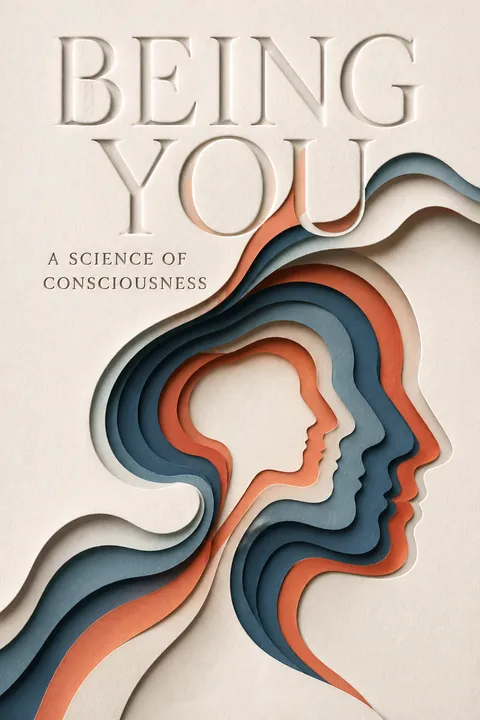
Being You explores consciousness through neuroscience, proposing theories like the "Controlled Hallucination Theory of Perception" and the "Beast Machine Theory of Consciousness". Seth argues that our perceptions and sense of self are predictions generated by the brain to regulate our bodies and ensure survival. The book covers levels of consciousness, free will, animal consciousness, and AI. While praised for its accessibility and comprehensive overview, some reviewers found parts challenging or unconvincing. Overall, it's considered a significant contribution to consciousness studies, blending philosophy and science.
People Also Read







Glossary
Real problem
Explaining experience mechanisticallySeth's approach to consciousness research: explain, predict, and control specific properties of subjective experience in terms of physical processes in the brain and body. It differs from explaining only behavior, and from asking directly why physical processes are accompanied by experience at all.
Neural correlate of consciousness
Neural basis of an experienceA neural correlate of consciousness is the minimal neural mechanism sufficient for a specific conscious experience. Researchers seek it by comparing brain activity when an experience is present with activity when it is absent, while trying to separate the mechanism of experience from attention, reporting, and other related processes.
Perturbational complexity index
Complexity of a brain responseThe perturbational complexity index, or PCI, estimates conscious level by measuring how complex the brain's response is after a brief magnetic pulse stimulates the cortex. The response is recorded with EEG. It can help distinguish some conscious and unconscious states without requiring a person to communicate or move.
Integrated information theory
Consciousness as integrated informationIntegrated information theory, or IIT, proposes that consciousness is identical to the integrated information generated by a system. Its central measure, Φ, is intended to capture how much information a whole system generates beyond its parts. The theory is influential and controversial, in part because calculating its distinctive intrinsic measure is extremely difficult.
Controlled hallucination
Prediction constrained by sensationA description of perception as the brain's ongoing construction of its best guess about the causes of sensory signals. Expectations shape what is experienced, while incoming signals constrain and revise those expectations. Ordinary perception and hallucination therefore share mechanisms, though hallucinations have a weaker grip on external causes.
Bayesian inference
Updating guesses with evidenceA method of reasoning under uncertainty that combines prior expectations with the likelihood of new evidence to produce an updated estimate. In Seth's account, the brain approximates this process as it interprets ambiguous sensory signals, weighing both what is expected and how reliable the incoming evidence seems.
Active inference
Reducing error through actionA process in which an organism reduces the mismatch between predictions and sensory signals by acting to change what it senses. Moving the eyes while searching for an object is a simple example. Active inference connects perception, movement, and learning, rather than treating perception as a passive input to action.
Interoceptive inference
Predicting internal bodily statesThe brain's prediction-based interpretation of signals about the body's internal condition, such as heartbeat, breathing, or digestion. Seth uses the concept to explain how emotions and moods arise from estimates of bodily state and help guide the regulation of physiological needs.
Beast machine theory
Selfhood rooted in living bodiesSeth's account of consciousness and selfhood as emerging through the predictive and regulatory processes of living organisms. It emphasizes that bodily control and the drive to maintain physiological integrity shape perception, emotion, and the experience of being a self. It does not establish that only biological systems can be conscious.
Free energy principle
A theory of self-maintaining systemsA broad mathematical framework proposing that living systems persist by remaining in statistically expected states and minimizing free energy, a quantity related to surprise and sensory prediction error. In Seth's account, it helps connect predictive perception and bodily regulation, but it is not itself a complete theory of consciousness.
Allostasis
Stability through anticipatory changeThe regulation of bodily conditions through change, including actions taken in anticipation of future needs. Unlike a simple return to a fixed equilibrium, allostasis can adjust the body's state in advance so that essential conditions remain within ranges compatible with survival.
FAQ
What's Being You: A Science of Consciousness about?
- Exploration of Consciousness: The book investigates how subjective experiences arise from biological processes in the brain and body.
- Predictive Brain Theory: Anil Seth suggests that our conscious experiences are "controlled hallucinations," shaped by the brain's predictions about sensory inputs.
- Interdisciplinary Approach: It combines insights from neuroscience, philosophy, psychology, and personal anecdotes to explore consciousness.
Why should I read Being You: A Science of Consciousness?
- Insightful Perspective: Offers a fresh perspective on consciousness, challenging traditional views and encouraging a rethink of self and reality.
- Accessible Science: Presents complex scientific ideas in an engaging manner, suitable for both lay readers and those familiar with neuroscience.
- Provocative Questions: Raises fundamental questions about identity, selfhood, and reality, prompting reflection on personal experiences of consciousness.
What are the key takeaways of Being You: A Science of Consciousness?
- Consciousness as Prediction: Consciousness is a predictive process where the brain generates best guesses about sensory inputs.
- Selfhood is Constructed: The self is a collection of perceptions and experiences shaped by biological and environmental factors.
- Reality is Subjective: Perceptions of the world are influenced by expectations and prior experiences, not direct reflections of reality.
What is the "controlled hallucination" concept in Being You: A Science of Consciousness?
- Definition of Controlled Hallucination: Perception is a "controlled hallucination," where the brain's predictions shape conscious experiences.
- Top-Down Processing: Perceptions are constructed from the brain's internal predictions rather than solely from sensory data.
- Implications for Reality: Suggests that perceived reality is a subjective interpretation influenced by expectations and prior knowledge.
How does Anil Seth define consciousness in Being You: A Science of Consciousness?
- Subjective Experience: Consciousness is defined as "any kind of subjective experience whatsoever," focusing on phenomenological properties.
- Distinction from Function: Differentiates between phenomenological aspects and functional properties, emphasizing experience.
- Hard Problem of Consciousness: Addresses the challenge of explaining how physical processes in the brain give rise to subjective experiences.
What is the "hard problem" of consciousness mentioned in Being You: A Science of Consciousness?
- Definition of Hard Problem: Coined by David Chalmers, it questions how physical brain processes result in subjective experiences.
- Contrast with Easy Problems: Easy problems involve explaining functions and behaviors associated with consciousness, like perception.
- Ongoing Mystery: Remains a central challenge in consciousness science, questioning the fundamental nature of experience.
How does Being You: A Science of Consciousness address the concept of self?
- Self as Perception: The self is a collection of perceptions and experiences continuously constructed by the brain.
- Narrative Self: Encompasses personal identity and autobiographical memories, highlighting its fluid nature.
- Embodied Selfhood: Explores the connection between physical bodies and experiences of being a self.
What is the "beast machine" theory in Being You: A Science of Consciousness?
- Definition of Beast Machine: Consciousness arises from our nature as living organisms maintaining physiological integrity.
- Predictive Mechanisms: Conscious experiences are shaped by predictive processing, with the brain making best guesses about inputs.
- Implications for Selfhood: Redefines selfhood as a perception intertwined with biological existence, not a separate essence.
What is the significance of predictive processing in Being You: A Science of Consciousness?
- Brain as a Prediction Machine: The brain constantly makes predictions about the world and our bodies, shaping conscious experience.
- Active Inference: Involves minimizing prediction errors through actions, allowing effective interaction with the environment.
- Control of Perception: Helps control perceptions, leading to a coherent experience of reality rather than mere reactions to stimuli.
What does Seth say about the relationship between consciousness and free will in Being You: A Science of Consciousness?
- Volition as Perception: Experiences of volition are forms of self-related perception, not evidence of an immaterial self controlling actions.
- Determinism and Free Will: Free will can exist within a deterministic framework, not requiring a break from determinism.
- Implications for Responsibility: Raises questions about moral responsibility, especially in cases of neurological conditions affecting control.
How does Being You: A Science of Consciousness address animal consciousness?
- Consciousness Beyond Humans: Argues that consciousness is not exclusive to humans; many animals likely have conscious experiences.
- Criteria for Consciousness: Emphasizes not judging animal consciousness solely on intelligence or language capabilities.
- Mammals and Beyond: Suggests all mammals are likely conscious, exploring potential consciousness in birds and cephalopods.
What are the best quotes from Being You: A Science of Consciousness and what do they mean?
- “We do not see things as they are, we see them as we are.”: Emphasizes the subjective nature of perception, shaped by individual perspectives.
- “We are conscious beast machines, through and through.”: Asserts that consciousness is rooted in biological existence as living organisms.
- “The self is a perception, another variety of controlled hallucination.”: Highlights the self as a dynamic construct shaped by experiences and predictions.
Download PDF
Download EPUB
.epub digital book format is ideal for reading ebooks on phones, tablets, and e-readers.








