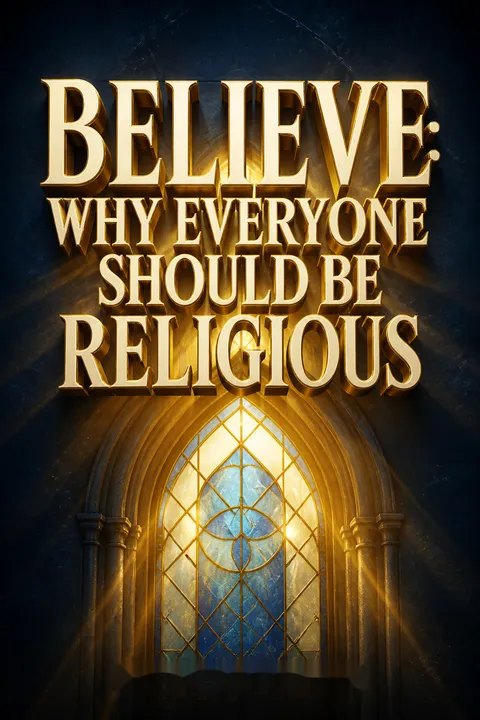


Key Takeaways
Treat religious belief as a live explanation, not merely a comforting habit.
The book’s central claim. Ross Douthat argues that religion deserves consideration not just because it offers community or comfort, but because it may describe reality more fully than secular materialism. He points to three converging clues: a universe with striking order, human consciousness that remains difficult to explain, and persistent reports of encounters with the supernatural. The argument is meant for ordinary readers, not only philosophers: a person need not first master theology to see reasons to question the assumption that matter is all there is.
A case, not a proof. Douthat’s conclusion is that religious belief is a reasonable response, and that ignoring the evidence can be as intellectually loaded as believing. His opening case is for religion in general, before asking readers to choose a particular tradition. Its strength depends on whether the clues add up to a better explanation, not whether any single one settles the question.
What's striking is the shift from asking whether religion is useful to asking whether it is true. That distinction matters: a comforting belief can still be false, and an unsettling belief can still be warranted. The book's cumulative approach resembles inference to the best explanation, where several incomplete clues are weighed together. But convergence is persuasive only if the clues are at least partly independent. Fine-tuning, consciousness, and unusual experiences may reinforce one another, yet each also admits competing explanations. The reader's task is not to count clues, but to compare whole explanatory accounts and notice which assumptions each requires.
Modern science reveals deeper order without explaining why order exists.
Science changes the question. Copernicus displaced Earth from the center of the old cosmos, and Darwin explained how natural selection can produce complex life without designing each organism. Douthat argues that neither discovery explains the law-governed system in which planetary motion and evolution occur. Modern physics, he says, has uncovered conditions unusually compatible with life. One example is the cosmological constant, whose value is estimated in the book to have a roughly 1 in 10^120 chance of arising randomly within a particular range.
A wider design argument. The multiverse hypothesis could explain why observers find themselves in a life-friendly universe, but it still requires a system capable of generating universes. Douthat sees that larger order as another question, not an answer. The Fermi paradox, the apparent absence of other civilizations, further raises the possibility that intelligent life is rare, though the evidence remains incomplete.
The strongest version of this argument identifies a genuine explanatory gap: describing physical laws is not automatically the same as explaining why those laws exist. Still, a low probability is meaningful only if there is a defensible way to define the possible outcomes and their probabilities. Fine-tuning estimates depend on assumptions about what could vary and how. Observer selection also matters: any observer necessarily finds themselves in conditions compatible with observers. Multiverse models are speculative, but their speculative character alone does not refute them. The argument supports metaphysical curiosity more securely than it establishes a creator, much less a particular religion.
Brain maps locate consciousness; they still do not explain first-person experience.
Correlation is not experience. Neuroscience can link brain activity to memory, emotion, and perception. Douthat emphasizes the distinction philosopher David Chalmers calls the hard problem of consciousness: explaining how physical processes give rise to the felt, first-person quality of seeing red, tasting wine, or choosing to act. Finding where a process occurs, he argues, does not explain how subjective experience arises from it.
A mind that fits the cosmos. The book also asks why human reasoning, shaped by evolution, reaches beyond immediate survival to uncover mathematics, physics, and cosmic history. Douthat treats this fit between mind and world as suggestive of a deeper relation between consciousness and reality. He extends the question to artificial intelligence: fluent language may imitate thought, but complexity alone does not demonstrate an experiencing self. He also invokes quantum theory, though interpretations that require conscious observation remain contested.
The distinction between mapping a mental state and explaining its felt character remains one of philosophy of mind's hardest problems. It is a useful warning against treating neural correlations as a complete theory of experience. Yet an unsolved problem is not, by itself, evidence for a supernatural answer. Some philosophers argue that consciousness may be explained through new physical principles rather than nonphysical mind. Likewise, quantum measurement does not generally require a human observer in the way the book's argument suggests. The productive conclusion is modest: confident claims that science has already reduced consciousness to mechanism outrun what is currently understood.
A secular culture can dismiss the supernatural while people keep encountering it.
Experience outlasts the consensus. Douthat calls the belief that modernity has drained the world of spiritual experience the myth of disenchantment. He recounts an episode involving the skeptic Michael Shermer: a broken radio, kept for years because it belonged to his wife's late grandfather, unexpectedly played music on their wedding day, then stopped working again. The episode did not make Shermer religious, but it unsettled his confidence that every anomaly has an ordinary explanation.
Many kinds of reports. The book groups spiritual experiences into mystical feelings of unity, encounters with a seemingly separate presence, visions or voices, and events that appear to affect the physical world. It cites near-death experiences, reported healings, and survey findings that many people claim mystical or miraculous experiences. Douthat argues that these reports persist even where religious institutions lose authority. Their persistence is evidence to examine, not automatic proof of supernatural causes.
The book usefully separates the existence of an experience from the explanation assigned to it. A person can report a vivid encounter without proving that its perceived source exists outside the mind. Cross-cultural variation also cuts both ways: it may reflect different interpretations of a shared reality, or the way expectation shapes perception. Anecdotes such as the radio story have emotional force but cannot establish how often comparable events occur or rule out mundane causes. The case for taking experience seriously is stronger than the case for treating every report as verification. Better reporting and careful comparison can respect both points.
Explore through durable traditions, not spiritual improvisation without guides or safeguards.
Why not go alone? Douthat argues that religious traditions are accumulated bodies of practice, interpretation, and moral teaching, developed across generations. A seeker can learn from them instead of inventing a personal system from fragments. He compares this to learning a demanding discipline: knowing a little about several sports does not make someone a better player than learning one properly.
Community changes practice. A congregation or other religious community provides shared rituals, teachers, correction, and relationships that can sustain commitments an individual might abandon. Douthat also raises a spiritual safety concern: if unusual experiences could involve forces beyond the self, personal enthusiasm is not enough to judge which encounters are beneficial. Institutions can offer tested guidance, though they can also be corrupt or harmful. His recommendation is not blind obedience, but serious exploration within a tradition, with room for questions and discernment.
This argument connects religion to what social scientists call distributed knowledge: no individual can reproduce all the learning embedded in a long-running practice. Community can also make commitments durable through ritual, shared expectations, and mutual care. But age and scale do not guarantee truth or safety. Institutions can preserve wisdom, as well as normalize abuses or discourage dissent. The sensible balance is neither solitary self-invention nor automatic submission. A seeker can value inherited practices while assessing how a community treats evidence, vulnerable members, and honest disagreement.
Choose a faith by its answers to real divisions, not vague sameness.
Religions overlap and diverge. Douthat rejects the idea that all religions must be wholly true or wholly false. Traditions may share moral insights and spiritual experiences while disagreeing about God, revelation, salvation, and the afterlife. He suggests approaching major traditions through questions that clarify their differences: Is the divine one or expressed through many powers? Is religious life mainly ethical, experiential, or liturgical? Is earthly life one decisive passage, or part of repeated lives? Does God reveal a final truth in history?
A practical starting point. These questions are not a complete map of every tradition, and the categories overlap. Their purpose is to help seekers notice what matters to them and investigate traditions that have endured across cultures and generations. Douthat believes that historical staying power is evidence worth considering, not a guarantee that a tradition is true. He argues that established faiths deserve attention before newly assembled spiritual systems.
The framework helps turn the vague question of which religion feels right into a set of substantive comparisons. It also resists easy pluralism, the assumption that differences do not matter. Yet the categories are broad: Buddhism, Hinduism, Christianity, and Islam each contain internal debates that can complicate any simple label. Longevity is informative but not decisive; many durable institutions persist through social power as well as insight. A careful seeker can use these questions as an initial filter, then study particular communities and texts rather than treating a tradition as a single, uniform position.
Suffering and religious wrongdoing challenge faith, but do not settle reality.
The problem of evil remains serious. Douthat does not dismiss the suffering that makes belief in a good, powerful God difficult. He argues instead that human beings may not know enough to declare the question settled, and that suffering does not rule out every form of religious belief. A person who doubts classical theism might still consider a less-than-omnipotent deity, a pantheistic view, or another account of spiritual reality.
Institutions have mixed histories. The book notes that only 121 of 1,763 wars in one historical catalogue were classified primarily as religious. Another tally attributed 11 or 12 of the hundred worst atrocities to religion. Douthat uses these figures to challenge the claim that religion uniquely causes violence, while acknowledging religious institutions have done grave harm. He also points out that religious movements have helped shape abolitionism, human rights, and limits on political power.
The distinction between a challenge and a refutation is valuable. Suffering puts pressure on claims about divine goodness, but its force depends on what kind of deity or afterlife is being considered. Likewise, counting wars by primary cause can illuminate patterns without resolving how religious identity interacted with politics, territory, or power. The same institution can restrain violence in one setting and enable it in another. Douthat's historical comparison appropriately complicates a one-sided indictment, but the statistics should not be mistaken for a moral ledger that cancels real victims or excuses institutional responsibility.
Test traditional sexual ethics for wisdom, rather than dismissing them as obsolete.
Sex is not a trivial concern. Douthat observes that major religious traditions generally treat sexual desire as morally significant, often connecting it to self-restraint, marriage, and the creation of families. If a religion claims that human lives and relationships matter eternally, he argues, it would be surprising if it had nothing to say about sex, one of the forces that can shape intimacy, commitment, and parenthood.
Critique without caricature. The book acknowledges that religious sexual rules can be experienced as unjust, and that liberal congregations often reinterpret or reject traditional teachings. It also points to modern problems such as pornography, loneliness, and difficulty forming relationships, arguing that sexual liberation has not automatically produced flourishing. Those trends do not prove that traditional doctrine is correct. They do suggest that seekers should ask what older teachings may have understood about desire and commitment before rejecting them outright.
The strongest point here is that sexual norms have consequences beyond private preference: they shape family structures, vulnerability, and social expectations. But invoking modern distress does not show that liberal sexual norms caused it, or that traditional restrictions would cure it. Economic insecurity, technology, changing gender roles, and access to contraception also matter. Traditional rules have sometimes protected commitments and sometimes imposed unequal burdens. A thoughtful evaluation asks which practices foster consent, care, and durable responsibility, and whether a tradition's account of those goods can be separated from historical injustices.
Commit where you can, even when certainty and ideal options are missing.
A first step can be imperfect. Douthat argues that endless comparison has its own cost: a seeker may remain undecided while never practicing any faith. He introduces the Emeth principle through a character in C. S. Lewis's fiction, a sincere worshiper of the wrong god who is nevertheless recognized for virtuous actions. The point is not that all religions are identical, but that a person may move toward truth through a tradition that is incomplete.
Inheritance can be a beginning. Many people adopt the faith of their families or communities; Douthat says this does not make their beliefs irrational by definition, since inherited assumptions shape secular worldviews too. He presents conversion as something that can begin with family, friendship, culture, or an unexpected encounter. Commitment need not mean certainty or permanence. A person can enter a tradition, learn its practices, and change course if experience or reflection warrants it.
The emphasis on action answers a genuine problem of choice: under uncertainty, refusing to decide is itself a decision with consequences. In behavioral science, participation can reveal information unavailable from detached comparison, because practice changes what a person notices and understands. Still, commitment can create sunk costs and make exit harder, especially in high-control groups. The book's advice is most persuasive when paired with safeguards: maintain outside relationships, permit questioning, and preserve the practical ability to leave. A provisional commitment need not become an irreversible identity.
Douthat's Christian wager rests on Jesus as history's singular, unsettling revelation.
The personal case. Douthat describes growing up around charismatic Christian experiences without having dramatic mystical experiences himself. He became drawn to Catholicism because it joined intellectual structure, ritual, and belief in the supernatural. His more specific commitment rests on the Gospels: he argues that they are early, historically grounded accounts whose varied details resemble testimony rather than polished invention.
Why Jesus, not just religion? Douthat sees the Christian story as unusually strange: its central figure is executed, his followers appear defeated, and the movement grows around their claim that he rose from the dead. He argues that this event, if true, should shape how other spiritual experiences are interpreted. This is his wager, not a conclusion forced by historical method. He finds Jesus' warnings about judgment and the urgency of human choices difficult, but takes that difficulty as part of the reason the story feels more than self-invention.
The book's final move is from general signs of transcendence to a particular historical claim. The case is strongest when it asks readers to take the Gospels seriously as ancient sources, rather than dismissing them because they contain miracles. But historical credibility cannot by itself establish resurrection; that conclusion depends on how one weighs testimony, alternative explanations, and prior beliefs about what can happen. Douthat presents Christianity as a reasoned wager rather than a laboratory result. Readers can recognize the argument's coherence while remaining appropriately clear about where historical evidence ends and theological judgment begins.
Analysis
Believe is an argument about intellectual posture as much as religious doctrine. Douthat challenges the assumption that secular materialism is the neutral position and religion the extra claim. He builds a cumulative case from cosmic order, consciousness, spiritual experience, and the persistence of religious institutions, then asks readers to move from general theism toward commitment to a particular tradition. The narrative matters: the skeptical Michael Shermer's wedding-radio story illustrates how anomalies can unsettle a worldview without instantly replacing it, while Douthat's own journey shows how a general openness becomes Catholic conviction.
The book's strongest insight is its distinction between scientific method and metaphysical interpretation. Science can make extraordinary progress while bracketing ultimate causes; that methodological choice does not automatically prove that no ultimate cause exists. Its second strength is practical: religious commitment is presented as a response to possible truth and moral stakes, not simply as therapy or nostalgia. The discussion of communal practice also recognizes that beliefs are formed and sustained socially, not in isolated minds.
The argument is less secure when suggestive evidence is treated as directional proof. Fine-tuning raises serious questions, but probability estimates and multiverse alternatives remain contested. Consciousness is not fully explained, yet the gap does not uniquely point to God. Reports of miracles and near-death experiences deserve fair investigation, but persistence of testimony is not equivalent to verification. The same caution applies to the claim that large religions are more truth-aligned because they endured. Survival can reflect wisdom, adaptation, political power, or several at once.
Douthat's method is therefore best understood as abductive and openly theological: he judges that religion explains a cluster of features better than secularism does, then gives Christianity priority through his reading of Jesus and the Gospels. That chain is coherent, but each transition adds assumptions. Readers may reasonably accept the case for taking religion seriously while withholding assent from its particular conclusions. The book succeeds if it makes disbelief a position to examine rather than a default that needs no defense.
Review Summary
Believe by Ross Douthat presents a case for religious belief in the modern world. Reviews are mixed, with some praising its accessible arguments for faith and others criticizing its lack of convincing evidence. Douthat argues that religion offers valuable frameworks for understanding existence and that belief is rational. He encourages readers to explore different faiths but emphasizes organized religion over individual spirituality. Critics note contradictions and omissions in his arguments, while supporters appreciate his attempt to bridge the gap between skepticism and faith.
People Also Read




Glossary
Emeth principle
Truth through imperfect devotionDouthat's name for the possibility that a sincere person may serve or approach ultimate truth while belonging to a mistaken or incomplete religious tradition. It comes from a character in C. S. Lewis's Narnia stories, whose virtuous conduct is recognized despite his worship of the wrong deity. The principle does not claim that all religions are equivalent or harmless.
Official Knowledge
Publicly accepted secular assumptionsDouthat's label for the assumptions governing much modern academic, bureaucratic, and media discussion. In this intellectual sphere, human life is generally explained through scientific or social-scientific causes, while supernatural explanations are excluded from consideration. The term describes a cultural default, not a single institution or a claim that every person working in those fields is personally atheist.
hard problem of consciousness
Why matter feels like experienceA philosophical problem concerning how physical processes in the brain give rise to subjective experience. Neuroscience can identify correlations between neural activity and perception, emotion, or memory, but the hard problem asks why those processes are accompanied by a felt point of view, such as the experience of color, pain, or thought. The term is associated with philosopher David Chalmers.
perennialism
Shared truths across religionsThe view that enduring truths about God or ultimate reality appear in different forms across multiple major religious traditions, rather than being possessed exclusively by one faith. Douthat sees a pull toward this view in cross-cultural patterns of spiritual experience and religious ideas. He considers it a plausible interpretation, but ultimately argues that Christianity makes a uniquely decisive claim through Jesus.
ethical, experiential, and liturgical
Three religious orientationsDouthat's broad categories for different entry points into religious practice. An ethical orientation emphasizes moral conduct and becoming a better person; an experiential orientation seeks direct encounters with the divine or supernatural; a liturgical orientation seeks communion through shared ritual and worship. The categories are starting points rather than exclusive boxes, and traditions may combine all three.
FAQ
1. What is "Believe: Why Everyone Should Be Religious" by Ross Douthat about?
- Rational Case for Religion: The book argues that religious belief is not only reasonable but the most rational response to the mysteries, order, and meaning of existence.
- Addressing Modern Skepticism: Douthat addresses both atheists and agnostics, as well as believers with doubts, making a case for why religion remains intellectually and existentially compelling in the modern world.
- Blueprint for Seekers: The book provides a step-by-step guide for moving from secularism or doubt into religious belief, emphasizing both intellectual reasoning and practical commitment.
- Exploration of Major Faiths: While Douthat is a Christian, the book begins with a general defense of religion before narrowing to his personal case for Christianity, making it relevant for seekers of all traditions.
2. Why should someone read "Believe: Why Everyone Should Be Religious" by Ross Douthat?
- Engages Thoughtful Skeptics: The book is written for atheists, agnostics, and doubters who are open to reconsidering religion, offering arguments that challenge secular assumptions.
- Strengthens Believers with Doubts: For those who already believe but struggle with modern skepticism, Douthat provides intellectual and practical support to reinforce faith.
- Accessible and Rigorous: Douthat uses clear, commonsense reasoning rather than dense philosophical jargon, making complex ideas approachable for general readers.
- Timely Cultural Relevance: The book addresses the current cultural moment, where many feel a spiritual void and are reconsidering the role of religion in personal and societal well-being.
3. What are the key takeaways from "Believe: Why Everyone Should Be Religious"?
- Religion Is Reasonable: Douthat contends that religious belief is more rational than atheism, given the evidence of cosmic order, consciousness, and persistent spiritual experience.
- Modern Disenchantment Is a Myth: The supposed decline of supernatural experience in the modern world is overstated; mystical and miraculous events remain common and significant.
- Commitment Matters: The book argues that joining a religious tradition and community is essential for a meaningful spiritual life, rather than remaining a spiritual dilettante.
- Pluralism and Tradition: While acknowledging the diversity of faiths, Douthat suggests that the major world religions are the best starting points for seekers, due to their depth, resilience, and accumulated wisdom.
4. How does Ross Douthat define "religion" in "Believe: Why Everyone Should Be Religious"?
- Supernatural Connection: Religion is defined as a system of belief and practice that connects humans to a supernatural order, not just a set of ethical guidelines or cultural habits.
- Moral and Existential Guidance: It offers moral direction in this life and preparation for a possible afterlife, addressing both the order of the world and human destiny.
- Dogma and Practice: Douthat emphasizes real belief in supernatural realities (God, gods, spirits, ancestors) and real commitment to following a tradition, not just vague spirituality or therapeutic practices.
- Focus on Major Traditions: The book privileges the world’s major faiths (those on a “COEXIST” bumper sticker) as the primary examples of religion.
5. What is Ross Douthat’s main argument for why everyone should be religious?
- Intellectual Superiority of Religion: Douthat argues that religious worldviews better account for the intelligibility, order, and fine-tuning of the universe than secular materialism.
- Mystery and Experience: He points to the persistence of mystical and supernatural experiences, even in secular societies, as evidence that materialism is incomplete.
- Human Consciousness: The book highlights the “hard problem” of consciousness, suggesting that mind and spirit are not reducible to matter, supporting religious perspectives.
- Moral and Existential Stakes: Douthat contends that religion uniquely addresses the “weight of glory” and the ultimate meaning and peril of human existence.
6. How does "Believe" address the relationship between science and religion?
- Science Reveals Order: Douthat argues that scientific discoveries, from the Big Bang to quantum mechanics, reveal deeper cosmic order and fine-tuning, supporting the case for a designer.
- Limits of Materialism: He critiques the idea that science has explained away the need for God, pointing out that scientific laws and consciousness remain unexplained by materialism alone.
- Multiverse and Mind: The book discusses the multiverse hypothesis and the mystery of consciousness, suggesting that these scientific theories often end up resembling religious or metaphysical ideas.
- Science as a Religious Enterprise: Douthat claims that the very success of science depends on religious assumptions about the rationality and intelligibility of the universe.
7. What is the "myth of disenchantment" according to Ross Douthat?
- Supernatural Experiences Persist: Douthat argues that mystical, miraculous, and supernatural experiences are as common in the modern world as in the past, contrary to the narrative of secular disenchantment.
- Official Knowledge vs. Lived Reality: While academia and media may dismiss the supernatural, ordinary people continue to report and experience the numinous.
- Modern Revivals: He points to phenomena like near-death experiences, charismatic revivals, and even UFO encounters as evidence that enchantment endures.
- Skeptical Explanations Fall Short: Attempts to explain away these experiences as mere psychological or neurological phenomena are, in Douthat’s view, inadequate.
8. What advice does "Believe" give to spiritual seekers or those considering religion?
- Start with Reason: Douthat encourages seekers to use their reasoning faculties to weigh the evidence for religion, rather than “faking it till you make it” or relying solely on ritual.
- Join a Tradition: He strongly advises against spiritual individualism, arguing that commitment to a major religious tradition and community is essential for growth and protection.
- Explore, Then Commit: While initial exploration and open-mindedness are valuable, Douthat insists that a meaningful spiritual life requires eventual commitment, even if it’s imperfect or provisional.
- Don’t Wait for Certainty: He reassures readers that it’s better to start somewhere, even with doubts, than to remain paralyzed by indecision or skepticism.
9. How does "Believe" address the diversity of religions and the challenge of choosing one?
- Not All or Nothing: Douthat rejects the idea that all religions are equally false or that choosing one means rejecting all others as worthless.
- Continuum of Truth: He suggests that major religions contain varying degrees of truth and that sincere seekers can draw closer to ultimate reality through any of them.
- Start with the Big Faiths: The book recommends beginning with the major, enduring world religions, as they have stood the test of time and offer the richest resources for seekers.
- Key Dividing Questions: Douthat outlines important questions (monotheism vs. polytheism, ethical vs. experiential religion, views on the afterlife) to help seekers navigate their choices.
10. What are the main moral and practical objections to religion addressed in "Believe," and how does Douthat respond?
- Problem of Evil: Douthat acknowledges the challenge of suffering and evil but argues that it’s not a decisive argument against religion or God, and that religious traditions offer resources for grappling with it.
- Religious Violence and Corruption: He concedes the sins of religious institutions but points out that all human institutions are flawed, and that religion has also been a force for good and reform.
- Sexual Ethics: Douthat addresses modern discomfort with traditional sexual morality, arguing that the seriousness with which religions treat sex reflects its real importance in human life.
- Liberal Alternatives: He notes that liberalized forms of religion exist for those who cannot accept traditional teachings, but cautions that these may lack the depth and transformative power of more orthodox traditions.
11. What is Ross Douthat’s personal journey and case for Christianity in "Believe"?
- From Observer to Believer: Douthat describes growing up amid charismatic Christianity, witnessing supernatural experiences but not having them himself, which led him to seek a more systematic faith.
- Catholicism’s Appeal: He found in Catholicism a balance of reason, tradition, mysticism, and community, as well as a capaciousness that accommodates both certainty and doubt.
- Historical Uniqueness of Jesus: Douthat argues that the Gospels and the figure of Jesus stand out historically and spiritually, making the case for Christianity’s unique truth claims.
- Openness and Commitment: While acknowledging the mystery and diversity of religious experience, Douthat ultimately commits to Christianity, seeing it as the most compelling and trustworthy path.
12. What are the best quotes from "Believe: Why Everyone Should Be Religious" and what do they mean?
- “It is the religious perspective that asks you to bear the full weight of being human.” – Douthat emphasizes that religion, unlike atheism, confronts the deepest questions and responsibilities of existence.
- “The world is charged with the grandeur of God.” (Gerard Manley Hopkins, quoted) – This poetic line encapsulates the book’s theme that the universe is suffused with divine meaning and beauty.
- “Reason still points godward, and you don’t have to be a great philosopher or a brilliant textual interpreter to follow its directions.” – Douthat insists that ordinary intelligence and common sense are sufficient for recognizing the case for religion.
- “If you are this sleeper, I beg of you—awake.” – In his closing, Douthat urges readers not to remain passive or indifferent, but to actively seek and respond
Download PDF
Download EPUB
.epub digital book format is ideal for reading ebooks on phones, tablets, and e-readers.








