

Key Takeaways
Treat small talk as the doorway to intimacy, not the whole conversation.
The opening has a job. Small talk lowers the uncertainty of meeting someone new. It becomes tedious when it never leads anywhere, but skipping it can feel intrusive because trust has not yet formed. Patrick King points to a 2010 study by Matthias Mehl, which found that more substantive conversations were associated with greater well-being. The association does not establish that small talk itself causes unhappiness.
Depth can arrive sooner than expected. In Arthur Aron’s 1997 study, strangers asked each other increasingly personal questions and reported feeling closer. The lesson is not to interrogate a stranger. Use light conversation to establish comfort, then follow signs of mutual interest toward something more substantial.
The useful distinction is between small talk as a destination and small talk as social calibration. A brief exchange lets people assess warmth, attention, and willingness to engage before taking emotional risks. That resembles trust-building in many settings: a low-cost first move makes a higher-stakes one more predictable. The research described here supports the value of meaningful conversation, but correlation is not a prescription to make every encounter intimate. Context matters. A lively conversation with a new friend and a polite exchange with a busy stranger can both be successful.
Warm up socially with tiny daily conversations and prepared personal stories.
Practice before the big moment. King calls brief, low-pressure encounters “ten-second relationships.” A greeting, a simple observation, or a short question can help make initiating contact feel ordinary. The book cites a commuter experiment by Epley and Schroeder: people told to talk with a stranger expected less enjoyment than they ultimately reported. A study by Sandstrom and Dunn similarly found that brief conversation with a barista was associated with a more positive experience.
Prepare your speaking tools. Reading aloud with varied expression can loosen voice and delivery. A “conversation résumé” is a short, refreshed inventory of experiences, interests, stories, and current topics. It gives a blanking mind something to draw on, without requiring a memorized script.
This approach turns social confidence into a practice problem rather than a fixed personality trait. Small encounters provide repetition with limited stakes, much like gradual exposure used to reduce avoidance. Preparation can also free attention: when a few personal stories are readily available, less mental energy goes to searching for something to say. The important limit is that practice partners are people, not props. Service workers may be expected to be polite, so a brief, respectful exchange is better practice than assuming they welcome a long conversation.
Let trust set the pace for personal disclosure.
Closeness develops in stages. King describes four levels of conversation: small talk, sharing facts, sharing opinions, and sharing emotions. Each level asks for more trust than the one before it. Mentioning a job or hobby is less exposing than revealing a fear or private feeling, so a new acquaintance may be comfortable with the first and not the second.
Watch for reciprocity. If someone responds to a personal detail with one of their own, the exchange may be ready to deepen. If they give short answers, change the subject, or seem uneasy, stay lighter. The sequence is a guide, not a mandatory ladder. Context matters: a close relative, a new colleague, and a stranger at a bus stop have different expectations of intimacy.
The staged model captures an important feature of self-disclosure: intimacy is co-created, not extracted. People often reveal more when the exchange feels reciprocal and the other person responds with care. The model is most useful as a sensitivity check, not a rulebook. Some people speak openly early; others need time or prefer privacy. Treating the stages as checkpoints could make conversation feel like a procedure. Attending to the other person’s comfort keeps a practical framework from becoming pressure to disclose.
Set a friendly tone before trying to sound impressive.
Lead with ease and curiosity. King’s memorable example is an eight-year-old at a barbecue who asked persistent, candid questions and made conversation feel unusually open. The point is not to imitate a child’s lack of boundaries. It is to notice how curiosity and reduced self-consciousness can make an exchange more alive than carefully filtered pleasantries.
Make the first move simply. If a direct introduction feels daunting, begin with a question about the setting, a comment on something happening, or a shared reason for being there. A playful observation can also loosen a stiff exchange. These are openings, not tricks: the other person’s response determines whether to continue.
People often focus so intently on avoiding awkwardness that they send signals of distance, then interpret the resulting reserve as proof that connection is difficult. A warm opening can interrupt that loop. Playfulness helps when it communicates safety and shared enjoyment, rather than making the other person the joke. The child’s example also highlights a useful distinction: unfiltered curiosity can feel refreshing when paired with genuine interest, but candor without sensitivity can feel invasive. Ease works best when it remains responsive.
Build connection by finding overlap and offering details of your own.
Give the conversation material. Similarity can emerge from shared interests, experiences, values, or feelings, not only from obvious matches such as attending the same school. Instead of quizzing someone about a favorite show, ask what kinds of stories they enjoy. Their answer may reveal a more useful point of connection. Sharing a few specifics about your own life gives the other person something to respond to, too.
Use matching with care. King describes mirroring as lightly matching another person’s pace, energy, or gestures to create a sense of ease. He also describes “elicitation,” using prompts such as sincere recognition, a tentative idea, or an expression of frustration to invite a response. These techniques should open conversation, not corner someone into giving information.
Connection often depends less on finding a perfect match than on creating enough detail for each person to recognize something familiar. Reciprocal disclosure helps because it gives the other person both a topic and permission to contribute. Mirroring can make interaction feel coordinated, but deliberate imitation may seem insincere if it is obvious. Elicitation deserves even more care: the book notes its roots in information gathering, which makes its ethical boundary important. An invitation respects a refusal; a tactic designed to make refusal difficult does not.
Tell the short version first, then let curiosity pull out the rest.
Make everyday life narratable. A mini-story turns a flat answer into a small event with a point. King’s “1:1:1 Method” keeps the story focused on one action, one sentence, and one main emotion. Instead of listing routine weekend activities, someone might mention that an ordinary errand ended with an unexpected mishap. The listener can then ask for the details that interest them.
Use structure when a story needs it. The “Story Spine” moves from the normal situation to a disruption, its consequences, a resolution, and the new normal. It helps organize a longer anecdote without requiring every story to follow a rigid formula. A callback to a memorable moment from earlier in the conversation can also create a shared reference or inside joke.
Starting with the point respects the listener’s attention and makes storytelling collaborative: the audience can signal which details deserve expansion. This is particularly effective in everyday conversation, where a long monologue can crowd out the other person’s contribution. A compact story is not automatically a good one, however. A useful detail, clear emotional stake, or surprising turn gives brevity its force. The story structure is a scaffold, not a requirement; ordinary speech can sound artificial when every anecdote is delivered as a perfectly engineered plot.
Keep conversation moving by making associations instead of forcing topics.
Give a topic somewhere to go. Conversation stagnates when both people keep circling the same shallow observation. Motion can come from a personal memory, a feeling, a related subject, a more specific detail, or a surprising hypothetical. The goal is not to steer toward a preset destination. It is to notice when the current thread is exhausted and follow a natural connection.
Practice mental detours. Free association means generating several ideas linked to a word, then using one as a conversational bridge. King offers three response menus: HPM means History, Philosophy, and Metaphor; SBR means Specific, Broad, and Related; EDR means Emotion, Detail, and Restatements. Together, they prompt personal memories, opinions, follow-up detail, related topics, or a reflection of what the other person said.
These prompts lower the pressure to produce a brilliant line on demand. They also show that conversational agility is often ordinary association made available quickly, rather than spontaneous genius. The warning against fixed destinations is important: a prepared topic can help, but insisting on it makes a speaker seem inattentive. Frameworks are most useful when practiced enough to disappear into natural listening. Used mechanically, they can produce a checklist interview instead of an exchange. The other person’s interest should guide which association survives.
Listen to understand, then ask questions that open a story.
Do not compose your reply too soon. King distinguishes listening from merely waiting for a turn to speak. A short pause after someone finishes can help the listener respond to what was actually said instead of rushing into a prepared anecdote. Encouraging phrases, accurate restatements, and attention to the speaker’s emotion can signal that their point landed.
Ask for meaning, not just data. Open questions, follow-ups, and requests for another perspective invite fuller answers than yes-or-no prompts. Silence can also give someone room to continue. Questions about an outside subject, such as a news story or a shared situation, may reveal values and reactions without demanding a personal confession. Sports interviewers do this well when they ask athletes to reconstruct a particular moment rather than summarize an entire game.
Good questions reduce the burden on the speaker by giving them a direction, while active listening makes the direction responsive rather than generic. This resembles reflective listening used in counseling, where paraphrasing and curiosity help people clarify their own thinking. Yet a string of thoughtful questions can still feel like an interview if the listener never contributes. The point is not to maximize disclosure or question count. It is to make room for both people, and to let silence serve reflection rather than treating every pause as a failure.
Compliment deliberate choices, not only traits people were born with.
Notice effort and taste. A comment about someone’s appearance may be pleasant, but King argues that recognition often feels more personal when it concerns something the person chose: a distinctive outfit, a thoughtful idea, or a considerate habit. Such a compliment recognizes agency and the person’s way of expressing themselves.
Make attention specific and sincere. The book also recommends noticing small, recurring mannerisms or preferences, then asking about them without judgment. Specific attention can show that someone has been heard as an individual, rather than treated as a generic social role. But the praise must be genuine and appropriate. An exaggerated or transactional compliment can create suspicion instead of warmth, especially if it seems to be a pretext for attention the recipient did not invite.
Recognition of effort can feel more meaningful because it acknowledges a choice the recipient can identify with, not merely a trait they happen to possess. It also conveys close attention, a valuable signal in relationships where people often feel unseen. Still, specificity is not automatically intimacy. Remarks about habits or appearance can feel invasive, and praise can carry unequal power depending on who gives it and why. The strongest compliment is accurate, proportionate, and offered without making the recipient responsible for rewarding the giver.
Give people more to connect with by living and learning broadly.
Bring real material to the exchange. King contrasts Jeffrey, who follows news and stays curious about different viewpoints, with Mike, whose narrow interests leave little room for connection. The distinction is not that everyone needs dramatic adventures. Pursuing a hobby, trying an unfamiliar activity, or having a project outside work creates experiences and stories to share.
Build breadth as well as depth. Reading and learning about varied subjects increases the chances of finding common ground and gives a person more to ask about. Opinions help keep discussion alive, provided they remain open to challenge. The book also suggests saying yes to reasonable opportunities rather than dismissing them reflexively. The aim is an engaged life, not a performance designed to impress at parties.
Conversation techniques can help people express themselves, but they cannot manufacture a rich inner life from nothing. Experience supplies details, questions, and genuine enthusiasm, while learning broadens the routes between one person’s interests and another’s. The valuable standard is engagement, not a contest in adventurousness or expertise. People with quiet routines can still be fascinating when they notice carefully and care deeply. Breadth matters because it creates more possible points of contact, but curiosity determines whether those points become real conversation.
Trade snap judgments for questions about what you may not know.
Make room for missing context. King warns against treating one’s own view as the only reasonable one. A person who labels others foolish or wrong too quickly tends to make disagreement feel unsafe, so people share less or avoid the conversation. Asking how someone reached a conclusion can reveal experiences or assumptions that were not visible at first.
Keep opinions without policing them. The book does not ask readers to abandon judgment altogether. It argues for distinguishing a considered view from reflexive condemnation. In an example, someone who appears to steal a parking space may be responding to an emergency. More generally, respect does not require agreement. It requires leaving room for complexity, asking before condemning, and choosing connection over the urge to win every minor dispute.
Curiosity is not the same as moral neutrality. Some actions warrant firm boundaries, and understanding a person’s reasons does not erase their impact. The conversational advantage comes from delaying certainty long enough to gather context, especially when the stakes are low and the evidence incomplete. That pause can prevent needless conflict and make disagreement informative rather than humiliating. The book’s central social insight is strongest here: people are more willing to be known when they are not treated as defendants on trial.
Analysis
Better Small Talk is a practical guide to a problem that is often misdiagnosed. Many people assume they dislike conversation, when what they dread is the stale, effortful kind that never gets beyond safe exchanges. King reframes social skill as a chain of learnable moves: prepare, open warmly, disclose at a pace suited to trust, offer stories, listen, and follow promising threads. That sequence gives readers something more useful than advice to simply be confident.
The strongest contribution is its emphasis on mutual participation. Compact stories invite questions; story-seeking questions help the other person contribute; listening makes the next move responsive. Conversation is presented less as performance than as cooperative improvisation. The practical devices, from free association to response prompts, are most valuable as training wheels that make attention easier under pressure.
Some claims need careful handling. The cited association between deeper talk and well-being does not prove that small talk reduces happiness. Brief pleasantries can provide safety and orientation, and their value depends on context. Likewise, techniques such as elicitation can shift from conversational support to manipulation if they are used to compel disclosure. A respectful conversationalist treats short answers and refusals as information, not obstacles to overcome.
The book’s most durable message is therefore not that every chat should become intimate or entertaining. It is that people can make ordinary encounters more human by bringing genuine curiosity, enough self-disclosure to give others a foothold, and enough restraint to let them choose how far to go. Fluency matters, but responsiveness matters more.
Review Summary
Better Small Talk receives mixed reviews, with an average rating of 3.65/5. Some readers find it insightful and practical, praising its tips on conversation skills and social interactions. Others criticize it for being too basic or obvious. Positive reviews highlight the book's advice on asking questions, active listening, and developing interesting personalities. Negative reviews mention redundancy, lack of scholarly sources, and oversimplification. Many readers appreciate the book's straightforward approach, while some find it lacking depth or tailored advice for diverse social situations.
People Also Read








Glossary
Conversation résumé
Prepared personal talking pointsA regularly updated collection of personal experiences, interests, accomplishments, opinions, and current topics that can be drawn on in conversation. It is meant to remind a person of material they might otherwise forget under pressure, not to serve as a script or formal biography.
Ten-second relationships
Brief social practiceA term used in the book for very short, everyday interactions with other people, such as greeting someone or exchanging a quick comment. These low-pressure encounters provide practice initiating contact and can make social engagement feel more familiar.
The 1:1:1 Method
A compact story structureA conversational storytelling technique in which a story focuses on one action, can be summarized in one sentence, and aims to evoke one primary emotion. Its purpose is to deliver the point quickly and leave room for the listener to ask questions or add to the exchange.
Story Spine
A sequence of story beatsA narrative outline that moves from an ordinary situation through a disruptive event and its consequences toward a resolution and a changed normal. The framework helps a speaker provide context, escalation, and closure without losing the thread of an anecdote.
HPM
Personal response promptsAn acronym for History, Philosophy, and Metaphor. It suggests three ways to respond to a conversational topic: connect it to a personal experience, express an opinion or feeling about it, or mention something it brings to mind. The prompts help a speaker respond without relying on a prepared topic.
SBR
Topic exploration promptsAn acronym for Specific, Broad, and Related. It offers three ways to continue a topic: ask about a particular detail, broaden the context, or move to a connected subject. The approach is designed to help conversation deepen or shift naturally while remaining connected to what the other person said.
EDR
Responsive listening promptsAn acronym for Emotion, Detail, and Restatements. It recommends responding to another person by noticing an emotion, asking for a relevant detail, or summarizing what they said to invite clarification. These responses show attention and encourage the speaker to elaborate.
Elicitation
Indirectly inviting a responseA questioning approach that uses a statement or prompt to encourage someone to share more than a direct question might elicit. The book describes recognition, shared complaints, tentative understanding, and correction of an incorrect assumption as possible prompts. Its use in ordinary conversation should respect the other person’s choice not to answer.
Arthur Aron's 1997 question study
Personal questions build closenessA study described in the book in which pairs of strangers asked one another personal questions that went beyond routine small talk. Participants reported increased openness and closeness. The study supports the potential of reciprocal self-disclosure, but it does not mean that intimate questions are appropriate in every context or guarantee a particular relationship.
Matthias Mehl's 2010 study
Everyday talk and well-beingA study described in the book that recorded participants’ daily social environments and compared casual conversation and more substantive discussion with measures of well-being. The reported association linked deeper conversations with greater happiness and well-being. As presented, the finding is correlational and does not establish that small talk causes lower well-being.
FAQ
What's "Better Small Talk" by Patrick King about?
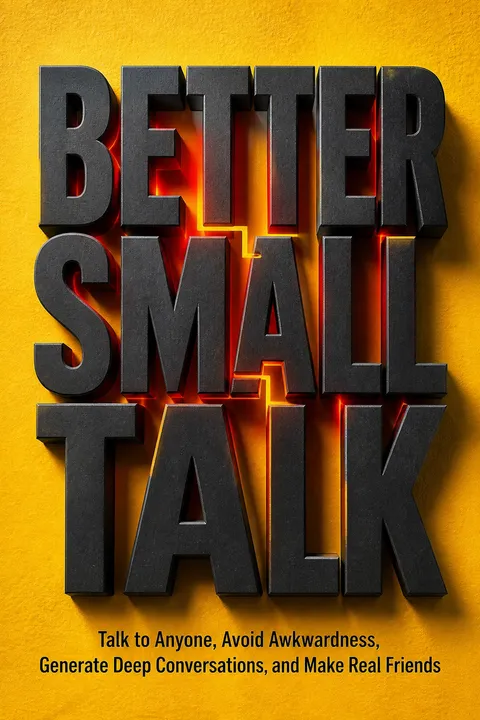
- Purpose of the book: "Better Small Talk" by Patrick King is designed to help readers improve their conversational skills, enabling them to talk to anyone, avoid awkwardness, generate deep conversations, and make real friends.
- Focus on social interaction: The book emphasizes the importance of social interaction for happiness and well-being, and provides strategies to enhance the quality of these interactions.
- Framework for conversation: It offers a framework for engaging people more effectively, moving beyond small talk to more meaningful conversations.
Why should I read "Better Small Talk"?
- Improve social skills: The book provides practical techniques to enhance your ability to engage in conversations, making you more likable and approachable.
- Avoid awkwardness: It offers strategies to prevent awkward silences and keep conversations flowing smoothly.
- Build deeper connections: By following the book's advice, you can learn to create more substantive and fulfilling interactions with others.
What are the key takeaways of "Better Small Talk"?
- Preparation is key: Prepare psychologically and physiologically for conversations to be more spontaneous and relaxed.
- Storytelling is powerful: Use storytelling techniques to captivate others and make conversations more engaging.
- Ask better questions: Develop the skill of asking open-ended and thought-provoking questions to deepen conversations.
How does Patrick King suggest preparing for small talk?
- Psychological preparation: Get in the mood to socialize by initiating short interactions, known as "ten-second relationships," to build confidence.
- Physiological preparation: Warm up by reading out loud with exaggerated emotional expressiveness to enhance engagement.
- Conversation résumé: Create a mental list of interesting stories and facts about yourself to draw from during conversations.
What is the "1:1:1 Method" in "Better Small Talk"?
- Simplified storytelling: The 1:1:1 Method involves telling a story with one action, one emotion to be evoked, and a one-sentence summary.
- Focus on impact: The method emphasizes the discussion and reaction that occurs after the story, rather than the story itself.
- Engage the listener: By keeping stories concise, you allow listeners to participate more fully in the conversation.
How can I keep conversations flowing smoothly according to "Better Small Talk"?
- Create motion: Ensure conversations are dynamic by shifting topics, going deeper, or introducing new angles.
- Think on your feet: Use free association to quickly generate new topics or questions when conversations stall.
- Use helpful acronyms: Employ acronyms like HPM (History, Philosophy, Metaphor) and SBR (Specific, Broad, Related) to guide responses.
What are some techniques for going deeper in conversations from "Better Small Talk"?
- Compliment effectively: Compliment people on things they have control over and have made conscious choices about for maximum impact.
- Listen actively: Focus on the other person, avoid interrupting, and use silence effectively to encourage deeper sharing.
- Ask insightful questions: Use open-ended questions and follow-up inquiries to explore topics more thoroughly.
How does Patrick King suggest building oneself to be more interesting?
- Pursue interests: Actively engage in hobbies and passions to have more to share in conversations.
- Expand knowledge: Read widely and learn about various topics to offer fresh perspectives and insights.
- Develop opinions: Form and express opinions to drive conversation and connection, while remaining open to others' views.
What is the role of storytelling in "Better Small Talk"?
- Captivating others: Storytelling is a key tool for engaging and captivating others in conversation.
- Mini-stories: Use mini-stories to answer common questions with more depth and interest.
- Inside jokes: Create inside jokes by calling back to high points in conversations, fostering a sense of connection.
How can I avoid being judgmental in conversations as advised in "Better Small Talk"?
- See beyond black and white: Avoid seeing only one correct way of doing things and respect others' perspectives.
- Be open-minded: Approach conversations with curiosity and a willingness to learn from others.
- Assume the best: Give people the benefit of the doubt and assume they are doing their best with the information they have.
What are the four stages of interaction in "Better Small Talk"?
- Small talk: The initial stage involves exchanging pleasantries and general chitchat to start a conversation.
- Fact disclosure: Share details about your life to build trust and rapport with the other person.
- Opinion disclosure: Find common ground by sharing viewpoints and opinions to deepen the connection.
- Emotion disclosure: Open up further by sharing personal feelings, leading to a more intimate relationship.
What are the best quotes from "Better Small Talk" and what do they mean?
- "We are a social species, and multiple studies confirm this." This highlights the importance of social interaction for human well-being and the need to improve conversational skills.
- "The best small talk in the world is always just an opening act for better things." This emphasizes that small talk is a stepping stone to deeper, more meaningful conversations.
- "You can make more friends in two months by becoming interested in other people than you can in two years by trying to get other people interested in you." This quote underscores the value of genuine interest in others as a means to build connections.
About the Author
Other books by Patrick King




Download PDF
Download EPUB
.epub digital book format is ideal for reading ebooks on phones, tablets, and e-readers.








