

Key Takeaways
Attraction fires in the animal brain, not the reasoning one
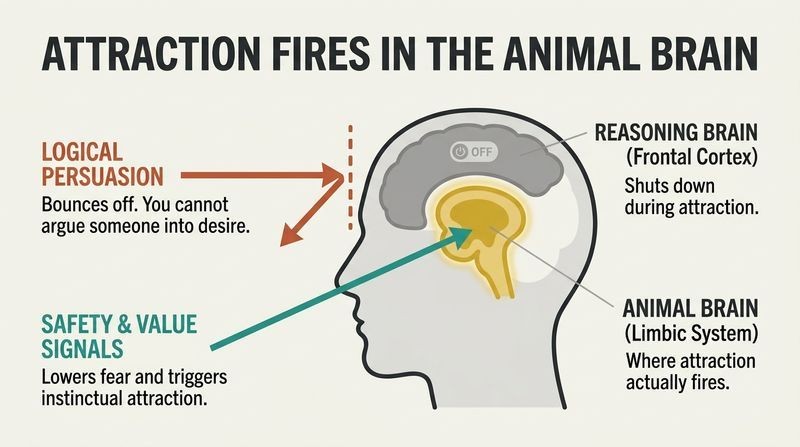
Love shuts down your judgment. Patrick King opens with Michael, a 29-year-old client who had never kissed a girl and was smothering a female friend with three texts to her every one, clearing his schedule, sending desperate check-in messages. His problem was not being boring; it was being too available. King's fix leaned on one lever: perceived availability signals mate value.
Brain imaging backs the deeper point. When people view someone they love, activity drops in the frontal cortex (judgment, self-control) and in regions tied to fear. Attraction is literally the neurological equivalent of rose-tinted glasses. The practical consequence: you cannot argue someone into desire. You can only lower fear and switch off the analytical mind, in yourself and in them.
The neuroscience King cites (Semir Zeki's UCL work) is real, though the causal story is looser than presented. Correlated deactivation in fMRI does not prove love "turns off" judgment so much as reallocates attention. Still, the practical reframe is sound and echoes Robert Sapolsky's work on how arousal states hijack cognition. What's useful here is the inversion of most dating advice: stop optimizing your words. Anxiety is contagious and anti-erotic. The Michael story also quietly illustrates loss aversion and scarcity, principles Robert Cialdini formalized in persuasion research decades ago.
Attraction climbs four rungs: health, status, emotion, then logic

Skip a rung and relationships collapse. King borrows Eric Waisman's sequence, arguing attraction unfolds in order, each stage gating the next:
1. Health (physical viability, vitality, energy)
2. Status (resources, standing, ability to provide)
3. Emotion (chemistry, do you actually like them)
4. Logic (shared values, deal-breakers, long-term fit)
Health is the gatekeeper: no perceived sexual viability, no progression, which explains the friend zone. Status is the resume phase. Emotion, surprisingly, ranks third, not first. Logic handles the vacation-fling problem, two people perfectly in sync who live on opposite continents and want different lives. King's point: many couples build on rungs one and two, ignore three and four, then fight like cats and dogs. Diagnose which rung you keep stalling on.
The framework is a tidy heuristic, but its rigid sequencing oversimplifies. Real attraction is often recursive, not linear; discovering shared values (logic) can retroactively boost perceived attractiveness (health), a halo effect well documented in social psychology. The model also leans heavily on evolutionary essentialism, treating status as male currency and beauty as female currency. That framing predates newer findings on assortative mating, where partners increasingly match on education and earnings regardless of gender. Where the framework earns its keep is diagnostic: it forces honest self-assessment about which stage consistently derails you, rather than blaming vague chemistry.
Signal availability and fertility with your body before you speak

Up to 93% of your message is nonverbal. Drawing on Helen Fisher and the Peases, King says attractive body language broadcasts two things. First, availability: open posture, uncrossed limbs, genuine smiles, a torso turned fully toward the person. It lowers perceived rejection risk. Second, fertility cues, which differ by sex: men take up space and emphasize the shoulder-to-waist taper (dominance), women accentuate curves and draw attention to healthy hair and lips.
You cannot fake it into existence, but you can dress and move into it. King notes Marilyn Monroe reportedly made herself invisible in a crowd by dressing down and dialing back her body language, then switched it on at will. If the ultimate sex symbol could vanish deliberately, average-looking people can amplify deliberately. Posture, gait, and grooming do heavy lifting.
The oft-cited "93% nonverbal" figure traces to Albert Mehrabian's narrow experiments on emotionally inconsistent messages, and King responsibly hedges the range. The evolutionary reading of hourglass and V-shape as fertility signals has empirical support (waist-to-hip ratio studies by Devendra Singh), but presenting these as rigid gender scripts risks caricature, think the Johnny Bravo and Jessica Rabbit references. What travels well across critiques is the actionable core: availability signals reduce a stranger's threat assessment. That aligns with polyvagal-style thinking on safety cues. Relaxed, open bodies invite approach; guarded ones repel it, regardless of raw looks.
Break the touch barrier deliberately or stay a friend forever
Touch is the one signal with no plausible ambiguity. Citing Nicolas Gueguen, King sorts flirtatious touch into three tiers:
1. Friendly (handshakes, shoulder taps) that sets a platonic tone
2. Plausible deniability (fixing hair, comparing hand sizes, guiding someone by the waist) that sows intriguing uncertainty
3. Nuclear (unmistakable, intimate touch) that declares intent and risks rejection
The research-backed sweet spot combines plausible deniability with occasional nuclear touch. Friendly touch barely registers. The friend zone, King argues, is largely built by people who broadcast every signal of interest except physical touch, so they read as pals. Escalate through the tiers, watch for warm reception, and never leap straight to nuclear, which triggers fight-or-flight and gets you slapped.
The typology is genuinely useful, but the modern reader must foreground consent in a way the framing underweights. "Plausible deniability" can shade into boundary-testing if a person ignores discomfort, and the ethical line is reciprocity, not cleverness. Gueguen's touch studies (light arm touches raising compliance) are real but effect sizes are modest and some have faced replication scrutiny. The stronger, defensible claim is that calibrated, welcomed touch accelerates intimacy through oxytocin release and signals confidence. The key word King includes but readers must bold: received warmly. Touch without attunement is not seduction; it is intrusion.
Intermittent rewards make you irresistible; constant availability makes you boring
The chase runs on slot-machine psychology. King grounds this in B.F. Skinner's operant conditioning: rats rewarded every lever press eventually slacked off, while rats rewarded unpredictably pressed frantically. Uncertainty, not consistency, drives pursuit. It is the same mechanism behind gambling addiction, and behind why replying instantly, always being free, and over-declaring interest kills attraction.
Unavailability amplifies value. In one study, 59% of women wanted to pursue a man described as single, but 90% wanted the identical man when told he was married. Rochester researchers found engineered uncertainty raises perceived mate value. The nuance: aim for medium availability. Fully available reads as low-value; totally unavailable reads as hopeless and triggers sour grapes. King's better long-game advice: actually become busy and engaged, so the scarcity is real, not performed.
This is the book's most contrarian and most abused idea. The Skinner analogy is evocative but treating a partner like a lab subject is corrosive if taken literally; manufactured hot-and-cold behavior correlates with anxious attachment dynamics, not secure ones. Attachment researchers like Sue Johnson would argue that lasting bonds require responsiveness, the opposite of strategic withholding. King's saving move is telling: stop faking scarcity, build a genuinely full life. That converts a manipulation tactic into authentic self-development. The married-man study also reflects mate-choice copying, an effect observed even in guppies, where females copy the preferences of other females.
Follow flirting's proven script: approach, synchronize, then touch
Successful bar flirtation runs on a three-stage sequence. Timothy Perper and Susan Fox watched strangers who left together and found a consistent order. Approach: orientation matters (men prefer being approached from the side, women from the front), genuine smiles predict success, and eyebrow "flashes" signal interest. Synchronize: bodies literally mirror each other, movements and energy align, simple observational openers beat clever pickup lines. Touch: escalate only after synchronization holds.
Rushing ahead breaks the spell. The most common failure is skipping a stage, barreling into someone's space at a thousand words a minute, or trying to touch before synchronizing. For slower-burn connections, King offers Jack Schafer's friendship formula: friendship equals proximity plus frequency plus duration plus intensity. Start with proximity, never lead with intensity, and dial up gradually.
The Perper and Fox observational work is a reminder that courtship, for all its mystery, has grammar. What's clever is King pairing two tools for two contexts: the three-stage script for high-receptivity settings (clubs, dating apps) and Schafer's formula for cold-start connections where intensity-first reads as threatening. This maps neatly onto the mere-exposure effect, Robert Zajonc's finding that familiarity itself breeds liking. One limitation: the bar-study sample selects for people already seeking hookups, so the script may generalize less to contexts where romantic framing is absent. Still, the meta-lesson (match your approach to the other person's readiness) is durable.
Lead with polarizing traits; being pleasantly average attracts no one
Strong emotion, even irritation, beats indifference. A 2017 study found the intensity of post-breakup hate tracks the intensity of prior love, mediated by betrayal. King's inference: love and hate are not opposites but cousins, both intense, both reserved for people who matter. Indifference is the true enemy of attraction. That is why romance plots so often start with mutual loathing.
Polarizing profiles win. OkCupid's data showed users who provoked strong love-it-or-hate-it reactions outperformed inoffensive, middle-of-the-road profiles. Being universally palatable earns only lukewarm interest. King's example: a skinny, nerdy guy should amplify his thinness and nerdiness, not sand it down, because the few who adore that will chase him, and broadcasting uniqueness is the only way they can find him. Narrow your focus; run the race you already win.
This is the book's most liberating insight and its most transferable beyond dating. It mirrors marketing's positioning theory: brands that try to appeal to everyone become invisible, while distinctive ones command loyalty. The OkCupid finding (from Christian Rudder's data essays) has a statistical elegance: variance in ratings, not just the mean, predicts message volume. There is a psychological cost, though. Leading with polarizing traits requires tolerating rejection at scale, which demands the secure self-esteem King elsewhere prizes. The idea also dovetails with signaling theory, where costly, hard-to-fake displays of authentic identity attract genuinely compatible matches and repel the incompatible efficiently.
Arranged marriages grow love backward, and it lasts longer
Commitment first, passion later, often works better. King surveyed Indian couples and a matchmaker. Arranged marriages start with practical fit (values, finances, family standing) and assume affection will grow through proximity and shared life. Robert Epstein's research found passionate love in Western love-marriages runs at roughly half-strength after 18 months, while love in arranged marriages climbs and overtakes it around the five-year mark, reaching double the intensity by year ten.
The active ingredients are unglamorous. Rock-solid commitment (divorce simply is not an option, so problems get solved), lowered expectations, problem-solving skills, and the proximity effect (familiarity breeding comfort, not contempt). King is not endorsing arranged marriage but extracting its lesson: treat compatibility partly like a business partnership, weigh long-term values, and stop expecting chemistry alone to sustain fifty years.
The Epstein data is provocative but comes with heavy caveats King soft-pedals: arranged-marriage samples embed strong cultural stigma against divorce and reporting bias, so "lasting love" may partly measure constrained exit options rather than flourishing. Sunk-cost commitment can trap as easily as it bonds. That said, the core corrective is well supported by Western research too; Gottman's decades of marital studies show that conflict-resolution skill and commitment predict longevity far better than initial passion. The deeper reframe, that romantic love as a marriage prerequisite is a historically recent luxury, is anthropologically accurate and usefully humbling for anyone raised on fairy-tale expectations.
Similarity, not opposites, predicts who stays together
Opposites attract, then attack. King argues the honeymoon glow hides value clashes that surface later. Long-term successful couples tend to be genuinely similar, sometimes even in physical appearance. The trap is believing your partner will eventually change core beliefs; values do not shift by osmosis, and when both people expect the other to change, compromise collapses. Think of the child-wanting partner paired with the child-averse one.
But only two traits actually need to match. In a study rating couples on the Big Five personality dimensions (extraversion, conscientiousness, openness, agreeableness, emotional stability), only agreeableness and emotional stability predicted relationship happiness when shared. The other three did not need to align. King's read: those two govern how gracefully you compromise and weather conflict, which is what daily partnership actually demands.
The similarity-attraction effect is one of social psychology's most replicated findings (Byrne's work since the 1960s), so King stands on firm ground against the folk wisdom of complementarity. The Big Five nuance is the sharper contribution: it explains why some very different couples thrive (differences in extraversion or openness can be enriching) while others implode (mismatched agreeableness means every disagreement escalates). This aligns with Gottman's finding that it is not the presence of conflict but its handling that predicts divorce. One caveat: shared values matter more than shared hobbies, a distinction worth preserving so readers do not screen partners on trivial tastes.
You are terrible at predicting who you will actually want
Your dating wish list is fiction. King recounts his teenage "must be a ballerina, must own a car, no painters" criteria to show how we build partner ideals from random single experiences. A 2008 speed-dating study (Eastwick and Finkel) nailed it: participants' stated preferences before the event had virtually zero overlap with who they were actually drawn to in person.
Distance distorts desire. Construal-level theory explains why: psychological distance makes us think in abstract ideals ("tall, funny, loves kids"), while proximity makes us respond to concrete reality. The more you vision-board, the further you drift from your real preferences. We also confuse self-interest (high earner benefits my future) with attraction, and we inherit criteria from culture and family. King's advice: stop screening on fixed traits and focus on how a dynamic connection actually feels in person.
This is arguably the book's most quietly radical claim, and it is well armed. The Eastwick-Finkel research launched a productive line showing that stated mate preferences poorly predict real-time choices, a humbling finding for the entire matchmaking-algorithm industry. Construal-level theory (Trope and Liberman) is a rigorous import that explains the mechanism elegantly. The practical implication cuts against modern dating-app design, which forces exactly the abstract, checklist-based filtering that research says misleads us. The honest takeaway: expose yourself to more real interactions and trust in-person response over the imagined ideal. Self-knowledge in attraction is discovered, not introspected.
Misattributed arousal: excitement transfers to whoever is standing near you
Your body confuses fear with desire. In Dutton and Aron's 1974 study, men who met an attractive woman right after crossing a scary, unstable bridge were twice as likely to call her afterward as men who crossed a safe bridge. Their racing hearts, pumped by fear, got misread as attraction. This is why thrilling dates (roller coasters, scary movies, and the skydiving stunts of dating shows) manufacture sparks.
Arousal itself has gendered wiring. King cites Emily Nagoski: most men are spontaneously aroused, while roughly a third of women are primarily responsive, needing context and cues first. Related research suggests women's desire spikes when they feel intensely desired, when a partner seems unable to resist them. The practical lesson: for many women, arousal follows feeling wanted and safe, not the reverse.
The bridge study is a psychology classic, though its effect is context-dependent and has nuances later researchers refined (the transfer works best when the attractive person is present during residual arousal). Nagoski's spontaneous-versus-responsive desire distinction, drawn from sex researcher Rosemary Basson's circular model, is genuinely useful and destigmatizing; it reframes "low libido" as a difference in arousal pathway rather than a deficiency. The practical caution: misattribution is a real effect but a thin foundation for a relationship. A spark borrowed from a roller coaster fades when the ride ends. Excitement opens a door; it does not furnish the house.
Great sex is presence and vulnerability, not positions and props
The magazine advice is a decoy. Peggy Kleinplatz studied what actually distinguishes remarkable sex and found it had nothing to do with novelty, toys, athleticism, or even, notably, orgasm and raw attraction. Instead, eight elements recurred across ages, genders, and cultures: presence, connection, intimacy, communication, authenticity, bliss, exploration, and vulnerability. This is empowering because none require a perfect body; anyone in a relationship can build them.
For women specifically, emotion precedes sex, not the reverse. A survey of nearly 700 women found three drivers of desire: intimacy (closeness comes first, sex expresses it), celebrated otherness (honoring rather than controlling difference), and object-of-desire affirmation (feeling genuinely, vocally wanted). Men often invert this, treating intimacy as sex's reward rather than its precondition. Make a partner feel safe, understood, and desired, and satisfying sex follows.
Kleinplatz's research is a valuable corrective to a performance-obsessed culture and aligns with attachment theory: felt security is the substrate of erotic surrender, a paradox sex therapist Esther Perel explores through the tension between security and desire. Perel would gently complicate King's tidy synthesis, noting that too much comfort and merger can dampen eroticism, which also feeds on distance and mystery, exactly the "celebrated otherness" point. The finding that orgasm is not central to "remarkable" sex is striking and challenges goal-oriented Western sexual scripts. The chapter's real gift is reframing sexual skill as emotional attunement, a learnable capacity, rather than innate technique or anatomy.
Analysis
Patrick King's project is to drag dating out of the realm of opinion and anecdote and reattach it to peer-reviewed evidence. The result is a hybrid: part evolutionary-psychology primer, part field manual. Its structure mirrors the arc of a relationship itself, from split-second attraction through flirtation, the chase, love, self-knowledge, and finally sex, which gives the book a satisfying narrative spine even as it hops between studies.
The book's greatest strength is synthesis. King collects genuinely useful research (Skinner's intermittent reinforcement, Dutton and Aron's bridge, Eastwick and Finkel's speed-dating disconnect, Kleinplatz's eight elements) and translates it into behavior. His most valuable and least intuitive claims are that we are poor predictors of our own desire, that polarizing beats palatable, and that commitment can generate love rather than merely follow it.
The book's weaknesses are twofold. First, it leans hard on evolutionary essentialism and rigid gender binaries, which can read as dated and which newer research on assortative mating and fluid preferences complicates. Second, several tactics (plausible-deniability touch, engineered scarcity, ambiguous compliments) hover near manipulation. King repeatedly rescues himself by insisting the healthiest move is to authentically become high-value rather than perform it, and that kindness and selflessness are universally attractive. That tension between gaming attraction and earning it is never fully resolved, and thoughtful readers should hold both.
Methodologically, the book cites real studies but sometimes overstates effect sizes and glosses replication concerns (the touch-compliance and Mehrabian figures deserve caution). Treated as a set of testable hypotheses rather than laws, it is a strong practical guide. Its deepest wisdom is almost anti-strategic: relax, reduce fear, share your weird authentic self, prioritize shared values and emotional attunement over chemistry, and understand that lasting attraction is less a trick you deploy than a life you build.
Review Summary
The Science of Attraction receives mixed reviews. Readers appreciate the author's reliance on scientific studies and the insightful information provided. The book is praised for its perspectives on relationships and attraction, with useful takeaways after each chapter. However, some criticize the author's interpretations and examples, finding them biased towards men pursuing women. Despite skepticism about the author's background as a dating coach, most reviewers find the book informative and worth reading, though they advise maintaining a critical perspective.
People Also Read








Glossary
Sociobiological theory of attraction
Attraction driven by reproductive fitnessThe idea that attraction is largely subconscious and rooted in the drive to propagate offspring within one's society. It predicts men gravitate toward cues of youth and fertility while women gravitate toward cues of status, resources, and protection. King treats it as a foundational but incomplete lens, since culture and individual variation heavily modify these biological tendencies.
Waisman's four steps to attraction
Health, status, emotion, logic sequenceEric Waisman's model that attraction unfolds in a fixed order: health (physical viability), status (resources and standing), emotion (chemistry and liking), and logic (shared values and long-term compatibility). Each stage must be cleared before the next. King uses it as a diagnostic tool to identify where a person consistently stalls in building relationships.
Plausible deniability touching
Ambiguous, deniable flirtatious touchOne of three touch categories from Nicolas Gueguen's research. It is touch that exceeds friendly contact but has an innocent cover story (fixing hair, buckling a seatbelt, comparing hand sizes), leaving the recipient wondering about intent. King says combining it with occasional unambiguous "nuclear" touch is the most effective flirtation strategy because it sustains attractive uncertainty.
Intermittent reinforcement
Unpredictable rewards drive compulsive pursuitA principle from B.F. Skinner's operant conditioning: rewards delivered unpredictably produce more persistent behavior than consistent rewards, the same mechanism behind gambling addiction. King applies it to "the chase," arguing that medium, uncertain availability increases perceived mate value, whereas constant availability breeds boredom and disinterest.
Misattribution of arousal
Confusing physical arousal for desireThe tendency to enter a state of physiological arousal (from fear, excitement, exertion) and then wrongly attribute it to a nearby person as sexual attraction. Demonstrated in Dutton and Aron's 1974 scary-bridge study, where fear-aroused men were twice as likely to pursue an attractive woman. It explains why thrilling dates spark romance.
Triangular Theory of Love
Intimacy, passion, and commitmentRobert Sternberg's model that love comprises three scales: intimacy (emotional closeness), passion (physical attraction and chemistry), and commitment (the active decision to sustain the relationship). The strongest relationships score high on all three and show matched, overlapping "triangles" between partners. Mismatches on any dimension become the couple's central source of tension.
Construal-level theory
Distance makes thinking abstractTrope and Liberman's theory that psychological distance (in time, space, social similarity, or likelihood) makes people think in abstract ideals, while closeness produces concrete, realistic thinking. Applied to dating, it explains why people's imagined ideal partner (abstract wish list) rarely matches who they are actually drawn to face-to-face.
Eight elements of great sex
Kleinplatz's components of remarkable intimacyPeggy Kleinplatz's research-derived list of what makes sex remarkable, consistent across demographics: presence, connection, intimacy, communication, authenticity, bliss, exploration, and vulnerability. Notably, novelty, technique, athleticism, and even orgasm and raw attraction did not make the list, suggesting emotional attunement, not performance, defines exceptional sex.
Friendship formula
Proximity plus frequency, duration, intensityFormer FBI agent Jack Schafer's equation for how connections form: Friendship equals Proximity plus Frequency plus Duration plus Intensity. King recommends building relationships by starting with proximity and never leading with intensity, then gradually increasing frequency and duration before deepening intensity, especially in contexts where direct flirting would seem threatening.
FAQ
What's "The Science of Attraction" by Patrick King about?
- Exploration of Attraction: The book delves into the science behind attraction, focusing on behavioral and evolutionary psychology to explain flirting, dating, and mating.
- Understanding Human Behavior: It aims to provide insights into the unconscious triggers that influence human attraction and relationships.
- Practical Advice: The book combines scientific research with practical advice to help readers improve their dating lives and build romantic connections.
Why should I read "The Science of Attraction"?
- Scientific Approach: The book offers a research-based perspective on attraction, making it a valuable resource for those interested in the psychology of relationships.
- Practical Tips: It provides actionable advice and techniques to enhance social interactions and romantic pursuits.
- Comprehensive Coverage: The book covers a wide range of topics, from body language to the psychology of love, making it a comprehensive guide for anyone looking to understand attraction better.
What are the key takeaways of "The Science of Attraction"?
- Four Steps to Attraction: Attraction involves physical, status, emotional, and logical components, which must be navigated sequentially for a fulfilling relationship.
- Nonverbal Communication: Body language, eye contact, and strategic touching play crucial roles in attraction and should be used effectively.
- Role of Uncertainty: Playing hard to get and creating a sense of mystery can increase perceived value and attraction.
How does Patrick King explain the "Four Sequential Steps to Attraction"?
- Physical Attraction: The initial step involves physical appearance and health, which are crucial for first impressions.
- Status and Resources: The second step evaluates a person's status and resources, which are important for long-term compatibility.
- Emotional Connection: The third step focuses on emotional chemistry and interpersonal bonding, essential for lasting attachment.
- Logical Compatibility: The final step assesses shared values and life goals, ensuring long-term relationship success.
What role does body language play in attraction according to "The Science of Attraction"?
- Nonverbal Cues: Body language is a significant part of communication, conveying availability and interest without words.
- Gender Differences: Different body language cues are attractive for men and women, emphasizing availability and fertility.
- Eye Contact: Sustained eye contact is crucial for building trust and attraction, but it should be balanced to avoid discomfort.
How does "The Science of Attraction" address the concept of "The Chase"?
- Intermittent Rewards: The chase involves creating intermittent rewards, which are psychologically addictive and increase attraction.
- Unavailability: Being slightly unavailable can make a person more desirable, as it creates a sense of scarcity and value.
- Balance of Interest: The key is to show enough interest to keep someone engaged but not so much that you appear too available.
What insights does Patrick King provide on flirting in "The Science of Attraction"?
- Three-Step Process: Successful flirting involves approach, synchronization, and touch, which help build rapport and attraction.
- Adapt to Context: Different flirting styles work in different contexts, and it's important to adjust based on the situation and the other person's receptiveness.
- Friendship Formula: Building connections through proximity, frequency, duration, and intensity can enhance flirting and lead to deeper relationships.
How does "The Science of Attraction" compare arranged marriages to love marriages?
- Commitment Over Love: Arranged marriages prioritize commitment and problem-solving over initial romantic love, which can lead to long-term success.
- Cultural Differences: The book explores how different cultures view marriage and the role of love, offering insights into the strengths of arranged marriages.
- Proximity Effect: Arranged marriages often rely on the proximity effect, where love grows over time through shared experiences and commitment.
What is the Triangular Theory of Love discussed in "The Science of Attraction"?
- Three Components: The theory identifies intimacy, passion, and commitment as the three components of love, which should be balanced for a successful relationship.
- Compatibility and Overlap: Successful relationships have a balanced combination of these components, and partners should have overlapping "love triangles."
- Application: Understanding these components can help individuals assess their relationships and work on areas that need improvement.
How does Patrick King address the concept of knowing what you want in a partner?
- Common Misconceptions: People often think they know what they want based on stereotypes or social pressures, but they are usually wrong.
- Psychological Distance: The book explains how psychological distance can lead to abstract and idealized views of what we want in a partner.
- Focus on Reality: It's important to focus on real interactions and experiences rather than preconceived notions of an ideal partner.
What are the universal desires in attraction according to "The Science of Attraction"?
- Excitement and Arousal: People are drawn to excitement and arousal, often misattributing these feelings to the person they are with.
- Gender-Specific Triggers: Men and women have different triggers for arousal, with men being more spontaneous and women more responsive.
- Humor and Voice: A sense of humor and certain vocal qualities are universally attractive traits that can enhance attraction.
How does "The Science of Attraction" suggest improving sexual relationships?
- Eight Elements of Great Sex: Presence, connection, intimacy, communication, authenticity, bliss, exploration, and vulnerability are key to remarkable sex.
- Beyond Techniques: Great sex is not just about techniques or novelty but involves deeper emotional and psychological elements.
- Exploring Kinks: Understanding and exploring kinks can enhance sexual satisfaction, but it's important to communicate openly with partners.
About the Author
Other books by Patrick King


Download PDF
Download EPUB
.epub digital book format is ideal for reading ebooks on phones, tablets, and e-readers.








