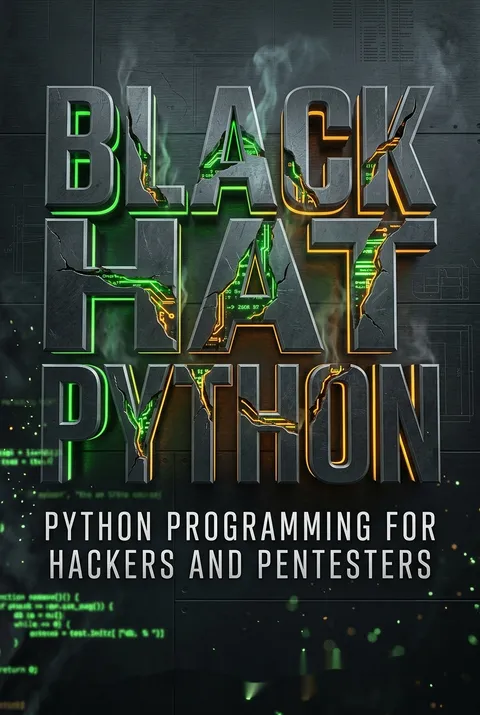


Key Takeaways
Write small Python security tools to understand what larger tools conceal
Start with a safe workspace. The book begins by preparing a virtual machine, a Python 3 virtual environment, and an editor. These choices are not glamorous, but they separate project dependencies and reduce the chance that experiments damage the host system. It also urges readable code: organized imports, clear names, and a main block that lets a script run directly or be imported without side effects.
Build understanding, not just software. The central premise is that writing a focused tool can reveal how a security task works beneath a polished interface. A quick script may be useful when standard utilities are unavailable, but the book's examples also expose the limits of quick work: network failures, timeouts, and unusual responses need careful handling before a prototype can be trusted.
What's valuable here is the link between craftsmanship and security judgment. A small, readable program is easier to inspect than a black-box utility, which matters when results could influence a serious decision. The same principle appears in scientific computing: reproducible environments and documented assumptions make an experiment easier to verify. The caution is that simplicity can create false confidence. A script that succeeds in a lab may fail under latency, malformed input, or platform differences, so understandability should be paired with testing and explicit limits.
Model network traffic in layers, from basic sockets to packet headers
Follow the data. The networking chapters move from ordinary TCP and UDP communication to proxies and raw packet inspection. A socket is the basic interface a program uses to send or receive network data. The examples show why even a modest understanding of sockets is useful: a program can connect to a service, relay traffic, or interpret a response without relying on a large external tool.
Look below the application. Raw sockets expose packet information such as IP addresses and protocol types. The book uses this foundation to explain ICMP responses and host discovery, then shows how header fields can be decoded from binary data. It also notes that real-world code needs to account for platform differences and assumptions about when peers send data.
The layered view is a durable mental model because network failures often occur at the boundary between layers. An application may appear broken when the real issue is routing, protocol negotiation, or a poorly understood response. This perspective also improves defensive analysis: knowing which layer a control observes helps explain what it can and cannot detect. The tradeoff is that low-level visibility can be noisy and incomplete. A packet capture is evidence of observed traffic, not a complete explanation of what an application or user intended.
Use Scapy for packet work, but treat captured data as sensitive evidence
Let a library handle structure. Scapy is a packet manipulation and analysis library that can capture traffic and expose protocol fields in a more convenient form than raw byte parsing. The book contrasts that leverage with the lower-level socket work that came before it. Its demonstrations include filtering traffic, examining packet captures, and extracting files from web traffic for further analysis.
A capture can reveal people. One example searches captured email traffic for authentication data; another examines extracted images for faces. These cases make the security risk concrete: network monitoring can expose credentials, browsing activity, and personal content when protocols or traffic are insufficiently protected. Such inspection belongs in authorized labs or assessments with clear limits, secure storage, and a plan to delete collected material.
What's striking is how quickly packet analysis crosses from system behavior into personal information. That makes data minimization as important as technical skill: collect only what the assessment requires, restrict access, and set retention limits before capture begins. The book's demonstrations also illustrate why encryption changes the analyst's view of a network, but encryption does not eliminate metadata or endpoint risk. A capture can be technically accurate and still be ethically or legally inappropriate without consent and a defined scope.
Turn web knowledge into structured discovery, then extend Burp where needed
Search with a model. The web chapters use knowledge of an application's framework, local file structure, and likely paths to guide discovery. When that knowledge is unavailable, they describe using candidate words to test for exposed files and directories. They also explain how HTTP libraries and HTML parsers help scripts communicate with and interpret web applications. The practical lesson is to use context to narrow investigation rather than treating every URL as equally informative.
Adapt the testing workflow. Burp extensions add custom behavior to an existing web security platform. The book demonstrates extensions for generating test inputs, gathering public host information, and building a candidate wordlist from site content. These examples show how automation can fit a particular application, but they should be used only against systems within an explicitly authorized scope.
Structured discovery resembles measurement design: a test is useful only when its target and interpretation are clear. Framework knowledge can make reconnaissance more efficient, while reusable platforms make observations easier to compare. Yet a successful response does not necessarily mean a file is sensitive or even belongs to the intended application. Rate limits, scope controls, and human review matter because automated discovery can produce both false positives and unintended load. The strongest workflow treats each result as a lead to validate, not a verdict.
Treat remote agents as software supply chains, not merely command channels
Modularity changes the risk. The book sketches a remote agent that receives configuration and task modules through a code-hosting service, then returns collected results. Its design separates the agent from the work it is told to perform. That flexibility makes updates easier, but it also means configuration, credentials, external modules, and stored results become parts of one security-sensitive system.
Endpoint tasks leave traces. The Windows examples discuss categories of activity such as recording input, capturing screens, running code, and checking whether a machine appears automated. In a defensive reading, these are behaviors to monitor and investigate, not recipes to deploy. The broader lesson is that modular software can change its behavior without replacing its core, so both its update path and its runtime actions deserve scrutiny.
A remote agent is best understood as a small distributed system. Its control channel, identity, update mechanism, and data store each create trust dependencies, much like a software supply chain. This framing helps defenders ask who can change instructions, how changes are authenticated, and what records remain. It also complicates the idea that encrypted traffic is inherently safe: encryption protects a channel from some observers, but it does not establish that the channel's operator or purpose is legitimate. Authorization must govern the design from the start.
Find Windows privilege risks by connecting process, user, and file behavior
Watch what runs and why. Windows Management Instrumentation, or WMI, provides information about system events and processes. The book uses it to examine process creation alongside details such as the command line, parent process, user, and enabled privileges. This combined view can reveal when an elevated process depends on a file or child process that has weaker protections.
Misplaced trust creates openings. A demonstration service periodically handles a script in a temporary location, illustrating how file permissions and process timing can turn routine automation into a security weakness. The defensive takeaway is to review which accounts run services, which files they access, and who can modify those files. Monitoring helps locate suspicious patterns, but fixing permissions and reducing privileges addresses the underlying exposure.
This is a useful shift from searching only for dramatic software flaws to examining ordinary operational seams. Enterprise systems depend on scheduled tasks, services, scripts, and update processes, so small permission mistakes can have outsized consequences. The same evidence is useful to defenders: process ancestry and file access can help distinguish expected automation from anomalous behavior. However, monitoring alone is not prevention. Good controls include least privilege, carefully scoped write permissions, and reviewable automation, while alerts need context to avoid treating every administrative task as hostile.
Treat data movement as the riskiest phase of any security test
Encryption is not permission. The exfiltration chapter explains hybrid encryption: a fast symmetric cipher protects the bulk data, while public-key encryption protects the smaller key used for that cipher. It then surveys several ways data might be transferred, including messaging, file transfer, and web services. The technical point is that sensitive information can leave through channels that appear ordinary; the ethical point is that collecting or moving it requires explicit authorization.
Test the whole path safely. For legitimate assessments, use synthetic or approved test data, controlled destinations, and documented limits. Verify that sensitive material is protected in transit and that temporary copies are removed. A successful transfer does not prove a system is secure or insecure by itself; it shows that a particular path behaved in a particular test.
The chapter's strongest lesson is that confidentiality and authorization are different properties. Encryption can reduce exposure to an eavesdropper, but it cannot make unauthorized collection acceptable or prevent misuse by the recipient. This distinction is central to privacy engineering, where purpose limitation and data minimization matter alongside cryptographic protection. A useful test therefore asks not only whether information can move, but whether the organization can detect, govern, and stop movement that violates policy.
Use memory snapshots to reconstruct activity, then investigate anomalies carefully
Memory preserves a moment. Volatility is a framework for analyzing memory images. The book uses it to inspect operating-system details, process lists and parent-child relationships, command-line arguments, network connections, and password-hash artifacts. A snapshot can reveal information that ordinary logs omit, including what was present in running processes when the image was taken.
Interpret findings in context. The book also describes custom analysis for checking whether processes have address space layout randomization, or ASLR, a defense that makes memory locations less predictable. A suspicious process or memory region is a lead, not proof of compromise. Snapshots can be incomplete or inconsistent, and legitimate software may resemble malicious behavior. Compare multiple indicators and preserve the original evidence before drawing conclusions.
Memory analysis is powerful because it captures volatile state, but that strength comes with an epistemic limit: the image is a partial, time-bound representation of a changing system. A process name, connection, or unusual memory region becomes meaningful through corroboration with other evidence and knowledge of normal system behavior. This resembles medical diagnosis more than simple signature matching: indicators alter confidence, but rarely settle a case alone. The book's offensive framing also usefully reminds defenders that forensic tools reveal capabilities that adversaries may study or repurpose.
Analysis
Black Hat Python is a technical field guide organized around a progression: prepare a Python environment, understand network primitives, use higher-level packet and web tools, extend established platforms, then examine endpoint behavior and memory. Its central argument is practical rather than theoretical. Security practitioners should be able to adapt code to an unfamiliar environment instead of relying entirely on prebuilt utilities. Python is presented as a bridge between concepts and experiments, especially when a machine has few tools available.
The book's strongest educational device is its movement between abstraction levels. A reader sees network communication first as sockets and bytes, then as structured packets, and then through libraries that compress much of the complexity. Later sections apply a similar pattern to web applications, Windows processes, and memory images. This helps explain not only what a tool can do, but what assumptions it makes and what evidence it exposes. The result is a useful lesson in systems thinking: vulnerabilities often sit between components, such as a privileged process and a file it trusts.
The same breadth creates a tension. The material spans reconnaissance, credential exposure, remote tasking, data collection, privilege escalation, and forensic analysis. These topics can support authorized testing and defense, but several examples could also be misused. A responsible adaptation therefore emphasizes concepts, interpretation, and safeguards rather than operational recipes. The book itself repeatedly depends on controlled machines and test targets; that lab discipline is not optional decoration, but what makes experimentation defensible and reproducible.
The code examples are best read as teaching artifacts, not production-ready security software. Their value lies in making mechanisms visible. Real deployments require robust error handling, version awareness, logging, privacy controls, and clear authorization. Read this book as a map of how security tools are assembled, and as an invitation to ask what each tool observes, assumes, and puts at risk. Its lasting contribution is the habit of looking beneath an interface while remaining accountable for what that view enables.
Review Summary
Black Hat Python receives mixed reviews. Many praise its practical examples and insights into using Python for hacking and penetration testing. Readers appreciate the hands-on approach and clear explanations of complex concepts. However, some criticize its use of outdated Python versions and reliance on Windows-specific content. The book is recommended for those with prior Python experience but may be challenging for beginners. Overall, it's considered a valuable resource for aspiring ethical hackers and security professionals, despite some limitations.
People Also Read







Glossary
Raw socket
Low-level network accessA raw socket gives a program access to network packets at a lower level than ordinary TCP or UDP connections. This allows inspection of packet headers and protocol data, but also requires the programmer to handle details that higher-level libraries usually manage. The book uses raw sockets to explain packet capture and header decoding.
Berkeley Packet Filter (BPF)
Packet-selection expressionBerkeley Packet Filter syntax describes which network packets a capture tool should accept, using conditions such as protocol, host, direction, or port. A filter can narrow a large stream to traffic relevant to an investigation. The book uses this syntax with Scapy to focus packet analysis on selected web and email protocols.
Scapy
Packet analysis libraryScapy is a Python library for capturing, dissecting, creating, and manipulating network packets. It represents protocol layers in a form that is easier to inspect than raw bytes and supports packet-capture analysis. In the book, Scapy illustrates how a mature library can replace substantial low-level parsing while still requiring careful interpretation of results.
Burp Extender API
Burp customization interfaceThe Burp Extender API allows developers to add custom behavior to Burp Suite, a web application testing platform. Extensions can interact with captured requests and other parts of Burp's workflow. The book uses it to demonstrate custom input generation and reconnaissance features, showing how a standard platform can be adapted to specialized, authorized testing needs.
Command-and-control (C2)
Remote task coordinationCommand-and-control describes the communication and coordination system through which a remote software agent receives instructions and returns results. The book presents a modular example that separates configuration, task code, and collected output. In defensive analysis, these components are useful categories for examining how remote agents are managed and where their trust dependencies lie.
Windows Management Instrumentation (WMI)
Windows system information interfaceWindows Management Instrumentation is a Windows interface for accessing system-management information and responding to certain system events. It can expose details about processes and other operating-system objects. The book uses WMI to illustrate process monitoring, including how process identity and ancestry can help investigators understand which account launched an activity.
Volatility
Memory analysis frameworkVolatility is a framework for examining computer memory images. Its plug-ins can recover information about operating-system structures, processes, network connections, and other artifacts that were present when memory was captured. The book demonstrates both built-in analysis and a custom plug-in, emphasizing that recovered indicators need validation and context.
Address space layout randomization (ASLR)
Memory-location randomizationASLR is a security mitigation that varies where important parts of a program are placed in memory. By making those locations less predictable, it complicates attacks that depend on fixed addresses. The book's forensic example checks process images for ASLR support, treating the result as one factor in assessing a system rather than a complete measure of security.
PCAP
Captured packet dataPCAP is a file format commonly used to store captured network packets for later analysis. A capture can preserve traffic for inspection with tools such as Scapy or Wireshark. The book demonstrates extracting application content from a capture, while also showing why packet files should be handled as sensitive records that may contain private information.
Hybrid encryption
Combined-key encryption designHybrid encryption combines symmetric and asymmetric cryptography. A symmetric cipher efficiently protects a larger body of data, while an asymmetric cipher protects the smaller symmetric key. The book uses this design to explain encrypted file handling. Encryption can protect confidentiality, but it does not establish that collecting, transferring, or retaining the data is authorized.
FAQ
What's "Black Hat Python: Python Programming for Hackers and Pentesters" about?
- Focus on offensive security: The book delves into using Python for creating hacking tools, focusing on offensive security techniques.
- Practical applications: It covers writing network sniffers, manipulating packets, and creating stealthy trojans, among other tasks.
- Comprehensive guide: The book provides a step-by-step approach to building tools that can be used in real-world penetration testing scenarios.
- Author's expertise: Written by Justin Seitz, known for his work in security analysis, the book leverages his extensive experience in the field.
Why should I read "Black Hat Python: Python Programming for Hackers and Pentesters"?
- Learn from an expert: Justin Seitz is a seasoned security consultant, offering insights from his experience with Fortune 500 companies and law enforcement.
- Hands-on approach: The book is practical, with exercises and examples that help readers apply what they learn immediately.
- Expand your toolkit: It teaches how to create custom tools, which is invaluable for penetration testers and security professionals.
- Stay updated: The book covers the latest techniques and tools, ensuring readers are equipped with current knowledge in cybersecurity.
What are the key takeaways of "Black Hat Python: Python Programming for Hackers and Pentesters"?
- Python's versatility: Python is highlighted as a powerful language for security analysis and tool creation.
- Custom tool development: Readers learn to write their own exploits and extend existing tools like Burp Suite.
- Network and web hacking: The book covers essential skills for network sniffing, web application attacks, and privilege escalation.
- Ethical hacking mindset: It emphasizes the importance of understanding both offensive and defensive security measures.
What are the best quotes from "Black Hat Python" and what do they mean?
- "The difference between script kiddies and professionals is the difference between merely using other people’s tools and writing your own." This quote underscores the importance of creating custom tools to truly understand and master hacking techniques.
- "When it comes to offensive security, your ability to create powerful tools on the fly is indispensable." It highlights the necessity of being adaptable and resourceful in cybersecurity.
- "Learn how to extend the hacks and how to write your own exploits." This encourages readers to go beyond using existing tools and develop their own solutions.
How does "Black Hat Python" teach network sniffing and packet manipulation?
- Raw sockets: The book explains how to use raw sockets to access low-level networking information, such as IP and ICMP headers.
- Packet decoding: It covers decoding IP and ICMP packets to extract useful information like protocol types and IP addresses.
- Practical examples: Readers are guided through creating a UDP host discovery tool and a simple sniffer to capture network traffic.
- Cross-platform techniques: The book provides solutions for both Windows and Linux environments, ensuring broad applicability.
What is the role of Scapy in "Black Hat Python"?
- Powerful library: Scapy is introduced as a versatile tool for packet manipulation and network analysis.
- Sniffing and ARP poisoning: The book demonstrates using Scapy to sniff traffic and perform ARP cache poisoning attacks.
- Image extraction: It includes a project on extracting images from HTTP traffic and performing facial detection using OpenCV.
- Efficiency and flexibility: Scapy simplifies tasks that would otherwise require extensive coding, making it a valuable asset for hackers.
How does "Black Hat Python" approach web application hacking?
- Web libraries: The book covers using libraries like urllib2, requests, and lxml for interacting with web services.
- Brute-forcing techniques: It teaches how to brute-force directories, file locations, and HTML form authentication.
- WordPress example: A specific example is provided for brute-forcing WordPress logins, highlighting common vulnerabilities.
- Custom tooling: Readers learn to create tools for mapping web app installations and discovering hidden files and directories.
What is the significance of GitHub in "Black Hat Python"?
- Command and control: GitHub is used as a platform for storing configuration information and exfiltrating data from victim systems.
- Module management: The book explains how to host trojan modules on GitHub and dynamically import them into a trojan.
- Encrypted communication: Using GitHub ensures encrypted communication over SSL, making it a stealthy option for attackers.
- Practical implementation: Readers are guided through setting up a GitHub account and creating a trojan framework that leverages the platform.
How does "Black Hat Python" address privilege escalation on Windows?
- Process monitoring: The book teaches how to use WMI to monitor process creation and identify high-privilege processes.
- File monitoring: It covers using ReadDirectoryChangesW to track file changes and inject code into high-privilege processes.
- Privilege analysis: Readers learn to analyze Windows token privileges to identify potential escalation opportunities.
- Real-world examples: The book provides practical examples of exploiting insecure file handling and scheduled tasks.
What are the offensive forensics techniques discussed in "Black Hat Python"?
- Volatility framework: The book introduces Volatility for memory forensics and analyzing VM snapshots.
- User and process recon: It covers using Volatility to gather information about user behavior and running processes.
- Custom plug-ins: Readers learn to write their own Volatility plug-ins to check for vulnerabilities like ASLR protection.
- Practical applications: The techniques are applied to real-world scenarios, such as analyzing VM snapshots for vulnerabilities.
How does "Black Hat Python" teach exfiltration techniques?
- Encryption methods: The book covers using PyCryptoDomeX for encrypting and decrypting files before exfiltration.
- Multiple channels: It teaches exfiltration via email, file transfers, and web server posts, with both platform-independent and Windows-specific methods.
- COM automation: Windows COM automation is used to exfiltrate data stealthily, leveraging trusted processes like Internet Explorer.
- Comprehensive approach: The book provides a range of techniques to ensure successful data exfiltration in various network environments.
Download PDF
Download EPUB
.epub digital book format is ideal for reading ebooks on phones, tablets, and e-readers.








