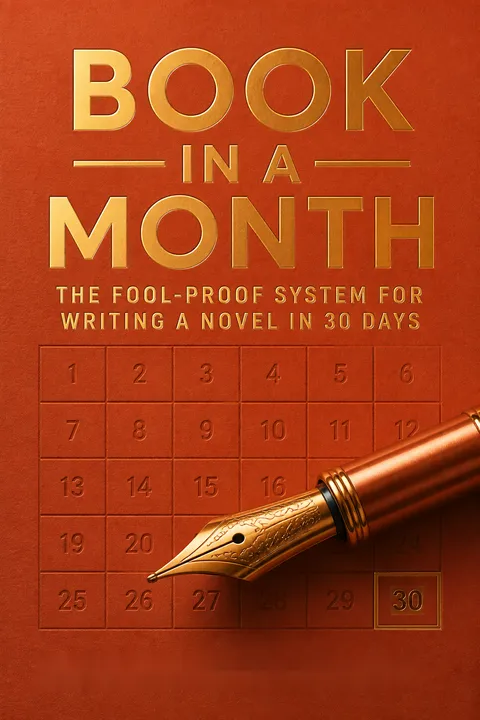


Key Takeaways
Use 30 days to finish a draft, not to certify a masterpiece.
Finish first, judge later. The book’s central promise is a complete draft in a month, not a polished manuscript ready for publication. Writing from beginning to end gives a writer the experience and raw material needed to revise. The author points to prolific novelists, including Nora Roberts and Barbara Cartland, as evidence that rapid drafting is possible, while stressing that a fast draft still needs skill and substantial editing.
Scale the goal to your life. If a full manuscript is unrealistic, use the month to complete a synopsis or detailed outline instead. A demanding deadline can focus attention, but only if the target fits the writer’s available time and obligations.
The distinction between completion and quality is the system’s most useful safeguard. A draft is a prototype: it makes structural problems visible in a way that an unwritten ideal cannot. This resembles iterative design, where an early version exists to be tested and improved, not admired. The deadline can reduce endless hesitation, but speed is not itself evidence of craft. Writers should treat the month as a production experiment, then evaluate both the manuscript and the process before repeating it.
When the story changes, log the fix and write forward.
Separate drafting from revision. The book’s method called Work ‘As If’ means recording a change without returning to rewrite earlier pages. If a character’s background shifts, note the consequences, adopt the new version from this point on, and keep drafting. The Story Tracker is the project’s running record for revisions and unresolved questions, organized by story act and areas such as character, plot, subplot, and setting.
Defer work likely to move. Subplots are especially easy to postpone because they often need to change when the main plot changes. Record where one might fit and what it should accomplish, then decide during revision whether it belongs. The rule is practical: do not ask the drafting mind to write and edit the same pages at once.
This technique protects attention from the seductive trap of fixing a sentence that is already behind the writer. In cognitive terms, it reduces task switching: the writer captures a concern without reopening an earlier problem-solving loop. The method also creates a useful revision backlog, so deferred work is not simply forgotten. Its limitation is that some discoveries may make the current scene impossible to write honestly. In that case, a brief outline adjustment may be better than mechanically pressing forward.
Map a few landmarks so the draft has somewhere to go.
Build a lean route. Start with a one-sentence summary that states the story’s core, then identify roughly ten key scenes in their intended order. The At-A-Glance Outline is a compact plan covering the beginning, middle, and end, including major turns, stakes, and the protagonist’s direction. It is a guide, not a scene-by-scene contract.
Divide the distance. The month assigns about one quarter of the target to each stage: the opening, the first half of the middle, the second half of the middle, and the ending. The book also recommends checking for at least three major events. These guideposts prevent a writer from spending most of the available pages on setup and reaching the deadline with no ending.
The plan’s value lies less in predicting every plot beat than in making progress measurable. A visible destination can reduce the paralysis that comes from facing an enormous, shapeless task. This is close to the distinction between a map and a script: the map gives direction while leaving room to respond to discoveries. The quartering is a useful default, not a law of narrative. Some genres and stories need different proportions, so the writer should preserve the function of each stage rather than obeying a page ratio blindly.
Turn writing time into a protected appointment, not leftover minutes.
Make time visible. Track how hours are actually spent, including distractions, then schedule writing as a specific appointment. The book suggests writing early in the day when possible, simplifying or delegating routine tasks, and saying no to nonessential demands. Its use of the Pareto principle, commonly called the 80-20 rule, is a prompt to identify the small share of activities producing most of the value, not a guaranteed mathematical law for every schedule.
Choose a feasible workload. A writer facing illness, a move, a new baby, or other major disruption can set a smaller target rather than treating a missed day as proof of failure. The system recommends weekly and daily milestones, with spare days available for genuine setbacks.
The appointment idea turns a private aspiration into a calendar commitment, much like an implementation intention: a plan that links a defined time to a defined action. Time tracking can expose the gap between feeling busy and knowing where hours go. Yet the advice to simply take time can understate real constraints, including caregiving, inflexible jobs, and financial precarity. The book’s more durable principle is not that every person has abundant free time, but that honest accounting helps distinguish negotiable routines from obligations that require a smaller goal.
Pick a story that carries your values, not just today's market.
Anchor the project in personal interest. The book argues that market fashions may change during the years between writing and publication, while a writer’s connection to a story can sustain the work now. Identify recurring interests, beliefs, and subjects, then bring them into the project even if the genre or assignment is not an obvious match. The Rocking Chair exercise asks writers to imagine looking back on life and name the book they would be proud to have written.
Make the goal specific. A broad target such as writing several books says little about what the writer cares about. A more useful goal names both the work and its underlying concern. That focus can guide choices, clarify a writer’s identity, and make the project easier to stay invested in.
The argument for personal investment aligns with self-determination theory, which distinguishes internally meaningful aims from goals pursued only for external approval. A story with a genuine emotional stake may be easier to sustain through a long revision process. Still, market awareness and artistic integrity need not be enemies. A writer can understand genre expectations, audience, and commercial limits while choosing a project that feels worth the effort. Passion is a source of persistence, not a substitute for researching readers or developing craft.
Treat resistance as a signal to adjust, not a verdict on talent.
Notice the avoidance pattern. The book calls resistance the pull to avoid a risky goal, often disguised as busyness, disorganization, abandoning one story for another, or waiting for someone else to decide what happens next. It recommends asking what feels threatening about finishing, then making the next step smaller and clearer. Outlining, setting a deadline, checking in with supportive peers, and allowing a short delay before quitting are among its practical tactics.
Protect the writer’s confidence. The author warns against using shame to force productivity or treating criticism of a draft as a judgment of the person who wrote it. A modest reward at the end of the month, and recognition of partial progress, can help maintain motivation. Trusting oneself means believing setbacks can be examined and goals revised without abandoning the larger ambition.
Naming avoidance can turn a vague sense of failure into a solvable process problem. Small tasks and peer accountability also make intentions more observable, which helps distinguish aspiration from action. The psychological language needs care, however. A missed writing session may reflect exhaustion, illness, or competing responsibilities, not a hidden fear of success. The strongest application is diagnostic rather than accusatory: ask whether the obstacle is emotional, logistical, or both, then respond to the actual cause.
Make the middle worsen the problem before offering false relief.
Escalate through varied pressure. The book separates three ways to intensify conflict: a barrier stops an attempted solution, a complication adds a new problem, and a situation creates a fresh dramatic predicament. These pressures should keep the protagonist’s goal active and make choices consequential. A character’s motivation should also go deeper than the stated task. A hero may pursue a rescue not only to help someone, but to prove worth or escape guilt.
Give success a catch. A Temporary Triumph is an apparent victory that advances the goal but is followed by a Reversal that makes matters worse or changes their meaning. A cliffhanger can hold a question open, but it needs a believable payoff. Together, these devices help the long middle feel like a chain of changing stakes rather than a stretch of filler.
The sequence of pressure, relief, and reversal gives a reader reasons to continue while allowing the protagonist’s motives to evolve. It also resembles the way suspense works in serialized drama: an answer closes one question while opening a more difficult one. The caution is that escalation need not mean ever-larger spectacle. A changed relationship, a moral cost, or a mistaken belief can raise the stakes without inflating the plot. The reversal feels earned when it grows from the character’s choices or the story’s established conditions.
Give every scene a job beyond occupying pages.
Test the scene’s purpose. The Domino Scene Test asks what would break if a scene disappeared. A useful scene should advance events, reveal character, deliver necessary information, or serve another clear purpose. The book points to the boat scene in Jaws, where characters waiting for the shark also expose their personalities and relationships. One concentrated scene can do more than several scattered scenes that each accomplish little.
Use a sequence when needed. A Scene Sequence is a short chain of scenes with its own beginning, middle, and end inside the larger story. It can build intimacy, reveal character, or create a contained episode, while the main goal remains in view. The method encourages writers to deepen a scene before adding another one merely to create the appearance of action.
This is an economy principle, not a demand that every scene serve only one function. Strong narrative scenes often carry several layers at once: action, character, atmosphere, and subtext. The Jaws example makes that efficiency concrete. The removal test is especially useful because it asks about consequences rather than whether a scene is enjoyable in isolation. A scene can be beautiful and still be misplaced; conversely, a quiet scene may be essential if later events depend on what it reveals.
Align theme and genre so the story’s promise feels intentional.
Find the idea beneath events. The book treats theme as the meaning or perspective conveyed by the writer’s choices, not simply the plot’s lesson. A Theme Spider worksheet gathers clues from what the writer cares about, recurring images, character decisions, and the reader’s intended experience. In Casablanca, the characters’ attempts to leave and their confrontation with old attachments help create a theme around the past and sacrifice.
Check the genre contract. A mystery needs a puzzle and clues; a romance needs a convincing relationship payoff; horror needs frightening events. These conventions are not a formula for originality. They are promises to readers. The book recommends checking that recognizable genre elements appear and build through the story, while letting the writer’s particular concerns shape how those elements are used.
Theme is most persuasive when it emerges from repeated choices rather than a speech explaining what readers should learn. Genre, meanwhile, functions like a shared agreement about the kind of experience a reader is buying. Bringing the two together can make familiar conventions feel personally specific. The risk is reducing genre to a checklist or theme to a single slogan. A useful review asks whether the story’s images and decisions create a coherent pattern, while leaving room for readers to interpret that pattern differently.
Make the ending earn its victory by planting the means early.
Set up the final test. Before the climax, the protagonist faces a final obstacle that tests the strengths, weaknesses, or change established by the story. The conflict with the antagonist should then resolve the central goal, through success, failure, or a meaningful change in what the protagonist wants. A sudden rescue or convenient new tool weakens the payoff if the story has not prepared for it.
Close the promises. The resolution shows what has changed, ties up necessary subplots, and completes the character’s movement. The book also advises revisiting the opening’s story promise, such as its tone, central question, or defining image, and making sure the ending answers it. A conclusion can surprise readers, but its causes should feel present in retrospect.
A satisfying ending combines surprise with retrospective clarity: the outcome is not obvious, yet its ingredients were available. This is a form of causal coherence, the sense that events arise from prior decisions rather than authorial convenience. The character arc matters because an external victory can feel hollow if the protagonist has not changed or consciously resisted change. Not every subplot needs equal closure, but unresolved threads should feel deliberate rather than accidentally abandoned.
Treat the draft as proof of follow-through, then protect the habit.
Measure the month honestly. At the finish, review the draft for story holes, missing research, forgotten characters, and problems to address in revision. Organize notes and keep a backup. The author recommends celebrating if at least 75 percent of the chosen goal is reached, rather than letting an imperfect result erase the work completed.
Keep moving deliberately. Writers can revise after a break or begin another project, but should make a next-step plan rather than letting the writing routine disappear. The first draft may need substantial rewriting, and the author advises caution about sharing it with critics before it is ready. Completion matters because it creates a manuscript that can be improved and a clearer understanding of what the next project requires.
The month is valuable not only for pages produced, but for evidence about process: when writing worked, where time went, and which obstacles recurred. That turns a one-time challenge into feedback for future projects. The 75 percent threshold is a humane motivational device, though it should not become a universal measure of success. A writer’s circumstances differ, and learning to set a sustainable pace can matter more than repeating an intense sprint. The essential gain is a completed object and a more informed next decision.
Analysis
Book in a Month is both a drafting schedule and a manual for staying emotionally engaged with a difficult creative project. Its distinctive move is to treat the novel as two problems at once: a narrative that needs structure, and a writer who needs protection from perfectionism, distraction, and discouragement. The four-week progression gives a practical route through the story, while the worksheets externalize decisions that would otherwise consume attention during drafting. The advice to record changes instead of revising backward is particularly effective because it preserves momentum without pretending that first ideas are final.
The book is strongest when it replaces vague ambition with observable actions: a target, a calendar, a scene map, time tracking, and a next step. Its craft guidance also connects plot mechanics to motivation. Obstacles matter more when they pressure a character’s deeper need, and a climax feels satisfying when earlier choices prepare it. The repeated emphasis on a complete draft correctly distinguishes making a manuscript from making a finished book.
Some claims are better read as coaching rhetoric than universal rules. Writers do not all have equal control over their time, and resistance cannot explain every interruption or difficulty. The author does acknowledge major obligations and recommends smaller goals, but the book’s forceful language about simply making time can obscure the value of sustainable pacing. Likewise, structural guideposts help writers who need direction, but can become formulaic if treated as fixed proportions. The adaptable core is more useful than rigid compliance: protect regular writing time, keep a record of decisions, move toward an ending, and revise with evidence rather than fear. For a new novelist, that is a concrete way to turn the identity of writer into the repeated act of finishing.
Review Summary
Book in a Month receives mixed reviews. Many find it helpful for outlining and structuring novels, especially for beginners. The worksheets and daily exercises are praised for encouraging productivity. Some appreciate its flexible approach, while others find it too formulaic. Critics argue it focuses too much on planning rather than actual writing. Several reviewers successfully used it to complete first drafts. The book's emphasis on overcoming writer's block and self-doubt is noted positively. Overall, it's seen as a useful tool for writers seeking structure, though not suitable for everyone's writing style.
People Also Read



Glossary
BIAM
30-day writing planBIAM is the book’s shorthand for its Book in a Month process. A writer sets a realistic project goal, divides the month into weekly stages, uses planning worksheets to guide the draft, and keeps writing rather than stopping to perfect earlier pages. The goal may be a manuscript, an outline, or a rewrite, depending on the writer’s circumstances.
Work “As If”
Draft past revisionsWork “As If” is the practice of recording a revision need and continuing the draft as though the change has already been made. The writer uses the updated version going forward, while keeping notes about earlier pages that will need attention. It prevents drafting and line-by-line revision from competing for attention during the month.
Story Tracker
Revision and idea logThe Story Tracker is a running record of changes, questions, and ideas that surface while drafting. Notes can be grouped by act and by areas such as character, plot, subplot, or setting. Rather than interrupting the draft to repair every inconsistency, the writer stores the issue here and returns to it during revision.
At-A-Glance Outline
Compact story roadmapThe At-A-Glance Outline is a concise plan for the story’s beginning, middle, and end. It prompts the writer to identify the setup, major turns, stakes, changes in the central problem, climax, resolution, and theme. It is designed to give a fast draft direction without requiring a detailed outline of every scene.
Temporary Triumph
Apparent short-lived victoryA Temporary Triumph is a moment when the protagonist appears to have reached an important goal, creating relief or confidence. The success does not last: a reversal soon reveals a new cost, obstacle, or misunderstanding. This beat raises hope before complicating the story, helping the middle develop momentum instead of remaining a string of unrelated setbacks.
Scene Sequence
Mini-story within storyA Scene Sequence is a connected group of scenes with its own beginning, middle, and end, embedded within the larger plot. It can provide a contained episode that reveals character, changes a relationship, or adds tension. The sequence should still relate to the main storyline, even when its immediate events are not the central conflict.
Theme Spider
Theme discovery worksheetThe Theme Spider is a worksheet for identifying and developing a story’s underlying meaning. It gathers clues from the writer’s reasons for choosing the story, recurring ideas and images, character choices, and intended effect on readers. Its purpose is to help the writer notice patterns and reinforce them through the story without turning the theme into an explicit lecture.
The Domino Scene Test
Scene necessity checkThe Domino Scene Test asks what would happen to the surrounding story if a scene were removed. If later events become confusing or lose their cause, the scene is probably doing necessary work. If removing it changes nothing, the writer can cut it or give it a clearer purpose, such as advancing the plot, revealing character, or supplying important information.
About the Author
Other books by Victoria Lynn Schmidt

Download PDF
Download EPUB
.epub digital book format is ideal for reading ebooks on phones, tablets, and e-readers.








