Key Takeaways
1. The Peasants' Revolt: A Templar Vengeance?
One captured rebel leader, when asked the reasons for the revolt, said, “First, and above all . . . the destruction of the Hospitallers.”
A Mysterious Uprising. The Peasants' Revolt of 1381, a massive and violent uprising in England, was far from spontaneous. It exhibited clear signs of widespread organization and a "Great Society" operating from London, yet its true leadership and motives remained shrouded in mystery. The rebels' specific targets and actions hinted at a deeper, unacknowledged agenda.
Targeted Fury. A striking feature of the revolt was the concentrated and vicious attacks on the Knights Hospitaller, including the murder of their prior, Sir Robert Hales, and the systematic destruction of their properties. In stark contrast, the rebels spared the principal church of the Knights Templar in London, even as they razed surrounding buildings. This selective destruction, coupled with the rebel leader Walter the Tyler's enigmatic title, suggested a connection to the long-suppressed Templar order.
Lingering Hatred. The Knights Templar, abolished 69 years prior, had every reason to despise the Hospitallers, who had inherited much of their vast wealth and property by papal decree. The ferocity of the attacks, particularly the explicit desire for the Hospitallers' "destruction," strongly implies a deep-seated, generational desire for vengeance, suggesting that the "Great Society" might have been an underground Templar network.
2. The Templar Suppression: A Brutal Betrayal
When de Molay retired that night, there was no way he could have known that just before the dawn of the next day an event would occur of such shattering dimensions that the date, Friday the Thirteenth, would live for centuries in the minds of millions as the unluckiest day of the year.
A King's Greed. King Philip IV of France, deeply indebted to the wealthy Knights Templar, orchestrated their downfall to seize their assets and cancel his debts. He meticulously planned a secret, simultaneous arrest of every Templar in France on Friday, October 13, 1307, a date forever etched in infamy. Grand Master Jacques de Molay, confident in the Templars' power and papal protection, was tragically unaware of the impending betrayal.
Papal Complicity. Initially outraged by Philip's usurpation of ecclesiastical authority, Pope Clement V, a weak and ambitious pontiff under Philip's influence, eventually succumbed to pressure. He issued the bull Pastoralis Preeminentiae, ordering all Christian monarchs to arrest and torture Templars in their domains, effectively legitimizing Philip's actions and condemning a holy order without due process. This marked a profound betrayal by the very authority the Templars had sworn to serve.
Agony and Defiance. The arrested Templars in France faced horrific torture by the Inquisition, designed to extract confessions of heresy, sodomy, and blasphemy. Many died under the torment, while others confessed to escape the pain, only to be burned alive as "relapsed heretics" if they later recanted. De Molay himself, after years of imprisonment, famously recanted his forced confession at the stake, proclaiming the order's innocence and cursing his persecutors, solidifying his martyrdom and fueling a legacy of resentment.
3. England and Scotland: A Haven for Fugitive Templars
The papal bull was never published, announced, or acknowledged in Scotland, thereby giving that country the aspect of a legal haven for fugitive Templars from England or the continent.
A Weak English King. The timing of the Templar suppression coincided with the ascension of Edward II to the English throne, a monarch characterized by weakness, indecision, and preoccupation with his favorites. This provided a crucial three-month warning period for English Templars after the arrests in France, allowing many to escape and disappear with their treasures and records before royal orders for their arrest were finally issued in January 1308.
Defiant Scotland. Robert Bruce, the newly crowned King of Scotland, was embroiled in a fierce war for independence against England. He openly defied Pope Clement V's directive to arrest Templars, never publishing the papal bull in his realm. This made Scotland a de facto sanctuary for Templar fugitives, who, as experienced warriors, would have been welcomed into Bruce's small but formidable cavalry, bolstering his forces against the English.
A System of Protection. The disarray of Edward II's government, coupled with the absence of the Inquisition in Britain, created an environment conducive to the formation of a clandestine network. Fugitive Templars, accustomed to secrecy and with international connections, could leverage existing sympathies among the populace and nobility to establish a mutual aid society, providing safe passage, lodging, and new identities for those fleeing persecution.
4. Masonic Language: Echoes of Medieval French
The French-language roots of the lost words of Masonry indicate the strong probability that the society was in existence in the first half of the fourteenth century, another point that contributes to the feasibility of origins associated with the Templars, who fled from arrest by church and state in that very period.
Unraveling Lost Meanings. Many unique Masonic terms, whose meanings were lost over centuries, find logical explanations when traced back to medieval French, the language of the Templars and the British aristocracy of the 14th century. This linguistic connection strongly suggests a French-speaking origin for the secret society, rather than an English stonemason guild.
Key Linguistic Links:
- Tyler: From French tailleur ("one who cuts"), fitting for a sword-wielding guard.
- Cowan: From French couenne ("ignoramus" or "bumpkin"), describing an unskilled outsider.
- Due-guard: From French geste du garde ("protective gesture"), a truncated term for a recognition sign.
- Cable-tow: From Latin capulum (via French cable), meaning "halter," describing the rope used in initiation.
- Lewis: From French levées ("sprouts" or "scions"), a term for sons and heirs.
- Abiff: From French à biffe ("who was eliminated"), designating Hiram as the murdered master.
- Juwes: From French jubé ("rood screen"), referring to the place of public punishment, thus "those who were punished."
Beyond Words. The term "Freemason" itself may derive from frère Maçon ("brother Mason"), reflecting the Templar practice of addressing each other as "brother" (frère). The unique Masonic use of "lodge" to mean a chapter or meeting place, rather than just a dwelling, also points to its original function as a "lodging" or safe house for fugitives, a meaning that gradually shifted as the need for hiding diminished.
5. Masonic Symbols: Veiled Templar Heritage
Suddenly we see the compass and square, and only minor modifications are required to give the new symbol the surface appearance of those tools.
The Circle and Mosaic. The central circle in a Masonic lodge, around which members "circumambulate," directly mirrors the circular architecture of many Templar churches, built to emulate the Church of the Holy Sepulchre. The black and white mosaic pavement, a prominent Masonic symbol, finds its origin in the Templar battle banner, the Beau Séant, which was divided into black (sin left behind) and white (pure life adopted).
Apron and Gloves. The white lambskin apron, presented as an emblem of innocence, was not a common garment for medieval stonemasons. However, the Templar Rule permitted no personal decoration except sheepskin and required a sheepskin girdle as a symbol of chastity. Similarly, the Templar priests wore gloves to keep their hands clean for serving communion, a practice that could have influenced Masonic ritual.
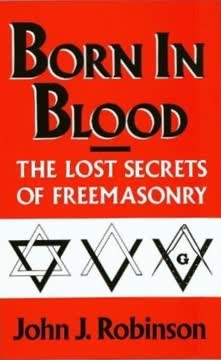
The Compass and Square. The most iconic Masonic symbol, the compass and square, is a veiled representation of the Seal of Solomon, a symbol deeply significant to the Knights of the Temple of Solomon. By omitting the horizontal bars of the six-pointed star, the Seal of Solomon transforms into the compass and square, allegorically linking Freemasonry's primary emblem to the Templars' foundational identity and the "unfinished" nature of their order.
6. The Hiram Abiff Legend: An Allegory of the Temple's Fall
The Temple of Solomon that was not completed can only be the Order of the Poor Fellow-Soldiers of Christ and the Temple of Solomon, the Knights Templar.
A Central Mystery. The legend of Hiram Abiff, the murdered master builder of Solomon's Temple, is the most dramatic and central ritual in Freemasonry. It deviates significantly from biblical accounts, where Hiram the metalworker lives to see the temple completed. This allegorical narrative, therefore, holds the key to Freemasonry's true origins and purpose.
The Unfinished Temple. The "unfinished Temple of Solomon" in Masonic lore directly symbolizes the Knights Templar, whose order, also known as the "Temple," was brutally suppressed and left "unfinished" by its enemies. The murder of Grand Master Hiram Abiff allegorically represents the fate of Jacques de Molay and the Templar leadership, who were tortured and executed, halting the "building" of their order.
Succession and Vengeance. The Master Mason initiate, by enacting the role of Hiram Abiff, symbolically assumes the mantle of the murdered Grand Master. His task is to ensure the survival and "completion" of the symbolic Temple (the Templar order) by keeping the secret society alive. The three "Juwes" who murder Hiram Abiff allegorically represent the Templars' historical persecutors: King Philip IV of France, Pope Clement V, and the Knights Hospitaller, whose "punishment" is woven into the ritual and historical events like the Peasants' Revolt.
7. Freemasonry's Religious Tolerance: A Legacy of Persecution
The Masonic willingness to accept the holder of any belief or mode of worship in bonds of brotherhood was a capital offense, which made Freemasonry a very high-risk organization to which to belong.
A Radical Stance. Freemasonry's core tenet—requiring belief in a Supreme Being but tolerating all modes of worship and forbidding religious debate—was a revolutionary and dangerous philosophy in medieval Britain. In an era of enforced Roman Catholic uniformity, such religious tolerance was a capital offense, punishable as heresy and treason.
Templar Disillusionment. The Knights Templar, a devout Catholic order, were betrayed and persecuted by the very Pope they served. This profound rejection by the Church, coupled with brutal torture and executions, would have shattered their traditional link to God through the papacy. They would have sought a new, personal relationship with God, leading to diverse individual beliefs but a shared need for mutual protection.
A Haven for Dissenters. This unique religious philosophy made Freemasonry an ideal secret society for a continuous stream of dissenters and protesters against the Roman Church throughout centuries of religious upheaval in Britain. From Lollards to early Protestants, those at odds with the established faith found a brotherhood that prioritized survival and mutual aid over doctrinal uniformity, fostering a clandestine network that defied state and church authority.
8. Debunking the Stonemason Myth: No Guild Connection
Freemasonry did not evolve from the medieval guilds of stonemasons in Britain because it would appear that there were no medieval guilds of stonemasons in Britain.
A Widely Accepted Fallacy. The prevailing theory that Freemasonry originated in medieval British stonemason guilds is a pervasive myth, accepted by Masons and anti-Masons alike. However, extensive historical research, including archival searches in major British cities like Oxford and Lincoln, reveals a startling absence of evidence for the existence of such guilds.
Guilds vs. Freemasonry. Medieval craft guilds were local, monopolistic associations of entrepreneurial owners, strictly tied to the Roman Catholic Church, and focused on profit and trade control. They bore little resemblance to the widespread, secretive, and religiously tolerant nature of early Freemasonry. The idea of itinerant stonemasons forming a secret, pan-British organization with unique oaths and symbols is historically unfounded.
A Cover Story. The "stonemason" identity likely served as a convenient cover story for a secret society whose true purpose was illicit. Just as other secret societies adopted innocuous fronts (e.g., fishing, trading), Freemasonry's allegorical connection to temple building provided a plausible, yet misleading, public narrative, allowing its true, dangerous origins to remain hidden.
9. The Protestant Pendulum: Why Secrecy Endured
Now, indeed, Freemasons had no more need for secrecy, no reason to hide from the establishment, or to plot against the establishment. Freemasonry had become the establishment.
Centuries of Religious Turmoil. The period from Henry VIII's break with Rome in the 16th century to the establishment of the Hanoverian dynasty in 1714 was marked by intense religious flux in Britain. The country swung violently between Anglican Catholicism, fervent Protestantism, and attempts to restore Roman Catholicism, creating a constant need for secrecy and protection for those whose beliefs diverged from the reigning monarch's.
A Dangerous Landscape. Each shift in royal religious policy brought new persecutions. Henry VIII burned Protestants, Mary I ("Bloody Mary") burned Anglicans, and Elizabeth I executed Catholics. The rise of Puritanism under Cromwell led to its own brand of intolerance, and James II's aggressive push for Catholicism united all Protestant factions against him. For centuries, expressing dissenting religious views or aiding those who did was a high-risk endeavor, often punishable by death or loss of property.
The End of Secrecy. The Glorious Revolution of 1688, which deposed the Catholic James II and brought the Protestant William and Mary to the throne, fundamentally altered the religious and political landscape. The Act of Succession in 1701 permanently barred Catholics from the British throne, and the Act of Union in 1707 solidified Great Britain as a Protestant nation. By 1717, with the Jacobite threat (Catholic restoration) effectively crushed and a stable Protestant monarchy in place, the existential need for Freemasonry's deep secrecy finally dissolved, allowing it to emerge into public view.
10. The Manufactured Mysteries: Distortions and Defamation
If a "neutral observer" asserts accusations of unfair advancement in business and government, corruption of the police and the judicial system, a connection with the KGB, an infiltration of the Vatican in a conspiracy to commit the biggest financial fraud of our time, responsibility for the Jack the Ripper murders, and the undoubted worship of the Devil, what is left for an enemy to assert?
Concocted Accusations. Beyond its genuine historical mysteries, Freemasonry has been plagued by "manufactured mysteries" – accusations of devil worship, global conspiracies, and corruption, often propagated by anti-Masonic writers. These claims frequently distort facts, take statements out of context, or rely on flimsy evidence to fit preconceived conclusions, rather than seeking truth.
Misinterpreting Papal Bulls. For instance, Pope Leo XIII's encyclical Humanum Genus (1884), often cited as proof of Masonic devil worship, actually condemned Freemasonry for promoting principles like the separation of church and state, government by the people, and religious tolerance – ideas the Catholic Church at the time viewed as subversive and part of the "kingdom of Satan" alongside all non-Catholic faiths. The encyclical was a condemnation of democratic ideals and the erosion of papal temporal power, not a specific accusation of devil worship.
Conspiracy Theories. Modern accusations, such as Masonic involvement in the Vatican banking scandals or KGB infiltration, often hinge on tenuous links or misrepresentations. For example, the P2 lodge scandal involved a clandestine group disavowed by official Masonry, yet it was framed as a "Masonic conspiracy." Such manufactured mysteries serve to demonize the organization rather than genuinely investigate its history or practices.
11. The Unfinished Temple of Solomon: A Call to Action
To achieve that goal on the Temple Mount would be a monumental task.
Beyond Allegory. The symbolic "unfinished Temple of Solomon" in Masonic ritual, representing the Knights Templar's interrupted mission, can be re-interpreted as a powerful metaphor for ongoing global challenges. The core Masonic principle of brotherhood among men of all faiths, born from centuries of persecution, offers a unique framework for addressing contemporary conflicts rooted in religious division.
A Global Challenge. The literal Temple Mount in Jerusalem, sacred to Judaism, Islam, and Christianity, remains a flashpoint of religious and political tension, a place where the "unfinished temple" of interfaith harmony desperately needs completion. The site, currently home to Islamic mosques, is revered by Jews as the location of their ancient temples and by Christians as a place where Christ taught.
Masonic Potential. Freemasonry, with its global reach and foundational commitment to universal brotherhood and respect for diverse beliefs, could play a pivotal role in fostering dialogue and seeking peaceful solutions for such deeply entrenched conflicts. By publicly advocating for its ancient principles of religious tolerance and mutual respect, Freemasonry could offer a model for bridging divides and working towards a shared future.
Last updated:
Review Summary
Born in Blood explores the theory that Freemasonry originated from the Knights Templar rather than medieval stonemason guilds. Reviews praise Robinson's thorough research and compelling circumstantial evidence linking Templar persecution to Masonic origins, particularly through linguistic analysis and ritual examination. The book covers the Peasants' Revolt of 1381 and traces secret society development. While readers find it informative and engaging, many note the evidence remains speculative without definitive proof. Some criticize repetitive sections, excessive historical detail, and lack of citations. Overall, reviewers appreciate its objective, accessible approach to controversial historical connections.
Similar Books