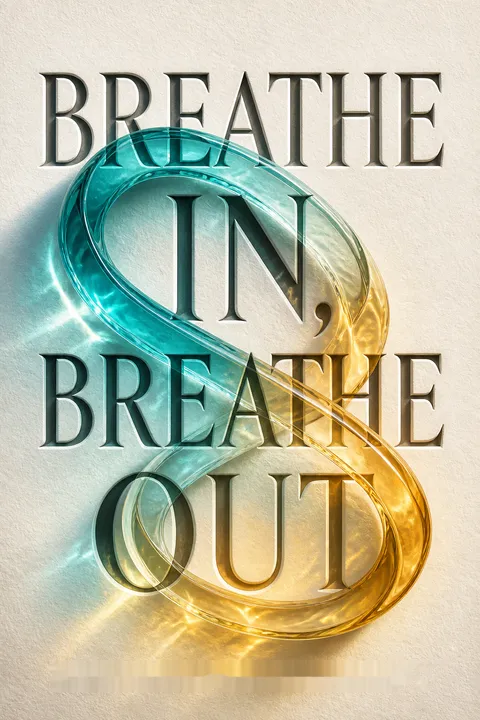


Key Takeaways
Use your breath to shift your state when thoughts will not budge
A personal turning point. Stuart Sandeman began exploring breathwork after his partner, Tiff, died of cancer. Grief had left him numb and withdrawn. At a workshop, an unfamiliar breathing practice brought a rush of emotion and, for the first time in months, he cried. He later used regular practice to feel more energetic, sleep better, and regain a sense of direction. The book does not claim breathwork cured Tiff’s cancer. Its central claim is that breathing offers a practical way to influence how the body and mind feel.
A two-way link. Thoughts and emotions affect breathing, while breathing patterns can reinforce or shift those states. Sandeman calls this a state of being loop. When anxious thinking and tense, rapid breathing feed each other, changing the breath can sometimes interrupt the cycle. Begin by noticing your breath without trying to fix it, then set an intention for what you want to change.
What's compelling is the use of breathing as a point of leverage when direct thought control is difficult. This resembles biofeedback, where people learn to notice bodily signals and alter them deliberately. Such practice can create a small gap between feeling alarm and acting from alarm. The distinction matters: breathwork can support grief, but it does not erase loss or replace medical care. Its value lies in offering a repeatable way to meet a hard moment with more choice.
At rest, favor quiet nasal breathing led by the diaphragm
Start with mechanics. Sandeman describes relaxed resting breath as quiet, nasal, smooth, and led by the diaphragm, the broad muscle beneath the lungs. As it contracts, the lower torso expands before the ribs and chest. Desk posture, restrictive clothing, habitual tension, and stress can make breathing feel shallow or effortful. The book recommends awareness first: notice whether the nose or mouth is doing the work, whether the chest or belly moves first, and whether the breath pauses, rushes, or feels strained.
Slow without forcing. The book's Magic Ratio practice uses an even count of five for the inhale and exhale, a pace close to six breaths per minute. Research discussed in the book links slow breathing with changes in heart-rate variability. The author also promotes mouth taping, including at night, but that is not a safe universal remedy. Nasal blockage, sleep apnea, or breathing difficulty calls for clinical assessment, not tape.
The useful principle is not that every person must breathe in one exact pattern, but that awareness and gentle pacing can change the experience of breathing. Slow breathing is studied for effects on autonomic regulation and stress, though responses vary and a forced slow pace can feel unpleasant. The book's strong case for nasal breathing also needs boundaries: congestion, structural problems, and sleep-disordered breathing deserve medical evaluation. Mouth taping should not be treated as a casual self-help experiment.
Read your breathing as a weather report, not a diagnosis
Notice patterns, not labels. The book groups common breathing habits into archetypes: chest breathing, reverse breathing, collapsed posture, breath holding, grabbing the next breath, and habitually controlling the exhale. These labels describe patterns to observe, not fixed personality types. For instance, Sandeman recalls Ian, a tightly dressed corporate director who exercised early, worked through packed meetings, and still struggled with low energy and insomnia. His posture and tense breathing suggested that he was carrying more strain than he recognized.
Try a brief check-in. Without changing anything, notice posture, clothing, breath route, movement in the chest and abdomen, speed, and tension. Repeat at rest, while speaking, during exercise, and before sleep. The point is to spot contexts that alter breathing. A hunch over a screen or a tight collar may restrict movement; a difficult conversation may make someone hold their breath.
This approach turns an automatic function into useful information, much like interoception, the capacity to notice internal bodily signals. Such attention can help people connect a situation with tension before it becomes an entrenched habit. The archetypes are best treated as prompts for curiosity, not clinical categories: the same person can breathe differently across tasks, and a pattern alone cannot reveal its psychological cause. That restraint preserves the book's practical insight without turning a breathing observation into a personality verdict.
Lengthen the exhale when stress is crowding out judgment
Give the body a downshift. Sandeman explains that stress often brings faster, shallower breathing and heightened alertness, while a slower, longer exhale can help some people settle. His basic calming sequence is to inhale through the nose for four counts, pause briefly, then exhale for eight while relaxing the jaw, shoulders, and face. Repeat only while it feels comfortable. The book also offers a longer-exhale pattern before meals and a different count-based exercise for sleep.
Match the tool to the moment. A few rounds may help before an interview, after a startling event, or when worry is keeping the mind busy. For sleep, Sandeman recommends a routine, daylight exposure, and limiting late screen use, alongside breathing. For pain, he suggests combining a calm breath with attention or imagery. These practices are supports, not treatments for every cause of insomnia, digestive trouble, or pain.
A longer exhale can act as a simple attentional anchor as well as a bodily cue to slow down. That combination is important: a person is not merely changing airflow, but also interrupting a stream of threat-focused thought. However, breathing patterns are not a universal switch. Some people feel more anxious when counting or holding their breath, and pain or digestive symptoms can have causes that breathing cannot address. Comfort and appropriate clinical care should guide the practice.
Let emotions move before they harden into familiar reactions
Feel, then choose. Sandeman argues that suppressing emotion can create tension and restrict breathing. His Recognise-Breathe-Reframe exercise asks people to name what they feel, locate it in the body, breathe calmly for a short period, and then ask what happened and what response would help. A humming version adds sound and movement. The point is not to force positivity: the book warns that insisting on a cheerful interpretation can silence grief or anger rather than resolve it.
Catch the familiar loop. Sandeman's own comic example is Airport Stu, his irritable, panicked self when rushing for a flight. He also describes Carlo, who repeatedly felt guilt and blamed himself. Awareness helped them notice recurring triggers instead of mistaking each reaction for an unchangeable trait. The book's 90-second rule suggests that a brief emotional surge may pass if it is allowed, but persistent or complex feelings are not guaranteed to resolve on that schedule.
Naming an emotion can help separate the experience from the identity claim that follows it: feeling anger is not the same as being an angry person. This fits with emotion-regulation approaches that encourage noticing, labeling, and reconsidering a reaction. The 90-second claim is more useful as an invitation to pause than as a biological stopwatch. Grief, trauma, and recurring anxiety can persist despite willingness to feel them, and may call for sustained support rather than a timed breathing exercise.
Use breathwork to support trauma care, not replace it
Past experience can shape present habits. Sandeman uses the image of a bag filled with stones to describe how painful experiences and beliefs can weigh on present behavior. He argues that stress and emotion may show up as bodily tension or restricted breathing. His own grief after Tiff's death and client stories, including Linda's account of a long-standing fear after a car crash, shape his case for deeper breathing practices.
Treat results as promising, not settled. Infinity Breathing is a continuous, gentle inhale and exhale without the usual pause, sometimes combined with sound, movement, or affirmations. Sandeman and psychiatrist Norman Rosenthal collected self-reports from 636 participants: 99 percent said sessions were helpful, 26 percent described them as transformational, and 19 percent reported adverse effects such as discomfort, heavy emotions, or fatigue. These are encouraging reports, but they do not establish efficacy or safety for everyone.
The book's strongest contribution here is its insistence that emotional suffering can involve the body, not only the story a person can tell about it. Trauma-informed care likewise emphasizes pacing, consent, and a sense of safety. The evidence described, however, is self-reported and lacks a comparison group, so dramatic client accounts cannot demonstrate that a breathing method resolves trauma. Intense practices can also provoke distress. People with trauma histories or serious symptoms should work with qualified clinicians and stop if a practice feels destabilizing.
Choose a breathing pattern for the task, not for every task
Different states need different tools. Sandeman presents flow as the balance between being too stressed and too relaxed. For a steady, attentive state, his Box Breathing practice uses equal counts for inhaling, holding, exhaling, and holding again. Jedi Breathing adapts alternate-nostril breathing to demand close attention to the air moving through each nostril. For a burst of energy, he describes more activating patterns, while emphasizing that they should be used sparingly.
Protect attention too. Breathing cannot compensate for endless interruptions. The book recommends doing one task at a time, reducing notifications, and setting aside a defined period for worry rather than letting it occupy the whole day. Flow also depends on the task: it should challenge a person's current abilities without being so difficult that they give up. A breathing practice may help establish readiness, but the environment and demands still matter.
This is a useful shift from searching for a single ideal breath to matching a tool to a goal. Performance psychology makes a similar point: the best level of arousal depends on the task, with high activation useful for some actions and harmful for others. Breath can help direct attention, but it is not a substitute for adequate sleep, task design, or fewer interruptions. Breath holds and rapid breathing can cause dizziness or distress, so the book's energizing exercises require caution.
Let your nose set an easy pace before chasing athletic intensity
Use breathing as feedback. The book encourages nose breathing during warm-ups, cool-downs, and manageable exercise. If nasal breathing becomes uncomfortable, slow down rather than forcing the pace. Sandeman cites a study of recreational runners who trained with nasal breathing for six months: their maximum oxygen consumption did not change, but they used fewer breaths per minute. This supports a possible improvement in breathing economy, not a claim that nasal breathing boosts every athlete's performance.
Coordinate breath and movement. For running, Sandeman recommends an odd-step inhale and even-step exhale pattern, such as three steps in and two steps out, so the same side does not always take the impact at the same point in the breath cycle. The book also discusses deliberate breath holds for sport. These are not casual challenges: never practise breath holds in water or while driving, and do not push through dizziness or distress.
The practical strength here is using breath as feedback rather than treating pace as the only measure of effort. The cited running study suggests that a breathing pattern may affect economy without changing maximal capacity, a distinction often lost in fitness claims. Yet performance depends on the sport, intensity, and individual physiology; mouth breathing during hard exertion is not a failure. Breath-hold training carries risks, especially around water and in people with health conditions, and should not be inferred to provide broad health benefits from athletic anecdotes.
Treat extraordinary breathwork experiences as meaningful, not proven metaphysics
Powerful experiences can feel larger than the self. Sandeman recounts Ryan, a film director who described travelling through a vivid, imagined landscape during a session and emerging with a new sense of calm and connection. The author links such reports to altered consciousness and discusses possible brain mechanisms, including changes in the default mode network. He also raises a possible role for DMT, while acknowledging that the explanation remains speculative.
Meaning does not require certainty. Sandeman says that whether he literally encountered Tiff during his first breathwork session matters less than the relief and direction the experience gave him. The book presents intensive breathing as one route to non-ordinary states, but these experiences vary widely. They can be emotionally intense, and the author stresses the role of a trained practitioner for powerful practices.
A vivid subjective experience can be psychologically consequential without confirming its supernatural interpretation. That distinction allows a person to honor what an experience means while remaining careful about claims concerning its cause. Research on consciousness, breathing, and brain networks is active, but proposed mechanisms do not yet explain every vision or feeling of connection. Because intense practices can alter perception and trigger distress, facilitator qualifications, screening, and informed consent matter as much as the promise of insight.
Use mortality to test whether today's choices match what matters
Make values concrete. Tiff's final writing, remembered by Sandeman, offered a simple idea: move through life without carrying every old burden as an identity. The book connects that idea to a prompt: imagine today were your last, then consider whom you would see, what you would regret leaving undone, and whom you would want to forgive. The purpose is not to live recklessly or abandon responsibilities. It is to notice whether the life being built reflects the things a person says matter.
Change what is changeable. Breathwork is presented as one daily practice for returning to the present and meeting difficult feelings without being ruled by them. The author recommends continuing a brief practice and choosing a tool to suit the day's need. His closing point is grounded in personal change: a person cannot control every loss or disruption, but can work on how they respond and what they prioritize.
Mortality prompts can clarify values because they compress a sprawling set of choices into a question of regret and attention. This connects with values-based therapies, which distinguish what can be controlled from what deserves commitment. The exercise should remain a reflection tool, not a demand to optimize every day or treat ordinary compromise as failure. Tiff's story gives the book's practical breathing advice its emotional center: healing does not mean forgetting a loss, but finding a way to live alongside it.
Analysis
The book's strongest organizing idea is that breathing is both a bodily process and a point of access to attention, arousal, and emotion. Sandeman moves through three practical aims: improve everyday breathing, use breath to engage with emotional patterns, and adapt breathing to sleep, focus, and sport. The narrative of Tiff's death gives this progression a human reason to exist. It also keeps the book from feeling like a catalogue of exercises: its central question is how to meet what life brings without becoming trapped in one habitual response.
The most defensible material is modest and actionable. People can notice their breathing, experiment with comfortable pacing, and observe whether a particular pattern helps them settle or focus. Slow breathing has a plausible and studied relationship with autonomic regulation, though responses differ. The book is less secure when it treats individual breathing styles as evidence of hidden psychological histories, or suggests that breathwork releases trauma stored in the body. Such ideas may resonate with clients, but anecdote is not a causal demonstration. The 636-person survey is encouraging, yet self-selection, self-report, and the absence of a comparison group limit what it proves.
That difference in evidence matters because the book sometimes places established physiology beside speculative claims about emotional addiction, birth trauma, DMT, immunity, and long-term health as though they carry similar weight. They do not. Nor should mouth taping or strenuous breath-holding be presented as routine self-help. Both can be unsafe for some people, and breathing symptoms may signal conditions that need medical attention.
Read the book, then, as an invitation to practice attention through the breath, not as a replacement for diagnosis or therapy. Its memorable promise is agency at a small scale: a pause, an exhale, a chance to notice what is happening before reacting. That promise is valuable precisely when it is kept within its limits.
Review Summary
Breathe In, Breathe Out receives mostly positive reviews, with readers praising its accessible approach to breathwork. Many find the practical exercises helpful for stress reduction, emotional management, and overall well-being. Readers appreciate the author's personal experiences and scientific backing. Some highlight specific techniques like the nose unblocking method as life-changing. While a few readers found parts of the book less engaging, most recommend it as a valuable resource for those interested in improving their breathing and overall health.
People Also Read






Glossary
State of being loop
Breath, thought, and feeling cycleSandeman's term for a feedback cycle in which thoughts and bodily feelings influence breathing, and breathing in turn affects bodily feelings and thoughts. For example, anxious thoughts may accompany tense, rapid breathing, which can reinforce anxiety. The practice implication is that changing the breath may sometimes interrupt the cycle when changing thoughts directly feels difficult.
Breathing archetypes
Common patterns of breathingA set of descriptive patterns Sandeman uses to help readers notice habits such as chest breathing, reverse breathing, collapsed posture, breath holding, breath grabbing, and habitual control of the exhale. They are awareness prompts rather than formal diagnoses. A person's breathing can vary by context, and an archetype alone cannot establish a cause or reveal a fixed personality.
Magic Ratio Breathing
Even, slow paced breathingA slow breathing exercise that uses an approximately equal, five-count inhale and exhale, producing a rate near six breaths per minute. Sandeman presents it as a way to practice calm, steady breathing and discusses research relating slow breathing to heart-rate variability. The count is a guide, not a requirement; the pace should remain comfortable rather than forced.
Carbon Dioxide Tolerance Test
First-urge breath-hold checkA breath-hold exercise associated with Konstantin Buteyko in which a person exhales normally, holds the nose, and times how long it takes to feel the first desire to breathe. Sandeman interprets shorter times as greater sensitivity to carbon dioxide. It is not a diagnostic medical test, and readers should not push to a maximum hold or use it in unsafe settings.
Recognise-Breathe-Reframe
A three-part emotion exerciseSandeman's method for responding to a difficult feeling. First, identify and locate the emotion without defining the self by it. Next, breathe calmly, with an optional humming and movement practice. Finally, reflect on what prompted the emotion, what response is desired, and whether a more useful response is available. The aim is to create time for choice, not to deny or instantly eliminate emotion.
Infinity Breathing
Continuous connected breathingA deliberate breathing practice in which the inhale and exhale flow into one another without the ordinary pause between cycles. Sandeman recommends a gentle, relaxed rhythm, sometimes adding sound, movement, or affirmations. He presents it as a way to explore emotion and tension. It is an intervention, not a recommended everyday resting pattern, and intense practice may be uncomfortable or destabilizing for some people.
Box Breathing
Four equal breathing phasesA paced exercise with four matching phases: inhale, hold, exhale, and hold again. Sandeman commonly suggests four counts for each phase, with shorter counts if the practice creates air hunger. The even rhythm is intended to support steadiness and focus. Breath holds should be soft, not strained, and the exercise should stop if it causes distress.
Jedi Breathing
Attention-focused nostril breathingSandeman's variation on alternate-nostril breathing. The practitioner directs an inhale through one nostril and an exhale through the other, then switches sides, sometimes without using the hands to make the exercise more demanding. Its main stated purpose is to concentrate attention on the breath and away from rumination or external distraction.
Holotropic breathwork
Facilitated altered-state breathingA method associated with psychiatrist Stanislav Grof that uses accelerated, connected breathing, often alongside music and expressive movement, to explore non-ordinary states of consciousness. Sandeman describes it as a way some practitioners seek emotional release and insight. The practice can be intense; it is distinct from gentle paced breathing and should not be treated as appropriate for everyone or undertaken without qualified support.
Wim Hof Method
Breathing, holds, and cold exposureA named practice associated with Wim Hof that combines rounds of forceful breathing, breath retention, and cold exposure. Sandeman discusses studies in which trained participants showed altered responses to an experimentally administered endotoxin. These findings concern a specific experimental setting and do not establish the method as a treatment for infection, autoimmune disease, or other medical conditions.
Download PDF
Download EPUB
.epub digital book format is ideal for reading ebooks on phones, tablets, and e-readers.








