

Key Takeaways
Use questions to expose assumptions before treating answers as knowledge.
A question opens a method. The book begins with people refusing to accept inherited explanations. Thales proposed that water underlies the world. His answer was not the lasting achievement; the important change was seeking a natural explanation rather than appealing to divine stories. Socrates made questioning itself central. He left no writings, but Plato’s dialogues preserve his practice of testing everyday claims about justice, virtue, and knowledge.
Branches overlap. Metaphysics asks what exists, epistemology asks how it can be known, logic examines arguments, ethics considers how to live, and political philosophy asks how society should be organized. These are connected inquiries: beliefs about human nature, for example, shape ideas about justice. The book’s history is therefore a record of arguments as much as a catalogue of answers.
The emphasis on questioning makes philosophy a public practice rather than a collection of grand conclusions. It resembles scientific criticism, where a claim gains strength by surviving informed challenge. But questioning is not automatically fair: status, education, and social power influence whose assumptions get examined and whose are treated as normal. Socrates’ approach is most useful when inquiry includes genuine listening as well as the exposure of contradiction. A good question should unsettle certainty without turning conversation into a contest for humiliation.
Compare rival pictures of reality before trusting what seems obvious.
Reality invites competing models. Early Greek thinkers proposed radically different accounts of what lies beneath appearances. Thales treated water as the basic substance. This is an early form of monism, the view that reality ultimately rests on one fundamental kind of thing. Pythagoras instead looked to number and mathematical relations. Heraclitus emphasized continual change, while Parmenides argued that reality must be unified and unchanging. Democritus and Leucippus proposed that matter consists of atoms moving through empty space.
Each model shifts the question. Plato placed perfect Forms beyond the changing world we sense. Aristotle argued that the defining nature of things is present in the things themselves, and tried to understand them through observation and classification. These theories disagree, but each asks readers to distinguish appearance from explanation.
The contrast between flux and permanence remains a powerful way to frame disputes about reality. Scientific theories also balance stability with change: they seek patterns that hold while explaining how particular events vary. The ancient proposals should not be mistaken for early versions of modern physics, since their evidence and methods were different. Their enduring value lies in making assumptions visible. Before asking which model wins, it helps to ask what each model makes possible to explain, and what it leaves out.
Treat knowledge as a contest between reason, experience, and their limits.
Knowledge has rival routes. Epistemology is the study of what can be known and how. Plato gives reason priority, arguing that the senses reveal imperfect appearances rather than lasting truths. Aristotle turns toward observation, proposing that general understanding can be built from particular cases. Centuries later, Descartes doubts almost everything, including sensory experience, until he finds certainty in the fact that he is thinking. Locke counters that the mind is not born stocked with ideas, but is furnished through experience.
Certainty has a price. Hume argues that repeated past patterns cannot logically guarantee that the future will match them. Kant responds that experience depends on structures supplied by the mind, not simply on raw sensation. The result is not a final agreement, but a useful tension: reasoning can outrun evidence, while experience always arrives through a perspective.
These positions resemble different tools, not merely rival teams. Observation can correct abstract speculation, while conceptual reasoning helps determine what observations count as evidence in the first place. Hume’s challenge is especially important because everyday prediction and scientific inference both rely on patterns continuing. That reliance may be practical without being logically certain. The debate therefore distinguishes confidence from proof, a distinction useful whenever decisions must be made before complete evidence is available.
Judge a good life by how it handles desire, suffering, and duty.
Ethics begins in lived problems. Socrates treats self-examination and understanding virtue as conditions of a worthwhile life. The Buddha’s Four Noble Truths identify suffering, trace much of it to craving, and describe its ending through a disciplined path. That path, the Eightfold Path, is a practical guide to conduct, attention, and understanding. Confucius locates ethical life in sincerity, ritual, and responsibilities within relationships, including those between family members and rulers and subjects.
Good lives take different forms. Epicurus seeks peace of mind through modest pleasures and freedom from fear. The Stoic Zeno advises living in agreement with nature and accepting what cannot be controlled. Diogenes rejects status and possessions so radically that he lives with almost nothing. These traditions differ, but all test moral ideas against the shape of an actual life.
The range of ethical traditions resists reducing happiness to pleasure or morality to rule-following. Buddhist attention to craving, Confucian attention to relationships, and Stoic attention to control each illuminate different sources of distress. Their social assumptions also deserve scrutiny: a tradition that values order can reinforce unequal roles, while radical self-sufficiency may be impossible for people with limited resources. Ethical reflection becomes stronger when ideals are tested against both personal experience and the conditions people actually face.
Design political rules by asking who gains power and who pays.
Political order needs justification. A social contract is an imagined agreement explaining why people accept common rules and government. Hobbes emphasizes protection from disorder; Locke stresses rights; Rousseau argues for political authority grounded in the people’s collective will. Machiavelli offers a harder view of rule, judging political action by its effects on the state rather than by conventional personal virtue.
Institutions distribute advantage. Adam Smith sees bargaining and specialization as engines of production, while Marx argues that ownership divides society into classes with conflicting interests. Mill defends individual liberty unless conduct harms others. Rawls asks people to choose principles of justice behind a veil of ignorance, without knowing their future social position. Together, these thinkers turn politics into a question about power, fairness, and the rules that shape ordinary life.
The imagined agreement behind political rules is useful because it asks whether institutions could be accepted by people who do not know which side of them they will occupy. Yet fairness cannot be secured by formal rules alone. Unequal wealth, access, and influence affect who gets to shape those rules and whose interests are recognized. The strongest reading of this tradition combines Rawls’s impartiality test with Marx’s attention to material power: justice must be assessed both in principle and in its distribution of real advantages.
Treat freedom as responsibility, not permission to follow a ready-made script.
No script can choose for you. Existentialism is a philosophical approach that starts from individual existence and the choices through which a person shapes a life. Kierkegaard describes the anxiety that accompanies freedom: choices matter because alternatives remain open. Nietzsche challenges inherited moral values and asks people to create meaning rather than rely on a supposedly higher world. Sartre argues that people are not made for a predetermined purpose, so their choices help define who they become.
Freedom meets social limits. Simone de Beauvoir shows how gender roles shape the possibilities available to women. Fanon examines how colonial racism pressures people to see themselves through a dominant culture’s standards. Arendt’s account of Eichmann warns that ordinary people can participate in evil by surrendering judgment. These thinkers link personal responsibility to the conditions that make some choices easier than others.
Existential freedom is most convincing when understood as responsibility within limits, not unlimited personal control. Sartre’s emphasis on choice challenges fatalism, while Beauvoir and Fanon show how social structures narrow the options people can realistically take. Arendt adds that obedience can dull judgment without erasing responsibility. The combination avoids two errors: blaming individuals for every constraint, and treating them as passive products of circumstance. Freedom matters most where people can recognize both their constraints and their remaining capacity to act.
Make science earn trust through tests that could prove it wrong.
Observation needs discipline. Bacon argues that knowledge grows through systematic investigation rather than inherited authority. But Hume exposes a problem: no number of past observations can logically prove that a pattern will continue. Popper proposes falsifiability as a mark of scientific claims: a theory must risk being contradicted by possible evidence. A claim that no observation could challenge may have other forms of value, but it is not functioning as a scientific theory in this sense.
Science also changes its frameworks. Kuhn describes normal science as work within an accepted paradigm, a shared framework of problems and methods. Anomalies can accumulate until a crisis produces a paradigm shift, in which the framework itself changes. Feyerabend challenges the idea that science follows one universal method. The book presents science as powerful, revisable, and historically shaped.
Popper’s standard is a useful check on theories that explain every possible outcome after the fact. Kuhn adds an important social dimension: evidence is interpreted within shared assumptions, and major change can require more than one decisive experiment. These accounts need not cancel each other. Falsifiability can guide the testing of a claim, while historical analysis explains why communities accept, revise, or resist it. Scientific confidence is strongest when methods and assumptions remain open to examination.
Read language as part of thought, not as a clear window onto reality.
Words gain meaning through relations. Saussure describes a sign as a sound-image joined to a concept, with no natural bond requiring a particular sound to name a particular thing. Wittgenstein argues that language sets limits on what can be clearly said, while Quine shows how difficult it can be to prove that one translation captures another speaker’s exact meaning. Language is not simply a transparent label placed over a fully understood world.
Texts resist simple closure. Derrida’s deconstruction reads for tensions and contradictions that disrupt a text’s apparent certainty. His term différance points to meaning that both differs among words and is deferred as more language is added. Lyotard examines how knowledge can become a commodity, while Rorty treats understanding as shaped by social conversation rather than as a perfect mental copy of reality.
This tradition makes readers attentive to framing, ambiguity, and the power hidden in familiar categories. That attention is valuable in law, politics, and media, where wording can shape what seems thinkable. But showing that meanings depend on context does not make every interpretation equally persuasive. Shared usage, evidence, and consequences still constrain responsible reading. The productive lesson is not that language traps people beyond escape, but that clear communication requires checking how words organize attention and exclude alternatives.
Expand philosophy’s circle to excluded people, cultures, and other animals.
Who counts as a thinker matters. Wollstonecraft argues that women’s apparent inferiority reflects unequal education, not a lesser capacity for reason. Du Bois and Fanon examine how racial hierarchy shapes social life and self-understanding. Oruka challenges the assumption that philosophy must be written, recording the reasoning of African sages in oral conversation. Said scrutinizes the stories empires tell about their rule, while Habermas emphasizes public spaces where traditions can be criticized.
Moral concern crosses human boundaries. Singer argues that animal suffering must count in ethical decisions. Naess urges people to understand themselves as part of a wider living world. These arguments broaden philosophy’s subjects and its evidence, asking whose experience matters and which forms of life have been left outside familiar accounts.
The expansion is more than adding overlooked names to an established canon. Oruka’s work questions what qualifies as philosophy, while feminist and postcolonial thinkers expose how supposedly neutral standards can reflect unequal institutions. Animal and environmental ethics further unsettle the assumption that moral concern stops at human interests. Inclusion does not require treating every tradition as identical or beyond criticism. It requires allowing different experiences and methods to reshape the questions, standards, and boundaries of philosophical inquiry.
Analysis
The Philosophy Book is a chronological reference work, not a single thesis-driven argument. Its short entries move from ancient Greek and Asian traditions through medieval religious philosophy, early modern disputes about reason and experience, and modern debates about science, politics, language, identity, and ethics. That format creates its main summarizing challenge: thinkers often contradict one another, and their claims lose force if presented as a tidy march toward one final answer. The book’s deeper coherence lies instead in recurring questions and changing methods.
Across the centuries, philosophy repeatedly asks what exists, how knowledge is possible, how a life should be lived, and who has authority to decide. Each answer changes the next question. Plato’s separation of appearance from reality invites Aristotle’s empirical correction. Descartes seeks certainty through doubt, while empiricists challenge the reach of reason. Political theories move from order and rights to class, liberty, and impartial justice. Twentieth-century thinkers then examine whether language, social power, or historical circumstance shapes what can be known and said.
The history is also deliberately broader than a list of European systems. Confucian, Daoist, Buddhist, Islamic, and African traditions demonstrate that philosophical work can begin with ethical conduct, social order, or oral reasoning rather than the metaphysical puzzles that dominate many Western accounts. Feminist, postcolonial, environmental, and animal ethics further challenge inherited limits on whose experiences count.
A concise adaptation should therefore preserve disputes, not flatten them into consensus. The value is not that every theory is equally persuasive, but that each supplies a different lens and reveals assumptions hidden by the others. Philosophy becomes memorable as a disciplined practice of testing explanations, revising concepts, and examining the institutions that shape thought. Its history offers less a final map of reality than a set of tools for noticing when an apparently settled answer rests on a debatable starting point.
Review Summary
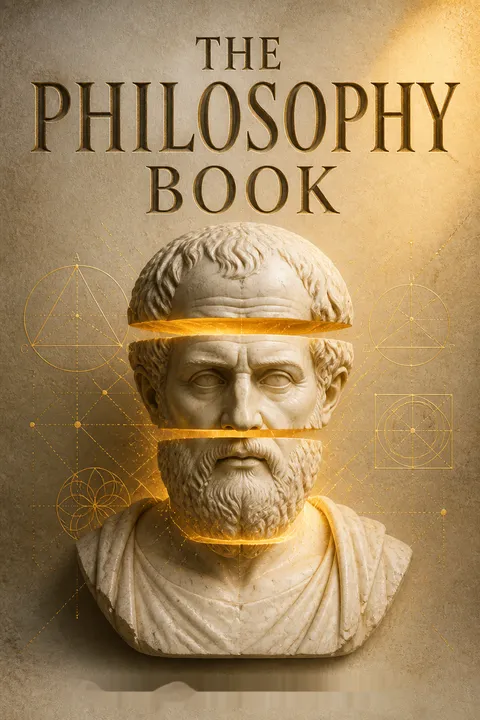
The Philosophy Book receives mostly positive reviews, praised for its accessible introduction to philosophy and comprehensive overview of major thinkers. Readers appreciate the clear explanations, illustrations, and global perspective. Some criticize its lack of depth on certain topics. The book is recommended for beginners, students, and those seeking a refresher. Reviewers note its usefulness as a reference guide and its ability to spark interest in further philosophical exploration. Overall, it's considered a valuable resource for understanding the basics of philosophy.
People Also Read

Glossary
Monism
One underlying realityA metaphysical position holding that reality ultimately consists of one fundamental substance or principle. Early Greek thinkers such as Thales sought a single basis for the many things in the world. Their proposed answers differed, but the shared move was to explain variety through an underlying unity.
Epistemology
The study of knowledgeThe branch of philosophy concerned with what can be known, how knowledge is acquired, and what distinguishes knowledge from belief or error. Its questions include whether reason can reveal truths independently of experience, how reliable the senses are, and where the limits of certainty lie.
Four Noble Truths
A map of sufferingThe Buddha’s account of suffering and its possible ending. It presents suffering as a feature of existence, identifies craving and attachment as central causes, maintains that suffering can cease, and points to a disciplined path as the means of reaching that end.
Eightfold Path
A discipline toward releaseThe practical Buddhist path associated with the ending of suffering. It brings together guidance on understanding, intention, speech, action, livelihood, effort, mindfulness, and concentration. In the book, it represents a way to reduce craving and live toward enlightenment rather than a speculative theory about the universe.
Social contract
Agreement behind political orderA philosophical model in which political authority is understood through an agreement among people who accept shared rules and institutions. Thinkers use it to explain why government is legitimate and what it owes its citizens. Hobbes, Locke, and Rousseau develop sharply different versions.
Existentialism
Freedom amid existenceA philosophical approach that begins with individual human existence and asks how people create meaning through choices and actions. In Sartre’s account, people are not made for a fixed purpose in advance. Existentialist thinkers also examine anxiety, responsibility, mortality, and the pressures imposed by social conditions.
Falsifiability
Capacity to fail a testKarl Popper’s proposed criterion for distinguishing scientific claims from claims that cannot be tested in this way. A theory is falsifiable if some possible observation could show it to be wrong. Surviving tests does not prove it permanently true, but failing a test can expose a problem.
Paradigm shift
Change in scientific frameworkThomas Kuhn’s term for a major transition in the shared framework through which scientists define problems, methods, and acceptable explanations. Normal scientific work usually proceeds within a paradigm. When anomalies contribute to a crisis, a competing framework may replace the established one.
Deconstruction
Reading for hidden tensionsJacques Derrida’s approach to reading that examines how a text’s meanings depend on contrasts, assumptions, and relationships among terms. It draws attention to contradictions that unsettle a text’s apparent stability. Deconstruction does not simply destroy a text or declare that interpretation is arbitrary.
Différance
Meaning through difference and deferralDerrida’s term for two linked features of meaning. A word takes meaning partly through its differences from other words, and its meaning remains open to revision as further language is added. The term combines the ideas of differing and deferring, emphasizing that meaning is not wholly present in one isolated word.
Public sphere
Space for public reasoningJürgen Habermas’s term for social spaces where private individuals can discuss public matters beyond direct state control. Literary salons and coffee houses are examples in his account of European history. Such spaces can support criticism of authority, though their openness can be weakened by concentrated control of communication.
FAQ
What's The Philosophy Book about?
- Comprehensive Overview: The Philosophy Book by Will Buckingham provides a thorough exploration of major philosophical ideas and thinkers throughout history, from ancient to modern times.
- Key Philosophers and Theories: It covers influential figures like Socrates, Plato, Aristotle, Descartes, Kant, Nietzsche, and Marx, detailing their contributions to ethics, metaphysics, epistemology, and more.
- Accessible Presentation: The book simplifies complex concepts, making them accessible to readers of all backgrounds, using diagrams, illustrations, and quotes to clarify philosophical ideas.
Why should I read The Philosophy Book?
- Beginner-Friendly: Designed for readers without a background in philosophy, it offers a clear introduction to complex ideas without overwhelming jargon.
- Engaging Format: The use of visual aids and witty quotes makes the material engaging and helps reinforce understanding and retention.
- Broad Coverage: It provides a comprehensive resource for exploring the history of philosophy and its relevance to contemporary issues.
What are the key takeaways of The Philosophy Book?
- Philosophy as Inquiry: Emphasizes that philosophy is about questioning and exploring fundamental truths, not just finding answers.
- Interconnected Ideas: Illustrates how philosophical ideas are interconnected, showing the influence of earlier thinkers on later ones.
- Practical Application: Encourages applying philosophical thinking to personal life, promoting critical thinking and self-reflection.
What are the best quotes from The Philosophy Book and what do they mean?
- "The unexamined life is not worth living.": Socrates highlights the importance of self-reflection and critical thinking for a meaningful life.
- "Knowledge is power.": Emphasizes the value of knowledge in empowering individuals to make informed decisions and progress.
- "Man is the measure of all things.": Protagoras suggests that human perception shapes our understanding of reality, indicating truth's subjectivity.
How does The Philosophy Book define knowledge?
- Justified True Belief: Discusses the classical definition of knowledge as “justified true belief,” foundational in epistemology.
- Skepticism and Certainty: Addresses skepticism, questioning whether true knowledge is possible, and presents philosophical responses.
- Empirical vs. Rational Knowledge: Contrasts knowledge gained through sensory experience with that derived from reasoning.
What is the significance of the Socratic method in The Philosophy Book?
- Dialogue and Inquiry: Presented as a foundational approach, emphasizing dialogue and questioning to uncover deeper truths.
- Moral Exploration: Used by Socrates to explore ethical concepts, prompting examination of beliefs about virtue and morality.
- Philosophical Legacy: Laid the groundwork for future discourse, influencing countless thinkers and shaping philosophical practice.
How does The Philosophy Book address the relationship between philosophy and science?
- Philosophy as Foundation: Discusses how philosophy provides foundational principles for scientific inquiry and theory development.
- Limits of Empirical Knowledge: Highlights limitations of empirical knowledge, arguing that science cannot answer all philosophical questions.
- Interdisciplinary Connections: Illustrates how philosophical questions often arise from scientific discoveries, enriching both fields.
What role does ethics play in The Philosophy Book?
- Moral Philosophy Exploration: Delves into ethical theories like utilitarianism, deontology, and virtue ethics, applying them to real-world dilemmas.
- Ethics and Society: Discusses the relationship between ethics and societal norms, encouraging reflection on justice and morality.
- Practical Application: Advocates for applying ethical reasoning to everyday life, considering moral implications of actions and decisions.
How does The Philosophy Book define existentialism?
- Individual Experience Focus: Emphasizes individual existence, freedom, and choice, exploring life's meaning from a personal perspective.
- Confronting Absurdity: Discusses existentialists' confrontation with life's absurdity and inherent meaninglessness, leading to personal meaning search.
- Influential Thinkers: Highlights key figures like Sartre and Kierkegaard, showcasing their contributions to understanding human existence.
How does The Philosophy Book explore the relationship between philosophy and politics?
- Political Philosophy: Examines questions of power, justice, and the state's role, discussing thinkers like Hobbes, Rousseau, and Marx.
- Ethics and Governance: Explores how moral principles inform governance and social structures, highlighting philosophy's societal importance.
- Contemporary Issues: Links historical theories to current political challenges, encouraging application of philosophical insights to modern events.
What is the impact of feminism in The Philosophy Book?
- Feminist Philosophy: Presents feminist philosophy as a critical lens for examining traditional ideas, highlighting figures like Simone de Beauvoir.
- Critique of Patriarchy: Explores challenges to patriarchal assumptions, advocating for inclusive understanding of gender and identity.
- Intersectionality: Emphasizes intersectionality, recognizing gender's intersection with race, class, and sexuality, enriching social justice discussions.
How does The Philosophy Book illustrate the concept of dualism?
- Mind-Body Distinction: Discusses dualism through Descartes' work, arguing for mind and body as distinct substances.
- Philosophical Implications: Explores implications for understanding the relationship between mental states and physical processes.
- Critiques of Dualism: Addresses critiques, including physicalist arguments that mental phenomena can be explained physically.
About the Author
Other books by Will Buckingham
Download PDF
Download EPUB
.epub digital book format is ideal for reading ebooks on phones, tablets, and e-readers.








