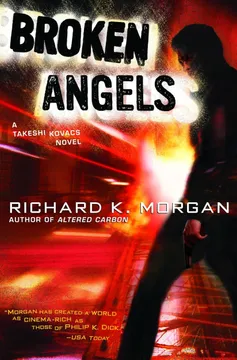


Plot Summary
A Wedge Officer Wakes
Takeshi Kovacs, a former Envoy serving as a lieutenant in Carrera’s Wedge, is hauled from the Northern Rim fighting with a shattered shoulder and chemically damaged lungs. In the orbital hospital, he meets Jan Schneider, a young Wedge soldier whose mismatched uniform and missing identification suggest he is hiding something.
Kovacs refuses to pretend that the local government’s forces have defeated Joshua Kemp’s rebellion, then loses consciousness as his injuries overwhelm him.
His mind is stored in a virtual shoreline while medics repair his sleeve. Isaac Carrera, the Wedge commander, orders Kovacs to review the war’s losses and return to combat quickly. The reprieve is temporary: Kovacs wakes to discover that even survival is being managed for military convenience.
Kovacs’s damaged body introduces the novel’s central contradiction: technological survival can preserve a person while making that person more available for further use. His mind is stored, his sleeve repaired, and his recovery shortened not for his sake but for the Wedge’s needs. His blunt refusal to call Kemp’s resistance a defeat also signals that his military competence does not require belief in the story his employers tell. The scene makes bodily injury and political injury parallel forms of damage, while the artificial refuge offers a brief glimpse of peace that the institution cannot allow him to keep.
Schneider’s Impossible Find
Once Kovacs is back in a repaired sleeve, Schneider approaches him with a proposal that could buy their way out of the war. On the Dangrek coast, Schneider’s archaeology team uncovered a Martian gate that opens onto a point in space near an intact starship.
The ship is too large to pass through the gate, and the team had no suitable spacecraft or route offworld, so Schneider joined the fighting rather than surrender the discovery to the Protectorate or corporate authorities.
Kovacs tests his account against records of the dig and finds enough details to believe him. The find is not simply buried treasure: the Charter lets the government seize discoveries judged strategically important, and anyone who reports the ship risks losing both the prize and their lives.
The discovery turns archaeology into a contest over who gets to define knowledge and own its consequences. Schneider’s story sounds like a familiar treasure hunt, but Kovacs recognizes the institutional danger beneath it: the Charter converts discovery into a potential state seizure, while corporations can make an inconvenient witness disappear. His decision to believe Schneider is not wonder overcoming skepticism. It is an operational judgment based on corroborating evidence. The gate therefore begins as both an object of scientific curiosity and a dangerous bottleneck, one that makes access, ownership, and survival inseparable.
Wardani Leaves the Camp
Kovacs and Schneider go to a government internment camp to take Tanya Wardani, the archaeologist who led the Dangrek dig. The commandant, a badly damaged man kept functioning by an electrical connection, resists the order until Kovacs presses him; he then reveals that Kempist fighters previously raided the camp to reach Wardani.
Schneider brings her out, and Kovacs tells the sergeant she will not be returned. During their escape, smart mines attack the shuttle over the sea. Kovacs and Schneider destroy the mines with missiles, decoys, and improvised tactics, then stage evidence of a crash so the Wedge will list them as dead.
On a beach, Kovacs uses Envoy techniques to break through Wardani’s trauma, giving her enough stability to explain the gate and help plan their next move.
The extraction is both rescue and recruitment. Kovacs recognizes Wardani’s emotional shutdown as a survival response, yet uses an intimate Envoy technique to restore her because the expedition depends on her expertise. His intervention is effective but ethically compromised: her recovery is partly instrumental, and she later feels the imbalance it creates. The camp commandant’s wired dependence and the children living under armed surveillance make the political system’s violence visible without turning it into an abstraction. Meanwhile, Kovacs’s false-death plan marks a point of no return. The trio has escaped their formal roles, but only by entering a more dangerous commercial game.
The Gate Becomes a Bargain
As Wardani recovers, she explains that she chose the Dangrek coast because Martian settlement patterns challenge the Guild’s accepted theories. The gate could reveal a larger Martian history, but the Northern Rim is also a military objective, and the fighting makes a quiet excavation impossible.
Kovacs proposes selling the find to a hungry second-rank corporation that might protect it from the Cartel’s larger members. The group reaches Dig 27, where local fixer Djoko Roespinoedji, housed in a child’s sleeve and guarded by a remotely controlled corpse, agrees to buy their stolen shuttle.
Djoko identifies Matthias Hand’s Mandrake Corporation as a promising target. He also warns that Landfall’s powerful companies can take whatever they want unless Kovacs makes them afraid of the cost.
Wardani’s theory gives the expedition intellectual stakes, but Kovacs sees that knowledge cannot travel safely without confronting the military map laid over it. His plan does not escape the market; it attempts to use competition within the market as protection. Djoko’s mixture of childlike appearance, business acumen, and weaponized corpse makes that world’s moral distortions concrete. He is not a benevolent alternative to the Cartel, only a more useful broker. The section also establishes the novel’s recurring tension between understanding a discovery and converting it into leverage. Each character approaches the gate through a different need: scholarship, escape, or profit.
Hand Takes the Bait
In Landfall, Kovacs and his companions feed a supposed Martian artefact record into a data channel aimed at corporate buyers. Mandrake responds almost immediately by sending a squad to seize them and the evidence.
Kovacs kills the attackers, removes one operative’s cortical stack, and uses a battlefield virtuality to identify Matthias Hand as the executive behind the response. At an auction, he meets Hand openly, returns the stack, and demands an advance payment, passage offworld, and new sleeves after the expedition.
Kovacs also threatens to release the ship’s coordinates to rival firms unless Mandrake acts. Hand accepts the bargain, recognizing that the promised find could transform his company’s standing, but his willingness to use lethal force has already shown Kovacs what kind of partner he is.
Kovacs’s bluff works because he understands that corporate violence is not the opposite of calculation; it is one of its instruments. He gives Mandrake proof enough to fear competition, then uses the attack itself as evidence that the company values the discovery. Hand’s acceptance is a meeting of professionals rather than a bond of trust. Their agreement depends on irreversible payment and mutual deterrence, a fragile substitute for shared ethics. Kovacs appears emotionally detached, but the violence he deploys is also personal: the war has trained him to treat every negotiation as a field operation in which another failed assumption may cost a life.
The Dead Become Recruits
Hand takes Kovacs to the Soul Market, where brokers sell cortical stacks recovered from the dead. They purchase soldiers with useful combat skills, then use Mandrake’s virtual systems to assess which minds can endure a new sleeve and a dangerous mission.
Kovacs backs Markus Sutjiadi, a disciplined operative with a serious record, as team commander rather than taking command himself. The recruits include pilot Ameli Vongsavath, systems specialist Sun Liping, demolitions expert Ole Hansen, and covert operators Luc Deprez and Yvette Cruickshank.
Their new Maori combat sleeves can resist radiation longer than Kovacs’s Wedge body. Hand offers them paid work after the mission, but the operation requires entering territory likely to be struck by a nuclear weapon. The commercial plan is already asking its soldiers to pay in flesh.
The Soul Market turns resurrection into labor procurement. The recruits are not restored as whole people in any socially meaningful sense; their stored minds are screened, priced, and assigned according to usefulness. Kovacs’s decision to give Sutjiadi command reflects both respect for the man’s experience and his own reluctance to lead another platoon into destruction. The new sleeves promise adaptation, but they also obscure the human cost by making bodies seem replaceable. The team’s consent is real, yet constrained by war, debt, and the offer of future employment. The scene asks whether a choice made among lethal alternatives can still be called freedom.
A Night Before Dangrek
Wardani asks Kovacs to meet her in virtuality, hoping to undo the emotional dependence his recovery technique has stirred in her. Their intimacy briefly gives her a sense of control over her own response, but the encounter ends without resolving the damage between them.
Before dawn, Kempist operatives break into Mandrake Tower, seize Wardani, and threaten Kovacs. He kills the leader and several attackers before Mandrake’s security drones eliminate the rest. The assailants carry equipment designed to destroy their stacks, which points to a political rather than ordinary corporate motive.
Hand discovers that Deng, the Mandrake operative Kovacs interrogated, has vanished. Then Hand reports that Kemp’s forces have destroyed Sauberville with a nuclear strike, killing its entire population and leaving the expedition’s destination irradiated.
The attack transforms private vulnerability into evidence of a larger political reach. Wardani’s request is an attempt to reclaim agency after being psychologically repaired for someone else’s plan, but the intrusion shows that her body and expertise remain objects of competing claims. Kovacs’s rapid violence saves her while reinforcing the very identity she resents in him. The destruction of Sauberville then strips away any illusion that their venture can remain a clean commercial transaction. The expedition is about to enter a landscape where civilian death has been made strategically useful, and where corporate decisions and revolutionary violence converge on the same bodies.
Sauberville’s Ashes
Hand brings the team to the Dangrek coast in a Mandrake assault craft, despite a warning from Carrera that the area is dangerous and that the Cartel cannot provide support. Sauberville is gone, replaced by a crater, smoke, dead seabirds, and radioactive fallout.
A battered trawler lies offshore, its deck empty and its nets tangled with two stripped corpses whose cortical stacks have been removed. The group clears a perimeter and follows Wardani to the rockfall concealing the Martian gate.
She explains how her team opened it before and offers a theory that a power surge forced the structure to shut itself beneath the cliff. Hand insists that Mandrake must place an ownership buoy beyond the gate before rivals arrive. The mission has begun under conditions that make both discovery and survival uncertain.
The ruined coast refuses the clean separation between archaeological work and military action. Sauberville’s destruction is not background scenery: it is the immediate cost of the strategy that has made the expedition possible. The stripped bodies foreshadow a human presence at the gate, while their missing stacks make death itself an unresolved piece of evidence. Wardani’s explanation offers a plausible technical model, but the others cannot verify it. Hand treats uncertainty as a problem of ownership; Sutjiadi treats it as a security risk; Kovacs treats it as an operational fact. Their competing frames are already shaping what they will notice and what they will miss.
The Nanobes Learn
Hand admits that experimental nanobes are loose beyond the team’s sentries. The systems, called OPERNS, evolve in response to threats, and he cannot provide the codes that would shut them down.
When the crew’s attempt to destroy them fails, the nanobes attack the claim buoy and tear it apart, killing Cruickshank and Hansen. The survivors realize that the creatures can adapt beyond ordinary weapons and may spread through the beach. Wardani finally opens the gate, whose field neutralizes the nanobes as they reach it.
The group sends the Nagini through and emerges hundreds of millions of kilometres from Sanction IV, beside a vast Martian vessel. The first crossing is a victory, but the ruined buoy means they have no reliable way to claim the ship or leave the system.
The nanobes embody a form of violence that learns from resistance, making each defensive act potentially productive for the attacker. Hand’s partial disclosure exposes a corporate culture that treats uncontrolled experimentation as acceptable collateral risk. The deaths of Hansen and Cruickshank are not heroic sacrifices in any tidy sense; they are the direct consequence of an inadequately understood weapon system. The gate’s ability to extinguish the nanobes establishes that Martian technology can overrule the human systems trying to contain it. Yet passage does not equal safety. The team has crossed into a space its political and technical frameworks cannot adequately describe.
A Ship Without a Crew
The Nagini approaches a vessel so immense that its hull dominates the surrounding stars. Near a docking entrance, the team finds four human explorers in vacuum suits, including Wardani’s former colleague Pharintorn Aribowo and the glyph theorist Weng Xiaodong.
Another crew member, Tomas Dhasanapongsakul, lies dead farther inside, still wearing a summer shirt despite the breathable atmosphere. Wardani recognizes the explorers as members of the earlier Dangrek expedition, the same people whose bodies were hidden in the trawler nets.
Their presence proves that the gate was used again after her original dig, but no one can explain why the team stayed outside the ship until its air supplies failed. Kovacs and the others recover the corpses and continue inward, unsettled by a mystery that Wardani cannot solve.
The dead explorers convert a technical puzzle into a moral one. Their deaths are not simply an archaeological loss: Wardani knew them, and their choices implicate her in a past she has tried to leave behind. The mismatch between an apparently breathable ship and bodies sealed in suits challenges the group’s assumptions about rational survival. Kovacs’s practical questions do not remove the emotional force of the evidence; they expose how little the survivors know. The discovery also weakens the comforting idea that expertise guarantees mastery. Wardani is the most qualified person present, yet the ship has already produced consequences she cannot interpret.
The Songspires Answer
Inside the ship, the party moves through enormous bubble-shaped chambers filled with dormant machines and unfamiliar structures. Wardani identifies songspires, plantlike Martian formations that sing when air or movement touches them.
Their sound changes as the team’s gravity equipment passes nearby, and the group finds a central platform where two mummified Martians hang in a web of instruments. These bodies appear to have died at their stations. Sun repairs the claim buoy, while the others search for a place where it can transmit through the ship’s shielding.
Then the vessel’s battle systems wake as an ancient opponent approaches. The ship trades attacks with the incoming vessel, and the songspires begin echoing its cries. The sounds overwhelm the humans with a shared grief that Kovacs cannot fully resist.
The ship’s architecture does not merely surround the characters; it alters the conditions under which they can perceive and feel. The songspires blur the boundary between organism, instrument, and archive, making an ancient emotional event audible in the present. Their response suggests that the vessel preserves more than machinery, though the characters lack a reliable vocabulary for what they encounter. The dead Martians at their stations also complicate the assumption that advanced technology has made its makers invulnerable. The battle’s return transforms the ship from an abandoned prize into an active participant, while the humans’ involuntary grief exposes the limits of Kovacs’s carefully engineered emotional control.
Wedge Hands Close In
The Martian ship’s psychic assault leaves the expedition incapacitated. Sun dies by suicide rather than endure the overwhelming experience, while the others are found and removed by Carrera’s Wedge. Kovacs wakes on the beach and conceals the ship’s true activity, presenting the expedition as a failed mission with no valuable discovery.
He also helps Markus Sutjiadi pass as Jiang Jianping, because the Wedge wants Sutjiadi for killing an abusive officer. Carrera arrives, learns that Mandrake has kept secrets from him, and kills Hand, taking his cortical stack.
He then orders Sutjiadi’s execution by the Wedge’s anatomiser. Kovacs and the remaining survivors are fitted with inhibitor devices and held in the camp. The people who entered the ship together are now prisoners, while the most powerful man on the beach controls their bodies and their future.
The return to Sanction IV does not restore the familiar world; it brings the expedition back into a more legible version of violence. The Wedge’s codes and rituals make punishment appear orderly, but the anatomiser exposes the brutality beneath that order. Kovacs’s concealment of Sutjiadi is a choice against institutional loyalty, though he knows the Wedge can interpret it as treason. Hand’s death also shows how quickly corporate power becomes disposable when a stronger client arrives. The section strips away any neutral ground: survivors must decide whether to submit to a system that preserves its authority by making public examples of its enemies.
Kovacs Breaks the Leash
As Sutjiadi screams through his execution, Kovacs tears out the medical filaments in his arm and uses his exposed implant to disable the inhibitor at his neck. He kills Tony Loemanako when the loyal Wedge noncom approaches, then removes Loemanako’s powered mobility suit and frees Wardani, Deprez, and Vongsavath.
While Sutjiadi remains on the anatomiser, Kovacs and Deprez steal polalloy combat protection and weapons. Kovacs attacks the guards, commandeers a grav bug, and fires smart-shrapnel rounds into the execution ground, killing the gathered Wedge personnel and destroying the spectacle.
Deprez is fatally wounded by Carrera, who escapes toward the gate. Kovacs’s mutiny stops Sutjiadi’s execution, but leaves the survivors surrounded by bodies and without a safe route home.
Kovacs’s rebellion is not a clean conversion from violence to justice. He uses the Wedge’s own equipment and methods to stop a state-sanctioned killing, inflicting mass casualties in the process. His choice exposes the moral inadequacy of institutions that call violence lawful only when they control it, but it does not make his counterviolence innocent. The act is driven by loyalty to the people beside him and by accumulated horror he can no longer keep compartmentalized. Deprez’s injury makes the cost immediate, while Sutjiadi’s rescue remains incomplete until the larger threat is settled. Kovacs has broken the leash, but he has not escaped the logic it taught him.
The Last Fight Outside
Kovacs learns that Carrera has crossed into the Martian ship and prepares to return before the Wedge commander can come back with reinforcements. He sends a nuclear shell through the gate as a diversion, then enters in a powered suit and impeller rig.
In hard space, Carrera’s expertise gives him the advantage: he hides his movements, uses grenades, and damages Kovacs’s suit. Kovacs survives by reading his opponent’s position and forcing the fight toward the docking bay. There he uses the ship’s alien architecture and the remains of its dead crew to gain a final opening.
Carrera’s face and lungs are exposed to corrosive material from a mummified Martian, and Kovacs kills him before the Wedge commander can recover. He has avenged his people, but his body is failing and the gate still needs to be closed.
The duel pits two forms of military mastery against each other. Carrera has decades of vacuum combat experience and institutional command; Kovacs has adaptive intuition and a willingness to improvise beyond the rules of the engagement. The decisive advantage comes neither from superior equipment nor a cleaner tactic, but from the alien material world Carrera dismisses as dead. That victory is costly and contingent, not a triumph of moral purity. Kovacs kills the man who has turned loyalty into coercion, yet the means remain recognizably violent. The fight also makes the Martian ship’s past physically consequential, as its remains become part of a present human conflict.
Wardani Names the Past
After Carrera’s death, Kovacs returns through the gate and Wardani closes it, preventing the Wedge from pursuing them immediately. The survivors hijack the battlewagon Angin Chandra’s Virtue and reach Dig 27, where Djoko offers Kovacs a virtuality and technical help in exchange for the ship’s claim.
Wardani stays behind rather than travel with Kovacs. Before they part, she admits that she summoned the earlier Kempist expedition to the gate and then killed its members when they planned to use the ship as a weapon against Landfall and Latimer.
She also sabotaged the present mission’s equipment to prevent the claim buoy from giving Mandrake control. Kovacs recognizes that her actions came from fear of another massacre, not simple political allegiance, but he cannot erase what her choices cost.
Wardani’s confession reorders the story’s earlier mysteries without reducing them to a single motive. She has repeatedly acted to prevent the ship from becoming a weapon, but her attempts at prevention involved killing people and deceiving allies. Her fear is intelligible, especially after witnessing the previous team’s ambitions, yet the novel does not equate moral seriousness with moral innocence. Kovacs’s response is more compassionate than exculpatory: he distinguishes survival from absolution and lets her name the truth. Her decision to remain on Sanction IV also marks a divergence between them. Their bond has mattered, but it cannot turn shared trauma into a shared future.
Two Ways to Leave
Kovacs and the remaining survivors arrange for Djoko to acquire the claim to the Martian ship, while Vongsavath takes control of the damaged battlewagon. Wardani refuses to leave with Kovacs, choosing to stay near the discovery so she can help when the ship is eventually explored again. Kovacs accepts her decision and assigns her his share of the money rather than turning her choice into a debt between them.
The departure is not a victory over Sanction IV’s war; the conflict continues, and the survivors carry physical and psychological damage away with them. But Kovacs has secured a route offworld and a chance to decide what comes next, while Wardani has reclaimed the work and place that first drew her to Dangrek.
The separation resolves the emotional conflict without forcing reconciliation into a conventional romantic ending. Kovacs and Wardani recognize that care does not grant ownership of another person’s next choice. Her decision to stay is not presented as pure courage or self-punishment; it is also a return to scientific purpose after that purpose was repeatedly captured by political and commercial interests. Kovacs’s willingness to leave her share behind turns money into a practical expression of respect. Both remain implicated in violence, but their final decisions are not dictated by the same institution or by the same fear.
Epilogue
Aboard the Angin Chandra’s Virtue, Kovacs and the survivors live through the long journey to Latimer in a shared virtual world that makes the years pass quickly. Their refuge is comfortable, but it cannot restore everyone they lost. Sutjiadi’s stack holds a mind too damaged to return safely, and the dead remain part of their daily memory.
Kovacs thinks about the Martian ship, the ancient battle still unfolding around it, and what humanity has failed to learn from the ruins it occupies. He plans to report to the Quellists, visit Cruickshank’s family, and keep moving. The virtual afterlife is pleasant, he concludes, but it is no substitute for choosing what to do while alive.
The epilogue refuses to make technological survival equivalent to healing. The survivors can inhabit a designed paradise, but the virtual world preserves grief rather than dissolving it; Sutjiadi’s damaged stack is a particularly stark reminder that storage is not restoration. Kovacs’s plans remain practical and unfinished, directed toward obligations rather than grand redemption. His imagined report to the Quellists also keeps the political story open: he has not escaped history merely by leaving Sanction IV. The closing unease about the Martian ships and their ancient war expands the novel’s scale while returning to its central question: whether access to inherited power can outpace a culture’s ability to understand the violence it carries.
Analysis
Broken Angels joins a mercenary war story to an archaeological mystery, then uses their collision to question who gets to control the past. The Martian ship is not simply a prize whose value can be measured in corporate ownership. Its technologies and preserved dead expose how little human beings understand about the civilizations they have colonized, while the competing claims of the Cartel, Kemp’s movement, Mandrake, and Wardani show how quickly ignorance becomes a license for possession.
Kovacs’s arc turns on the limits of engineered detachment. Envoy conditioning makes him observant and effective, but it cannot erase the accumulating cost of combat. His reflex to convert danger into a solvable tactical problem repeatedly protects him, until the Martian ship forces emotion back into his body with a scale he cannot manage. His later choice to rebel against the Wedge is not a clean moral awakening. He still kills extensively, but no longer accepts an institution’s claim that violence becomes just because it is authorized.
Wardani’s story complicates the distinction between principled resistance and culpable action. She tries to prevent the starship from becoming a weapon, yet her secrecy and violence endanger people she means to protect. Her confession matters because Kovacs lets her account for her decisions without treating explanation as absolution. Their separation respects the fact that intimacy cannot repair history by itself.
The novel also makes resurrection a practical and ethical problem. Stacks preserve minds, but trauma can make a person impossible to restore; sleeves can be replaced, but a life cannot be reduced to usable combat capacity. The Soul Market, the Wedge’s execution rituals, and the virtual refuge of the epilogue all test the same promise of technological continuity. Survival is possible. Meaning, responsibility, and peace remain harder to manufacture.
Review Summary
Broken Angels is widely seen as a significant departure from its predecessor, shifting from noir mystery to military sci-fi with alien archaeology elements. Most readers appreciate Morgan's world-building and Kovacs as a protagonist, though many feel the book doesn't quite match the first novel's appeal. Common criticisms include forced sex scenes, a slower pace, and complex plotting that can be hard to follow. Positive reviews highlight the book's tonal versatility, gripping action, and thought-provoking themes around war, capitalism, and religion.
People Also Read




Characters
Takeshi Kovacs
Envoy turned mercenaryKovacs is a former Protectorate Envoy, now a combat lieutenant in Carrera’s Wedge, whose training lets him read danger and people with unnerving speed. He is skeptical of institutions but not free of their habits: he can treat violence as routine, then discover that grief has been waiting beneath his control. His childhood on Harlan’s World and his experience at Innenin left him suspicious of authority and wary of collective causes. He values competence, improvisation, and personal loyalty more than ideological purity. His relationship with Wardani challenges his practiced detachment, while his ties to the Wedge pull him toward a military identity he claims to have outgrown.
Tanya Wardani
Archaeologist with a theoryWardani is a Guild Master whose expertise in Martian artefacts is matched by a fierce independence from the institutions that certify and fund archaeological work. She chose an obscure coastal dig because its evidence might challenge the official account of Martian civilization. Internment has left her emotionally guarded, but her analytical mind and sense of responsibility remain active beneath that barrier. She distrusts soldiers and corporate sponsors because she understands how quickly discovery becomes a weapon or a commodity. Her relationship with Kovacs is complicated by his use of Envoy techniques to restore her, leaving care entangled with coercion and mutual need.
Matthias Hand
Mandrake dealmakerHand is an acquisitions executive at the ambitious Mandrake Corporation, skilled at negotiation and accustomed to treating risk as a business variable. He seeks a discovery large enough to elevate Mandrake into the Protectorate’s governing commercial circle. Beneath his polished manner, he is a believer in a spiritual tradition that gives him a vocabulary for forces Kovacs prefers to dismiss. Hand’s religious convictions do not cancel his corporate instincts; he can make a sincere appeal to wonder and then calculate what ownership will yield. His partnership with Kovacs rests on leverage and mutual advantage rather than trust.
Isaac Carrera
Wedge commanderCarrera founded and commands the Wedge, a mercenary force whose reputation rests on tactical discipline and brutal efficiency. He understands soldiers as valuable instruments, but also knows that their loyalty depends on visible rules and consequences. His relationship with Kovacs is shaped by professional respect and a shared history of combat. Carrera can be pragmatic, politically alert, and personally decisive, yet his idea of order leaves little room for individual conscience once the Wedge’s authority is challenged. He represents the military system Kovacs knows intimately and cannot simply dismiss.
Jan Schneider
Pilot with a secretSchneider is a skilled pilot and the first person to bring Kovacs the story of the Martian ship. His charm and improvisational ability make him useful in a crisis, while his history with Wardani gives their expedition an unsettled emotional edge. He wants a way out of Sanction IV’s war and is drawn to the promise of wealth and safety. Beneath his jaunty manner lies the memory of civilian deaths he cannot comfortably carry. His fear of repeating that experience shapes his choices more deeply than he first admits.
Djoko Roespinoedji
Dig 27 fixerRoespinoedji is a local businessman whose youthful sleeve contrasts with his seasoned commercial instincts. He navigates the competing interests of government, the Cartel, and the rebellion by trading access and information. His remote-controlled corpse guard and theatrical presentation reveal a man who turns vulnerability into leverage. He grew up around the archaeological economy of Dig 27 and understands that discovery has value only when someone can control its movement. Kovacs treats him as a useful broker, never as a friend whose interests can be assumed.
Ameli Vongsavath
Pilot and systems aceVongsavath is an accomplished pilot whose skill survives a severe injury and a transfer into a new combat sleeve. She is precise around machines, skeptical of unnecessary risk, and frank enough to challenge both Hand and Kovacs. Her military career is a conscious choice supported by a family that sees service as practical training and stable employment. She approaches danger through systems knowledge rather than bravado, though she understands that even excellent equipment cannot guarantee safety. Her competence becomes essential whenever the expedition must move through unfamiliar technology.
Sun Liping
Systems specialistSun is a military systems expert whose attention naturally extends below the visible surface, toward the processes and conflicts that sustain it. She is calm without being incurious, and she can discuss violence as a chosen profession without pretending it is harmless. Her parents brought her to Sanction IV as a child, making the planet her home despite its political instability. Sun’s technical skill helps the expedition interpret both human equipment and the Martian vessel, while her composed manner gives the group a steadier perspective.
Luc Deprez
Covert operations killerDeprez is a covert operative from a military family, trained to kill efficiently and recover the dead for interrogation. He carries no illusion that skill makes violence clean. His account of his first killing shows how a professional identity can grow around an act that initially horrified him. He is curious about Kovacs’s past and willing to discuss death, duty, and the choices soldiers make. Beneath his dry manner, he is troubled by the young people and civilians consumed by Sanction IV’s war.
Markus Sutjiadi
Soldier with a codeSutjiadi is an experienced operative who values discipline and loyalty to the people under his command. His calm exterior can resemble detachment, but he believes a soldier’s duty has limits when orders or superiors violate basic obligations. He distrusts the political explanations offered for the Sanction IV conflict and is unsettled by the Martian gate because it represents knowledge humanity may not be prepared to handle. Kovacs respects his experience and his refusal to treat obedience as a substitute for judgment.
Yvette Cruickshank
Young tactical commandoCruickshank is a highly accomplished young soldier from the Limon Highlands, proud of her training and unwilling to be treated as fragile. Her humor is abrasive and physical, and she uses it to meet danger on her own terms. She is curious about the Martian ship and about the people around her, especially Kovacs, whose age and experience make him both an object of attraction and irritation. Her confidence does not mean she is untouched by death; it means she refuses to let other people define what her youth should feel like.
Ole Hansen
Demolitions specialistHansen is an experienced demolitions expert whose competence is tempered by the knowledge that a single error can erase an entire team. He carries grief for soldiers he served with and approaches new work with blunt humor rather than ceremony. His practical skills make him valuable in both the expedition and its defense. He is wary of systems he cannot control, a sensible instinct in a mission built around unfamiliar machinery and a war that keeps changing its weapons.
Tony Loemanako
Wedge platoon noncomLoemanako is a veteran noncommissioned officer who maintains warmth and loyalty even after severe injuries. His face and body have been rebuilt by military biotechnology, but he remains recognizably himself through his humor and concern for his platoon. He embodies the Wedge’s promise of fellowship and medical support, while also showing how those promises return wounded soldiers to the battlefield. His relationship with Kovacs is shaped by trust earned through combat.
Deng Zhao Jun
Mandrake security managerDeng is a Mandrake tactical operations manager whose corporate training has prepared him for coercion and interrogation. He is disciplined enough to resist direct threats, but his value to his employer is limited by the company’s ability to replace him. His encounter with Kovacs reveals how quickly an organization can turn a loyal operative into a disposable asset.
Semetaire
Soul Market brokerSemetaire is a sharply theatrical broker in the Soul Market, where cortical stacks are bought and sold. He presents himself as a figure of death and spiritual authority, using ritual and spectacle to distinguish his business from ordinary salvage. His operation shows how even the dead can be sorted, cleaned, priced, and assigned a future according to military demand.
Joshua Kemp
Rebel leaderKemp leads the Sanction IV rebellion against the Cartel-backed government. His political movement draws on Quellist language, though his use of it is selective and often self-serving. To the people fighting under him, he represents the possibility of changing who governs the planet. To Kovacs and Wardani, he is also a reminder that revolutionary purpose can justify violence as readily as corporate security can.
Pharintorn Aribowo
Wardani’s fellow archaeologistAribowo is a skilled glyph specialist from Wardani’s earlier Dangrek team. Her archaeological ability and field experience make her part of the small circle capable of working with the gate. She represents the intellectual and personal history Wardani carries into the expedition, as well as the danger of asking less experienced researchers to handle technology whose purpose remains uncertain.
Weng Xiaodong
Martian glyph theoristWeng is a glyph theorist associated with Wardani’s earlier research team. His work reflects the Guild’s difficult effort to interpret Martian systems without assuming that they followed human logic. He is one of the people whose presence turns the gate from an abstract discovery into a shared project with real personal stakes.
Plot Devices
Cortical stacks
Memory survives the bodyA cortical stack stores a person’s mind and can be transferred into another sleeve, making bodily death potentially reversible. The technology enables soldiers to return to combat and lets the Soul Market sell stored people as military assets. It also creates a sharp distinction between survival and recovery: a stack can remain intact while the mind inside is too damaged to function. The novel uses resleeving to make death economically and politically negotiable, but never consequence-free. Bodies can be replaced; memory, trauma, and identity cannot be managed so neatly.
Envoy conditioning
Intuition made operationalEnvoy training sharpens perception, adapts the mind to unfamiliar conditions, and controls emotional responses under stress. Kovacs uses it to assess people, fight through danger, and revive Wardani from the shutdown imposed by internment. Yet the same conditioning can turn detachment into a weapon against the self, delaying grief until it breaks through with overwhelming force. The device supports the action while complicating the story’s account of agency: Kovacs’s choices are his, but his instincts and emotional thresholds have been deliberately engineered.
The Martian gate
A threshold to alien historyThe gate links a hidden coastal structure on Sanction IV to a distant point beside an intact Martian starship. Wardani can interpret its glyphs and operate its controls, but even her expertise does not make the system fully understandable. The gate gives the expedition access to a discovery that governments and corporations would fight to own. It also separates the team from ordinary support, exposes them to an ancient battle system, and becomes the only route by which Kovacs can confront Carrera. Its operation changes the scale of the story from planetary conflict to an unresolved history among star-faring civilizations.
OPERNS nanobes
Resistance teaches the weaponMandrake’s experimental nanobes reproduce and evolve in response to threats. Hand describes their initial state as inactive, but once stimulated they adapt to the weapons used against them, turning the team’s defenses into lessons for the next attack. The system is a corporate project whose operators cannot fully predict or control it. It makes conventional military strategy unstable: force may buy time, but it can also create a more capable enemy. The nanobes also damage the expedition’s equipment and force the survivors through the gate before they are ready.
The Soul Market
War sells the dead backThe Soul Market trades cortical stacks recovered from battlefields, sorting them by condition and selling viable minds to employers who need trained personnel. Hand purchases a team for the expedition, then uses virtual assessment to select soldiers suited to the mission. The market makes the novel’s resurrection technology part of the economic machinery of war. A soldier’s stored mind becomes an inventory item, while a new sleeve becomes a capital expense. Its existence lets the expedition recruit experienced specialists quickly, but it also exposes the thin line between offering a second chance and exploiting people who have already died once.
Download PDF
Download EPUB
.epub digital book format is ideal for reading ebooks on phones, tablets, and e-readers.








