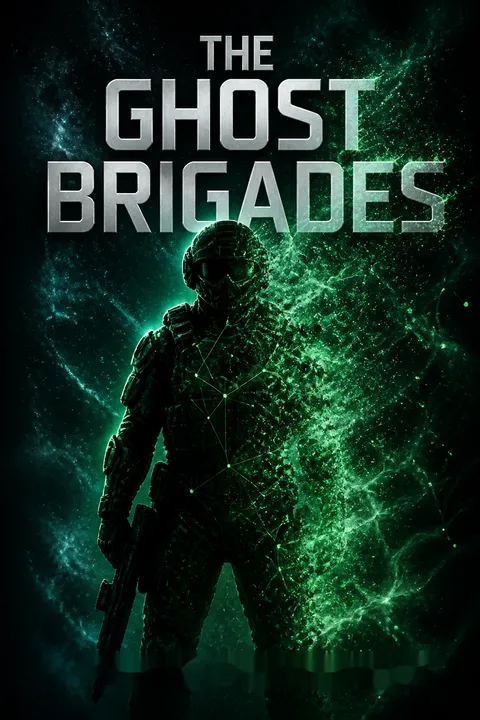


Plot Summary
The Rock Finds Cainen
A human assault begins with a meteor strike that cracks open an underground Eneshan base where Rraey scientist Cainen has been held. When his captor, Aten Randt, turns his weapon on him, Cainen shoots Randt and is taken by the human soldiers. Lieutenant Jane Sagan interrogates him, eventually using a fatal, controllable disease to make him talk.
Cainen reveals that the Rraey, Eneshans, and Obin are preparing a coordinated war against humanity, with a human scientist named Charles Boutin helping them. The attack has found more than a secret laboratory: it has uncovered a plan whose human architect may know how to turn the Colonial Union's own technology against it.
The opening makes discovery physical and morally compromised. Humans locate the base through an almost primitive tactic, dropping rocks to read the tremors, then extract information by inflicting a disease they can partly control. Cainen's survival depends on the same coercion that makes him useful, placing him in a relationship that will resist easy labels of ally and enemy. The conspiracy also unsettles the Colonial Union's confidence: its most dangerous threat is not simply an alien alliance, but a human mind capable of supplying the alliance with intimate knowledge of human systems.
A Mind Without a Body
After the raid, forensic examiners discover that the body buried as Charles Boutin is a clone, not the scientist himself. Lieutenant Harry Wilson finds a hidden recording of Boutin's consciousness, created with technology reverse-engineered from the Consu.
Colonel James Robbins and General Greg Mattson realize the recording might explain Boutin's defection, but it cannot function without a suitably prepared brain. Special Forces General Szilard agrees to grow a soldier using Boutin's genes and attempt the transfer, despite the legal and ethical risks.
When the new soldier wakes, he screams rather than recognizing Mattson or speaking with Boutin's memories. The experiment appears to have failed, leaving the CDF with an adult body, an empty identity, and no explanation for the traitor's plans.
The clone investigation turns the question of bodily identity into a practical military problem. A corpse can carry the right DNA without being the person whose life it seems to certify, while a consciousness recording promises continuity without guaranteeing a self. Mattson's decision is shaped by urgency, but also by a system accustomed to treating bodies as equipment. The failed awakening exposes the limit of that confidence: a consciousness cannot simply be installed like a file. The CDF has created a person before it knows whether the person will inherit anything at all.
Jared Joins the Eighth
The soldier receives the name Jared Dirac from Judy Curie, who explains that his BrainPal is supplying knowledge faster than his new brain can absorb it. At Camp Carson, instructor Gabriel Brahe integrates Jared with the other members of the Eighth Training Squad; the sudden influx of their lives overwhelms him and drops him to the floor.
Sarah Pauling helps him recover, while Steven Seaborg mocks his inexperience. During two weeks of accelerated training, Jared learns weapons, discipline, and the squad's shared combat awareness.
Brahe also assigns him Mary Shelley's Frankenstein, whose rejected creation gives Jared a way to consider the mistrust surrounding Special Forces. The squad's jokes, arguments, and small rituals gradually teach him a human closeness that training alone cannot provide.
Jared's first education is social, even though it arrives through military technology. Integration offers intimacy without gradual consent: the squad knows him in a rush, while he has barely acquired a private past. Brahe's lessons reveal how Special Forces soldiers internalize their assigned purpose, yet Jared's reading gives him a vocabulary for the gap between being made and being welcomed. Frankenstein matters less as a prediction than as a question. Can a designed person become more than the use his makers intended? Jared's bonds with Pauling and the squad begin to answer through ordinary acts of attention.
Gettysburg's Butcher Shop
Assigned to Lieutenant Sagan's platoon aboard the Kite, Jared joins a raid on Gettysburg after the ship destroys a lone Rraey cruiser in orbit. The soldiers enter the colony expecting to clear enemy troops while sparing its buildings, but Rraey fire and a pursuit into a garage leave Jared disarmed and badly hurt.
He survives by spitting his SmartBlood into his attacker's face and triggering its combustion. The platoon then finds the human settlers butchered and stored as meat, including children.
Jared breaks down beside the smallest bodies, while veteran Daniel Harvey explains that many soldiers first encounter human families only after they are dead. After the fighting, the platoon accepts Jared and Pauling as members, binding their welcome to the same combat that has wounded them.
Gettysburg destroys the distance between military abstraction and bodily consequence. The settlers' illegal status does not make their slaughter less real, and Jared's question about protecting them exposes the thinness of the CDF's moral categories. His improvised use of SmartBlood shows how a purpose-built weapon can become an instrument of individual survival, but the victory cannot compensate for what the platoon finds. Harvey's account makes the atrocity part of a repeated institutional pattern: soldiers are trained to defend humanity while being denied ordinary contact with it. Jared's belonging arrives through grief, not triumph.
The Heir's Last Cry
Months later, Sagan leads a covert assault on the Eneshan palace during the heir Vyut Ser's consecration. The platoon kills the hierarch's consort and takes the infant, while Sarah Pauling dies covering the team's climb out. In orbit, Jared injects Vyut with a treatment that permanently sterilizes her.
Sagan uses the child to force Hierarch Fhileb Ser to abandon the secret war, replace her consort with the human-approved Hu Geln, and turn against the Rraey. The demands threaten the Ser dynasty and leave the hierarch grieving on a public channel. When Sagan orders Jared to kill Vyut to seal the bargain, he cannot do it. Sagan takes his knife and kills the child herself, making the mission's success inseparable from its cruelty.
The operation forces the Special Forces to enact the moral violence that other authorities have designed and delegated. Sagan's bargaining strategy exploits Eneshan political structure, but its leverage is a child whose body becomes a diplomatic instrument. Jared's refusal to kill Vyut is not a tactical error so much as a limit he discovers in himself. Sagan crosses that limit for the mission, and the contrast does not make her simply monstrous or him simply innocent. Both are trapped in a command system that calls coercion necessity, yet each remains responsible for what they do within it.
Black Jellybean Memory
On Phoenix Station, Jared tastes black jellybeans and suddenly remembers calling a little girl his daughter. The name Zoe surfaces with the grief of someone who knows her death, and Jared bolts toward a military research lab he has never visited. There he encounters Cainen and identifies the room as Boutin's before he can explain how he knows. Sagan arrives and stuns him.
In the infirmary, Jared remembers no clear identity beyond his own, but he knows that Boutin had a daughter. Mattson and Szilard realize the old consciousness may be emerging through Jared rather than remaining inert. Mattson takes control of the soldier for research, while Sagan reminds Jared that whatever memories surface, his present identity is his own.
The jellybeans reveal memory as embodied rather than merely stored. Flavor bypasses the institutional records surrounding Boutin and delivers a relation first: fatherhood, then loss, then a name. Jared's sudden knowledge is frightening because it arrives without authorship; he cannot tell whether the memory belongs to him or has merely taken up residence. Sagan's insistence on his identity offers an ethical counterweight to the CDF's diagnostic gaze. The same event that makes Jared valuable as a source of intelligence threatens to reduce him to evidence about someone else.
A Choice at the Lab
Cainen and Wilson explain that Boutin's consciousness may be resurfacing as Jared gains experiences capable of connecting to its memories. They warn that further recovery could change Jared's personality, then offer him a choice about continuing the experiment.
Jared recognizes that nearly every major fact of his life, from his creation to his service, was decided by others. He chooses to proceed because he wants to understand Boutin and believes he can remain himself while learning more.
Meanwhile, Special Forces ships begin disappearing near Obin territory, and intelligence points toward an escalating threat. Rather than risk more blind deployments, the CDF plans to send Jared to Omagh, where Boutin once worked, hoping that the station's remains will unlock what the jellybeans began.
Cainen's offer makes consent the first consequential decision Jared can identify as his own. It does not erase the coercive conditions around him: his survival, his military status, and Cainen's own precarious position all press on the choice. Yet the decision matters because Jared understands its pressure and still claims it. The missing ships transform his private identity crisis into a public danger. His desire to know Boutin is no longer only curiosity about a predecessor; it becomes a way to understand an enemy whose actions may threaten the very people Jared was made to protect.
The Station Above Omagh
A tiny Skip Drive sled carries Jared into the Omagh system, where Captain Martin and other space-adapted Special Forces soldiers retrieve him among the planet's rings. They guide him into the abandoned Covell Research Station, where bodies and wreckage drift through unpressurized corridors.
A drawing signed by Zoe triggers memories of Boutin's work, his wife's death, and the family quarters where his daughter lived. Jared finds her room and clutches her stuffed elephant, Babar, as Boutin's grief floods his own consciousness.
The memories identify Arist as the place Boutin went after leaving Omagh. Obin scouts arrive before the team can linger, and the Gamerans destroy one of their craft to cover Jared's escape. He returns carrying Babar and a much fuller understanding of the past.
Covell makes memory architectural. Jared does not recover Boutin through a file or an expert's explanation, but by moving through the rooms where a family lived and disappeared. The station's preserved objects are not neutral clues: they restore the intimate texture of a loss that military history would summarize as a casualty. Babar becomes a physical anchor for a consciousness that is otherwise difficult to distinguish from Jared's own. The Gamerans' strange bodies also widen the story's idea of personhood: adaptation can alter a human form without cancelling the life inside it.
The General's Refusal
Back at Phoenix Station, Jared confronts Mattson with Babar and learns why Boutin blamed the general for Zoe's death. Mattson had refused to let Boutin bring his daughter to a research posting, prioritizing uninterrupted work; afterward, he acknowledged that his decision contributed to her vulnerability.
Jared feels the anger attached to Boutin's memories but cannot yet accept the same conclusion about treason. His recovered knowledge places Boutin on Arist, an Obin-held moon, and Cainen warns that revenge may not explain the scientist's full purpose.
Szilard returns Jared to Sagan's command and equips her with a classified system for monitoring his private thoughts. Sagan accepts the risk because she needs Jared's insight for a covert mission into the Obin home system.
Mattson's admission gives the antagonist's grievance a concrete institutional origin without making it sufficient justification for what follows. A managerial choice, framed as efficiency, becomes irreversible when war reaches the place where a child was left behind. Jared inherits the emotional force of that choice but not yet its political meaning. This distinction preserves his agency: shared memory does not compel shared judgment. Sagan's new surveillance capacity dramatizes the opposite impulse, the institution's attempt to make uncertainty legible by watching inward. Trust, here, is granted only under continuous observation.
The Sky Goes Silent
The 2nd Platoon approaches Arist in miniature Skip sleds, intending to seize Boutin and escape in a capture pod. As the first six soldiers land, the Obin exploit a hidden weakness in the BrainPal system and cut off both communication and integration.
The arriving soldiers lose the equipment that guides their descent; Alex Roentgen falls without his parachute, and the rest of the platoon dies around the landing meadow. Jared, Sagan, Seaborg, Harvey, and Wigner initially survive, but Wigner is shot when his weapon cannot authenticate without his BrainPal.
Obin craft herd the remaining four into a clearing. The Obin offer to spare them if they surrender, then shoot Seaborg to force Jared away from his squad. Jared is taken to Boutin's science station.
The ambush turns the Special Forces' greatest advantage into a single point of catastrophic dependence. Integration normally makes the squad an expanded sensorium; when the Obin cut it, each soldier experiences the loss as physical disorientation and isolation. The falling bodies show that the failure is not just technical. Their training and weapons have been organized around a system they never had reason to question. Jared's separation from the survivors also converts a collective military failure into an intimate dilemma: survival now requires leaving the people whose minds have been part of his own.
The Obin's Missing Self
At the station, Boutin explains that the Consu gave the Obin intelligence without individual consciousness, and that he has promised to help them acquire it. He also reveals a plan to place a dormant virus in Jared's BrainPal, then use him to infect the wider CDF network.
The virus would make soldiers' bodies fail when activated, leaving human colonies exposed. Boutin has already captured Special Forces crews whose ships vanished and used some in his research. Jared discovers that Zoe is alive: the Obin found her during the attack on Covell and kept her as leverage, while Boutin demanded their help.
Zoe now lives near the lab, trusting her father despite their long separation. Jared understands that Boutin's war is not only a response to grief; it is a plan to remake human power through mass death.
Boutin's explanation complicates the apparent hierarchy between creator and created. He sees the Obin as deprived of a self, yet proposes to solve that deprivation by making Jared a disposable carrier and killing the people whose bodies depend on BrainPals. His argument about the Colonial Union's abuses contains real grounds for distrust, but his remedy reproduces the same instrumental logic on a larger scale. Zoe's survival sharpens the contradiction: Boutin protects one child while constructing a mechanism that could sacrifice whole populations. Personal love and political violence coexist without cancelling one another.
Jared's Last Transmission
Outside the station, Sagan, Harvey, and the wounded Seaborg escape the Obin gun perimeter by bending a flexible tree and launching Sagan over its defenses. Harvey attacks the mess hall to draw soldiers away, while Seaborg destroys the power generators; the resulting blast restores their BrainPal links.
Sagan reaches Zoe and carries her out as Jared stays behind with Boutin. After confirming Zoe is safe, Jared lets Boutin begin transferring his own consciousness into Jared's body, but secretly records a final message.
He has programmed the message to trigger the nanobots in his SmartBlood, which ignite throughout his bloodstream when Boutin opens it. The combustion kills Boutin and prevents the transfer from making him a virus carrier. Jared dies, having chosen to protect Zoe and the human population rather than preserve himself.
The climax sets two forms of agency against each other. Boutin treats Jared's body as a vessel whose intended owner can reclaim it; Jared turns the body's engineered properties into a final act of refusal. His use of SmartBlood completes an earlier survival instinct, but its meaning has changed: what once saved him in a fight now prevents a technology from converting him into a mass-killing device. Sagan's rescue of Zoe and Jared's destruction of Boutin are coordinated without being interchangeable. Their separate choices protect a child and a population, while leaving no uncomplicated victory.
The Living Carry Forward
Sagan escapes Arist with Zoe in a capture pod, while Harvey remains behind to search the damaged station and Seaborg's fate is left with the surviving team. The CDF repairs its BrainPal security and begins addressing the danger Boutin exposed.
His consciousness recording could potentially be used to recreate Jared, but Sagan refuses to override Jared's final decision and orders the recording erased. Cainen, whose health and isolation have worsened during captivity, asks Sagan to serve as his second in a ritual death and to return his body to his home colony.
She accepts both requests, despite their shared history as captor and prisoner. The resolutions do not undo the losses on Arist; they give the survivors choices about what those losses will mean.
The aftermath measures care by whether it respects the wishes of the vulnerable, not by whether it can reverse death. Sagan could treat Jared's stored consciousness as a recoverable asset, just as the CDF treated his body as a research opportunity, but she recognizes that his final choice matters. Cainen's request creates a different ethical test: Sagan must respond to a former enemy whose suffering is partly her responsibility. Their agreement does not erase his imprisonment or her role in it. It acknowledges that responsibility can continue after strategic necessity has ended.
John, Jane, and Zoe
A month later, Sagan brings Zoe to the cemetery where the names of Charles, Cheryl, and Zoe Boutin are engraved together, though the bodies do not all lie there. Zoe understands that her father and Jared died far away, and admits that she misses them. Sagan tells her that she plans to leave military service for a colony with John Perry, the man she loves, and asks whether Zoe would like to join them.
Zoe worries that accepting a new household might mean replacing her parents. Sagan assures her that remembering them is part of the offer, not an obstacle to it. Zoe accepts the possibility of a family with John and Jane, kisses the headstone, then takes Sagan's hand and asks for something to eat.
The ending answers the novel's recurring question of whether a life can belong to more than one history. Zoe does not have to choose between loving her dead parents and accepting care from Sagan and John. Sagan's offer gives the child a future without pretending the past can be repaired, and Zoe's practical turn toward food makes acceptance feel like a child's own decision rather than an adult's symbolic victory. Jared's legacy persists not as a restored consciousness but in the living relationships he helped protect. The story closes on chosen care, modest in scale beside the war, but concrete enough to endure.
Analysis
The novel makes personhood a contested outcome rather than a biological fact. Jared is grown as an adult, furnished with a BrainPal, trained for war, and then asked to carry another man's consciousness. Each institution can describe this as efficient, useful, or necessary; the story tests those descriptions against specific experiences of choice, grief, and bodily vulnerability. Jared's education in being human comes not from genetic inheritance but from relationships: Pauling's correction, Cloud's humor, Cainen's insistence on choice, and the squad's shared life.
Boutin's critique of the Colonial Union is not baseless. The Union manages information, treats colonies as strategic assets, and sends Special Forces into work its ordinary soldiers may refuse. But Boutin converts legitimate grievances into a plan that would kill the CDF and expose whole populations to conquest. The novel refuses the comforting idea that love or grief automatically makes political violence righteous. His devotion to Zoe is real, and so is the danger of making her loss authorize mass death.
The repeated technology of connection carries the same ambiguity. Integration creates extraordinary solidarity, but dependence on it makes the soldiers vulnerable and can subsume individual judgment. Consciousness transfer offers continuity, but it also risks making one person the occupier of another's body. Jared's decisive act is therefore not simply sacrifice. It is a choice made after he recognizes that his life has repeatedly been allocated by others. His death does not settle whether the Colonial Union deserves its power, nor does the ending repair what its wars have broken. Instead, the novel locates a narrower and more demanding hope in accountable choices: Sagan honors Jared's decision, Cainen asks for a dignified end, and Zoe is offered a future that does not require forgetting her parents.
Review Summary
The Ghost Brigades receives generally positive reviews, with readers praising its expansion of the Old Man's War universe, deeper exploration of ethical questions, and fast-paced action. Many find it an entertaining sequel, though some feel it lacks the humor of the first book. Readers appreciate the focus on the Special Forces and new characters, particularly Jared Dirac. While some criticize predictable plots or clunky writing, most enjoy Scalzi's accessible style and world-building. Overall, it's seen as a solid continuation of the series, even if not quite matching its predecessor.
People Also Read







Characters
Jared Dirac
Newly made soldierJared is a Special Forces soldier grown to adulthood in a matter of months, equipped with a BrainPal and trained to learn at extraordinary speed. His quick intelligence is not matched by a settled sense of identity: he must discover humor, friendship, grief, and choice while already serving in combat. Integration gives him a deep bond with his squad, but it also makes solitude and individual judgment unfamiliar. Jared is curious about what makes a person human, and he resists treating others as tools even when military orders demand efficiency. His defining tension is between the purpose assigned to him and the person he is trying to become.
Jane Sagan
Unflinching platoon leaderJane Sagan is a disciplined Special Forces lieutenant who leads a combat platoon and serves as its intelligence officer. She prizes preparation, emotional control, and clear command, qualities that make her effective in missions where hesitation can kill. Yet she is not untouched by the consequences of those missions. Sagan can act decisively under pressure while privately carrying doubt about the choices she has been ordered to make. Her relationship with Jared begins under suspicion, because she knows his history is unusual and potentially dangerous. She is slow to show tenderness, but her sense of duty includes responsibility for the people and children caught in the path of military plans.
Charles Boutin
Brilliant consciousness researcherCharles Boutin is a gifted civilian scientist whose expertise spans consciousness transfer, BrainPal systems, and human genetics. Colleagues know him as intellectually formidable and difficult to manage, a man whose intensity can make ordinary cooperation feel like an obstacle. Family matters profoundly shape his private life, while his work gives him access to decisions and technologies that affect entire populations. Boutin is capable of affection and grief, but those feelings coexist with a powerful certainty that his political judgments are justified. The gap between his personal attachments and the scale of his ambitions makes him difficult to classify as either a simple monster or a merely wounded man.
Administrator Cainen
Captive Rraey scientistCainen is a Rraey scientist and administrator specializing in xenobiology and neural systems. His captivity places him between loyalty to his people and the need to survive among human captors. He is observant, intellectually proud, and initially guarded, but prolonged isolation makes recognition and companionship newly important to him. Cainen thinks deeply about spiritual responsibility and the moral weight of choice, challenging Jared to distinguish a decision made freely from obedience shaped by conditioning. His ability to explain difficult science is matched by an awareness of his own compromises. He is neither a neutral adviser nor a straightforward villain, but a person trying to retain dignity in confinement.
Sarah Pauling
Jared's closest allySarah Pauling is a member of Jared's training squad and an exceptionally capable Special Forces soldier. She is quick to help, but never confuses affection with indulgence; during training she warns Jared that friendship cannot substitute for combat focus. Her humor and directness make her a source of emotional ease in a life built around compressed training and dangerous assignments. Sarah recognizes Jared's tendency to become distracted by the people he cares about, and she pushes him to protect himself as well as others. Her bond with him grows through shared experience, loyalty, and an unusual kind of closeness made possible by integration.
General Szilard
Special Forces commanderSzilard commands the Colonial Defense Forces' Special Forces and thinks in terms of strategic risks, long timelines, and the people his organization cannot afford to lose. He sees Jared as a potential source of intelligence as well as a soldier who deserves careful handling. His manner is more patient than Mattson's, but he is still willing to impose decisions for the sake of a larger mission. Szilard's confidence in prediction gives him a personal stake in preparing for wars before they arrive. He understands that Special Forces soldiers are treated differently from ordinary troops, even while he remains part of the system that directs them.
General Greg Mattson
Military research chiefMattson leads the CDF's Military Research operation, overseeing technologies that include consciousness transfer and soldier development. He is blunt, impatient with ceremony, and committed to producing practical results. His difficult relationship with Boutin is shaped by clashing temperaments as well as the pressures of managing sensitive research. Mattson's decisions are often made in the name of efficiency, but he is not indifferent to their human consequences. He can acknowledge a mistake without pretending that acknowledgment erases it. His rough manner makes it easy to mistake him for a simple antagonist, though his choices emerge from a mixture of institutional responsibility, personal history, and strategic judgment.
Harry Wilson
Consciousness technicianWilson is a CDF technician who worked with Boutin on consciousness-transfer research and understands the technology behind the recorded mind. Practical, irreverent, and willing to admit the limits of his knowledge, he helps bridge scientific theory and military action. His work on the consciousness archive gives him an unusual responsibility toward Jared, whom he treats as a person rather than only as a project. Wilson's humor provides relief without concealing the danger of what he is helping to build. He is loyal to his colleagues, though his loyalty does not prevent him from recognizing the ethical risks of their experiments.
Zoe Boutin
Child between two worldsZoe is the young daughter of Charles and Cheryl Boutin. She is imaginative, affectionate, and direct in the way children often are, using familiar objects and favorite sweets to make an unstable world feel legible. Separation from her family leaves her longing for familiar people and routines, but she remains capable of forming new attachments. Her stuffed animals and memories of home are not decorative details; they are the anchors through which she understands what has happened to her. Zoe's needs make the consequences of adult political decisions immediate and personal, while her own questions reveal how much care depends on being honest without overwhelming a child.
Steven Seaborg
Jared's training mateSeaborg begins as one of Jared's most antagonistic training mates, quick to mock and slow to trust. His hostility is partly fueled by insecurity and competition, especially where Sarah Pauling is concerned. Training forces him to confront the difference between confidence and useful judgment, and combat gives him reasons to reassess Jared. Seaborg remains prickly, but he can recognize competence and accept help without disguising the fact that it costs him something. His relationship with Jared shows how the squad's integration does not eliminate conflict; it makes the conflict harder to hide and therefore harder to evade.
Daniel Harvey
The platoon's blunt fighterHarvey is a loud, aggressive Special Forces soldier who excels at drawing enemy attention and turning a direct attack into a tactical advantage. He dislikes missions that require quiet restraint, but his instincts are not merely destructive: he thinks about logistics and understands what a distraction must accomplish. Harvey also has a hard-earned knowledge of how soldiers encounter civilian suffering, and he tries to prepare Jared for what the battlefield reveals. His bluntness can sound callous, yet he is loyal to his platoon and willing to put himself in danger for its members.
Gabriel Brahe
Special Forces instructorBrahe trains newly decanted Special Forces soldiers at Camp Carson. He insists that physical speed and mental processing are not enough; recruits must learn discipline, cultural context, and how their actions appear to ordinary humans. Brahe understands that Special Forces are both feared and misunderstood, and he prepares his trainees to navigate that stigma without accepting it as truth. His teaching is brisk and sometimes sharp, but it is meant to give young soldiers tools for becoming more than efficient weapons. He encourages the squad to build a shared identity while reminding them that they remain individuals.
Judy Curie
Jared's first guideCurie helps newly awakened Jared understand his BrainPal, his unfamiliar body, and the expectations awaiting him at training. She is patient enough to explain his confusion without pretending it will disappear immediately, then sends him onward before he becomes dependent on her guidance.
Lieutenant Cloud
Pilot and early friendCloud is a CDF shuttle pilot who meets Jared during his first hours of life. His ordinary humor and casual willingness to talk offer Jared an early example of human connection outside Special Forces culture. Cloud treats him as a person rather than a curiosity, and their exchanges give Jared a glimpse of a social world he has not yet learned how to enter.
Captain Martin
Gameran field leaderMartin leads a group of Special Forces soldiers whose bodies have been adapted for long periods in space. He explains their unusual physiology to Jared while guiding him through the dangerous rings around Omagh, combining practical caution with a lively interest in what their bodies might make possible.
Hu Geln
Eneshan peace advocateHu Geln is an Eneshan ambassador and tribal counselor whose views place him at odds with expansionist policy. His political role makes him an important contact between Enesha and humanity, even though he is not one of the story's principal combatants.
John Perry
Sagan's trusted partnerPerry is a CDF soldier whom Sagan trusts and loves. Though he remains largely outside the events on Arist, his presence matters to the future Sagan imagines beyond military service and helps define the family life she is prepared to build.
Plot Devices
BrainPal and integration
Shared minds, shared riskThe BrainPal supplies Special Forces soldiers with information, communication, and links to the perceptions of their squad mates. Integration makes a unit capable of sharing sight, tactical knowledge, and emotion at extraordinary speed, but it also blurs personal boundaries and makes isolation painful. The Obin attack exploits this dependence by disabling the system during the Arist assault, leaving the soldiers without their usual coordination and guidance. The same technology that grants them an advantage therefore creates a point of vulnerability, and it raises the story's central question of whether connection strengthens a self or can also constrain it.
The consciousness archive
A life stored as dataBoutin uses advanced Consu-derived technology to record a consciousness outside its original brain. The CDF tries to transfer that recording into a specially grown Special Forces body, but the first attempt fails to produce Boutin's identity. Instead, Jared develops his own sense of self while fragments of Boutin's memories later emerge through experience. The archive makes possible the central conflict over identity: it allows a mind to persist, but does not guarantee that a person can be moved without changing or displacing someone else. Jared's final recorded message also turns the technology into a means of preserving his choice rather than undoing it.
Sensory memory anchors
Objects unlock the pastOrdinary sensations and objects connect Jared to memories that are not initially accessible to him. Black jellybeans trigger his first clear recognition of Zoe, while her drawings and stuffed elephant at Covell deepen his connection to Boutin's family life. These anchors make memory feel embodied rather than like information retrieved from a database. They also allow Jared to encounter Boutin through affection and grief before he understands the scientist's politics. The objects are small, familiar things, but they redirect the military investigation toward a personal history and eventually help Jared decide what he will do with the identity he has inherited.
SmartBlood
Engineered blood, final defenseSpecial Forces soldiers carry nanobot-based SmartBlood that transports oxygen, repairs injuries, and resists disease more effectively than ordinary blood. Jared first discovers its capacity to combust when he uses it to escape a Rraey attack on Gettysburg. That same property later becomes central to his last defense against Boutin's plan. A feature designed to make soldiers more durable can also become dangerous when deliberately activated, turning the technology inside Jared's body into a weapon against the attempted transfer and its intended consequences.
Miniature Skip sleds
A hidden route through spaceThe small Skip Drive sleds let Special Forces approach guarded worlds without bringing in a detectable warship. Their low mass allows them to use nearby gravitationally stable points, while the Gamerans, soldiers adapted to vacuum, help recover and guide the craft through the rings around Omagh. The sleds make the secret trip to Covell possible and later carry the assault team toward Arist. They provide stealth, not safety: once the soldiers leave the sleds, they must survive a dangerous descent and find their own route off the planet. The device enables infiltration while magnifying the cost of a failed extraction.
FAQ
Synopsis & Basic Details
What is The Ghost Brigades about?
- A Covert Military Operation: The Colonial Defense Forces' Special Forces, known as the Ghost Brigades, are deployed on a critical mission following the discovery of a human traitor, Dr. Charles Boutin, who has allied with alien races planning an attack on humanity.
- The Birth of a Soldier: The story centers on Jared Dirac, a newly created Special Forces soldier whose body was grown using Boutin's genes and intended to house his consciousness, though the transfer initially failed.
- Unraveling a Conspiracy: As Jared navigates his accelerated training and first missions, he begins to access fragments of Boutin's memories, leading him and his unit, particularly Lieutenant Jane Sagan, to uncover the full scope of Boutin's betrayal and the true nature of the alien alliance.
Why should I read The Ghost Brigades?
- Deep Dive into Identity: The novel uses the sci-fi premise of consciousness transfer and genetically engineered soldiers to explore profound questions about what makes us human, the nature of self, and whether identity is tied to memory or experience.
- High-Stakes Military Sci-Fi: It delivers thrilling action sequences, intricate tactical planning, and a tense interstellar conflict, showcasing the unique capabilities and brutal realities faced by the genetically enhanced Special Forces.
- Complex Moral Landscape: The story challenges readers with morally ambiguous situations, forcing characters to make difficult choices with far-reaching consequences, and questioning the ethics of warfare, genetic engineering, and government control.
What is the background of The Ghost Brigades?
- Colonial Union Context: The story is set in the universe of Old Man's War, where humanity, organized under the Colonial Union (CU), is constantly fighting for habitable planets against numerous alien species. The CU recruits elderly Earth citizens, transferring their consciousness into young, genetically enhanced bodies for military service.
- Special Forces Origins: The Ghost Brigades are an even more advanced, secretive branch of the CDF, created from the genetic material of deceased recruits and grown into adult bodies with enhanced physical and mental capabilities, including BrainPal integration for rapid learning and communication.
- Inter-Species Politics: The plot is driven by the complex and often hostile relationships between humanity and other intelligent races, particularly the Rraey, Enesha, and the enigmatic, powerful Obin, highlighting a brewing, unprecedented alliance against the CU.
What are the most memorable quotes in The Ghost Brigades?
- "We are born with a purpose. And that purpose is simple: to keep humans alive in this universe.": Gabriel Brahe defines the core, indoctrinated purpose of Special Forces soldiers (Chapter 5), highlighting their engineered existence and singular mission.
- "You are Administrator Cainen Suen Su... And while it's true enough that you have some medical training, your two primary areas of study are xenobiology and semi-organic neural net defense systems...": Lieutenant Sagan reveals her intelligence on Cainen (Chapter 1), marking a pivotal moment where the interrogation shifts from Cainen's lies to Sagan's knowledge, establishing her strategic depth.
- "I want to know what it takes to make someone do this. What makes them a traitor... You would be surprised at how little it takes. Something even as simple as kindness from an enemy.": Jared Dirac expresses his desire to understand Boutin's betrayal, and Cainen offers a chilling perspective on the fragility of loyalty (Chapter 10), foreshadowing Cainen's own complex motivations and fate.
What writing style, narrative choices, and literary techniques does John Scalzi use?
- First-Person Perspective (Limited): While the book shifts perspectives, a significant portion is told through Jared Dirac's internal experience, particularly his rapid learning and processing via the BrainPal, offering a unique window into his developing consciousness and confusion.
- Conversational and Witty Dialogue: Scalzi employs sharp, often humorous dialogue, even in tense situations, which serves to humanize the genetically engineered soldiers and contrasts with the brutal realities of their existence and missions.
- Infodumps as Narrative: Rather than traditional exposition, Scalzi integrates large amounts of technical, historical, and biological information directly into the narrative, often through BrainPal processing or character briefings, reflecting the characters' accelerated learning and the data-rich environment they inhabit.
Hidden Details & Subtle Connections
What are some minor details that add significant meaning?
- The Obin Naming Convention: Boutin reveals that "Obin" means "lacking" in their own language, and "Obinur" means "home of those who lack" (Chapter 13). This subtle detail underscores the Obin's unique self-awareness of their lack of consciousness and their driving motivation for the alliance with Boutin, adding depth to their seemingly inscrutable nature.
- The BrainPal Backdoor's Origin: Boutin explains that the backdoor wasn't designed for malicious use but as a diagnostic tool for monitoring and tweaking prototypes (Chapter 12). This detail highlights the unintended consequences of technology and the potential for even well-intentioned design flaws to be exploited for devastating purposes.
- The Significance of Names: The Special Forces naming convention (random first, notable scientist/philosopher last) is explicitly discussed (Chapter 3, 4, 12), contrasting with "realborn" names. This seemingly minor detail emphasizes the engineered, curated nature of the Special Forces identity, distinct from the organic, familial origins of names in traditional human society.
What are some subtle foreshadowing and callbacks?
- Cainen's Warning about Boutin: Early in the book, Cainen tells Sagan that Boutin's orders were likely to kill him rather than let him be taken alive (Chapter 1). This foreshadows the extreme measures Boutin takes later, including killing his own clone and attempting to kill Jared, to prevent his plans from being revealed or thwarted.
- The BrainPal's "Artificial Consciousness": Cainen describes the BrainPal's initial function in newborns as creating an "illusion of consciousness" that the brain rushes to replace (Chapter 6). This subtly foreshadows the vulnerability Boutin exploits – the BrainPal is not the consciousness itself, but a system that can be manipulated to affect it, leading to the devastating jamming effect.
- The "Keep Your Friends Close" Callback: Cainen advises Sagan to "Keep your friends close and your enemies closer" regarding Dirac (Chapter 6). General Szilard later echoes this exact phrase to Sagan (Chapter 11) when explaining his decision to put the potentially traitorous Dirac on the mission to find Boutin, showing a shared strategic mindset across different species and ranks.
What are some unexpected character connections?
- Cainen's Paternal Feelings for Jared: Despite being from enemy species and Cainen's role in inadvertently leading to Jared's creation, Cainen develops a paternal affection for Jared (Chapter 10). He sees himself as responsible for Jared's difficult existence and offers him a genuine choice, highlighting a surprising bond formed through shared hardship and moral reflection.
- Sagan's Connection to John Perry: General Szilard mentions Lieutenant Sagan's temporary command of "a realborn member of the CDF... John Perry" (Chapter 6), noting his success under her. This is a direct callback to the protagonist of Old Man's War, subtly linking the two books and hinting at Sagan's past experiences with "unconventional" soldiers.
- Harvey's Unexpected Morality: Despite his boisterous, violence-loving persona, Daniel Harvey expresses strong moral objections to the mission to kidnap the Eneshan heir (Chapter 7), calling it "scummy" and "bullshit." This reveals a hidden depth and moral compass beneath his aggressive exterior, contrasting with the perceived amorality of Special Forces soldiers.
Who are the most significant supporting characters?
- Cainen: The Rraey scientist is crucial as the initial source of intelligence on the alien alliance and Boutin. His later role in analyzing Jared's consciousness and offering moral perspective provides key scientific and philosophical insights into the story's central themes.
- General Szilard: As the head of Special Forces, Szilard is the strategic mind behind the critical missions and the decision to use Jared. His pragmatic, sometimes ruthless approach contrasts with other characters, and his unique BrainPal capabilities introduce a new layer of technological power and control.
- Sarah Pauling: Jared's closest friend and confidante during training and early missions, Pauling represents the human connection and camaraderie within the Special Forces. Her death is a major emotional turning point for Jared and the platoon, underscoring the high cost of their missions.
Psychological, Emotional, & Relational Analysis
What are some unspoken motivations of the characters?
- General Mattson's Guilt: While he claims his decision not to let Boutin bring Zoe to Phoenix was purely pragmatic, Mattson's reaction to Jared's punch and his later admission ("I accept I bear a part of the responsibility for the fact she is dead") reveal a deep-seated guilt over his role in Zoe's death (Chapter 10). This unspoken burden likely influences his later actions regarding Jared and Boutin.
- Sagan's Distrust of Jared: Lieutenant Sagan's initial frostiness and later anger towards Jared stem from her knowledge of his origins and the potential for Boutin's consciousness to emerge (Chapter 6, 11). Her unspoken fear is that he will become the traitor he was partially created from, posing a threat to her unit and mission.
- The Obin's Existential Longing: Beyond the simple desire for consciousness, the Obin's motivation is rooted in an existential longing for selfhood, a state they know they lack (Chapter 13). Their willingness to go to war and ally with other races, despite their usual isolation, speaks to a profound, unspoken need for individual existence.
What psychological complexities do the characters exhibit?
- Jared's Developing Identity: Jared's primary complexity is his struggle to forge an identity while inheriting memories and personality traits from Charles Boutin. He experiences Boutin's emotions (grief, anger) as his own, leading to confusion and internal conflict, but ultimately asserts his own moral compass and sense of self ("I am Jared Dirac," Chapter 14).
- Special Forces' Engineered Psychology: The Ghost Brigades exhibit a complex psychology shaped by their accelerated development and BrainPal integration. They learn rapidly, form intense bonds through integration, and are conditioned for a singular purpose, yet they also grapple with concepts like humor, loneliness, and the perceived "otherness" from "realborn" humans (Chapter 4, 5).
- Boutin's Grief-Fueled Rationalization: Boutin's actions are driven by the trauma of losing his daughter, but his elaborate plan to overthrow the Colonial Union is a complex rationalization of his rage. He frames his betrayal as saving humanity, demonstrating how personal pain can be twisted into a grand, destructive ideology (Chapter 13).
What are the major emotional turning points?
- Jared's Integration with the 8th Training Squad: The sudden, overwhelming experience of integration (Chapter 4) is a massive emotional turning point for Jared, shifting him from isolated confusion to a profound sense of connection and belonging, fundamentally shaping his understanding of self and community.
- The Gettysburg Mission Aftermath: Witnessing the Rraey slaughterhouse and the dead children (Chapter 6) is a brutal emotional turning point for Jared and the platoon, exposing them to the true horror of the war and the depths of alien cruelty, solidifying their purpose despite the mission's moral compromises.
- Jared's Epiphany at Covell Station: Touching Babar and accessing the full torrent of Boutin's memories and grief over Zoe's death (Chapter 9) is the critical emotional turning point for Jared's consciousness, fully integrating Boutin's past into his present and forcing him to confront the source of the betrayal.
How do relationship dynamics evolve?
- Jared and Pauling's Bond: Their relationship evolves from training partners to deep emotional intimacy and mutual support (Chapter 4, 5, 6). Pauling's death is a significant loss for Jared, highlighting the intensity and fragility of Special Forces bonds forged through shared experience and integration.
- Jared and Sagan's Complex Trust: Their dynamic shifts from interrogator/prisoner (via Cainen) and suspicious commander/recruit to a grudging, then earned, trust (Chapter 6, 11, 14). Sagan's initial wariness gives way to respect for Jared's choices and capabilities, culminating in her trusting him with the critical task of stopping Boutin.
- Jared and Boutin's Mind-Twin Connection: Despite being adversaries, Jared and Boutin share a unique, complex relationship as mind-twins (Chapter 10, 12, 13). Their conversations reveal shared intellectual interests and emotional understanding, highlighting the strange intimacy created by shared consciousness even across opposing sides of a conflict.
Interpretation & Debate
Which parts of the story remain ambiguous or open-ended?
- The Full Extent of Boutin's Plan: While Boutin outlines his motivations and the BrainPal virus, the precise details of his long-term strategy for overthrowing the CU and establishing a new government remain somewhat vague, leaving room to question its feasibility and his true capacity for leadership.
- The Future of the Obin: The story ends with the Obin denied consciousness and their alliance with Boutin shattered. Their future actions and whether they will continue to pursue consciousness or retaliate against humanity remain uncertain, leaving their role in the larger universe open to interpretation.
- The Long-Term Effects on Zoe: While Zoe is rescued and finds a new family with Sagan and Perry, the psychological impact of her traumatic experiences (witnessing the attack on Covell, being held by the Obin, her father's betrayal and death) is not fully explored, leaving her future emotional state open-ended.
What are some debatable, controversial scenes or moments in The Ghost Brigades?
- The Kidnapping of the Eneshan Heir: The mission to abduct Vyut Ser (Chapter 7) is explicitly framed as morally ambiguous by characters like Harvey. This scene sparks debate about the ethics of using a child as a political tool, even to prevent a larger war, forcing readers to weigh the potential outcomes against the immediate moral cost.
- The Obin's Lack of Consciousness: Boutin's assertion that the Obin lack true consciousness despite their intelligence (Chapter 13) is a highly debatable philosophical point within the story. It challenges conventional definitions of sentience and raises questions about whether the Obin are truly "perfect" or simply profoundly alien and misunderstood.
- Cainen's Request for Assisted Suicide: Cainen asking Sagan to be his "second" and help him die (Chapter 15) is a controversial moment, raising ethical questions about assisted suicide, particularly in the context of his suffering and the circumstances of his capture and illness.
The Ghost Brigades Ending Explained: How It Ends & What It Means
- Jared's Sacrifice: Jared Dirac prevents Charles Boutin from transferring his consciousness and spreading the BrainPal virus by triggering a self-combustion of his SmartBlood (Chapter 14). This kills both Jared and Boutin (in Jared's body), thwarting Boutin's plan to use Jared as a carrier and preventing the widespread death of CDF soldiers.
- Zoe's Rescue and New Family: Lieutenant Jane Sagan rescues Zoe Boutin from the science station and brings her back to Colonial Union space (Chapter 14, 15). Sagan later decides to retire from the Special Forces, take custody of Zoe, and form a family with John Perry, offering Zoe a chance at a normal life despite her traumatic past.
- Meaning and Themes: The ending reinforces the themes of choice, identity, and the cost of war. Jared, despite being engineered and manipulated, makes a conscious choice to sacrifice himself, asserting his identity as Jared Dirac and fulfilling his purpose to protect humanity. Zoe's survival and new family represent hope and the possibility of life continuing and healing even after immense loss and betrayal. The resolution of the Boutin threat highlights the dangers of unchecked power and the importance of individual moral action.
Old Man's War Series


About the Author


Download PDF
Download EPUB
.epub digital book format is ideal for reading ebooks on phones, tablets, and e-readers.








