

Plot Summary
Prologue
Captain Arullos Gineos is facing a real mutiny aboard the Tell Me Another One when the ship suddenly falls out of the Flow, the strange route that makes interstellar travel possible. Her mutineer, navigator Ollie Inverr, becomes the crew’s best chance of survival: he steers them through a shrinking, erratically moving entrance shoal while Gineos orders the crew into the ship’s narrow central section.
Once they are safe, she kills Inverr and uses a bluff to disarm his followers. The crisis saves the ship, but its impossible escape points toward a greater danger: the Flow itself is changing.
The mutiny turns a familiar contest for command into a test of practical dependence. Gineos and Inverr are enemies, yet each needs the other’s competence when the Flow behaves in a way their world has never recorded. Their temporary cooperation does not dissolve the original betrayal: once survival is secured, Gineos acts on the authority Inverr tried to steal. The episode establishes a governing tension of the novel. Systems can bind people together without making them trust one another, and when those systems fail, individual skill may matter more than official rank.
An Heir Without Practice
Cardenia Wu-Patrick spends her father’s final days beside his bed, knowing that her half brother Rennered’s death in a racing accident has made her the unexpected heir. Emperox Batrin tells her that she need not imitate the confident ruler her brother might have become, then suggests she take the imperial name Grayland, after a predecessor whose reign holds a warning.
When Batrin dies, Cardenia accepts the crown and pushes back against the executive committee’s attempts to dictate her schedule and marriage prospects. In the private Memory Room, she consults her father’s recorded likeness. He directs her toward Jamies Claremont, a scientist on End whose long-running Flow research may reveal a danger the empire is not ready to face.
Cardenia inherits authority at the precise moment she is grieving the father she only recently began to know. Her reluctance is not simple incapacity: it reflects a life in which imperial privilege kept power at a distance until Rennered’s death made it unavoidable. Batrin’s advice offers no comforting illusion that she can rule without pressure; it asks her to preserve a private self while occupying a public role designed to consume it. The Memory Room sharpens that conflict. Her inheritance is not merely a throne but an archive of choices, including warnings that previous rulers could receive and still fail to act on.
End's Fruit Becomes Bait
Kiva Lagos, the House of Lagos representative aboard a citrus-growing cargo ship, arrives at End expecting to sell haverfruit and secure new licenses. Instead, imperial customs bars the cargo after a virus devastates local crops, including banu, a staple food. Kiva’s investigators find no virus in the ship’s samples, but the Duke of End refuses to lift the ban, while his Nohamapetan adviser, Ghreni, blocks Kiva’s offer to lend the frozen Lagos funds back to him.
The duke is using the civil war to seize guild money. With the ship’s expected earnings wiped out, Kiva turns wealthy residents desperate to flee into paying passengers. The plan rescues the voyage’s finances, but draws Ghreni’s attention to the ship and its passengers.
Kiva’s first response to crisis is commercial improvisation, not moral reflection. She turns a planetary emergency into a service she can sell, while recognizing that money determines who can escape the fighting. That mixture of shrewdness and discomfort keeps her from becoming either a simple profiteer or a conventional heroine. The embargo also shows how a local disaster can be converted into political leverage: the duke uses a genuine food threat to justify a seizure that benefits his war effort. Kiva’s suspicion that the virus was planted is important because it makes business conflict inseparable from the larger Nohamapetan strategy.
Seven Years of Flow
On End, scientist and imperial auditor Jamies Claremont shares his decisive evidence with his son Marce and daughter Vrenna. His decades of ship-navigation data confirm that the Flow routes are not permanently stable: the network is beginning to collapse, and most routes may vanish within seven or eight years.
The route from End to Hub could close within days. Jamies orders Marce to carry the research to the emperox, since Jamies is watched during the rebellion and cannot leave without drawing suspicion.
When Ghreni asks Jamies to divert imperial funds for weapons, Jamies delays rather than authorize the illegal transfer. He makes Vrenna his heir and gives Marce money for passage, creating a public reason for his son to leave before End is cut off.
The scientific revelation gives the political plot a deadline that cannot be negotiated away. Jamies has not discovered a weapon or a route to safety; he has established that the structure supporting ordinary life is temporary. His decision to send Marce rather than go himself is both strategic and familial. He accepts the cost of separation because Marce can still reach the center of power, while Jamies’s own visibility makes escape dangerous. The unresolved request for imperial funds places the family inside End’s immediate conflict even as they prepare for a catastrophe beyond it. Private loyalty and public duty begin to pull in opposite directions.
Marce Becomes a Hostage
Before Marce can reach the port, Ghreni’s men abduct him to force Jamies to release the imperial money. Ghreni also realizes that Marce’s planned departure is unusual, but cannot get him to reveal why he is going to Hub. Vrenna tracks the kidnappers to a warehouse and frees her brother, stunning the guards and recovering his belongings.
Kiva, who had accepted payment to report Marce’s booking, has her crew pass Vrenna the information needed to find him. She then offers Marce passage under the forged identity Kristian Jansen, complete with altered biometrics, on the condition that he work as a real crewman. The rescue does not erase Kiva’s betrayal, but it gives Marce a way off End.
This episode refuses a clean division between loyalty and self-interest. Kiva knowingly sells information that enables Ghreni to seize Marce, yet also helps Vrenna rescue him when the danger becomes immediate. Her conduct is not framed as hidden altruism; she wants the profit and accepts that her choices carry consequences. Vrenna’s direct action contrasts with Marce’s vulnerability, while their reunion gives the impending separation a personal cost. The fabricated identity is more than a disguise: it turns Marce into labor, requiring him to earn his passage among people who have no reason to treat him as a privileged passenger.
The Crown Takes Shrapnel
At her coronation, Grayland II performs the rituals that make her head of the empire, church, and House of Wu, then steps toward a balcony crowded with well-wishers. An explosion tears through it.
Grayland survives, but her friend and chief of staff, Naffa Dolg, dies, along with people in the crowd and members of the guard. As she recovers, Grayland grieves privately and resists turning mourning into a convenient excuse for political maneuvering.
In the Memory Room she questions the recorded founder, Rachela I, and learns that the Interdependency’s sacred founding story concealed a deliberate grab for control of trade routes and monopolies. Grayland now faces both a physical threat and the knowledge that her inherited order was built to enrich her own family.
The bombing attacks Grayland at the moment the state is trying to make her authority visible and unquestionable. Instead, it exposes the bodily risk beneath ceremony and makes the cost of rule intimate through Naffa’s death. The Memory Room then destabilizes the political meaning of the crown itself. Grayland discovers that her duty is not simply to preserve a system whose founders claimed it served everyone; the system’s origin story was part of how it secured power. Her grief and new knowledge converge, turning her first months as ruler into a test of whether inherited legitimacy can be used to dismantle inherited injustice.
Kristian Boards the Yes, Sir
Marce boards Kiva’s ship as Kristian Jansen, hiding his appearance behind a manufactured face and false biometrics. During the voyage, another crewman tells him that rumors of Flow failures have circulated among sailors for years, though guilds explain away missing ships as piracy or equipment failure.
Kiva discovers that one wealthy passenger, Chat Ubdal, is actually Ghreni’s former military associate, casing engineering access. Security catches Chat trying to attack Marce. Under pressure, he reveals that pirates are approaching as part of a plan to remove Marce and prevent the ship from entering the Flow.
Kiva and Marce stage Chat’s death and hand a disguised body to the pirates, then the Yes, Sir slips into the Flow. Their uneasy alliance becomes intimate, but Kiva still demands to know why Marce is wanted.
The ship’s confined space makes deception a practical condition of survival. Marce can reach Hub only by inhabiting an identity built for him, then performing the ordinary work attached to it. The rumors he hears show how institutions protect themselves from facts by preferring familiar explanations, even when the pattern of failures points elsewhere. Kiva’s decision to deceive the pirates saves her crew, but her contingency plan includes sacrificing Marce if necessary. Their intimacy therefore does not resolve the imbalance between them. It emerges alongside interrogation and mistrust, suggesting that closeness in this world can be real without being safe.
Ghreni Claims the Dukedom
On End, Ghreni’s sister Nadashe has sent him to exploit a private forecast that wrongly predicts the Flow will shift toward End, making it the future center of trade. Ghreni has secretly backed the rebellion while serving the duke, hoping to replace him.
When the duke summons Jamies to smooth over the kidnapping dispute, Ghreni stuns Jamies, shoots the duke, and plants evidence to make the count appear responsible. He persuades the imperial representative to appoint him acting duke by offering to end the rebellion.
Then the Flow shoal from End to Hub disappears. Jamies explains that the routes are collapsing, not shifting, and that the remaining route to End may bring desperate arrivals. Ghreni, suddenly ruling a besieged world, accepts Jamies’s help.
Ghreni’s rise is built on a forecast he treats as certainty because it promises a future in which his ambition becomes historically important. His coup succeeds through improvisation and manipulation, but the actual scientific event destroys the premise beneath his plan. The reversal is not simply that he was wrong; it is that political power has become more necessary just as it has become less capable of controlling events. Jamies’s offer forces Ghreni to confront the difference between wanting a throne and being responsible for the people trapped under it. His ambition may now be useful, but only if it is redirected toward survival.
Marce Reaches the Emperox
After the Yes, Sir reaches Hub, Marce meets Grayland and confirms that the route from End has likely closed. He explains that the collapse will spread, with the route from Hub to Terhathum among the next likely losses.
Grayland asks him to remain and help her explain the evidence, making him her science-policy assistant rather than sending him straight back to End. Meanwhile, Kiva tells her mother, Countess Huma Lagos, what Marce has revealed and describes Ghreni’s attempt to seize him. Huma recognizes that the Nohamapetans’ actions exceed a local business dispute.
She confronts Amit Nohamapetan, demanding compensation, Nadashe’s resignation from the executive committee, and an end to Amit’s marriage pursuit of Grayland. Amit delays his answer, confirming the pressure has reached his family.
Marce’s meeting gives Grayland something she lacks: evidence grounded in a scientist’s method rather than the court’s inherited assumptions. Her choice to ask him to stay also marks a shift in how she exercises authority. She seeks cooperation instead of treating service as an entitlement, and Marce agrees because he understands the stakes. The Lagos confrontation broadens the conflict from one ship and one planet to competing houses with resources, grudges, and political access. Huma’s demands are tactical rather than moral, but they reveal that the Nohamapetans have invested too heavily in End for their conduct to be accidental.
The Tenner Comes Apart
Grayland tours the newly built Nohamapetan ship with Amit, intending to consider his marriage proposal and privately conclude that she does not want him. In the cargo hold, Amit reveals that he too is relieved she does not want the match, because his family’s priorities have changed.
Grayland realizes the Nohamapetans know something about the Flow and warns that Terhathum may be in danger. Before Amit can explain further, a shuttle crashes through the ship’s hull. The wreckage kills Amit and guards, while ruptured compartments begin tearing apart.
Grayland is dragged through a closing pressure door, loses guards in the failing ring and spoke, and nearly suffocates before reaching the main ship. Her survival leaves her injured and bereaved, but the attack confirms that the political struggle has become lethal again.
The damaged ship literalizes the collapse Grayland has been trying to make others understand. A vessel designed to carry people and goods becomes a maze of ruptures, failing gravity, and sealed passages. The attack also strips away the marriage plot’s diplomatic performance: Grayland and Amit both know the proposed alliance has stopped serving their interests, but they cannot reach an honest resolution before violence intervenes. Her survival depends on other people’s physical actions, not on the symbols of office she wore at her coronation. The sequence makes vulnerability inseparable from authority: the emperox can command an empire and still be trapped behind a pressure door.
Nadashe's Coup Exposed
While Grayland recovers, Kiva traces the shuttle attack to an End immigrant who had been paid by Ghreni and supplied with a transmitter by a customs official. The immigrant’s written account points toward manipulation, while the official, Che Isolt, gives investigators the link to Nadashe.
Marce presents the Flow research to the executive committee and explains that Hatide Roynold’s forecast of a shift toward End was mathematically wrong. Grayland accuses Nadashe of backing the rebellion, sabotaging Lagos crops, arranging attacks, and using the resulting panic to push for military intervention.
Nadashe admits she has already sent the troopship Prophecies of Rachela, carrying ten thousand marines, through the route to End. The guards take her into custody, but the ship is beyond recall.
The revelation ties together actions that had seemed like separate crises: the crop virus, Ghreni’s schemes, the bombings, and the proposed intervention at End. Nadashe’s strategy rests on a false model, yet it is politically effective because she has built institutions and violence around it before anyone can test the premise. Her final advantage is temporal. She has already moved the troopship, so exposing her does not undo the consequences of her plan. The scene makes knowledge necessary but insufficient: truth can identify the danger while leaving the machinery of power already in motion.
End Becomes Humanity's Lifeboat
With the troopship already headed to End, Grayland and Marce face the choice the committee cannot postpone: End is the only system with a naturally habitable planet, while every other human settlement depends on habitats that will eventually fail without trade.
Grayland orders the military to plan for taking control of End and suspends Nohamapetan monopolies, assigning their administration to the Lagos family. Marce presents the collapse data to parliament, but most lawmakers still reject it, even as Grayland’s administration begins preparing.
In the Memory Room, Grayland tells her father’s recorded likeness that the Interdependency was built on a lie and concludes that a new lie may be needed to end it. The book closes with humanity’s survival unresolved and the next struggle already underway.
The resolution refuses the comfort of a single decisive victory. Nadashe is exposed, but her troopship is moving; Grayland has authority, but not public belief; End may be humanity’s refuge, but its new rulers may try to control access as the Wus once did. Grayland’s redistribution of monopolies is a concrete break with the old order, though it also depends on a powerful house that stands to benefit. Her proposed lie is not an endorsement of deception so much as recognition that political myths helped build the crisis and may be needed to mobilize action before evidence persuades everyone. Survival demands governing people as they are, not as reason alone would wish them to be.
Epilogue
In the Memory Room, Grayland tells the recording of her father that she has ordered plans to retake End, shifted Nohamapetan monopolies to the Lagos family, and failed to persuade most of parliament that the Flow is collapsing. She cannot know whether her preparations will succeed.
What she can see is that the Interdependency’s founding story was a political invention that served those already in power. She decides that the system may need one final, purposeful falsehood to bring people together before the routes close. The choice does not solve the crisis; it gives her a strategy for confronting a public that may refuse the truth until it is too late.
The final exchange treats political myth as a tool with moral consequences, not as an uncomplicated evil. Grayland knows that the Interdependency’s founding narrative concealed exploitation, yet she considers using another constructed story to prevent mass death. The distinction is purpose and accountability: the old lie protected a ruling family, while her proposed one would need to serve people who may never know they were being persuaded. This is not a clean answer. The novel leaves open whether a ruler can use deception without reproducing the structure she hopes to dismantle. Grayland’s uncertainty keeps the ending from turning crisis leadership into easy virtue.
Analysis
The novel sets an impersonal physical disaster against institutions designed to make human dependence profitable. The Interdependency genuinely solves a survival problem: habitats and distant settlements need resources from elsewhere. Yet the Wu dynasty and merchant houses have turned that necessity into a monopoly system, teaching citizens that the existing political arrangement is identical to humanity’s continued survival. The coming collapse exposes the difference. Cooperation remains essential, but the structures claiming to provide it may obstruct preparation and movement.
Cardenia’s political awakening is therefore not a simple rejection of government. She has to use the imperial office to dismantle or redirect parts of the order that gave the office meaning. Her difficulty is practical as well as ethical: facts arrive slowly, lawmakers protect their interests, and the only naturally habitable world may become a choke point controlled by another ambitious house. The Flow’s independent routes also resist neat symbolism. Their collapse does not punish human greed; people supply that interpretation because they need a story for catastrophe. The danger comes from nature, while the preventable suffering comes from political choices.
The book’s competing leaders embody different responses to uncertainty. Jamies and Marce submit their models to evidence and acknowledge probability. Nadashe turns an uncertain forecast into a plan because it promises power. Ghreni follows ambition into a position that suddenly demands responsibility. Kiva adapts quickly, though her loyalty remains mixed with calculation. Grayland’s final thought about using another lie captures the novel’s hardest problem: truth alone may not move a society trained to ignore it. Whether a new story can mobilize people without rebuilding the old exploitation remains unresolved, leaving the crisis open rather than pretending that awareness is the same as rescue.
Review Summary
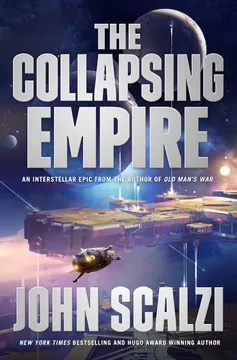
The Collapsing Empire is a highly entertaining space opera with witty dialogue and intriguing political intrigue. Readers praise Scalzi's accessible writing style and compelling characters, particularly Kiva Lagos. The novel introduces a fascinating concept of interstellar travel via "The Flow" and sets up an impending crisis for humanity. While some criticize the lack of character depth and cliffhanger ending, most reviewers found it engaging and look forward to the series continuation. Overall, it's considered a fun, fast-paced read that balances humor with serious themes.
People Also Read






Characters
Cardenia Wu-Patrick, Grayland II
Reluctant imperial reformerCardenia is the unexpected heir to the House of Wu, raised close enough to imperial life to understand its privileges but far enough away to imagine a life of her own. Her education in literature and teaching reflects a preference for interpretation and care over command. She is candid, self-conscious, and wary of becoming a symbol rather than a person, especially when advisers treat marriage and succession as state property. Her friendship with Naffa gives her a rare space for unguarded feeling. As ruler, she must learn to use authority without confusing obedience with loyalty, and to question institutions that have shaped her identity as well as her power.
Marce Claremont
Scientist carrying the warningMarce is a Flow physicist and the son of Jamies Claremont, whose research he helps verify. Thoughtful, observant, and more comfortable with data than court performance, he often copes with fear by focusing on practical details. He has spent his life on End and knows that leaving means abandoning his father, twin sister, and familiar world, perhaps permanently. His scientific training makes him attentive to uncertainty: he can describe probabilities without pretending they are guarantees. Marce’s decency is real but not grandiose; he can be frightened, resentful, or overwhelmed while still choosing to carry information that may save others.
Kiva Lagos
Profane merchant strategistKiva is the blunt, pleasure-seeking daughter of Countess Huma Lagos and a representative of the family’s citrus monopoly. She treats business as a contest in which hesitation invites exploitation, and her language makes little effort to disguise her judgments. Beneath that armor, she notices how war sorts people by their ability to pay for escape. Kiva can make hard bargains, tolerate danger, and protect her ship without becoming conventionally selfless. Her relationship with Marce tests the boundary between transactional loyalty and personal attachment, while her rivalry with Ghreni draws her into a contest much larger than her original commercial problem.
Ghreni Nohamapetan
Ambitious house operatorGhreni is a persuasive political operator who excels at reading people, offering useful arrangements, and concealing his own purposes. His family sends him to manage its interests on End, where he works close to the duke and learns how local power can be turned to advantage. He prizes audacity and improvisation, traits that make him effective but also tempt him to overestimate his control. Ghreni is neither a simple loyalist nor a mere opportunist: he acts within a family strategy while pursuing his own rise. His choices expose the gap between acquiring power and understanding the forces that power cannot command.
Nadashe Nohamapetan
Architect of family ambitionNadashe is the sharpest political mind among her siblings, patient enough to plan across years and disciplined enough to make other people carry out the visible risks. She sees marriage, committee appointments, rebellions, and trade routes as connected pieces of the same strategic board. Her confidence can resemble foresight, but she is capable of mistaking a favorable theory for certainty when it serves her design. Nadashe respects competence and expects others to understand the stakes as she defines them. Her relationship with Grayland is shaped by a contest over influence, legitimacy, and who gets to decide what the empire must become.
Amit Nohamapetan
Reluctant dynastic suitorAmit is the conventional, outward-facing member of the Nohamapetan siblings, expected to represent the family and eventually take charge of its business. He is less quick-minded than Nadashe and Ghreni, but he understands risk and recognizes when a plan may fail. His proposed marriage to Grayland is both a political arrangement and a family expectation, leaving little room for a private preference. Amit’s carefulness can look like passivity, yet he is not simply a puppet: he notices the costs of ambition even when he cannot control the decisions around him.
Vrenna Claremont
Soldier turned protectorVrenna is Marce’s twin sister, a former marine who now serves as a constable on End. Her training makes her direct, alert, and comfortable acting under pressure, while her teasing relationship with Marce keeps her from becoming only a hardened protector. She is willing to take physical risks for her family and has little patience for people who threaten them. Unlike Marce, Vrenna remains on End, tied to the responsibilities and dangers of a planet in revolt. Her loyalty is practical: she does not promise that everything will be fine, but she makes herself useful when it matters.
Jamies Claremont
Scientist in political exileJamies is Marce and Vrenna’s father, an accomplished Flow physicist placed on End under the cover of an imperial auditing post. He has spent decades collecting data quietly, disciplined by the possibility that his findings could destabilize the empire and be dismissed as political provocation. Jamies is cautious rather than timid: he knows when a warning needs a human messenger and when a delay may buy precious time. His devotion to his children is expressed through difficult choices, especially when sending Marce away means accepting that their family may not reunite.
Batrin Wu, Attavio VI
Dying father and former rulerBatrin, formally Emperox Attavio VI, is Cardenia’s father and the ruler whose death brings her into power. Their relationship is complicated by years of distance and by his earlier choice to keep her outside the demands of the court. As he weakens, he speaks more openly about his own failures and his daughter’s likely burdens. His recorded likeness in the Memory Room can offer advice without the evasions of a living ruler, though it is not the conscious man Cardenia loved. Batrin’s central concern is that Cardenia learn to rule as herself.
Naffa Dolg
Friend inside the palaceNaffa is Cardenia’s trusted friend and chief of staff, trained in court history and skilled at translating institutional demands into manageable choices. She can correct Cardenia’s etiquette without surrendering the intimacy of their friendship, and her republican family background helps keep imperial ceremony from seeming inevitable. Naffa understands that Cardenia needs both competent administration and someone who can speak to her as a person. Her presence represents a rare bridge between private affection and public duty, especially in a palace where nearly every relationship carries political meaning.
Countess Huma Lagos
Household power brokerHuma is Kiva’s mother and the head of the House of Lagos, a formidable negotiator who treats politeness as optional when a direct threat will do. She understands that legal claims, public reputation, and private leverage can all become currencies in a dispute between houses. Huma loves her daughter without confusing affection with indulgence, and she is willing to let Kiva handle difficult business while remaining alert to the larger political map. Her skill lies in discovering what an opponent values and making the cost of refusal unmistakable.
Captain Arullos Gineos
Mutiny-surviving captainGineos commands the Tell Me Another One with a practical eye for danger and an instinct for keeping the ship’s people alive. Her background in a street gang left her with a concealed weapon and little patience for ceremony when a crisis becomes immediate. She understands that authority can be compromised by bad appointments and divided loyalties, but does not surrender responsibility when those failures arrive. Gineos is at her best when technical urgency leaves no time for pride, and she makes decisions with an unsentimental awareness of what survival will cost.
Ollie Inverr
Mutineer with a navigator's giftInverr is Gineos’s executive officer, ambitious enough to lead a mutiny for a promised weapons profit and skilled enough to navigate an unprecedented Flow emergency. He is not driven by personal hatred of the captain so much as by money and a belief that the scheme can be controlled. His competence becomes indispensable once the ship is stranded, exposing how the same person can be both threat and resource. Inverr’s presence complicates simple judgments about merit: saving people in one crisis does not undo the choice that endangered them.
Rachela I
Founder in the archiveRachela I is the legendary founder of the Interdependency and its church, encountered by later rulers as a simulation in the Memory Room. The historical woman was a political organizer who understood how shared beliefs could bind distant systems. Her archived self is frank about the human choices behind the founding story and distinguishes moral principles from claims of divine authority. She offers Cardenia a perspective no living courtier can provide, though the simulation is memory and modeling rather than the continuing consciousness of the founder.
Hatide Roynold
Patron-funded Flow researcherHatide is a Flow physicist whose privately funded research predicts that the network will shift toward End. Her work gives the Nohamapetans a basis for a risky political strategy, but her initial calculations contain errors that undermine the forecast. As a researcher working outside broad peer review, she illustrates how isolation can distort even serious scientific work.
The Duke of End
Besieged planetary rulerThe Duke of End rules a distant, frequently rebellious world where imperial policy leaves local conflicts largely to local power. He faces a costly revolt, declining revenue, and pressure from guild interests. His reliance on advisers and emergency measures reflects the precariousness of a noble title on a planet where rulers can be displaced when their support collapses.
Gell Deng
Loyal imperial secretaryDeng served Batrin for decades and becomes a steady administrative presence for Cardenia. He knows how the palace functions and offers her loyalty without pretending to replace Naffa as her friend. His restrained kindness gives Cardenia room to grieve while still carrying out the duties of her office.
Plot Devices
The Flow
Trade route and ticking clockThe Flow is the alternate-space network that lets ships travel between distant human systems in weeks or months rather than years. Its stable routes make trade, migration, and the Interdependency’s political order possible. Ships enter and leave through shoals, carrying a small bubble of ordinary space-time with them. The discovery that those routes are collapsing turns a background technology into the central deadline: systems will lose access to one another, and most human settlements depend on imported resources. The routes do not all close at once, so each predicted collapse changes who can still travel and where people may be stranded.
The Memory Room
Ancestral counsel without consciousnessThe Memory Room contains recorded sensory and mental data from the emperoxs, gathered through a neural network implanted in each ruler. Its system can produce conversational simulations of past emperoxs, allowing the current ruler to ask about history and policy. The archive offers unusually intimate access to imperial lives, but its figures are not the dead returned to consciousness. For Cardenia, it becomes a private place to test her judgment, learn what her predecessors knew, and confront the official story of the empire’s origins.
Interdependent monopolies
Trade as political controlThe empire assigns major industries and resources to powerful houses, which hold monopolies over essential goods and services. The arrangement encourages systems to rely on one another, but it also concentrates wealth and influence in guild families and the imperial house. Control of trade routes can be more powerful than control of a single product. The houses use this structure to fund political alliances, pressure local rulers, and shape the response to the Flow crisis. As the network fails, the monopoly system becomes both a liability for ordinary people and a source of leverage for those trying to control the last habitable refuge.
Forged crew identity
A disguise that demands laborThe House of Lagos uses prebuilt false identities, including biometric records, to move people through customs without drawing attention. Marce travels as Kristian Jansen, with altered facial features and manufactured biometric markers. The cover works because it matches an existing crew identity, but it requires him to take a real job aboard the ship rather than pass as a wealthy passenger. The device gives Marce a route out of End while keeping him vulnerable to detection and dependent on Kiva’s crew.
Flow navigation records
A warning hidden in ship dataJamies studies navigation records from ships traveling to End, searching for changes in the Flow rather than errors in commercial routing. Repeated observations let him test a mathematical model against real encounters with the shoals. A ship’s anomalous exit and encounter with a shrinking shoal provide crucial confirmation that the network is changing. The same records can also be misread: Hatide Roynold’s private analysis produces a forecast that benefits the Nohamapetan plan but rests on flawed calculations. The device makes evidence a contested resource, because data must be collected, interpreted, and trusted before it can change policy.
About the Author






Download PDF
Download EPUB
.epub digital book format is ideal for reading ebooks on phones, tablets, and e-readers.








