

Key Takeaways
A frozen bank balance exposes who really controls your money
A claim is not cash. In 2022, during Lebanon’s banking crisis, a young decorator entered a Beirut bank with a fake gun to retrieve family savings for her sister’s cancer treatment. The striking point was not simply that the bank had failed. It was that a balance people thought of as their money could not be accessed without the institution’s permission. A bank deposit is a claim recorded on a ledger, and the bank, regulators, or government may control that ledger.
Ask who can act. The book returns to two questions: who can observe or block transactions, and who can create money cheaply enough to dilute everyone else’s. The answers change with the technology and institutions behind the ledger.
What's striking is how an ordinary deposit can feel like personal property in calm times, then reveal itself as an institutional promise under stress. This resembles a broader distinction in law and technology between possessing an asset and having a claim administered by someone else. Deposit insurance and regulation can reduce individual risks, but no guarantee makes every claim instantly liquid in a system-wide crisis. The useful habit is to ask what stands behind a financial balance, who can restrict it, and what happens if many people demand access at once.
Money helps strangers trade when favors and barter stop working
Credit comes first at home. The earliest written ledgers, found in Mesopotamia, tracked commodities and transactions more than 5,000 years ago. But people can keep simpler ledgers in memory: siblings trade chores, friends return favors, and familiar groups share food without pricing every exchange. Trust and reputation make this informal credit work.
Strangers need settlement. Trade becomes harder when people do not know one another or may never meet again. Barter requires a double coincidence of wants, meaning each trader must have exactly what the other wants. Shell beads helped by providing a small, durable, portable good that others valued. The book calls its unifying idea the ledger theory of money: money is a way to track and settle value, whether people, institutions, or physical scarcity maintain the ledger.
The ledger lens bridges two explanations that are often treated as rivals. Credit theory emphasizes obligations and trust; commodity theory emphasizes scarce objects that can settle exchanges without trusting a counterparty. Both describe real coordination tools, but at different scales and levels of trust. The distinction also clarifies why neither system simply replaces the other: a community may rely on favors internally while using portable money with outsiders. The framework is strongest as a map of monetary functions, not as proof that every society follows one universal historical sequence.
A money's scarcity lasts only until technology makes it cheap
Salability beats mere rarity. Money must be useful to trade, not just hard to find. It generally needs to be durable, portable, divisible, recognizable, and slow to produce relative to the amount already available. A stock-to-flow ratio measures existing supply against new annual production. Gold’s high ratio reflects both its durability and the fact that mining adds only about 1.5 percent to above-ground supply in a typical year, or roughly 67 years of current production.
Technology can wreck the balance. Industrial drilling made wampum beads faster to produce, and new transport technology let outsiders bring more rai stones to Yap. In both cases, supply growth weakened the money. The book’s lesson is that monetary scarcity is relative to what people can make, not a permanent quality guaranteed by tradition.
This is a useful evolutionary test for any proposed store of value: what happens if its price rises and production becomes more attractive? The stock-to-flow idea captures resistance to supply growth better than rarity alone. Yet it does not settle every question. Liquidity, legal treatment, demand, and trust in verification matter too, and a high ratio cannot guarantee stable purchasing power. A rare object may still be difficult to sell, while a widely used monetary asset may retain demand for reasons beyond physical scarcity.
Fast payment networks made centralized claims outrun physical settlement
Communication changed the race. For centuries, payments and the settlement behind them moved no faster than people, horses, and ships. Telegraph cables changed that in the nineteenth century. Banks could update accounts across oceans almost instantly, while gold still had to be transported and verified physically. Transactions could now multiply faster than the underlying asset used to settle them.
Efficiency concealed fragility. Banks and clearinghouses netted many payments against one another, so far fewer transfers of metal were needed. In nineteenth-century Britain, estimates cited in the book put bank cash reserves at only about 4 to 7 percent of liabilities payable on demand. That arrangement was efficient while customers trusted the system. It also left banks vulnerable if many claimants wanted settlement at once, and gave financial institutions control over the fast-moving ledger.
The key insight is that monetary power can follow infrastructure, not just political authority. Whoever controls the fastest settlement rails can become a gatekeeper even when the underlying asset is scarce. Similar patterns appear in communications networks, where convenience and scale can concentrate influence in a small number of intermediaries. The book’s technological account explains why gold struggled to compete in digital commerce. It does not mean gold-backed systems had no other weaknesses, or that every centralizing outcome was inevitable; institutions and public choices still shaped how the technology was used.
Flexible money buys crisis relief by shifting costs across time
Separate the kinds of money. Base money is central-bank currency and bank reserves. Broad money includes that currency plus deposits people and businesses use. When a commercial bank lends, it generally creates a deposit, expanding broad money without adding new central-bank reserves. When a central bank buys existing assets from banks, it expands base money but does not automatically give households more deposits to spend.
Who funds the deficit matters. If a government spends more than it taxes and the central bank buys the new debt with newly created reserves, both base and broad money can grow. The book contrasts the 2008 response, which chiefly supported banks, with the 2020-2021 response, when large fiscal transfers helped broad money rise sharply. Across repeated cycles, it argues, debt is often rescued rather than cleared, shifting the burden into future inflation or restructuring.
This distinction is essential because the phrase money printing can hide several different operations. New reserves inside banks do not have the same immediate effect as new deposits paid to households, and neither guarantees a fixed amount of consumer inflation. Spending, credit demand, supply constraints, and expectations all shape the outcome. The book’s accounting examples make the plumbing more legible, while its long-cycle argument highlights political incentives to postpone losses. That argument is persuasive as a risk pattern, though not a precise timetable for when a debt system must reset.
Reserve-currency privilege exports volatility and distorts production at home
The dollar became the shared reference. After the 1971 end of dollar convertibility into gold, the United States helped preserve global demand for dollars through oil trade and financial ties, including arrangements with Saudi Arabia. The dollar became the main reserve and trade currency, despite having no fixed redemption into a scarce asset.
The same system has costs. Developing countries often borrow in dollars while earning in local currency. When the dollar strengthens, their debts become harder to repay, helping trigger crises such as those in Latin America in the 1980s and Asia in the late 1990s. The book also argues that global demand for dollars can keep the U.S. currency unusually strong, making imports cheaper and domestic exports less competitive. The privilege can therefore strain borrowers abroad and industrial workers at home.
A reserve currency supplies a valuable public service: it gives distant markets a common unit and deep pools of liquidity. But the costs and benefits are distributed unevenly. Foreign borrowers inherit exchange-rate risk they cannot control, while the issuer gains financing advantages that may weaken incentives to adjust trade imbalances. The book offers a compelling political-economy account, not a single-cause explanation of industrial decline. Productivity, trade policy, technology, and business decisions also matter. The practical insight is to examine both sides of monetary privilege rather than treating it as an unqualified national advantage.
Trace new money's route to see who gains and who pays
Injection points matter. The Cantillon effect describes how new money affects people unevenly depending on who receives it first. A gold miner can spend newly mined gold before prices adjust; workers paid later may find that prices have already risen. In modern systems, large banks, corporations, and borrowers with privileged access to cheap credit can similarly act before the effects spread.
Relief can reinforce advantage. During the pandemic, the Paycheck Protection Program supplied about $800 billion in forgivable loans. A study cited in the book estimated that only 23 to 34 percent went directly to workers who otherwise would have lost jobs, while roughly three-quarters accrued to the wealthiest fifth of households. The book connects this uneven access to cheap credit and repeated bailouts with financialization: the growing use of assets such as homes and equities as substitutes for reliable money.
Following the route of funds is a more precise way to debate stimulus than arguing only about its total size. Distribution depends on timing, eligibility rules, administrative capacity, and who already has access to credit. Emergency support can prevent avoidable bankruptcies and unemployment, so unequal outcomes do not alone prove that intervention was unjustified. They do show why program design matters. The Cantillon effect also helps explain why people can experience a boom in asset prices as prosperity in aggregate while facing higher housing costs and little improvement in wages.
Keep Bitcoin's base layer lean; scale payments through optional layers
Bitcoin changes who maintains the ledger. Its rules cap issuance at 21 million coins, while independent node operators check whether new blocks obey those rules. Miners use proof-of-work, a process that expends computing energy to order transactions and make rewriting the record costly. The network’s design favors a relatively simple base layer that ordinary users can verify.
Everyday speed can sit above settlement. The Lightning Network uses payment channels anchored to Bitcoin, allowing participants to make many rapid payments without recording each one on the public base ledger. This layered approach trades some directness for speed and capacity, and users can choose custodians or federations for added convenience at the cost of trust. The book argues that enlarging the base layer too aggressively risks making nodes harder to run and control more centralized.
Layering is a familiar engineering strategy: keep a dependable foundation narrow, then build specialized services above it. The analogy is useful because it makes clear that higher throughput is not free; it shifts costs into hardware, trust, or complexity. Bitcoin’s proof-of-work design also uses real energy, which the author presents as a way to make transaction history costly to forge. That rationale deserves evaluation alongside the environmental cost, not instead of it. The layered model is promising, but convenience layers can recreate custodial dependence if users do not understand the trade-offs.
Treat Bitcoin as a risky monetary option, not a guaranteed replacement
Adoption is not proof of permanence. Bitcoin has operated since 2009 and developed a substantial network, but it remains software maintained by fallible people. The book notes past inflation bugs, the possibility of future bugs, government restrictions, attacks on mining, and competition from other digital assets. Its fixed supply depends on users continuing to enforce the network’s rules, not on a physical law that makes software infallible.
Energy use has a specific design role. Miners seek cheap power and can operate near stranded or excess sources, including flared gas or surplus renewable electricity. In 2020, the network used less than 0.1 percent of global energy, according to the book. The possibility of useful energy matching does not mean every mining operation is clean or socially worthwhile. The case for Bitcoin remains conditional on durable utility and resilient adoption.
The book is strongest when it treats Bitcoin as an experiment with identifiable failure modes rather than a prophecy. Its network effects and user-run verification may make it harder to displace than a simple software copy suggests. Still, monetary adoption is not determined by code alone. Volatility, regulation, usability, custody practices, and public confidence all shape whether people treat an asset as money. Likewise, a flexible electricity buyer can help integrate surplus power, but that benefit must be measured at each site rather than assumed from the technology’s design.
Defend privacy before emergency systems make surveillance ordinary
Digital control can be precise. A central bank digital currency is a digital form of central-bank money. Unlike physical cash, it can be designed so the issuer can monitor transactions or enforce rules over how money is used. The book describes the eNaira, launched in Nigeria in 2021, as having adoption below 1 percent a year later, even as many Nigerians used other digital assets despite banking restrictions.
Self-custody changes the cost of censorship. During Canada’s 2022 trucker protests, authorities froze some bank accounts and donation services were shut down. The book reports that two-thirds of bitcoin donations reached their intended recipients. That does not establish that every affected action was lawful or admirable. It illustrates a different safeguard: when users hold their own keys, authorities cannot freeze funds simply by instructing a bank.
Privacy is best understood as control over disclosure, not a blanket demand for secrecy. The same tools can protect dissidents, ordinary consumers, and criminals, which is why rules should distinguish targeted investigation from universal monitoring. The Canada example is politically contested, but that is precisely why due process matters: a safeguard is most revealing when applied to unpopular people. Digital payments can improve access and convenience too. The central question is whether those benefits require the issuer to know, limit, and potentially revoke every person’s capacity to transact.
Analysis
The book’s most durable contribution is not a prediction about Bitcoin. It is a way to examine money as infrastructure: a ledger, a settlement process, a set of rules, and a distribution of authority. That lens makes ancient beads, bank deposits, reserve currencies, and digital tokens comparable without pretending they are identical. It also turns apparently technical questions, such as who can update a ledger or redeem a claim, into questions about power and accountability.
The causal story is strongest when it identifies mechanisms. Faster communication made it practical to transfer bank claims without moving gold. Fractional banking expanded credit and liquidity while creating run risk. Dollar borrowing exposes foreign balance sheets to U.S. policy. Those links are concrete and help explain why financial convenience often brings new dependencies.
The argument becomes less certain when it moves from mechanism to sweeping diagnosis. Money growth, consumer inflation, asset prices, industrial decline, and political discontent interact, but none is explained by a single monetary variable. A weak currency can damage savings, while flexibility can also help authorities respond to banking panics, wars, or severe downturns. The institutional question is not simply whether discretion exists, but who authorizes it, who benefits, and how losses are disclosed.
Bitcoin sharpens the debate because it attempts to combine digital speed with scarce, user-verified settlement. Yet the trade-offs remain real: energy, volatility, software risk, usability, and reliance on optional custodians. The most useful conclusion is plural rather than maximalist. Compare monetary systems by their reliability, accessibility, privacy, and capacity to absorb shocks, then ask which risks users can see and choose. The book makes that comparison newly legible, even where its preferred answer remains open to challenge.
Review Summary
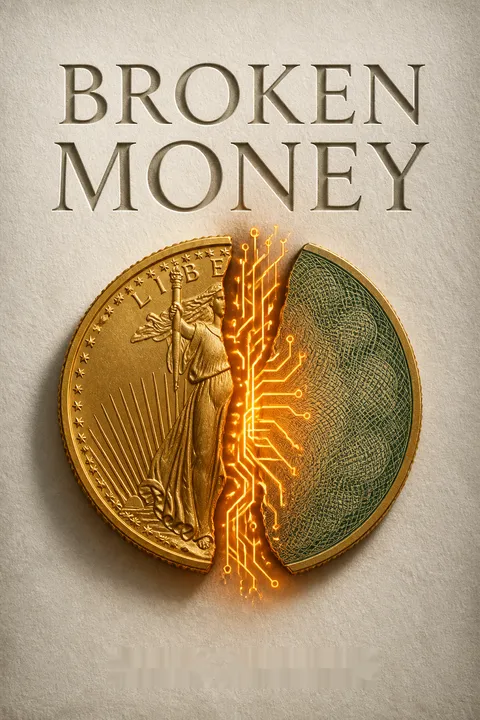
Broken Money by Lyn Alden receives high praise for its comprehensive exploration of monetary systems, from ancient times to modern cryptocurrencies. Readers appreciate Alden's clear explanations of complex financial concepts, her balanced approach to discussing Bitcoin, and her insights into the flaws of current fiat systems. The book is lauded for its accessibility to both novices and experts, though some find the Bitcoin sections less convincing. Overall, it's considered an essential read for understanding money's past, present, and potential future.
People Also Read





Glossary
ledger theory of money
Money as value accountingA way of understanding money as a system for recording and settling value. In trust-based systems, people or institutions maintain the ledger through memory, law, or banking. In commodity systems, scarce physical assets settle exchanges through possession. The theory combines credit and commodity accounts of money by asking who maintains the ledger and how reliably.
stock-to-flow ratio
Existing supply versus new supplyA measure of an asset’s current stock divided by the amount newly produced over a period, commonly one year. In monetary analysis, a higher ratio can indicate that supply is difficult to expand relative to what already exists. It is not a complete measure of monetary quality, because portability, divisibility, liquidity, durability, and demand also matter.
salable good
An asset easy to resellThe good most readily accepted in exchange because many people want it or expect others to accept it. Salability depends on qualities such as durability, portability, divisibility, recognizability, scarcity, and liquidity. An asset that is extremely rare but difficult to divide or sell may be valuable as a collectible without working well as money.
Cantillon effect
Uneven effects of new moneyThe principle that newly created money does not affect everyone equally or simultaneously. People and institutions closest to the initial recipients can spend or invest before prices fully adjust. Those who receive the money later, including wage earners whose pay changes slowly, may face higher prices without receiving an equivalent early benefit.
Eurodollar system
Dollar banking outside the U.S.A network of dollar-denominated deposits and credit created through banks outside the United States. Despite its name, it includes offshore dollar banking in many regions, not only Europe. It expanded global access to dollar finance but added layers of bank claims and liabilities beyond the direct view of U.S. regulators.
Long-term debt cycle
Debt buildup and monetary resetA prolonged pattern in which repeated policy responses prevent private and public debt from fully clearing during ordinary downturns. Debt accumulates across successive business cycles until interest-rate cuts and routine support become inadequate. Authorities may then expand base money, shift liabilities toward government, restructure debts, or allow inflation to reduce their real burden.
Base money
Currency and bank reservesThe monetary base managed by a central bank. In the U.S. system described in the book, it consists chiefly of physical currency in circulation and commercial-bank reserves held at the Federal Reserve. It differs from the larger supply of bank deposits used by households and businesses.
Broad money
Money held by the publicA measure that includes physical currency and bank deposits, such as checking and savings balances. These deposits are liabilities of commercial banks rather than direct liabilities of the central bank. Broad money can expand when banks lend and create deposits, and may contract when debts are repaid or deposits are lost through bank failures.
Proof-of-work
Energy-backed transaction orderingA method for ordering transactions in which miners expend computing power and electricity to produce valid blocks. Other network participants check that blocks follow the rules. The work makes rewriting recent history costly, while the node network, rather than miners alone, enforces which blocks are valid.
Lightning Network
Bitcoin payment channelsA payment network built over Bitcoin in which participants open channels using base-layer transactions, make repeated rapid payments within those channels, and later settle their balances on the base layer. Routing can connect people without a direct channel. It increases speed and capacity but introduces liquidity requirements and choices about custody.
central bank digital currency
Digital central-bank moneyA digital form of money issued as a liability of a central bank. It could make payments and cross-border settlement more direct than legacy banking processes. Depending on its design, it may also allow issuers to monitor transactions, restrict uses, or apply rules to balances, raising questions about privacy and control.
Gresham's law
Spend weaker money firstA monetary pattern in which people tend to spend the less desirable money and hold the more desirable one when the two are forced to circulate at a fixed exchange rate or face unequal transaction costs. The book applies the idea to situations where taxes or other frictions encourage people to save harder money and use weaker money for ordinary payments.
FAQ
What's Broken Money about?
- Historical Evolution: Broken Money by Lyn Alden explores the historical evolution of money, from ancient ledgers to modern financial systems, and examines why certain commodities like gold and silver became dominant.
- Critique of Current Systems: Alden critiques the current financial system, highlighting the issues with fiat currencies, such as inflation and devaluation, and argues for a reevaluation in light of technological advancements.
- Future of Money: The book speculates on the future of money, particularly with the rise of cryptocurrencies and digital currencies, and discusses their potential to address the shortcomings of current systems.
Why should I read Broken Money?
- Informed Perspective: The book provides a comprehensive understanding of money's workings and historical context, helping readers make informed financial decisions.
- Critical Analysis: Alden offers a critical analysis of the financial system, challenging conventional wisdom and encouraging readers to think critically about monetary policies.
- Practical Implications: The book discusses the practical implications of monetary systems on everyday life, empowering readers to navigate financial challenges effectively.
What are the key takeaways of Broken Money?
- Nature of Money: Money serves as a ledger, tracking value and transactions, with consistent properties throughout history despite changes in form.
- Impact of Technology: Technological advancements have historically influenced money's nature, and the current system needs to adapt to modern technologies like cryptocurrencies.
- Consequences of Fiat Systems: Fiat currencies pose risks like inflation and economic instability, prompting a need to consider alternatives for savings and investments.
What are the best quotes from Broken Money and what do they mean?
- "Money is a ledger.": This quote encapsulates the book's theme that money is fundamentally a record of transactions and value, emphasizing its societal role.
- "The financial system as we know it isn’t working anymore.": Alden critiques the current system's failure to meet economic needs, urging a reevaluation of fiat currencies.
- "Politics can affect things locally and temporarily, but technology can affect things globally and permanently.": This highlights technology's transformative power in shaping monetary systems, suggesting cryptocurrencies' potential impact.
How does Lyn Alden define money in Broken Money?
- Core Definition: Alden defines money as a ledger system for recording transactions and value, crucial for understanding its historical purpose.
- Properties of Effective Money: Effective money is portable, divisible, durable, and scarce, determining which forms succeed historically.
- Commodity Money: Alden views commodity money, like gold, as governed by natural laws and scarcity, contrasting with fiat money's arbitrary nature.
What historical examples does Broken Money provide?
- Ancient Ledgers: The book discusses ancient Mesopotamian clay tablets as early ledgers, foundational to modern money.
- The Gold Standard: Alden examines the gold standard's rise and fall, highlighting its role in monetary stability and fiat currency volatility.
- Hyperinflation Cases: Examples like Zimbabwe and Venezuela illustrate fiat currencies' dangers and poor monetary policies' consequences.
How does Broken Money address the future of money?
- Rise of Cryptocurrencies: Alden explores cryptocurrencies like Bitcoin as alternatives to fiat currencies, analyzing their potential to address current system shortcomings.
- Decentralized Finance (DeFi): The book discusses DeFi's implications for banking and money, suggesting it could provide more equitable financial access.
- Technological Innovations: Alden emphasizes blockchain and digital currencies' role in creating efficient, stable monetary systems.
What is the Cantillon Effect mentioned in Broken Money?
- Definition: The Cantillon Effect describes how changes in money supply affect different groups unevenly, benefiting those closest to new money first.
- Impact on Wealth Distribution: This effect contributes to wealth inequality, as those with early access to new money benefit from rising asset prices.
- Historical Context: Alden provides historical examples, linking the Cantillon Effect to modern monetary policies and socioeconomic impacts.
How does Broken Money critique central banking?
- Centralization of Power: Alden critiques central banking for concentrating monetary power, leading to poor decision-making and instability.
- Inflationary Policies: Central banks' inflationary policies erode purchasing power and savings, highlighting risks in relying on them for stability.
- Lack of Accountability: The book emphasizes central banking's lack of accountability, urging consideration of alternative monetary frameworks.
What solutions does Broken Money propose for the current financial system?
- Adoption of Sound Money: Alden advocates for sound money principles, suggesting commodity-backed currencies for economic stability.
- Decentralized Alternatives: The book encourages exploring decentralized financial systems and cryptocurrencies to enhance inclusion and reduce centralization.
- Reform of Banking Practices: Alden calls for banking reforms to promote transparency and accountability, aiming for a resilient financial system.
How does Lyn Alden explain the relationship between fiat currency and inflation in Broken Money?
- Inflation as a Feature: Inflation is inherent in fiat systems, as governments can print money, eroding purchasing power.
- Impact on Savings: Inflation affects savers in fiat currencies, prompting a need for alternatives that preserve value.
- Historical Examples: Alden provides historical context, illustrating fiat currencies' flaws and the urgency for sound money alternatives.
What role does Bitcoin play in the future financial system according to Broken Money?
- Decentralized Alternative: Bitcoin serves as a decentralized alternative to fiat currencies, offering a stable store of value.
- Global Payment System: Bitcoin facilitates global transactions without intermediaries, democratizing financial access.
- Long-term Viability: As fiat limitations become apparent, Bitcoin's adoption could reshape the financial landscape, challenging existing systems.
About the Author
Other books by Lyn Alden

Download PDF
Download EPUB
.epub digital book format is ideal for reading ebooks on phones, tablets, and e-readers.








