

Key Takeaways
Ask who benefits when meat gets dear and industrial calories stay cheap
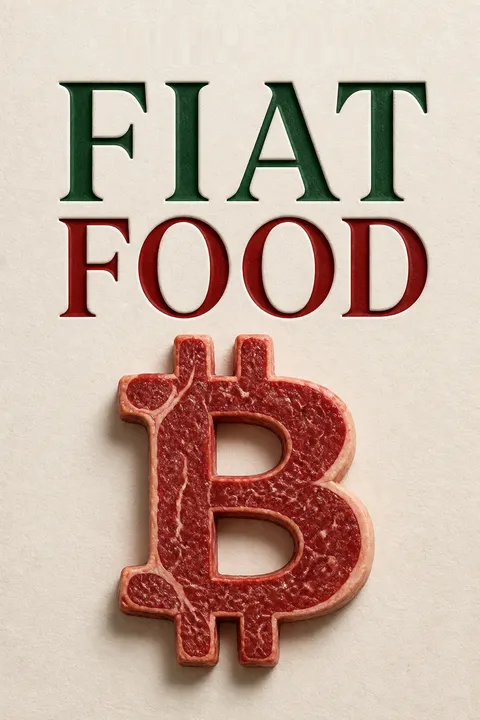
The book's central claim. Matthew Lysiak argues that the shift from gold-backed money to fiat currency changed more than monetary policy. In his account, inflation made nutrient-dense foods harder to afford, while subsidies and industrial production made grain-based foods cheaper. He presents this as a political economy of food: decisions about money, farming, and official nutrition advice reinforce one another. The proposed remedy is Bitcoin, which he believes could limit money creation and weaken those incentives.
A human opening. The book begins with Gina Mostaccio, who followed changing dietary guidance and took prescribed statins before dying of a heart attack. Her story conveys the stakes, but it does not establish that the advice or medication caused her death. The book's argument depends on a much wider historical case.
What's striking is the attempt to connect grocery choices to monetary institutions rather than treating diet as a matter of individual discipline alone. That lens can prompt useful questions about subsidies, prices, and the interests behind public guidance. But a link between inflation and food policy is not, by itself, proof that one was designed to conceal the other. The argument is strongest when it asks readers to inspect incentives, and weaker when it treats a complex system as the product of a single coordinated motive.
Trace nutrition advice through the institutions that made it authoritative
Authority has a history. The book follows nutrition advice through Ancel Keys, the American Heart Association, food manufacturers, government agencies, and the Seventh-day Adventist Church. It describes how Crisco was marketed as a modern alternative to animal fats, and how John Harvey Kellogg's cereal business grew from religious ideas about diet into a mass-market industry. Later, Lysiak argues, official recommendations helped normalize low-fat eating and grain-heavy meals.
Follow the money. The account points to Procter & Gamble's major donation to the AHA and to corporate support for nutrition research. These examples raise a legitimate question: who funds the institutions that define healthy eating? They do not alone show that every recommendation was bought, or that commercial influence explains each shift in policy.
This institutional history is more illuminating than a story about one misguided expert. Research, professional bodies, public agencies, and marketing can reinforce one another, even without a single command center. That is a familiar dynamic in fields where organizations depend on funding and public trust. Still, finding a financial relationship establishes a potential conflict, not necessarily a corrupt conclusion. The careful reader asks both what a sponsor stood to gain and whether the underlying evidence holds up independently.
A striking correlation is not proof that saturated fat causes heart disease
Keys's hypothesis. Ancel Keys argued that saturated fat raised blood cholesterol and contributed to heart disease. His Seven Countries Study compared diet and heart-disease outcomes across seven nations, but critics cited in the book said the selection left out countries that complicated his argument. Such comparisons can reveal patterns, but they cannot by themselves establish that one dietary factor caused an outcome.
Competing explanations. John Yudkin argued that sugar and carbohydrates deserved more scrutiny. The book recounts his conflict with influential researchers who favored the fat-centered account. This history illustrates how a plausible hypothesis can become a public certainty before the evidence is decisive. It also does not prove that Yudkin's alternative was correct: identifying weaknesses in one explanation is not the same as validating another.
The useful lesson is methodological: observational comparisons generate hypotheses, while causal claims require stronger designs and careful control of confounding factors. Countries differ in far more than the foods they eat. The book is persuasive when it shows how selective comparisons can harden into a dominant narrative. Its own presentation needs the same scrutiny, however. Evidence against a saturated-fat explanation does not establish that sugar alone explains heart disease, or that one traditional diet suits everyone.
Follow farm subsidies into the ingredients that dominate packaged food
Policy shapes supply. Lysiak describes Agriculture Secretary Earl Butz's push for larger farms and expanded crop production. He argues that subsidies and industrial processing helped corn, soy, and sugar become cheap, versatile ingredients across the food system. One example is high-fructose corn syrup, which became widely used in soft drinks and packaged products after surplus corn created incentives to find new markets.
Prices change choices. The book's broader point is that government support can influence what farmers grow and what manufacturers can produce cheaply. It connects this pattern to a diet increasingly reliant on processed foods. That is a plausible account of how policy shapes markets, but the book's claim that inflation is the main driver of the food shift is larger than the evidence in these examples alone can demonstrate.
The chapter makes a valuable distinction between consumer preference and the conditions that shape available choices. When public policy lowers the cost of some inputs, manufacturers can build entire product lines around them, and shoppers encounter those products everywhere. This resembles path dependence: once infrastructure and habits form around a cheap ingredient, changing course becomes difficult. Yet relative prices also reflect technology, demand, trade, and farming conditions. Subsidies matter, but they are not a complete explanation of dietary change.
Audit the index and the policy before trusting the headline number
Measurement choices matter. The book argues that the Consumer Price Index can understate the felt cost of living when shoppers substitute cheaper goods for more expensive ones. Its example is a household that can no longer afford steak and buys a cheaper alternative instead. A spending-based measure may register the new purchase without capturing the loss in quality or nutrition.
Guidance matters too. Lysiak also traces the move from the 1980 dietary guidelines to the 1992 food pyramid, which recommended six to eleven daily servings of bread, cereal, rice, and pasta. He sees both statistics and dietary guidance as tools that can shape public perceptions. The practical lesson is to inspect what a measure includes and what a policy assumes, rather than treating either as neutral by default.
A statistic is an instrument, not a transparent window. What it measures, how it handles substitutions, and what it leaves out all affect its meaning. The same is true of dietary guidance, which turns evidence into recommendations for broad populations. But the book's critique sometimes reads methodological choices as deliberate concealment. Substitution can reflect genuine consumer behavior as well as obscure hardship. A sound audit examines both the consequences of a method and the evidence for the motives attributed to its designers.
A hidden null result warns how consensus can outrun evidence
The Minnesota trial. The book highlights a controlled dietary study begun in 1968, involving people in hospitals and a nursing home. One group ate foods rich in saturated fat, while another received a diet in which much of that fat was replaced with corn oil. The published results reported no difference in cardiovascular events, cardiovascular deaths, or overall mortality between groups.
A delayed record. The trial ended in 1973, but its results were not published until 1989. Lysiak says the findings were rediscovered in archived records decades later and challenged the confidence of the diet-heart hypothesis. The episode raises serious questions about publication and research incentives. A single trial, however, cannot settle every dietary question; its design, duration, participants, and limits also matter.
Unpublished or delayed results can distort a research literature, especially when null findings receive less attention than dramatic positive ones. The episode makes transparency more than a procedural virtue: it affects what clinicians, policymakers, and the public believe the evidence says. At the same time, a null result is not proof that an intervention has no effect under all conditions. The strongest conclusion is narrower: important evidence should be accessible, and certainty should reflect the whole body of research rather than a favored subset.
Bitcoin could constrain money creation, but it cannot prescribe dinner
The monetary proposal. Bitcoin is presented as decentralized digital money with a fixed eventual supply of 21 million coins. The book argues that replacing fiat currency with a harder money would make it harder for governments to fund spending through money creation, forcing them to rely more openly on taxation or borrowing. It links that constraint to reduced corporate subsidies and less political influence over food markets.
The proposed chain. In Lysiak's view, fewer subsidies and less official influence would weaken incentives for cheap industrial foods and improve access to meat. This is a theory about political and economic mechanisms, not a demonstrated nutritional outcome. Bitcoin's monetary design does not directly dictate what farms produce, what stores stock, or what people choose to eat.
The proposal is most compelling as a question about fiscal accountability: would a harder monetary constraint make public spending more visible and politically costly? That is different from showing that a Bitcoin-based system would produce healthier diets. Food markets depend on land, logistics, technology, culture, and household budgets as well as money. Even if a currency changed government incentives, the health effects would require separate evidence. Monetary reform and nutrition reform should be evaluated as related, but distinct, claims.
Use personal diet experiments as clues, not universal medical evidence
A personal account. In the book's final chapters, Saifedean Ammous describes moving from a highly processed diet to low-carbohydrate eating and then to a meat-only diet. He reports improvements in weight, energy, and mood, and says online communities helped him compare experiences. His practical advice includes prioritizing meat, finding an accommodating butcher, and using inexpensive cuts and bones.
A bounded lesson. These experiences explain why the approach appealed to him, but they are personal reports, not controlled evidence that everyone should eat this way. Lysiak's author note also says the book is not a medical treatise. Readers considering major dietary changes should distinguish the account's conviction from established, individualized medical guidance.
Self-experimentation can be useful when it is systematic: change one variable, observe outcomes, and record what happens. Communities can help people notice patterns that formal research has missed. But people who share a diet may also share selection effects, expectations, and reporting biases. A compelling testimonial can justify a question or a cautious personal trial; it cannot establish population-wide safety or benefit. The distinction protects both curiosity and scientific standards.
Check institutional incentives without treating every disagreement as proof of corruption
Scrutinize the source. Across the book, Lysiak asks readers to examine who funds research, professional groups, public campaigns, and food programs. He argues that commercial and political interests can shape which findings gain attention and which foods become normal. His examples include corporate sponsorship of nutrition bodies and school programs that serve branded, processed foods.
Test the claim. The same standard should apply to the book's own conclusions. A funding tie deserves disclosure and investigation, but it does not automatically invalidate research. Nor does a contested recommendation prove that officials deliberately misled the public. The most useful habit is to separate documented relationships, scientific findings, and claims about motive, then judge each on its own evidence.
This is the book's most durable tool for readers: follow incentives, then verify the inference. Conflict-of-interest analysis is essential because institutions can develop blind spots when funding and reputation depend on particular outcomes. But suspicion can become its own shortcut, turning any counterargument into evidence of a plot. A strong critique names the relationship, shows how it affected methods or conclusions, and remains open to evidence that complicates the accusation. Skepticism works best when it is applied consistently.
Analysis
Fiat Food is built as an investigative polemic. Its narrative begins with the 1971 end of dollar convertibility into gold, then assembles a cast of economists, nutrition researchers, religious organizations, food companies, and government agencies. The organizing idea is that a monetary system reliant on inflation benefits from cheap, industrial food, while official nutritional advice helps normalize that food. Bitcoin is offered as the structural alternative. This architecture gives the book momentum: a change in money becomes a story about the dinner table, public health, and personal freedom.
The book is strongest when it directs attention to the institutions between research and consumers. Funding, professional authority, public procurement, subsidies, and marketing all shape what counts as normal food. Its discussion of the delayed Minnesota Coronary Survey is especially effective as a case for transparency and restraint in scientific claims. The story also raises a useful question that survives disagreement with its thesis: how should the public evaluate guidance when its authors and institutions have financial or ideological ties?
The causal argument is less secure. Historical sequence does not by itself establish that fiat money caused the rise of processed foods, that food policy was designed to disguise inflation, or that a Bitcoin standard would reverse either trend. The book often moves from evidence of a conflict of interest to an assertion of coordinated intent. It also treats findings that challenge one nutrition theory as though they establish a preferred alternative. Those are different inferential steps.
The final dietary prescription is more categorical than the historical evidence warrants. Ammous's account of improved health is important as testimony, but it cannot establish that a meat-only diet is optimal for everyone. The book is therefore best read as a forceful challenge to institutional confidence, not as a settled account of monetary history or a universal clinical plan. Its enduring contribution is to make readers inspect who sets incentives, who defines evidence, and what remains unproven.
People Also Read








Glossary
Fiat Food
Food shaped by fiatThe book's term for the industrial, highly processed foods it associates with government monetary policy and inflation. Lysiak argues that fiat money and related subsidies favor inexpensive, mass-produced ingredients such as corn, soy, and sugar, while making nutrient-dense animal foods less affordable. The term expresses the book's central economic and dietary thesis, not a standard nutrition category.
Diet-heart hypothesis
Fat and heart disease theoryThe hypothesis that dietary saturated fat raises blood cholesterol and thereby increases the risk of heart disease. The book associates its rise to influence with Ancel Keys and argues that the evidence was treated as more conclusive than it warranted. It contrasts this account with alternative explanations, especially the proposed role of sugar and refined carbohydrates.
Seven Countries Study
International diet comparisonAn epidemiological study associated with Ancel Keys that compared dietary patterns and cardiovascular outcomes among men in seven countries. Keys used its findings to support a relationship between saturated fat, blood cholesterol, and heart disease. Critics described in the book objected to the selection of countries and stressed that observational comparisons can show association without proving causation.
Minnesota Coronary Survey
Controlled dietary trialA dietary study begun in 1968 in Minnesota institutions, comparing a diet rich in saturated fat with one in which much of that fat was replaced by corn oil. The book reports that researchers found no difference in cardiovascular events, cardiovascular deaths, or total mortality between the groups. Its delayed publication and later rediscovery are used to question how research results enter public debate.
Phillips Curve
Inflation and unemployment tradeoffAn economic model describing an inverse relationship between inflation and unemployment, often used to frame policy choices. The book recounts how policymakers relied on this idea before the 1970s experience of both rising inflation and unemployment challenged it. Lysiak presents the episode as an example of economic theories being used to justify monetary expansion.
Agro-Industrial Complex
Industrial food power networkThe book's label for the connected food manufacturers, agricultural businesses, research institutions, and policy influences involved in mass-produced food. Lysiak argues that the network benefits from subsidized crops and processed ingredients, and uses research, advertising, and public programs to shape what consumers eat. The term is a critical framing rather than a formal regulatory designation.
Medical Industrial Complex
Commercial health-care networkThe book's term for the relationships among pharmaceutical companies, health-care providers, insurers, and medical organizations that influence health-care priorities and spending. Lysiak argues that these interests can benefit from treating illness without addressing dietary causes. The term describes his critique of commercial incentives in medicine, not a single organization or official system.
Bitcoin standard
Money with fixed supplyThe book's proposed monetary system in which Bitcoin, rather than government-issued fiat currency, serves as money. Bitcoin's protocol limits total issuance to 21 million coins. Lysiak argues that this constraint would restrict government money creation and reduce incentives for corporate subsidies and food-policy manipulation. The expected effects on public budgets, markets, and health remain claims to evaluate.
Download PDF
Download EPUB
.epub digital book format is ideal for reading ebooks on phones, tablets, and e-readers.








