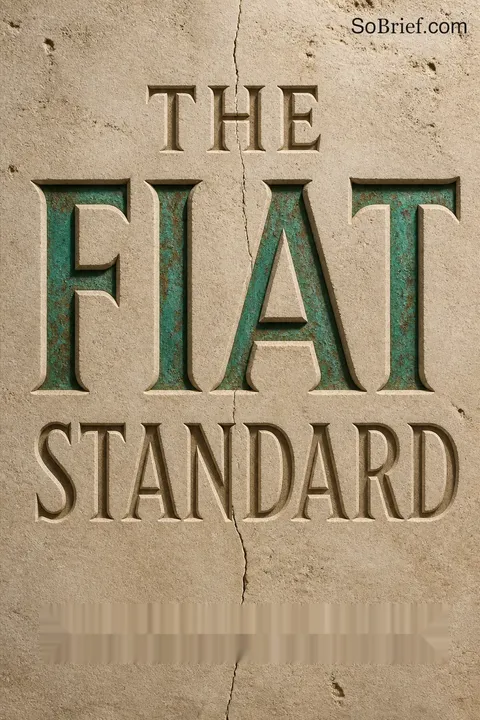


Key Takeaways
Understand fiat's rise as a payment upgrade with a political price.
Convenience helped fiat spread. The book’s central claim is that fiat money did not triumph only through deception or coercion. It solved a real problem: moving value across long distances. Gold held value well over time, but shipping and verifying it was costly, slow, and exposed to government control. Bank ledgers and centralized payment networks made international trade easier, while governments gained more control over the money those networks carried.
The trade-off was substantial. In the author’s account, fiat combined gold’s old settlement system with promises backed by governments and banks. That improved convenience, but weakened the market limits on money creation. A useful way to assess any monetary system, therefore, is to ask both how well it transfers value and who can change the rules or expand its supply.
What's useful here is the decision to explain fiat's appeal before condemning its costs. Technologies often spread because they solve a practical bottleneck, even when their institutional consequences are troubling. The comparison between gold's durability and fiat's portability makes monetary history less like a morality play and more like an engineering trade-off. The limit is that the book gives political actors a dominant role in explaining fiat's growth, while public trust, network effects, and ordinary banking convenience also deserve attention. Naming the benefit makes the critique sharper, not weaker.
When banks lend, they create spendable money without creating new capital.
Credit acts like issuance. The book calls lending “fiat mining”: banks create new deposit money when they issue loans, rather than simply handing borrowers money previously saved by someone else. Its example is a home loan: a bank can credit the buyer's account, allowing the seller to be paid, even though no equivalent pile of cash was set aside first. The loan creates a claim on future repayment, while the house is available in the present.
Claims are not resources. The author argues that extra credit cannot itself produce more land, labor, machinery, or materials. When loans encourage competing projects without additional real savings, prices and expectations can rise ahead of available resources. Defaults can then contract credit and damage businesses beyond the original borrowers. The book sees recurring booms and busts as a central failure mode of this system.
The distinction between financial claims and productive capacity is foundational. A larger number on a bank ledger is not another factory, skilled worker, or unit of energy. That insight helps explain why credit booms can create confidence without creating the resources needed to fulfill every plan. The stronger claim, that credit expansion is the primary cause of business cycles, belongs to a particular Austrian economic tradition and remains contested. Still, the practical test is valuable: when financing grows quickly, ask whether the economy has gained productive inputs or merely more bids for existing ones.
Keep savings distinct from investments when cash steadily loses purchasing power.
Saving buys certainty. The book defines saving as keeping liquid, relatively low-risk resources for future needs. Investing instead trades liquidity and safety for a possible return, with a possibility of loss. It argues that fiat inflation blurs this distinction: people who want to preserve purchasing power may feel pushed into bonds, property, or stocks, even when they would prefer a dependable cash reserve.
Debt can look like the rational route. If cash loses value while borrowed money is repaid in that same currency, the borrower may benefit, especially when the loan finances a hard asset. The book describes this as a system that rewards debt and penalizes savers. It also uses the Federal Reserve's rejection of the proposed Narrow Bank, which would have passed central-bank interest to depositors, to illustrate how a very safe savings option might challenge riskier banks.
Separating saving from investing is more than a vocabulary lesson. It clarifies why a household may need liquid reserves even when its long-term portfolio seeks growth. The book's critique also identifies a distributional tension: borrowers with appreciating assets can fare differently from people holding cash alone. Yet inflation does not make every loan wise, and an asset's price can fall faster than a debt's burden. The Narrow Bank example raises a worthwhile institutional question, but its rejection alone does not establish that regulators acted to suppress safe saving rather than address other policy concerns.
Treat money as an institution that can lengthen or shorten society's horizon.
The future has a price. In the book, “time preference” means how heavily someone values present benefits over future ones. Money that reliably holds value can make saving and long-term planning more attractive. Money expected to lose value can make spending sooner seem sensible. The author extends this idea from personal choices to institutions, arguing that inflation encourages short-term decisions in business, government, and family life.
Buildings make the argument visible. The book contrasts Boston's McKim Public Library, built in the 1890s and still standing, with the later Johnson building, which required a costly overhaul after roughly forty years. The author reads the difference as evidence that decision-makers increasingly discount future durability. This is an illustration of his broader argument, not proof that monetary change alone explains architecture, family structure, or social behavior.
The most compelling part of this claim is the mechanism: what people expect money to do can change the value they assign to patience. Behavioral economics likewise studies how immediate rewards can outweigh delayed benefits, although it does not imply that one monetary system determines an entire culture's horizon. The library comparison is memorable because buildings embody choices across generations. It is also vulnerable to confounding factors such as architectural fashion, materials, maintenance, and public budgets. The passage is strongest as a question about incentives, and weaker when treated as a single-cause explanation.
Audit who benefits when governments fund food, science, energy, or development.
Follow the incentives. Across food policy, universities, research, energy, and international development, the book asks whether decision-makers answer to the people affected by their choices. It argues that public funding can weaken feedback: institutions may keep receiving money despite poor results, while organized industries gain from subsidies or regulation. In food policy, it points to the growth of large-scale agriculture after the 1970s and the political influence of agribusiness. In research, it describes careers built around publication and grant metrics rather than practical value.
Good intentions can align with private gain. The book invokes the “Bootleggers and Baptists” pattern: moral advocates and commercial beneficiaries can support the same rule for different reasons. Its account is polemical, especially on nutrition, climate research, and energy policy. The portable lesson is to inspect funding, accountability, evidence, and who bears the cost, rather than infer success from a policy's stated purpose.
The institutional question travels well beyond money: when funders, providers, and beneficiaries are different groups, accountability can become diffuse. Public choice economics examines how concentrated benefits and widely distributed costs can make politically organized interests unusually influential. That framework strengthens the book's scrutiny of subsidies and grant systems. It does not, by itself, show that public funding necessarily corrupts research or that private funding reliably produces truth. The most defensible reading is diagnostic: investigate incentives and replication, then assess claims on their evidence rather than accepting either official authority or contrarian confidence.
Measure money by how well it holds value and settles across distance.
Two kinds of usefulness matter. The book uses “salability across time” for a money's ability to preserve value, and “salability across space” for how easily it can move between people and places without losing value. Gold scores well on the first measure but poorly on costly physical transport. Fiat payment networks made long-distance transfers easier, but rely on banks and governments to clear transactions.
Bitcoin offers another combination. The author argues that Bitcoin can preserve scarcity while settling value internationally without physically moving an asset. He contrasts a gold bar shipment across the Atlantic, estimated in the book at about $3,000 and two to three days, with a Bitcoin transaction that could cost about $1 and settle in hours at the time of writing. These figures are a 2021 snapshot, and the comparison concerns final settlement, not ordinary consumer payments.
The framework is valuable because it resists reducing money to a single feature. Portability, durability, divisibility, and ease of verification all matter, and a monetary system can excel in one dimension while failing in another. The settlement comparison also clarifies why a cheap, instant payment notification is not necessarily final transfer of value. Bitcoin's advantage is strongest when censorship resistance and independent verification matter. For smaller everyday purchases, convenience, volatility, fees, and trust in payment providers can make other options more attractive.
Protect Bitcoin's decentralization, even if everyday payments move off-chain.
A small base layer is a choice. Bitcoin's limited block space helps ordinary users run full nodes, computers that independently check transactions and enforce network rules. The book argues that simply enlarging blocks could make verification too expensive and concentrate control. It therefore expects many lower-value payments to use second layers, which process transactions outside the main blockchain and settle batches on it.
Convenience brings trade-offs. The Lightning Network is one such system: users lock funds into payment channels, exchange transactions off-chain, and record opening or closing balances on Bitcoin's base layer. This can make payments faster and cheaper, but requires liquidity and can involve more reliance on channel operators or custodians. The book's principle is that scaling should preserve enough independent verification to protect Bitcoin's monetary rules, rather than maximize the raw count of on-chain transactions.
This is a useful distinction between a settlement layer and a payments layer. A secure base does not need to record every small exchange directly, just as other infrastructures rely on layers of service built above a core network. The trade-off is not simply decentralization versus speed: it also involves liquidity, custody, censorship risk, and users' ability to exit intermediaries. The book recognizes that convenience may draw people toward custodial services. That makes node diversity and credible withdrawal options important measures of resilience, not technical details for enthusiasts alone.
Judge Bitcoin's energy by what it enables, not by consumption alone.
Mining pays for verification. Bitcoin miners expend electricity and computing power to add blocks of transactions. The book argues that this proof-of-work process makes fraud costly while allowing anyone to verify the result cheaply. It also claims miners have an incentive to seek inexpensive or stranded energy, including methane that would otherwise be flared and remote hydroelectric power. The network's energy use, in this account, is the cost of a monetary service, not an incidental waste.
The book challenges energy accounting. It estimates that global energy production in 2019 included about 56,000 terawatt-hours that were not ultimately consumed, while Bitcoin used roughly 120 terawatt-hours at the time. Those figures do not prove every mining operation uses otherwise-wasted power, nor that its benefits outweigh its costs. The sound question is what energy is used, what alternatives exist, and what security or economic value the expenditure provides.
The key analytical move is to compare energy use with a service delivered, rather than treating consumption as self-evident evidence of harm. That is how societies assess data centers, transport, and industrial production. The book also supplies a plausible market mechanism for using electricity far from customers, since Bitcoin mining can locate near generation. But low electricity prices do not automatically mean zero social cost, and the source does not establish that all miners consume otherwise-wasted energy. A serious assessment needs site-level evidence, emissions intensity, grid effects, and a transparent account of the network's value.
Bitcoin can ease fiat's exit, but central banks may instead tighten control.
A transition need not begin with collapse. The book imagines Bitcoin gradually attracting demand away from fiat savings and debt, reducing incentives to borrow and issue credit. If people retain access to another functioning monetary network, the decline of one currency need not erase economic coordination. Bitcoin could serve as an alternative, while fiat systems shrink rather than fail overnight. The author presents this as a possibility, not a guaranteed forecast.
The opposing path is centralization. Central bank digital currencies, or CBDCs, could make government money more directly controlled and monitored, according to the book. It warns that this might strengthen political influence over payments and credit, increasing demand for monetary alternatives. A 2021 Chinese ban on mining caused Bitcoin's estimated hashrate to fall by about half; the network slowed, then its difficulty adjustment helped blocks return toward their usual pace. Resilience does not eliminate regulatory, technical, or market risks.
The gradual-upgrade scenario is more plausible as a framework than as a prediction: competing systems can coexist, and users can shift between them without a single dramatic handover. The Chinese mining episode usefully shows that a geographically concentrated industry can relocate while the protocol continues, though it also brought price and performance shocks. The book's CBDC warning highlights a real design question about privacy and control, but outcomes depend on legal safeguards and implementation. Neither a peaceful transition nor an authoritarian one follows automatically from the technology.
Analysis
The book is best understood as a comparative monetary argument that widens into a theory of social institutions. Its most distinctive contribution is the paired lens of salability across time and space. Gold preserves value but is awkward to transport; fiat makes settlement convenient but relies on centralized credit and political authority; Bitcoin is presented as a scarce digital asset that can move across borders without those authorities. This framework gives the narrative a clear arc, from the wartime suspension of gold redemption to the proposed Bitcoin alternative.
The strongest analytical steps are those connecting monetary rules to observable incentives: lending creates deposit money, deposits are not identical to saved productive resources, and payment systems can grant power to their operators. These claims invite scrutiny of who bears risk and who controls settlement. The book is less persuasive when it treats that mechanism as a sufficient explanation for wide-ranging changes in architecture, family life, nutrition, scientific practice, energy policy, and development. Those subjects have many interacting causes, and examples or correlations do not by themselves establish that fiat money caused them.
Its polemical voice also requires careful handling. Several claims about nutrition, climate science, and renewable energy are presented with confidence that exceeds the evidence supplied in the text. Readers should separate the book's general argument about incentives from its domain-specific verdicts, which require independent evaluation. The same caution applies to Bitcoin: scarcity and censorship resistance are meaningful properties, but volatility, custody, scaling, governance, and energy impacts remain consequential. The book is most valuable not as a neutral survey or settled forecast, but as a forceful challenge to treat money as infrastructure whose design changes who can save, transact, and exercise power.
Review Summary
The Fiat Standard receives mixed reviews, with ratings ranging from 1 to 5 stars. Supporters praise its insightful analysis of fiat currency systems and their societal impacts, while critics argue it presents biased views and lacks rigorous evidence. Some readers find the book thought-provoking and essential for understanding modern economics, while others criticize its stance on topics like climate change and nutrition. The book's exploration of Bitcoin as an alternative to fiat currency is both lauded and contested by readers.
People Also Read







Glossary
Salability across space
Ease of moving valueThe degree to which a monetary good can be transferred between distant people or places without substantial cost, delay, or loss of value. The book uses this concept to explain why bank settlement networks and fiat became useful alternatives to shipping physical gold, and to compare Bitcoin's digital transfers with the transport of gold.
Fiat mining
Money creation through lendingThe book's analogy between Bitcoin mining and credit creation in fiat banking. When a bank issues a loan, it can create new deposit money that borrowers and sellers can spend. Unlike Bitcoin issuance, this process is not governed by a fixed, publicly verifiable supply schedule, and its volume changes with lending, repayment, and default.
Time preference
Preference for present goodsA measure of how strongly a person values present consumption relative to future consumption. In the book's argument, money that holds value reliably makes saving and planning easier, while money expected to lose purchasing power can make immediate spending seem more attractive. The author applies this economic concept to individual choices and broader institutions.
Cantillon effect
Unequal gains from new moneyThe uneven distributional effects that occur when newly created money enters an economy through particular people or institutions before reaching others. The book applies this idea to fiat credit, arguing that borrowers and those closest to new lending may benefit earlier, while holders of cash can face reduced purchasing power as the money supply expands.
Proof of work
Costly block validationBitcoin's process for selecting which proposed transaction record is added to the blockchain. Miners expend computing resources and electricity to produce a valid block, while network nodes can check that work and the block's rules comparatively cheaply. The book presents this difference in cost as a way to make attacks expensive and verification widely accessible.
Difficulty adjustment
Automatic mining calibrationBitcoin's mechanism for changing the computational difficulty of mining so that blocks continue to arrive at roughly ten-minute intervals on average. The adjustment responds to changes in the network's total computing power. In the book's account, it helps keep issuance predictable while changing the cost of attempting to add blocks.
Lightning Network
Bitcoin payment channelsA second-layer payment system built around channels funded through Bitcoin transactions. Participants can make repeated transfers off-chain, then settle the final balances on Bitcoin's base layer. The book describes it as a way to support faster, lower-cost payments while noting that channel liquidity and reliance on intermediaries create trade-offs.
FAQ
What's The Fiat Standard about?
- Exploration of Fiat Money: The Fiat Standard by Saifedean Ammous examines the nature and implications of fiat money, contrasting it with hard money like gold and bitcoin.
- Critique of Fiat Systems: Ammous critiques the fiat monetary system, arguing it leads to debt slavery and distorts economic incentives.
- Bitcoin as an Alternative: The book highlights bitcoin as a more stable and sound monetary system, offering a solution to the problems created by fiat money.
- Historical Context: It provides historical insights into the evolution of money and the emergence of fiat systems.
Why should I read The Fiat Standard?
- Understanding Modern Economics: The book provides insights into the functioning of modern economies dominated by fiat currencies.
- Critical Perspective: Ammous encourages readers to question the status quo and consider alternatives like bitcoin.
- Broader Implications: It discusses the societal impacts of fiat money on family structures, food production, and education.
- Informed Decision-Making: The insights can help make informed decisions regarding investments and savings in a digital currency-influenced world.
What are the key takeaways of The Fiat Standard?
- Fiat Equals Debt Slavery: Ammous argues that the fiat system creates a cycle of debt that enslaves individuals and governments.
- Bitcoin's Advantages: Bitcoin is presented as a superior alternative due to its fixed supply and decentralized nature.
- Economic Freedom: The book advocates for a monetary system that promotes individual freedom and economic growth.
- Inflationary Nature of Fiat: Fiat money leads to inflation, economic instability, and a loss of individual financial sovereignty.
How does The Fiat Standard define fiat money?
- Government-Issued Currency: Fiat money is currency declared legal tender by a government, not backed by a physical commodity like gold.
- Debt-Based System: It operates on a debt-based system where new money is created through lending.
- Lack of Intrinsic Value: Fiat money lacks intrinsic value, relying on trust in the issuing government.
- Inflationary Nature: It is subject to inflation, as governments can print more money, decreasing purchasing power over time.
What is the significance of bitcoin in The Fiat Standard?
- Decentralized Currency: Bitcoin is portrayed as a decentralized alternative to fiat money, free from government control.
- Store of Value: It serves as a reliable store of value, especially in times of economic uncertainty.
- Global Financial System: Bitcoin has the potential to transform the global financial system by providing a stable, borderless currency.
- Economic Freedom: It promotes individual financial sovereignty and reduces reliance on government-controlled financial systems.
What are the societal impacts of fiat money discussed in The Fiat Standard?
- Increased Time Preference: Fiat money raises individuals' time preference, focusing on immediate gratification over long-term planning.
- Destruction of Savings: It undermines the ability to save effectively, as it is subject to inflation.
- Impact on Food Production: Fiat money influences agricultural practices, leading to industrial farming methods prioritizing short-term profits.
- Government Control: It allows governments to exert control over the economy, leading to economic distortions.
How does The Fiat Standard compare fiat money to bitcoin?
- Hard vs. Soft Money: Fiat money is easily produced and subject to inflation, while bitcoin is scarce and designed to retain value.
- Salability Across Space and Time: Bitcoin combines the advantages of both fiat and gold, offering high salability across space and time.
- Decentralization: Bitcoin operates on a decentralized network, reducing the risk of government manipulation and control.
- Financial Sovereignty: Bitcoin provides individuals with greater control over their finances, contrasting with fiat's centralized nature.
What is the concept of "fiat mining" in The Fiat Standard?
- Lending as Mining: Fiat money is created through lending, likened to mining, where financial institutions "mine" new fiat tokens by issuing loans.
- Inflationary Consequences: This process leads to inflation, as more money is created without a corresponding increase in real wealth.
- Debt Incentives: The structure of fiat mining incentivizes individuals and institutions to accumulate debt.
- Cycle of Debt Slavery: It further entrenches the cycle of debt slavery, as described by Ammous.
How does The Fiat Standard address the issue of inflation?
- Inflation as a Systemic Issue: Inflation is a natural consequence of the fiat system, driven by the constant creation of new money through lending.
- CPI and Measurement Problems: The Consumer Price Index (CPI) is critiqued as a flawed measure of inflation.
- Long-Term Consequences: Unchecked inflation can lead to economic instability and crises, as seen in historical hyperinflation episodes.
- Need for Sound Money: Ammous emphasizes the need for sound money to mitigate these risks.
What are the best quotes from The Fiat Standard and what do they mean?
- "Fiat has effectively destroyed savings as a financial instrument.": Highlights how fiat money undermines the ability to save effectively.
- "The monetization and universalization of debt is also a war on savings.": Emphasizes the shift towards a debt-driven economy.
- "Bitcoin effectively combines gold’s salability across time with fiat’s salability across space.": Illustrates bitcoin's unique advantages as a monetary system.
- "Fiat money is a tool for governments to control their citizens.": Suggests that fiat currencies enable state control over economic activity.
How does The Fiat Standard address the issue of energy consumption in bitcoin mining?
- Energy as a Resource: Bitcoin mining utilizes energy that would otherwise be wasted, such as excess natural gas from oil extraction.
- Incentivizing Energy Production: Bitcoin creates incentives for the development of cheap and renewable energy sources.
- Efficiency of Mining: The efficiency of bitcoin mining operations is driven by the need for low-cost energy.
- Innovations in Energy: This leads to innovations in energy production and consumption.
What are the potential risks of adopting bitcoin according to The Fiat Standard?
- Government Regulation: Potential for government crackdowns on bitcoin, though its decentralized nature makes it difficult to eliminate.
- Market Volatility: Bitcoin is subject to significant price volatility, which can deter some investors.
- Technological Vulnerabilities: Risk of software bugs and technological failures, mitigated by bitcoin's open-source nature.
- Emerging Technology: Volatility is a natural characteristic of emerging technologies and markets.
About the Author

Download PDF
Download EPUB
.epub digital book format is ideal for reading ebooks on phones, tablets, and e-readers.








