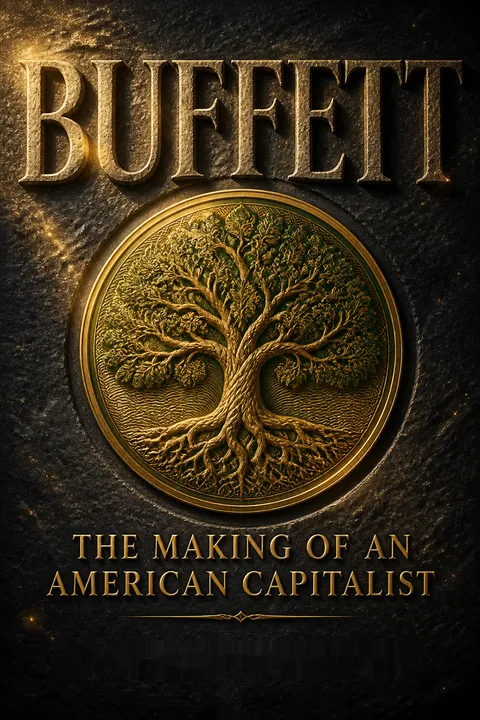


Key Takeaways
Build an edge by waiting for businesses you can understand
A mind trained to notice. As a boy, Buffett counted passing cars, tracked soda bottle caps to compare brands, and searched company figures for overlooked value. The habit became a career: from 1957 through 1995, the Buffett Partnership and Berkshire compounded at about 29 percent annually, compared with roughly 11 percent for major market averages. A $10,000 investment made at the start of his career would have grown to about $125 million by the end of 1995, according to the book.
Temperament made the method work. Buffett avoided leverage and elaborate trading systems. He focused on a few businesses, waited for attractive prices, and stayed invested through changing markets. Lowenstein’s central claim is that discipline, patience, and independent judgment, rather than a secret formula, powered an astonishing record.
The biography makes an important distinction between a method and the temperament needed to use it. A checklist can teach investors what to examine, but it cannot make waiting feel comfortable when prices fall or peers seem richer. Buffett’s record also invites caution: one remarkable career is evidence that exceptional investing can happen, not proof that the same returns are readily repeatable. The more transferable lesson is less glamorous than the headline number: build a process that reduces impulsive decisions, then judge it over a horizon long enough for business performance to matter.
Treat each stock as ownership, not a moving price
A share means a business. Ben Graham taught Buffett to estimate a company’s intrinsic value, meaning what the underlying business is worth based on its assets, earnings, and prospects. That estimate is distinct from the price investors happen to quote. Graham’s parable of Mr. Market makes the distinction vivid: imagine a business partner who offers a new price every day, sometimes sensible, sometimes driven by excitement or fear. The owner may accept the offer, or ignore it.
Use volatility as an offer. When American Express shares plunged after a salad-oil fraud threatened its reputation, Buffett checked whether customers were still using its cards and traveler’s checks. They were. He concluded the business remained strong, bought heavily, and treated the falling quote as an opportunity rather than a verdict.
This model separates two questions that markets constantly blur: what a business can earn, and what other investors currently feel about it. It also changes the role of news. A price drop matters when it signals weaker economics, but not simply because it is a drop. The model is most useful when investors have done enough work to distinguish those cases. Without that groundwork, calling Mr. Market irrational can become a convenient excuse for refusing to admit a mistaken thesis.
Demand a wide gap between your estimate and the price
Leave room for error. Graham’s margin of safety is the cushion between an investment’s estimated worth and the price paid. It protects against mistakes in analysis, bad luck, or a business that performs worse than expected. Graham often searched for exceptionally cheap companies, including firms whose shares traded below the value of their current assets. These were sometimes called cigar butts: troubled businesses that might still have a little value left to extract.
Precision is not required. The estimate of value is uncertain, so the price must be low enough to make that uncertainty tolerable. Buffett’s early purchase of Union Street Railway, whose cash alone was far above its share price, illustrates the appeal of a measurable bargain. His later investments in brands relied on less exact estimates, but he still sought a meaningful gap between price and expected value.
The idea resembles safety engineering: a bridge is not designed to survive only the average load, and a portfolio should not depend on every forecast being right. The margin is especially useful because it turns uncertainty into a price discipline rather than a reason to pretend certainty exists. Its weakness is that a precise-looking discount can be illusory when assets are hard to sell or a business is structurally deteriorating. A cheap quote is protection only if the underlying value is real.
Concentrate only when conviction rests on evidence, not bravado
Wait for a rare pitch. Buffett sometimes put a large share of his capital into one investment when he believed the facts justified it. American Express eventually reached about 40 percent of his partnership’s portfolio. That concentration was not a bet on a market forecast. He had investigated the company’s products and found that the fraud had not driven customers away.
Patience includes doing nothing. During the speculative boom of the 1960s, Buffett could not find enough investments that met his standards. In 1969, after years of strong results, he closed his partnership and returned capital rather than imitate a market he did not understand. He re-entered as prices collapsed in the mid-1970s. Concentration magnifies judgment in both directions, so it requires deep research and the ability to accept being out of fashion.
Concentration can make strong analysis matter more, but it also makes analytical error more consequential. Buffett’s restraint is therefore as important as his willingness to place a large bet: he did not treat boldness as a virtue in itself. In modern portfolio terms, concentration exposes an investor to company-specific risk that broad diversification reduces. The approach is not a universal prescription. It depends on unusual knowledge, emotional steadiness, and a willingness to hold cash when compelling opportunities are scarce.
Pay for durable customer loyalty, not just cheap assets
Value can live off balance sheets. Buffett’s early investments followed Graham’s preference for cheap, tangible assets. His thinking broadened as he recognized that a trusted brand can command repeat purchases and support higher prices without requiring vast new investment. He and Charlie Munger bought See’s Candy for $25 million, despite its limited book value, because customers valued its name and product.
Coca-Cola made the case at scale. In 1988, Berkshire began buying Coca-Cola at an average price of about $10.96 per share. Buffett saw a famous brand, a low-capital business, and substantial room to grow abroad. The company was improving its international sales and focusing on its core drink. He could not calculate the brand’s worth as neatly as cash in a bank, but judged its earning power compelling at the price.
A brand is not merely a logo. It can reduce the effort required to win customers again, which gives a company more durable cash generation than a balance sheet alone reveals. That durability can justify paying more than an asset-based investor once would. But reputation is not permanent property. Consumer tastes, distribution, and competitors can change, so a celebrated name deserves scrutiny rather than reverence. The useful question is whether loyalty still produces measurable economic advantages.
Judge managers by what each retained dollar earns
Growth can destroy value. Berkshire Hathaway began as a struggling textile company. Its leaders repeatedly invested in modernizing mills, but competitors made similar moves, prices stayed weak, and the industry’s returns remained poor. Buffett eventually shifted capital toward insurance, banking, publishing, and other businesses. The lesson was not that textiles lacked effort, but that excellent effort cannot always repair unattractive economics.
Measure capital use. Buffett judged managers by the return earned on the money they retained, not by sales growth or company size. A smaller business earning a strong return could be more valuable than a much larger one earning little. He also granted operating managers broad independence, while keeping capital allocation at Berkshire’s center. He was slower than he should have been to close the textile mill, showing that loyalty and attachment can compete with sound economics.
This is a sharp distinction between operational competence and business quality. A capable manager can run a weak business efficiently and still generate poor returns if competition forces constant reinvestment. The principle connects to capital budgeting: each retained dollar should be compared with the best alternative use of that dollar. Yet numerical discipline has limits. Closing a business affects workers and communities, costs that do not appear cleanly in a return calculation. Buffett’s delay reveals that capital allocation is also a human judgment.
Let insurance float grow only when premiums price risk honestly
Cash arrives before claims. In insurance, float is money collected as premiums before claims are paid. Berkshire could invest that money during the interval, making insurance a source of capital as well as an underwriting business. But float is not free money: if premiums are too low for the risks taken, later claims can erase the apparent advantage.
Refusing business can be strategic. From 1980 to 1984, Berkshire reduced premiums from $185 million to $134 million rather than chase poorly priced policies. When competitors suffered losses and pulled back, insurance prices rose, and Berkshire’s financial strength made it a preferred provider. By 1986, premiums had reached about $1 billion. The gain came from combining patient capital with careful judgment about what risks were worth taking.
Insurance turns patience into a financing advantage, but only when the promise to pay claims is taken seriously. The crucial discipline is to resist volume for its own sake, especially when competitors are cutting prices to preserve market share. This logic extends beyond insurance: any business that receives cash before delivering its full obligation can mistake temporary liquidity for genuine profit. Strong capital reserves and conservative estimates are what distinguish useful float from a delayed financial problem.
Ignore the crowd's forecast; study the business underneath it
Prices can be wrong together. The Efficient Market Theory holds that available information is already reflected in stock prices, making consistent outperformance extremely difficult. Buffett argued that this may describe many moments, but not every moment. During the 1973-74 market collapse, investors avoided companies such as the Boston Globe’s parent even when the shares traded at only a few times earnings. Buffett bought because he valued the business rather than the prevailing mood.
Volatility is not the same as business risk. The financial measure beta treats a stock’s past price swings as a proxy for risk. Buffett objected that a lower price does not make a sound business more dangerous to own. The 1987 crash, when selling spread rapidly despite no equivalent sudden collapse in business prospects, dramatized how crowd behavior can overwhelm analysis.
The strongest version of Buffett’s argument is not that markets are foolish, but that their accuracy varies. Prices aggregate information impressively in ordinary conditions, yet shared incentives and fear can push investors toward the same mistake. That distinction matters more than declaring either perfect efficiency or permanent mispricing. His critique also warns against confusing a measurable proxy with the thing it is meant to measure. Still, volatility is not meaningless: forced sellers and short time horizons can make price instability a genuine practical risk.
Protect trust as an asset, especially when panic hits
A crisis tests the institution. When Salomon Brothers’ bond trader submitted false Treasury bids, senior leaders delayed full disclosure. The scandal threatened the firm’s funding and access to government auctions. Buffett stepped in as interim chairman, apologized publicly, cooperated with investigators, and demanded that employees stay far from even questionable conduct. The government ultimately declined to bring criminal charges against the firm, and Salomon continued operating.
Reputation takes years to build. Buffett had long treated business partners as relationships, not disposable transactions. His approach to the crisis showed the practical value of that belief: candor helped restore confidence when legal maneuvering alone could not. But personal trust is not a substitute for internal controls. The episode also exposed how weak oversight and poor incentives can let one employee’s misconduct become an institutional emergency.
Trust is often described as a moral asset, but Salomon shows its operational role: creditors, customers, employees, and regulators must believe the institution can keep functioning before they will continue doing business with it. Buffett’s candor helped create that possibility. The episode also shows why character cannot carry the whole burden. Clear responsibilities, timely escalation, and independent controls are needed so that a firm does not depend on one unusually credible rescuer when its systems fail.
Notice when ambition compounds faster than family connection
Success had a private cost. Buffett’s work gave him extraordinary focus and pleasure, but his children often experienced him as emotionally distant. His wife, Susie, carried much of the family’s social and domestic life; after she moved to San Francisco, they remained close, while Astrid Menks became his companion at home in Omaha. The arrangement preserved important relationships, but also reflected Buffett’s strong resistance to disrupting familiar routines.
Money was not the same as care. Buffett limited what he gave his children because he feared wealth would weaken their independence. His restraint had a coherent principle behind it, yet it could feel impersonal to the people he loved. The biography presents a man whose discipline made him a remarkable investor and whose narrow focus sometimes made ordinary emotional needs hard for him to notice.
The personal story complicates any simple celebration of single-mindedness. Deep focus can produce rare mastery, but attention is finite, and what is excluded may matter more than the achievement itself. Buffett’s family could see both his devotion and its limits. His reluctance to use money as affection also raises a broader distinction between equality and responsiveness: treating loved ones by one rule can be principled, yet still fail to meet their particular needs. Success does not settle that tension.
Analysis
Lowenstein’s biography is most valuable when it treats Buffett’s investing as a life pattern rather than a bag of techniques. The boy who counted soda caps and memorized figures grows into an investor who interprets business through numbers, waits for rare opportunities, and builds an unusually concentrated company around enduring ownership. Graham supplies the conceptual foundation, while Munger and Buffett’s experience broaden it from bargains in assets to bargains in business quality. The recurring narrative is a contest between independent judgment and the pressure to conform, whether the pressure comes from markets, managers, or regulators.
The book also resists a tidy hero story. Buffett’s patience sometimes became attachment: he kept Berkshire’s textile operations too long, stayed with investments that disappointed, and could be harshly impersonal with his children. His generosity toward managers and partners coexisted with a formidable insistence on control. These contradictions matter because they show that a successful temperament is not a universally admirable personality. The same narrow focus that filters market noise can filter out emotional signals at home.
The biography’s investment evidence is compelling but must be read with historical perspective. Buffett’s record spans very different cycles, yet a biography centered on one extraordinary winner naturally risks making his path appear more reproducible than it is. His actual method depends on access to capital, exceptional memory, long horizons, and the ability to tolerate public doubt. Most readers cannot copy his outcomes. They can, however, adopt the more defensible habits the narrative documents: analyze the business, compare price with value, refuse investments outside one’s understanding, and treat reputation as part of the balance sheet.
The book’s deepest claim is that investing is not chiefly a contest of speed or sophistication. It is a discipline of judgment, character, and capital allocation. Buffett’s achievement makes that claim memorable, while his mistakes and private costs prevent it from becoming a simple myth of effortless wealth.
Review Summary
Buffett: The Making of an American Capitalist is highly praised for its insightful portrayal of Warren Buffett's life and investment philosophy. Readers appreciate the book's detailed exploration of Buffett's business acumen, character, and personal relationships. Many consider it one of the best biographies on Buffett, offering valuable lessons on value investing and long-term financial strategies. The book is commended for its balanced approach, discussing both Buffett's successes and flaws. Some readers note that while the book is slightly dated, it remains relevant and engaging for those interested in business and investing.
People Also Read







Glossary
Intrinsic value
Estimated business worthIntrinsic value is an estimate of what a company or security is worth based on the underlying business, including its assets, earnings, and prospects. It is distinct from the price quoted in the market. The estimate is uncertain rather than exact, so investors compare it with the purchase price instead of treating it as a guaranteed figure.
Margin of safety
Cushion against errorMargin of safety is the difference between an investor’s estimate of a security’s value and the price paid for it. Graham’s principle is to buy only when that gap is large enough to provide protection against errors in analysis, adverse events, or weaker-than-expected business performance. It does not eliminate risk, but makes the investment less dependent on precise forecasts.
Mr. Market
Unstable daily quotationsMr. Market is Benjamin Graham’s parable for the stock market. He is an imagined business partner who offers to buy or sell an investor’s share each day at a changing price. Sometimes the offer is reasonable; sometimes emotion makes it foolish. Investors can use the quote when it is favorable and ignore it when it is not.
Float
Premiums awaiting claimsFloat is the money an insurer receives in premiums before it pays claims and related costs. While the funds remain available, the insurer can invest them. Float can be valuable capital, but it is not automatically profitable or free: if the insurer underprices risks or underestimates future claims, losses may exceed the investment benefit.
Franchise
Durable customer preferenceA franchise is a business advantage rooted in customer preference, brand strength, or market position that helps a company retain customers and earn attractive returns. In Buffett’s analysis, a strong franchise can support pricing power and require relatively little capital to maintain. The advantage is economic, not merely a legal license or a famous name.
Circle of competence
Known area of judgmentA circle of competence is the set of businesses or subjects an investor understands well enough to evaluate. Buffett’s approach stresses knowing the limits of that circle, not making it as large as possible. If a company’s economics depend on unfamiliar technology or other factors the investor cannot assess, passing may be wiser than guessing.
Efficient Market Theory
Prices reflect available informationEfficient Market Theory holds that security prices incorporate publicly available information, making it difficult to identify mispriced stocks consistently. The book presents Buffett’s challenge to the strongest version of the theory: prices may often be informative without being perfectly accurate at every moment. Market emotion and shared behavior can create gaps between price and business value.
Beta
Historical price volatilityBeta is a measure comparing how much a stock’s price has moved against movements in the broader market. Financial theorists use it as a proxy for risk and expected return. Buffett objected that past price volatility does not necessarily measure the risk of owning a business, which depends more directly on its economics and the price paid.
Rhinophobia
Fear of holding cashRhinophobia is the term used in the book for an investor’s dread of having cash rather than investments. Cash can feel unproductive, creating pressure to buy something even when prices are unattractive. The label captures a behavioral danger: the desire to stay active can push investors into weaker opportunities simply to avoid waiting.
Super-cats
Catastrophe reinsurance policiesSuper-cats are large reinsurance policies that protect insurers against exceptionally costly catastrophes affecting many policies at once. Berkshire wrote this coverage when it judged the premiums adequate for the potential losses. Because a severe event can produce enormous claims, the business depends on cautious risk estimates, financial strength, and willingness to refuse inadequate prices.
FAQ
What's Buffett: The Making of an American Capitalist about?
- Biography of Warren Buffett: The book chronicles Buffett's journey from a young boy in Omaha to becoming one of the most successful investors in history.
- Investment Philosophy: It explores his unique investment strategies, particularly his adherence to value investing principles.
- Personal and Cultural Insights: The narrative delves into Buffett's personal life and his influence on American capitalism.
Why should I read Buffett: The Making of an American Capitalist?
- Insight into Success: Gain valuable insights into the mindset and strategies that propelled Buffett to success.
- Understanding Value Investing: The book provides a thorough understanding of value investing, emphasizing intrinsic value and long-term thinking.
- Inspiration and Relatability: Personal anecdotes humanize Buffett, making his principles relatable and applicable to everyday life.
What are the key takeaways of Buffett: The Making of an American Capitalist?
- Value Investing Philosophy: Focus on buying undervalued companies with strong fundamentals.
- Long-Term Perspective: Emphasizes the importance of patience and a long-term investment horizon.
- Integrity and Character: Highlights the role of personal values in professional success.
What are the best quotes from Buffett: The Making of an American Capitalist and what do they mean?
- “Price is what you pay, value is what you get.”: Stresses the importance of understanding intrinsic value over market price.
- “Be fearful when others are greedy and greedy when others are fearful.”: Encourages a contrarian approach to market sentiment.
- “The stock market is designed to transfer money from the Active to the Patient.”: Emphasizes the advantage of long-term investing over short-term speculation.
What is Warren Buffett's investment philosophy as described in Buffett: The Making of an American Capitalist?
- Value Investing: Focuses on buying undervalued companies with strong fundamentals.
- Circle of Competence: Advises investing in businesses one understands well.
- Margin of Safety: Ensures the purchase price is significantly below the intrinsic value.
How did Buffett's early life influence his investment strategies?
- Childhood Experiences: Early exposure to business and finance instilled an entrepreneurial spirit.
- Mentorship from Graham: Education under Benjamin Graham shaped his focus on intrinsic value and risk management.
- Practical Learning: Early stock market experiences taught him the importance of thorough research.
What role did Benjamin Graham play in Buffett's life?
- Mentorship: Graham was a significant influence on Buffett's investment philosophy.
- Investment Principles: Taught Buffett the importance of intrinsic value and a margin of safety.
- Long-Term Impact: Buffett credits Graham as a pivotal figure in his career.
How does Buffett view risk in Buffett: The Making of an American Capitalist?
- Calculated Risk: Focuses on thorough analysis rather than speculation.
- Avoiding Leverage: Prefers investing his own capital to minimize potential losses.
- Long-Term Perspective: Believes holding investments long-term reduces the likelihood of loss.
How does Buffett's investment approach differ from Wall Street trends in Buffett: The Making of an American Capitalist?
- Contrarian Mindset: Often goes against popular investment trends, focusing on undervalued stocks.
- Emphasis on Fundamentals: Prioritizes understanding the long-term potential of a business over short-term gains.
- Avoidance of Speculation: Prefers investing in companies with solid fundamentals and a clear growth path.
How did Buffett handle market downturns in Buffett: The Making of an American Capitalist?
- Emotional Detachment: Remains calm and rational, making informed decisions during downturns.
- Buying Opportunities: Views downturns as chances to buy quality stocks at discounted prices.
- Focus on Fundamentals: Emphasizes the importance of business fundamentals over market sentiment.
What is the significance of the relationship between Buffett and Charlie Munger in Buffett: The Making of an American Capitalist?
- Mutual Respect and Influence: Munger challenges Buffett's thinking, enhancing their investment strategies.
- Complementary Strengths: Their differing personalities create a balanced partnership.
- Long-Term Collaboration: Exemplifies the power of collaboration in achieving long-term success.
How did Buffett's philanthropic efforts evolve over time?
- Initial Reluctance: Initially hesitant to give away wealth, valuing self-sufficiency.
- Major Shift: Reconsidered philanthropy after his first wife's death, pledging to give away most of his wealth.
- Collaboration with Gates: Partnered with the Gates Foundation, focusing on large-scale impact in global health and education.
About the Author



Download PDF
Download EPUB
.epub digital book format is ideal for reading ebooks on phones, tablets, and e-readers.








