

Key Takeaways
Define the life money should buy before calculating your freedom number
Start with the destination. Sam Dogen's escape plan began with a job that damaged his health: at Goldman Sachs, 4:30 a.m. alarms and long days left him with chronic pain and stress. He originally planned to leave by forty, but negotiated a severance and left banking at thirty-four. The point is not simply to quit work. Financial freedom means control over how time is spent, including the freedom to care for family, pursue meaningful work, and speak up without fearing a boss.
Price your preferred life. Dogen suggests estimating the income your desired lifestyle actually requires. His guide is a net worth of 20 times average gross annual income, or investments generating enough income to cover expenses, with a buffer for taxes. A goal based on your own life is more useful than an abstract millionaire target.
What's striking is the book's insistence that wealth is valuable because it creates options, not because a large account balance is inherently fulfilling. That aligns with the economic idea of option value: resources matter partly because they preserve choices when circumstances change. A personal budget also makes sacrifice legible, because each saved dollar can be connected to time or freedom. The caution is that a formula such as 20 times income cannot capture health costs, dependents, public benefits, or unequal earning conditions. It is a planning prompt, not a universal finish line.
Make bold money moves when the odds favor you, not certainty
Choose under uncertainty. Dogen's 70/30 philosophy means acting when a decision seems at least 70% likely to be optimal, while accepting that roughly 30% of the time it may not work out. He contrasts this with waiting for certainty, which can mean missing a job, a home, or a relationship simply because no one can promise the outcome. The method is to gather information, estimate the odds, and act when the balance looks favorable.
Improve your forecasts. The book recommends recording predictions about uncertain events, such as a house's sale price or a sports result, then comparing them with what happened. This makes errors visible and helps refine future judgments. The goal is not to eliminate mistakes, but to learn from them and avoid confusing a lucky outcome with skill.
This framework usefully treats decision-making as a learnable skill rather than a contest in confidence. Forecasting research distinguishes calibration, whether events assigned a probability occur at that rate, from accuracy on any single guess. That distinction helps prevent one lucky investment from becoming a reason for overconfidence. The 70% threshold, however, can suggest more precision than personal decisions allow. Probabilities are often subjective, and a low-probability outcome can still have enormous consequences. The strongest version of the method pairs estimates with a clear view of downside, reversibility, and the cost of waiting.
Turn every saved dollar into a named piece of future freedom
Give money a job. Dogen recommends maintaining an emergency fund, using tax-advantaged retirement accounts, and building taxable investments that can be accessed before the usual retirement age. He suggests saving at least 20% of after-tax income in taxable investments after retirement contributions, with 50% or more as an ambitious target. His broader point is that saving in cash alone may not build enough wealth to create independence.
Connect saving to life. Income tethering means linking an investment or effort to a specific expense or goal. A weekly $8 croissant costs $416 a year. At a 3% return, about $13,866 invested could generate that amount annually. Naming what an investment funds makes progress tangible, whether the target is a small pleasure, education, or housing.
Income tethering draws on mental accounting, the tendency to organize money into psychologically distinct categories. Used deliberately, that habit can make long-term saving feel rewarding now, rather than like an indefinite act of deprivation. It also helps translate an abstract portfolio into a concrete life. The arithmetic is illustrative, not a guarantee: investment returns fluctuate, taxes matter, and a stable yield is not assured. The useful practice is the connection between money and purpose, not treating a projected return as a promise to fund a particular treat forever.
Pay expensive consumer debt first, and borrow only to build assets
Separate useful debt from costly debt. Dogen puts revolving credit-card balances at the top of the payoff list because interest can be extremely high, while the purchases often lose value. He also warns against oversized car loans and offers a One-Tenth Rule: spend no more than 10% of gross annual income on a car. A mortgage can be different because it finances an asset that may appreciate and provides housing, though it still creates risk.
Split spare cash deliberately. The Financial Samurai Debt and Investment Ratio, or FS DAIR, allocates a percentage of cash flow after living expenses to extra debt repayment by multiplying the interest rate by ten. At 3% interest, that means 30% toward extra principal and 70% toward investing. At 10% or higher, the framework directs all available cash to debt.
The most solid part of this framework is its recognition that debt repayment offers a certain saving equal to the interest avoided, while investment returns are uncertain. That comparison becomes especially compelling for high-rate consumer debt. The rule also keeps people from treating every low-rate loan as an emergency. Still, a fixed formula cannot replace attention to liquidity, employer retirement matches, or a borrower's need for psychological security. The debt snowball, which clears small balances first for momentum, may cost more in interest but can be more sustainable for some households.
Diversify your wealth and measure risk by recovery time
Match risk to your life. Dogen asks investors to translate a market loss into months of work needed to recover it. His example assumes a 35% decline: a $500,000 stock portfolio could fall by $175,000. At $10,000 of gross monthly income, that loss equals 17.5 months of gross pay, before taxes and living costs. Someone unwilling or unable to spend that time rebuilding may be taking too much risk.
Build a mix you can hold. The book recommends spreading wealth across stocks, bonds, and real estate, and placing at least 80% of stock investments in passive index funds or ETFs. It also proposes a conservative initial retirement withdrawal rate tied to 80% of the ten-year Treasury yield, then adjusting once the retiree has experience living without a paycheck.
Framing a portfolio decline as lost work time gives risk a human scale. It connects investment theory to labor supply and personal capacity, rather than treating volatility as a number detached from daily life. Diversification also reduces dependence on any single source of wealth or income. The withdrawal-rate proposal is intentionally cautious, but tying spending mechanically to bond yields has limitations: yields and markets move differently, and households can adapt spending or earn income. Historical averages also conceal sequence risk, the danger that losses arrive early in retirement when withdrawals are already underway.
Buy a home only when its costs leave room for your life
Use guardrails before bidding. Dogen's 30/30/3 rule says monthly housing costs should stay around 30% or less of gross income, buyers should have 30% of the home's value saved, and the purchase price should generally be no more than three times annual household income. The savings target includes a 20% down payment and a 10% reserve. He allows that buyers might stretch toward five times income under favorable conditions, but treats that as riskier.
Compare need with opportunity cost. BURL means buy utility, rent luxury. A spacious home may be a poor use of capital if its rent could pay for a smaller home and leave cash over. Dogen describes downsizing and renting out a larger San Francisco house, which improved monthly cash flow. Renting can also make sense when career mobility matters more than owning.
The value of these rules is less that they identify a perfect home price than that they force buyers to examine cash flow, reserves, and ongoing costs before emotion takes over. BURL adds an important opportunity-cost lens: living in a property means giving up the rent or investment income it might produce. Housing, however, is both an asset and a source of stability, community, and personal utility. A rent-versus-buy calculation cannot fully price those benefits, and local taxes, supply, and mobility can change the answer substantially.
Treat your career as your first investment, not a life sentence
Build earning power early. Dogen argues that a career is often the first major source of investable capital. He got his Goldman Sachs interview after being the only student to show up for an early bus to a career fair, then went through 55 interviews before receiving an offer. He advises workers to target opportunities with strong pay, build skills and relationships, and consider changing jobs every two to five years when compensation or advancement stalls.
Plan the exit, too. In 2012, Dogen negotiated a departure from banking that included severance worth roughly five to six years of living expenses, along with other compensation. His advice is to explore a negotiated layoff rather than simply quit when already planning to leave. A smooth handoff can serve the employer and improve the employee's negotiating position.
The career chapter treats wages as investable fuel and bargaining power as a skill, a useful corrective to the idea that diligence alone guarantees fair pay. The author's bus story makes the point vividly: initiative created access where pedigree did not. Labor economics also suggests that changing employers can sometimes produce larger pay gains than internal raises, although the advantage varies by occupation, benefits, and job security. The advice to work long hours and move frequently is not universally optimal. Care responsibilities, health, pensions, and the value of a stable team all belong in the calculation.
Build a side business that can outlive your available hours
Create an asset, not just another shift. Dogen calls a side hustle an X factor, an additional source of income and autonomy alongside a main job. Gig work can provide immediate cash, but a scalable product, service, or online brand can reach more customers without requiring an equal increase in hours. Examples include a rideshare driver who built an information website, and a pool-industry worker whose educational blog and videos became a profitable business.
Test before leaping. The book recommends starting while a paycheck still covers basic needs. Consider going full time only when the work is genuinely appealing and its income can cover living costs. Replacing a salary may require 30% to 60% more gross income to account for benefits, taxes, and business expenses. A modest lifestyle business can be a better fit than chasing a low-probability jackpot.
The distinction between selling hours and building a repeatable product is central to the economics of entrepreneurship. A scalable asset can compound reach in a way that one-to-one service work cannot, and a stable job can function as insurance while an idea is tested. Yet success stories are highly visible precisely because many attempts fail or earn little. Online businesses also depend on platforms, search rankings, and changing audience behavior. A sound experiment therefore sets a time and cash budget, measures demand, and protects household essentials before treating early enthusiasm as proof of a durable business.
Price education and family decisions against their real opportunity costs
Pay for outcomes, not prestige alone. Dogen estimates that one San Francisco private-school path from kindergarten through college would cost about $745,660 in tuition at the prices he examined. Investing those payments at 5% instead could produce roughly $1.13 million over 17 years. He cites a study estimating private college's career earnings advantage over public college at about $73,000, while stressing that fit, safety, scholarships, and a child's needs matter. His rule of thumb is to consider private school when household income is at least seven times net tuition.
Protect independence at home. Money choices shape relationships, too. Dogen favors both joint and separate accounts so partners can manage shared goals while retaining personal spending autonomy. He urges couples to discuss debt, saving, and expectations before commitment, rather than assuming affection will resolve financial conflict.
This section is strongest when it replaces prestige with a question about what a particular educational setting actually provides. Opportunity-cost calculations reveal that tuition competes with investment, family security, and time. But education's value is not reducible to later salary: safety, belonging, disability support, and intellectual fit can matter more than a narrow return estimate. The same principle applies to couples. Shared financial goals need not erase personal autonomy, and separate accounts can reduce friction, but transparency and agreement about household responsibilities matter more than account architecture alone.
Protect your time, health, and privacy from status spending
Keep wealth quieter than its symbols. Dogen's Stealth Wealth approach discourages conspicuous cars, luxury displays, and casual disclosure of income or assets. His One-Tenth Rule suggests keeping a car's purchase price at or below 10% of gross annual income. His father modeled frugality by choosing water instead of soda, then using the saved money to invest. The point is not to deny every pleasure, but to avoid buying status at the cost of future choices.
Count the cost of your time. Cooking, cleaning, or home maintenance is not automatically free when it consumes valuable hours or carries stress and injury risks. Dogen suggests comparing the cost of outsourcing with what that time could enable. He also links financial freedom to health, noting that some of his chronic pain eased after leaving a punishing job.
Stealth Wealth is a useful defense against social comparison: visible consumption invites people to judge, imitate, or make demands, while quiet finances preserve privacy. The time-cost lens similarly exposes the hidden price of unpaid tasks and can help people spend on support without guilt. But rules such as the car limit are blunt instruments. A reliable vehicle may be essential where transit is poor, and outsourcing is not affordable for everyone. The deeper principle is to assess spending by its effect on safety, time, and chosen priorities, rather than by whether it looks frugal or impressive.
Analysis
The book's central argument is that financial independence is not achieved by saving in isolation. It comes from coordinating earning, investing, spending, career choices, housing, and relationships around a concrete picture of a desirable life. Its strongest organizing move is to treat money as a way to buy time and options. This lets the author connect seemingly separate topics, from taxable investment accounts to severance negotiation, under one question: does this decision increase future freedom without making the present life intolerable?
The practical style is memorable because it converts broad advice into thresholds: 20 times income, a 30/30/3 home rule, 10% of income for a car, and a 70/30 decision framework. These are useful as prompts that force people to calculate trade-offs. They are less reliable as universal prescriptions. Personal finance depends on local housing markets, income volatility, family obligations, health, and public benefits. A threshold can discipline a decision, but cannot substitute for modeling its actual consequences.
There is also a productive tension between caution and ambition. The book favors diversification, conservative early retirement withdrawals, and avoiding consumer debt, while encouraging real estate leverage, aggressive saving, entrepreneurship, and high-effort careers. That tension is not a flaw by itself. It reflects the difference between taking calculated risks and accepting risks that can permanently damage a household. The reader's task is to distinguish risks that are reversible from those that are not.
The advice is most transferable when treated as a decision process rather than a fixed financial blueprint: define the desired life, estimate costs, compare alternatives, protect against ruin, and update assumptions as circumstances change. The author's personal experience supplies useful examples, but it also reflects a high-income finance career and access to investment opportunities that many readers may not share. A practical adaptation should preserve the agency of the framework while recognizing that sound choices cannot remove structural constraints or guarantee the same results.
Review Summary
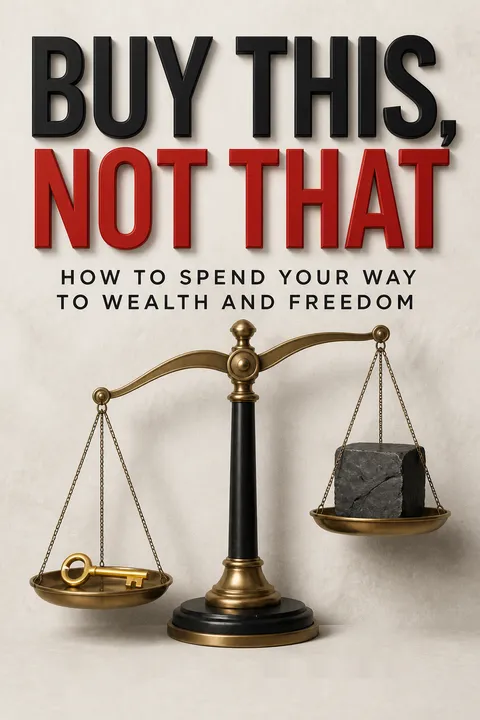
Buy This, Not That offers valuable financial advice, particularly for high earners. Readers appreciate Dogen's practical approach to achieving financial independence, including strategies for real estate investment, career optimization, and side hustles. The book's strengths lie in its comprehensive coverage of personal finance topics and the author's experience-based insights. However, some criticize its focus on high-income individuals and occasional repetitiveness. Overall, reviewers find it a useful guide for those seeking financial freedom, though its relevance may vary depending on the reader's financial situation.
People Also Read








Glossary
70/30 philosophy
A probability threshold for actionA decision-making approach that recommends acting when a choice appears to have at least a 70% chance of being optimal, while accepting that some decisions will still turn out poorly. The framework discourages waiting for certainty and urges people to learn from outcomes, manage downside risk, and revise their forecasts.
Financial Samurai Safe Withdrawal Rate (FSSWR)
A conservative retirement withdrawal guideThe author's proposed initial retirement withdrawal formula: multiply the current ten-year Treasury yield by 80%. For example, a 2% yield implies a 1.6% withdrawal rate. Dogen presents it as a cautious starting point during the vulnerable early years of retirement, with the possibility of adjusting withdrawals after adapting to life without a paycheck.
Income tethering
Link investments to life goalsA practice of assigning a specific purpose to savings, investments, or work income. Instead of treating money as an abstract balance, a person identifies what it funds, such as a recurring treat, education, housing, or family travel. The connection is meant to make saving more motivating and keep financial effort tied to lived priorities.
Financial Samurai Debt and Investment Ratio (FS DAIR)
A debt and investing splitA rule for allocating cash flow after living expenses between extra debt payments and investing. The debt interest rate, expressed as a percentage, is multiplied by ten to determine the percentage directed to debt repayment. At 3% interest, the suggested split is 30% to debt and 70% to investments. At 10% or higher, the framework directs all available cash to debt.
30/30/3 home-buying rule
Three home-affordability guardrailsA home-buying framework recommending that monthly mortgage costs stay near or below 30% of gross income, buyers save 30% of the home's value, and the home's price remain at or below three times annual household income. The savings target is described as a 20% down payment plus a 10% reserve. The author allows a more aggressive price near five times income in some circumstances.
BURL
Buy utility, rent luxuryAn approach to real estate spending that favors owning a practical home with little unused space while renting a more luxurious property when its ownership cost is disproportionately high. It asks homeowners to consider the market rent they forgo by living in their property, and to compare that opportunity cost with the benefits of owning.
X factor
A side-income sourceThe author's term for a side hustle or independent income stream that can supplement a main career. It may begin as active gig work, then develop into a business, product, or brand with greater reach. The X factor can provide savings, career flexibility, and an alternative source of income if employment changes.
Index Plus strategy
Index investing with a small active sliceAn equity approach that places at least 80% of a public stock portfolio in passive index funds or ETFs, while leaving a smaller portion for individual stocks, actively managed funds, or other investments. The broad index allocation aims to capture market returns, while the limited active portion allows investors to pursue specific opportunities without putting the whole portfolio at risk.
Stealth Wealth
Keep wealth inconspicuousA set of behaviors intended to protect privacy and avoid unwanted attention around money. It includes limiting conspicuous purchases, avoiding public discussion of full income or wealth, and staying humble about success. The approach treats discretion as a way to reduce social pressure, judgment, and unwanted demands while preserving personal freedom.
One-Tenth Rule for Car Buying
Cap car cost at income's tenthA car-buying guideline that limits a vehicle's purchase price to 10% or less of gross annual income. The author applies the limit to new or used vehicles, whether bought outright or leased, and suggests considering the combined value if owning more than one car. It is designed to curb oversized vehicle spending and preserve money for investing.
Frenzy Zone
The city's broad-demand price bandThe author defines a city's Frenzy Zone as roughly 20% below to 20% above its median property price. The range represents homes affordable to a relatively large pool of buyers, which can support demand in both strong and weak markets. He suggests considering properties just above the band when reduced competition may create better negotiating opportunities.
neutral real estate
Owning the home you occupyThe author's label for owning a primary residence without owning additional properties. A homeowner is less exposed to rising rents than a renter, but generally cannot capture rental income from the home while living in it. Dogen contrasts this position with being short real estate as a renter and long real estate as an owner of multiple properties.
Download PDF
Download EPUB
.epub digital book format is ideal for reading ebooks on phones, tablets, and e-readers.








