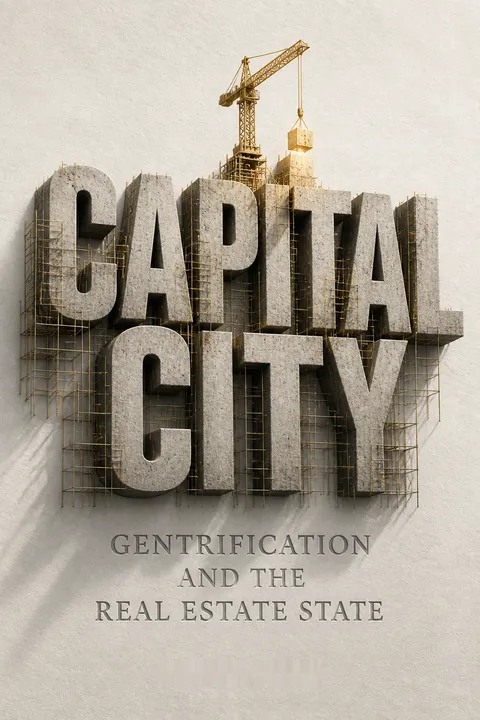


Key Takeaways
Treat rising property values as a political choice, not proof a city is thriving
Follow the money. The book opens with two urban disasters: the 1911 Triangle Shirtwaist Factory fire, which killed 146 workers, and the 2017 Grenfell Tower fire, which killed more than seventy residents. The settings differ, but both reveal how decisions made to protect profit can put residents in danger. In the book’s account, real estate has become a dominant destination for global wealth: property was valued at $217 trillion, about 60 percent of the world’s assets.
Name the governing tendency. Stein calls the political formation built around real estate’s influence the “real estate state.” It is not a single agency or an all-powerful bloc. It is a tendency in government, especially city government, to treat rising property values as a public goal, even when the gains go to owners and the costs fall on tenants.
The term redirects attention from individual villains to the rules and incentives that make private gain a public priority. That is especially useful in cities, where choices about taxes, zoning, infrastructure, and safety are often presented as technical necessities. The opening disasters make the stakes tangible: a building’s value and a resident’s security can be shaped by the same decisions. The argument is strongest as a lens for identifying whose interests policy serves. It is less useful if treated as a complete explanation of every city outcome, since local coalitions and institutions still matter.
Ask who gains when a planning decision is presented as neutral
Planning makes power physical. Planning shapes space over time, through choices about what can be built, where infrastructure goes, and which communities receive investment. The practice is ancient, but professional planning grew alongside industrialization, migration, and social conflict. In Paris, Baron Haussmann’s broad avenues helped remake the city after uprisings and displaced working-class residents. In New York, the 1811 street grid organized land into regular lots that could be bought and developed.
Neutral rules have histories. Zoning was often described as rational land management, yet early examples excluded Chinese residents, and New York zoning was championed by merchants seeking to keep garment workers away from Fifth Avenue. Stein describes two tensions planners manage: owners want public infrastructure but resist limits on property; governments invite public participation while keeping key decisions within elite control. These are the property contradiction and the capitalist-democracy contradiction.
This history makes a powerful point: procedure is not the same as neutrality. A rule can apply to everyone on paper while protecting some groups’ assets and restricting others’ options. The distinction matters because planning debates often turn on the language of expertise, as if an equation or map settles a question of justice. Yet the historical examples also caution against reducing every planning intervention to a single motive. Building codes, parks, and transit can improve lives even when they also raise nearby property values. The critical question is who can stay to enjoy those gains.
Track the investors and buyers whose combined choices produce gentrification
Follow both sides. Gentrification is the reinvestment of capital in a neighborhood that raises costs and displaces poorer residents and their cultural life. It requires both producers, such as developers and landlords, and consumers, such as wealthier renters, buyers, and shoppers. If investors build but affluent customers do not arrive, the project may fail; demand without investment also cannot transform a neighborhood. Government helps connect the two, using planning, tax policy, and public improvements to attract capital and residents.
Look at the groundwork. From the 1950s to the 1990s, New York lost 750,000 manufacturing jobs while the value of its land rose from $20 billion to $400 billion. Redlining had restricted credit in Black and immigrant neighborhoods, while urban renewal had cleared working-class areas. As industry left, property investment took up space left behind by disinvestment and demolition.
The producer-consumer distinction prevents a common simplification: gentrification is not merely newcomers changing a neighborhood’s taste or appearance. It is a coordinated process in which capital, demand, and public policy reinforce one another. The focus on government also explains why seemingly beneficial investments can become displacement pressures. This framework can help residents ask more precise questions: who is financing the change, who is expected to move in, and what happens to existing tenants? It should not imply that every new resident causes displacement. The argument concerns systems that make rising land values profitable and tenant protections weak.
Follow the rent gap: capital targets places where future rents dwarf current ones
Compare present and potential. Geographer Neil Smith’s “rent gap” describes the difference between what a property currently earns and what it could earn after renovation, redevelopment, a change in use, or the removal of tenants. Investors seek locations where closing that gap can produce a return. Gentrification is therefore not simply a return of people to the city; it is a search for profitable future income from land.
Watch the use change. In Manhattan’s Chinatown, garment factories once employed about 20,000 workers in 500 shops. As residential and commercial rents became more lucrative than factory rents, owners converted buildings into offices, hotels, and condominiums. The same logic can apply to individual buildings, whole neighborhoods, rural properties, and tourist districts. Since investment moves unevenly, some places gentrify while others face abandonment or disinvestment.
The rent gap gives a concrete way to understand why apparently neglected spaces attract investors: their value is judged not only by what they produce today, but by the income someone expects to extract tomorrow. It also connects housing to land use and employment, as Chinatown’s factory conversions show. The model is a strong account of investor incentives, but potential rent is an expectation, not a guarantee. Public policy, tenant resistance, financing, and demand can widen or constrain the gap. That makes the concept useful not as a prediction of inevitable change, but as a map of where speculative pressure may gather.
Inspect the subsidies and zoning changes behind every promised public benefit
Public money can de-risk private gain. Stein calls the use of public incentives to attract investment “geobribery.” New York’s J-51 program offered landlords tax breaks for repairs and conversions; its 421-a program subsidized new apartment construction, including luxury projects. Tax Increment Financing, or TIF, lets a city borrow for improvements in a designated district and repay the bonds from future tax growth. If property values rise, developers benefit and the public helps pay for infrastructure; if they do not, the city remains responsible for the debt.
The zoning pen creates value. Upzoning can let a developer build more rent-producing space, while downzoning can make existing buildings more valuable by limiting future supply. Parks, transit, and public plazas can also raise nearby property values. Without strong tenant protections, landlords can capture those improvements through higher rents, while residents who need them most may be priced out.
The useful question is not simply whether a project brings a park, apartments, or jobs. It is how much public risk and subsidy the project requires, who owns the resulting value, and whether residents can remain. This is a more rigorous test than accepting a developer’s list of promised benefits. It also avoids assuming that every incentive is automatically wasteful: some projects may deliver real public goods. The distribution matters. A neighborhood can gain new amenities while losing the people whose taxes, labor, and community life helped make it valuable.
Judge housing plans by who gets protected, not by their affordability label
Different politics, similar pressures. Michael Bloomberg and Bill de Blasio offered sharply different political styles, yet both used rezonings and development to address housing costs. Bloomberg’s administration upzoned working-class neighborhoods while often protecting wealthier areas. De Blasio made affordable housing central to his agenda through Mandatory Inclusionary Housing, which required some income-targeted apartments in certain rezoned areas. But the plan also depended on substantial luxury construction, and its income targets excluded many of the poorest households.
A rezoning can raise prices before building begins. East New York was a disinvested, predominantly Black neighborhood chosen for an early de Blasio rezoning. In anticipation, land prices rose 63 percent and rents rose 16 percent, reaching an average of $1,850. The book argues that a promise to build affordable units does not itself protect existing rent-regulated homes or residents from speculation and displacement.
The comparison shows why political branding is a poor substitute for examining a policy’s mechanics. A program can require affordable units and still produce far more market-rate housing, increase nearby land prices, or fail to serve households with the greatest need. At the same time, this critique should not be confused with the claim that housing supply never matters. The sharper issue is what kind of housing is built, where it is built, and what protections accompany it. Evaluating outcomes by income, tenure, and displacement risk makes the word “affordable” less easy to use as a shield.
Read the Trump family as a history of changing public subsidies
Three generations, three openings. Stein uses the Trump family to show how public planning created opportunities for private fortunes. Friedrich Trump profited from businesses near railway routes and later bought Queens property as bridges, rail lines, and city infrastructure made it more valuable. His son Fred built federally subsidized housing, including segregated developments, and used public programs to finance large projects. Donald shifted toward luxury development, tax abatements, public land, and favorable zoning.
The state never disappears. For example, Donald’s Grand Hyatt project received a forty-year tax break after public agencies classified the luxury hotel as an economic development project. His career illustrates the book’s broader sequence: private actors first benefit from public investment, then partner directly with government, and finally gain political influence over the rules themselves. The story is not an exception to the real estate state, but a vivid example of how it works.
The family history turns a large structural claim into a sequence of concrete business strategies. It also challenges the familiar story of the lone developer succeeding through personal genius: the projects depended on infrastructure, subsidies, land-use decisions, and public authorities. The case is especially revealing because each generation used a different policy environment rather than following one timeless formula. Still, one family cannot represent every developer or city. Its value is illustrative: it makes visible the public scaffolding that can disappear from narratives celebrating private success.
Keep neighborhood improvements public by securing land before prices rise
Protect the ability to stay. Stein points to stronger rent regulation, expanded public housing, and community land trusts as ways to prevent public investment from becoming a private windfall. A community land trust is a nonprofit arrangement that keeps land outside the speculative market, while residents or cooperatives own or occupy the buildings under rules that preserve affordability. New York’s Cooper Square development emerged from decades of resident resistance and keeps much of its housing affordable over time.
Change what government funds. The book notes that the United States spent roughly $200 billion annually on housing through tax deductions, subsidies, and vouchers, while only about $7 billion went to government-owned and managed housing. Stein argues that shifting resources toward public housing, land acquisition, and tenant protections would make housing less dependent on profit. Socialized land, the larger goal, means treating land as a shared resource rather than a commodity to trade for private gain.
The strongest feature of these proposals is that they do not treat affordability as a temporary discount attached to a market-rate project. They address ownership and control, the deeper mechanisms that determine who benefits from neighborhood change. A land trust, for example, can preserve affordability across later sales rather than relying on a promise from one developer. Such models still require land, funding, management, and democratic accountability. They are not plug-in fixes for every housing shortage. Their wider significance is that they make non-speculative ownership practical and visible, rather than merely theoretical.
Make organized tenants a planning force developers cannot ignore
Planning needs organized power. Stein argues that planners alone cannot undo real estate’s influence because their authority is limited by politicians, markets, and property law. Tenants can challenge that balance through rent strikes, eviction blockades, anti-foreclosure actions, and campaigns to preserve public or community-owned housing. In New York, tenants made up 68 percent of residents, giving tenant movements a potentially powerful base. Their leverage comes not only from their numbers, but from landlords’ dependence on rent payments.
Participation must build power. The book’s proposed New York City Not For Sale platform called for ending homelessness, universal rent control, tenant ownership of distressed buildings, fully funded public housing, and more democratic control over development. Community planning is meaningful when residents can build a counter-plan and identify who blocks it. Endless consultation without influence can instead make exclusion feel democratic.
This is the book’s practical political conclusion: better expertise is not enough when the underlying balance of power remains unchanged. Tenant organizing links household security to decisions about land, construction, and public budgets. It also gives planning a constituency capable of enforcing promises. The emphasis on conflict is important because landlords and tenants do not share identical interests, and a process built around consensus can conceal that fact. Yet movements still need institutions and workable coalitions to turn pressure into durable policy. Protest can open the door; collective capacity is what keeps it open.
Analysis
Capital City’s central achievement is to connect decisions that are usually discussed in separate arenas. Zoning, public housing, policing, tax incentives, transit, and financial markets become parts of one political economy: a city that increasingly relies on property values to attract capital and fund public life. The result is a useful reversal of common explanations. Gentrification is not simply a neighborhood becoming fashionable, nor is planning an innocent technical activity later corrupted by developers. Public policy helps produce the market in which private actors profit.
The book’s historical sweep strengthens that claim. Colonial land seizure, racial exclusion in lending and zoning, urban renewal, deindustrialization, and contemporary luxury development are presented not as identical episodes, but as changing ways of organizing land and labor. The Trump family narrative gives that long history a human scale, showing how successive generations adapted to new state programs and planning regimes. The New York case then tests the thesis against two mayors with different ideologies, demonstrating how electoral change can coexist with continuity in development priorities.
The framework is most persuasive when it identifies mechanisms: a tax break transfers public resources; a rezoning can create private development value; weak tenant protection lets owners capture the benefits of public investment. It is less conclusive when it treats real estate’s dominance as the decisive explanation across very different cities. Industrial policy, household demand, local institutions, and resident coalitions can alter outcomes, as the book’s own examples suggest. The emphasis on class and race clarifies who tends to bear the costs, but it can leave the specific policy tradeoffs less fully resolved. More housing may be necessary in some places, even if luxury supply alone cannot deliver affordability or security.
The book’s answer is therefore not simply to reject planning, but to democratize its purposes and change who controls land. Its strongest practical lesson is that policies matter, but organized residents determine whether those policies can survive political pressure. The city is not a neutral backdrop to economic life. It is an asset, a public project, and a contested source of power.
Review Summary
Capital City by Samuel Stein explores the role of urban planning in gentrification and the "real estate state." Readers praise its accessible explanation of how real estate interests shape cities, but some criticize its focus on New York City. The book examines historical trends, policy impacts, and potential solutions. While many found it eye-opening and informative, some felt it lacked depth or practical solutions. Critics argue it oversimplifies complex issues, while supporters appreciate its radical perspective on urban development and housing policy.
People Also Read







Glossary
real estate state
Government shaped by property interestsA political tendency in which real estate capital has exceptional influence over government, especially municipal decisions about land, housing, infrastructure, and public spending. It is not a single agency or an all-powerful institution. It describes how policy increasingly treats rising property values and a healthy property market as measures of urban success, even when residents face higher costs or displacement.
rent gap
Current rent versus potential rentThe difference between the income a property or area currently generates and the higher income an owner or investor believes it could generate after renovation, redevelopment, a change of use, or tenant removal. Investors may act to close this gap when the expected return justifies the costs. The concept helps explain why reinvestment targets particular places rather than occurring evenly everywhere.
geobribery
Public incentives to attract investmentA term for using public resources, tax abatements, or other government advantages to lure private development to particular locations. These incentives are justified as ways to create jobs, improve neighborhoods, or increase tax revenue. The book emphasizes that they can transfer risk to the public while allowing developers and property owners to capture much of the resulting value.
property contradiction
Capital needs, yet resists, planningThe tension between capitalists’ need for government to provide infrastructure, services, and predictable rules, and their resistance to state intervention that might constrain private property or profits. Different kinds of capital also want different things from planning. Industrial firms may prefer lower land costs, while property owners may profit from higher rents and property values.
capitalist-democracy contradiction
Public voice, private controlThe tension that arises when a government claims democratic legitimacy while preserving the control of property owners and investors over major decisions. Planning processes invite public comment and participation, but the available choices may be limited and final authority may remain with political and economic elites. The concept explains how participation can be real yet still fail to redistribute power.
spatial fix
A new place for investmentA way for capital to address economic pressures by moving investment into new spaces or reorganizing existing ones to create opportunities for profit. In the book, gentrification becomes a spatial fix when deindustrialization and earlier disinvestment leave urban land available for reinvestment. The process can shift capital and economic harm between places rather than resolve the underlying inequalities.
community land trust
Land held outside speculationA nonprofit ownership structure that removes land from ordinary speculative markets while supporting affordable housing or other community uses. Residents or cooperatives may own or occupy buildings on the land, with long-term rules that limit resale prices or eligibility. The arrangement aims to preserve affordability over time and reduce residents’ exposure to rising land values.
socialized land
Land held as a shared resourceA proposed change in property relations that treats land as a commons or public resource rather than a commodity whose ownership gives private holders control over its use and value. The book presents multiple possible scales, from expanding public housing and community ownership to broader public control of land. The aim is democratic stewardship, not the elimination of personal belongings.
FAQ
1. What is "Capital City: Gentrification and the Real Estate State" by Samuel Stein about?
- Explores the rise of the "real estate state": The book examines how real estate capital has come to dominate urban politics, planning, and daily life, especially in cities like New York.
- Focuses on planners and gentrification: Stein analyzes the role of urban planners in facilitating gentrification and the displacement of working-class communities.
- Connects global and local trends: The book situates local urban changes within broader global shifts in capital investment, financialization, and neoliberal policy.
- Advocates for radical alternatives: Stein calls for mass movements and new planning paradigms to reclaim cities from real estate interests and make them more just and equitable.
2. Why should I read "Capital City" by Samuel Stein?
- Understand urban transformation: The book provides a critical lens on why cities are becoming more expensive and unequal, making it essential for anyone interested in urban issues.
- Reveals hidden power structures: Stein uncovers how real estate interests shape not just skylines but also politics, public policy, and everyday life.
- Empowers readers to act: The book offers insights into how planners, activists, and residents can challenge the dominance of real estate capital.
- Accessible and engaging: Written in a clear, compelling style, "Capital City" is suitable for both general readers and those with a background in urban studies or activism.
3. What are the key takeaways from "Capital City" by Samuel Stein?
- Real estate capital dominates cities: The book argues that real estate interests have unprecedented influence over urban planning and governance.
- Planners are caught in contradictions: Urban planners are tasked with both serving the public good and raising property values, often leading to gentrification and displacement.
- Gentrification is planned, not accidental: Stein shows that gentrification is a political and economic process, actively facilitated by state policies and planning decisions.
- Change requires mass movements: The author emphasizes that only organized, collective action can challenge the real estate state and create more equitable cities.
4. How does Samuel Stein define the "real estate state" in "Capital City"?
- A political formation: The "real estate state" is a government structure where real estate capital has disproportionate power over urban policy and planning.
- Not new, but intensified: While landowners have always influenced cities, their power has grown with the financialization of real estate and the decline of other urban industries.
- Embedded at all levels: The real estate state operates from the local to the global scale, but is most entrenched in municipal governments where planning decisions are made.
- Shapes planners' roles: Planners are pressured to prioritize property values and development, often at the expense of social equity and public needs.
5. What is gentrification, and how does "Capital City" explain its causes and consequences?
- Defined as capital reinvestment: Gentrification is described as the process where capital flows into urban neighborhoods, displacing poorer residents in favor of wealthier newcomers.
- Driven by policy and planning: Stein argues that gentrification is not a natural or inevitable process, but is actively planned and incentivized by governments and planners.
- Results in displacement and inequality: The process leads to higher rents, loss of affordable housing, and the marginalization of long-standing communities, especially people of color.
- Linked to global capital flows: Gentrification is part of a broader trend of real estate becoming a primary investment vehicle for global capital.
6. What role do urban planners play in gentrification, according to "Capital City"?
- Mediators between capital and community: Planners are positioned between the demands of real estate interests and the needs of residents, often forced to prioritize the former.
- Implementers of policy tools: They use zoning, tax incentives, and public-private partnerships to facilitate development, which frequently accelerates gentrification.
- Caught in structural contradictions: Planners may want to serve the public good, but are constrained by political and economic systems that reward property value increases.
- Potential agents of change: Despite these constraints, planners can also be allies in movements for more just and equitable urban policies if they organize and resist real estate dominance.
7. How does "Capital City" analyze the history and evolution of urban planning in the United States?
- From reform to real estate: The book traces planning from its roots in progressive reform, through the City Beautiful and City Practical movements, to its current entanglement with real estate capital.
- Planning as a tool of exclusion: Early planning often reinforced segregation and inequality through zoning and urban renewal.
- Shift to neoliberalism: Since the 1970s, planning has increasingly served private interests, with public functions devolved to the local level and public assets privatized.
- Moments of resistance: The book highlights advocacy and equity planning as historical countercurrents, showing that alternative models have existed and can be revived.
8. What specific policies and mechanisms does "Capital City" identify as driving gentrification and the real estate state?
- Tax incentives and abatements: Programs like New York’s 421-a and J-51 provide massive tax breaks to developers, encouraging luxury development.
- Zoning and upzoning: Changes in zoning laws often increase development capacity in working-class neighborhoods, raising land values and triggering displacement.
- Privatization of public assets: The sale or lease of public land, housing, and spaces to private interests accelerates gentrification and reduces public control.
- Public-private partnerships: These arrangements often prioritize profit over public benefit, further entrenching real estate interests in city governance.
9. How does "Capital City" use New York City as a case study for the real estate state and gentrification?
- Examines recent mayors: The book compares the policies of Michael Bloomberg and Bill de Blasio, showing bipartisan consensus on promoting luxury development.
- Details rezoning campaigns: It analyzes how large-scale rezonings have targeted working-class and communities of color for upzoning, while protecting wealthy neighborhoods.
- Highlights public asset giveaways: Stein documents the transfer of public land and housing to private developers under both liberal and conservative administrations.
- Shows the limits of reform: Even progressive policies like inclusionary zoning often fail to produce truly affordable housing or prevent displacement.
10. What solutions and alternatives does Samuel Stein propose in "Capital City" for unmaking the real estate state?
- Policy reforms: Stein suggests redirecting inclusionary zoning to wealthy areas, expanding rent regulation, and protecting public and subsidized housing from privatization.
- Decommodifying land: He advocates for community land trusts, public housing expansion, and taxing away unearned land value increases.
- Building mass movements: The book emphasizes the need for organized tenant, labor, and anti-gentrification movements to shift the balance of power.
- Democratizing planning: Stein calls for public stewardship, socialized land, and regional planning that centers the needs of residents over property owners.
11. What are the main contradictions and challenges faced by planners in the real estate state, according to "Capital City"?
- Serving two masters: Planners must balance the demands of capital (property owners, developers) with the needs of the public, often with conflicting outcomes.
- Public planning in a private market: Any public improvement risks being captured as private profit, making it difficult to create benefits for those most in need.
- Limited agency: Planners are constrained by political structures, funding mechanisms, and the dominance of real estate interests, making transformative change difficult.
- Potential for resistance: Despite these challenges, planners can organize, ally with movements, and push for policies that challenge the status quo.
12. What are the best quotes from "Capital City" by Samuel Stein, and what do they mean?
- "The real estate state is a government by developers, for developers." This encapsulates Stein’s argument that urban policy is increasingly shaped by and for real estate interests, often at the expense of the public.
- "Planning today is defined by incredible dreams and stultifying realities." Stein highlights the gap between the visionary potential of planning and the constraints imposed by capitalist priorities.
- "Gentrification is what happens when real estate rules and planners follow." This quote underscores the idea that gentrification is not accidental, but a product of policy choices and power structures.
- "The city must belong to those who build it, not those who buy it." Stein’s vision for a just city centers on democratic control and collective stewardship, rather than private ownership and profit.
- "We need more planning, not less, and we need to engage with the politics of planning in order to change the way our cities work." The book concludes with a call to reclaim planning as a tool for social justice, rather than abandoning it to market forces.
Download PDF
Download EPUB
.epub digital book format is ideal for reading ebooks on phones, tablets, and e-readers.








