

Key Takeaways
Claim the power to remake the city, not merely enter it.
A right to shape. Harvey recalls a 1970s poster imagining Paris as a place of lively neighborhoods, small shops, and public gathering. Against the highways, towers, and redevelopment reshaping the city, Henri Lefebvre framed the right to the city as both an outcry against alienated urban life and a demand to create something different. It means more than getting access to urban services: it means collective power to shape how urban life is made.
Not a return to the past. This right is collective because no individual can decide how housing, land, transport, and investment are organized. It is also contested: developers, financiers, tenants, and excluded residents can all invoke it while wanting very different cities. In Porto Alegre, participatory budgeting gave residents a direct role in deciding how portions of municipal funds were spent.
What's striking is the shift from treating urban rights as a list of entitlements to treating them as a question of authorship. A city is not simply a service provider; its layout and priorities influence who meets, who travels easily, and who can remain. Participatory budgeting makes that abstract claim tangible, though consultation alone is not shared power. The crucial test is whether residents can influence consequential decisions, including land use and investment, rather than merely comment on plans already made.
Follow the money: urban building absorbs capital and can ignite crises.
Cities absorb surplus. Capitalists must reinvest profits to remain competitive, creating pressure to find new places for investment. Urbanization provides one such outlet through construction, infrastructure, and property markets. In 1850s Paris, Napoleon III and Georges-Eugène Haussmann used debt-financed rebuilding to absorb capital and labor, remaking neighborhoods and daily life. After World War II, Robert Moses's highways and suburban expansion performed a comparable role across the New York region and beyond.
The outlet can overflow. Long construction timelines and rising property values invite speculation. In the United States, mortgage debt reached roughly 40 percent of GDP, and the expanding housing market helped fuel the 2007-09 crisis. Harvey argues that property booms are not peripheral to the economy: when credit-driven building and prices collapse, financial institutions, workers, and city budgets can all be pulled down with them.
This account corrects a common blind spot: buildings are not just the physical aftermath of economic activity. Their financing, construction, and eventual use help shape economic demand and risk. The long life of infrastructure also locks in patterns of travel and energy use for decades. Still, construction is not inherently wasteful or destabilizing. Housing and transit can meet real needs. The analytical question is who directs investment, who bears the losses when forecasts fail, and whether the resulting assets serve residents or speculative returns.
Treat redevelopment as a transfer of power, not neutral improvement.
Improvement has winners. Harvey uses creative destruction to describe how redevelopment replaces existing urban arrangements while opening new opportunities for profit. Haussmann's Paris boulevards were presented as civic improvements, yet working-class residents were pushed from valuable central neighborhoods. Similar conflicts appear in Mumbai, where Dharavi's land value attracted developers seeking to clear a settlement whose residents had little secure title. The promised upgrade can therefore mean a new landscape for investors and a longer journey to housing for those displaced.
Poverty can be relocated. Harvey warns that legal titles or small loans may help some people while leaving the forces that create insecurity untouched. Poor residents may sell newly granted property under financial pressure, or face debt obligations that deepen vulnerability. The broader question is whether a policy gives people lasting control over housing and livelihood, or simply makes land and residents easier to incorporate into markets.
The useful insight is to evaluate redevelopment by tracing who gains access, who loses it, and where displaced residents go. This resembles distributional analysis in environmental policy: a project can improve aggregate conditions while concentrating harms on people with little political influence. Yet displacement is not the only possible outcome of investment, and preserving every existing arrangement can also preserve unsafe housing or inadequate services. The challenge is to improve material conditions without treating residents as obstacles to be cleared or as temporary occupants of valuable land.
A public square becomes a commons only when people collectively use it.
Public is not automatically common. A public space is administered by a state or other authority; a commons is created when a group collectively uses, cares for, or governs something it considers essential. A street can be managed as traffic infrastructure or become a gathering place for social life and protest. Tahrir Square in Cairo and Syntagma Square in Athens became urban commons when people assembled there to debate and make political demands.
Commoning is a practice. Harvey uses this term for the social activity that makes a resource collective and keeps its use from being governed solely by market exchange. That activity can concern parks, public education, neighborhood culture, or shared services. The High Line park in New York illustrates the tension: a public space can attract visitors while also raising nearby property values and pricing out people who helped make the neighborhood appealing.
This distinction helps explain why access alone is an incomplete measure of public life. A space may be legally open yet feel controlled, surveilled, or commercially curated. Conversely, a group can create shared value through repeated use and stewardship without owning the underlying asset. Commons governance still requires rules about access, maintenance, and conflict. Romantic language about community can obscure exclusion within the group, so the relevant questions include who participates, who is kept out, and who captures the value created.
Scale local cooperation without letting local autonomy harden into inequality.
Small groups can coordinate. Elinor Ostrom's research on shared resources showed that communities can devise practical rules rather than relying only on privatization or centralized control. But a method that works among a small group of water users may not work for a metropolitan region or a global problem. Larger systems need nested layers of decision-making, a scale challenge that Harvey argues is too often avoided by movements committed to purely local, horizontal organization.
Autonomy can privilege the wealthy. The Tiebout model imagines residents choosing among local jurisdictions with different taxes and services. In practice, people with money can more easily move to places with better-funded schools, while poorer residents have fewer choices. Harvey's point is not that local democracy is undesirable, but that local decisions need broader arrangements capable of addressing inequality across communities.
The central tension resembles the design problem of federalism: decisions should be close to affected people when local knowledge matters, but some issues require coordination and redistribution across borders. Pure centralization can suppress local insight; pure localism can let prosperous districts hoard advantages. A workable system therefore needs multiple levels with clear responsibilities and accountability. The unresolved question is how higher-level rules gain democratic legitimacy, rather than becoming another remote authority that claims to act for the common good.
Protect cultural difference from being sold as a city's premium brand.
Uniqueness attracts money. Monopoly rent is extra income made possible by control over something distinctive and difficult to reproduce, such as a location, artwork, or cultural reputation. Wine producers use claims about local soil and tradition to distinguish their bottles. Cities make similar claims through architecture, heritage, and lifestyle. Barcelona built international appeal through its Catalan history, art, and architecture, then drew major investment around the 1992 Olympics.
Branding can erase its source. Once a place's distinctive qualities attract capital, development can homogenize the very character being marketed. In Barcelona, rising property values, multinational businesses, and redevelopment threatened older neighborhoods and local life. The struggle then becomes political: whose history and aesthetics define the brand, and who receives the income generated by collective creativity and reputation?
What's compelling is the paradox: markets need difference to distinguish products, yet standardization can consume the difference that gives a place value. This is visible in tourism, where residents' everyday culture becomes a curated experience for visitors. Collective pride can help communities defend their history, but appeals to authenticity can also exclude migrants or minorities whose lives are part of that history. Cultural policy therefore has to ask not only what makes a city distinctive, but who has authority to define that distinction and share its benefits.
Organize around the work that builds and sustains everyday urban life.
The city is a workplace. Harvey widens the idea of class beyond factory employment to include people who construct, maintain, transport, feed, and care for urban populations. Construction crews, delivery drivers, teachers, cleaners, and caregivers help produce and reproduce city life, even when their work is insecure or scattered across many sites. Housing costs and predatory lending also shape workers' lives outside the workplace, allowing landlords and financiers to claim income from wages.
Organizing must cross the factory gate. In 2006, immigrant workers' demonstrations disrupted economic activity in Los Angeles and Chicago, showing the leverage of workers who were not organized in conventional unions. Harvey argues that such movements need alliances across neighborhoods and jobs. The challenge is to connect demands about wages and working conditions with housing, services, and the treatment of the communities where workers live.
This broader map of labor aligns with scholarship on social reproduction, which studies the often overlooked work that sustains people and the workforce. It also reveals why workplace-only organizing can miss rent, debt, care, and transportation as sites of economic pressure. But shared exposure does not automatically create solidarity. Workers may be separated by race, citizenship, occupation, or competition for scarce services. Building a citywide coalition requires institutions that can negotiate these conflicts, not just a declaration that everyone belongs to the same class.
Build durable alliances before a protest's brief opening closes.
El Alto organized across difference. This Bolivian city grew through migration by indigenous rural communities, displaced miners, and poorer residents priced out of La Paz. Its organization combined neighborhood associations, groups for informal workers, and conventional unions. Local assemblies and cultural ties helped sustain collective identity, while three of the four main supply routes into La Paz passed through El Alto. In 2003, protests there helped force the resignation of the country's president.
A citywide movement takes work. The uprising did not emerge from spontaneous unity alone. Existing groups had built local relationships, negotiated disputes, and connected city life to rural networks. Their structure included layers of coordination and leadership, not simply leaderless assembly. Harvey treats El Alto as a revealing example, not a template: its particular history and institutions helped make its alliances possible.
El Alto makes organization visible as social infrastructure. Neighborhood ties, occupational associations, and shared cultural practices supplied channels through which separate grievances could become coordinated action. This is a useful corrective to accounts that explain protest only through sudden anger or charismatic leadership. The case should not be copied mechanically: its history, geography, and political traditions are distinctive. Its transferable lesson is to build durable relationships and trusted ways to resolve internal disputes before a crisis demands rapid coordination.
Read urban unrest against elite predation, without excusing street violence.
London's disorder had a context. After riots broke out in 2011, some commentators described young looters as feral and lawless. Harvey points to a society in which financiers, corporations, and politicians could also engage in predatory behavior, often shielded by money and institutional power. That comparison challenges selective moral outrage, while the book also recognizes that the rioters did not turn their anger into a clear demand or a durable political organization.
Occupy made a different move. Occupy Wall Street and related square occupations used bodies in central public spaces to create sites for public discussion and protest. The tactic asserted that people could gather where financial and political power was concentrated. Such occupations can make hidden grievances visible, but visibility alone does not produce a shared program or lasting influence.
The comparison between street looting and elite extraction is deliberately provocative because it exposes unequal standards of judgment. Its limit is equally important: structural explanation is not moral equivalence. Street violence can injure neighbors and damage the very communities facing deprivation. Occupation offers a contrasting tactic, turning public space into a forum, but its openness can make decisions and representation difficult. Protest becomes more consequential when it links public attention to durable organizations and specific demands.
Turn the right to the city into democratic control of urban surplus.
The slogan needs substance. The right to the city can mean many things, from better housing to control over development. Harvey's proposed political demand is democratic influence over the surplus used to build and manage cities. That includes decisions about land, infrastructure, housing, and public services, not merely access to finished projects. The existing system, he argues, gives disproportionate influence to developers, financiers, and wealthy political actors.
Local wins need wider power. Participatory budgeting, tenant organizing, and public campaigns can open routes to influence, but they cannot by themselves control the wider forces of investment and credit. Harvey calls for a combination of public provision, popular organization, and coordination across scales. He offers no finished institutional blueprint; the demand is to make urban decision-making answerable to the people whose labor creates and sustains city life.
This conclusion gives the book's political vocabulary a measurable test: who decides where collective resources go, and who can contest that decision? It also avoids reducing democracy to elections by emphasizing daily control over budgets and urban development. The institutional challenge is formidable. Popular participation can be unequal, expertise cannot simply be discarded, and investment decisions cross municipal borders. Any durable alternative must make technical knowledge contestable while giving affected communities real authority and protecting poorer districts from losing resources to richer ones.
Analysis
The book's central move is to treat urbanization as an active engine of capitalism, not a backdrop to it. Investment in buildings and infrastructure absorbs surplus capital, changes daily life, and can produce the conditions for financial crisis. That causal account connects subjects often kept apart: property speculation, eviction, public space, cultural branding, labor, and protest. Its historical comparisons, from Haussmann's Paris to postwar US suburbanization and the 2008 housing collapse, make the argument memorable because each rebuilding boom promises stability while rearranging who can inhabit the city.
The strongest political insight follows from that integration. Class power operates not only at work but through rents, debt, services, and access to urban space. A citywide perspective can therefore connect people whose jobs are fragmented but whose lives depend on shared systems. The El Alto case makes this more than a slogan: neighborhood associations, informal-worker groups, unions, and popular assemblies offered ways to coordinate across distinct interests. Harvey also resists the easy claim that local autonomy or horizontal organization automatically produces equality. Scale and redistribution require institutional answers.
The argument is less complete as a political design than as a diagnosis. It insists on democratic control of urban surplus and on coordination beyond the neighborhood, but gives limited guidance on how representation, technical competence, and enforcement would work together without recreating unaccountable authority. Its structural focus can also make varied redevelopment projects appear too similar, even when public investment improves housing or services. These limits do not dissolve the thesis. They identify the work required to turn a right to the city from a compelling claim into accountable institutions. The book is most useful as a set of diagnostic questions: who directs investment, who absorbs risk, whose labor creates urban value, and who gets to stay and decide?
Review Summary
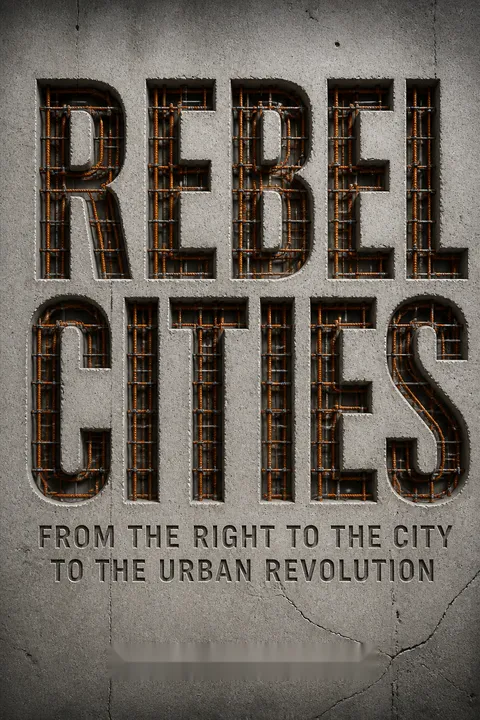
Rebel Cities by David Harvey explores how cities have become central to capital accumulation and class struggle. Harvey argues for reconsidering urban spaces as sites of revolutionary potential, examining topics like the right to the city, urban commons, and rent. The book combines Marxist economic analysis with geographical insights, discussing historical examples and contemporary movements. While some readers found parts challenging or dated, many praised Harvey's rigorous approach and thought-provoking ideas about urbanization, capitalism, and social change.
People Also Read



Glossary
Right to the City
Collective power over urban lifeA collective claim to shape how urbanization works and what kind of city it creates. It is more than individual access to housing, services, or public space. In Harvey's account, the right belongs to those who produce and sustain urban life and includes power to influence investment, development, and the qualities of everyday city life.
urban commons
Shared urban resources and relationsThe shared social and physical resources created and used through urban life, including public spaces, services, cultural practices, and neighborhood ties. An urban commons is not simply a public asset. It depends on collective use and stewardship, and it can be enclosed, commercialized, or appropriated by private interests.
commoning
Collective practice of making commonsThe social practice through which a group establishes and maintains a collective relationship with an aspect of its environment. Commoning can involve creating, protecting, or governing shared resources. Its defining feature is that the resource is organized for collective use rather than being governed solely by market exchange or private profit.
fictitious capital
Tradable claims on future incomeFinancial claims whose present prices depend on expected future income, such as mortgage securities, government debt, or titles to rent-producing property. The claims are real and can shape investment and livelihoods, but their apparent self-generated value ultimately depends on income produced elsewhere. When expectations outrun that basis, asset prices can collapse.
monopoly rent
Income from controlled uniquenessAn enhanced income stream gained through exclusive control of something considered distinctive and difficult to reproduce. It may come from a unique location, cultural reputation, artwork, or product. In cities, owners and businesses can capture such income by trading on qualities created collectively, including heritage, architecture, and neighborhood life.
collective symbolic capital
A place's shared prestigeThe reputation and cultural distinction associated with a place, built through its history, architecture, public image, and collective life. This reputation can attract visitors and investment, giving a city an economic advantage. Because it is collectively produced, conflicts arise over who defines it and who captures the value it generates.
accumulation by dispossession
Wealth gained through taking assetsThe transfer of assets, rights, or resources from less powerful groups into the control of capital or state-backed development. In urban settings, it can occur through eviction, foreclosure, land clearance, or predatory financial practices. The term directs attention to how accumulation can proceed by taking existing wealth and security, not only by producing new goods.
heterotopia
Urban spaces of alternative possibilityIn Lefebvre's usage as presented by Harvey, heterotopias are social spaces and practices where different ways of living can emerge within the existing urban order. They may form without a complete political plan, through how people gather and organize daily life. Their possibilities are unstable and can be absorbed or reclaimed by dominant institutions.
urban entrepreneurialism
Coalitions promoting urban growthA style of urban governance in which local authorities form partnerships with businesses, civic organizations, and other institutions to attract investment and promote development. Such coalitions can coordinate infrastructure and cultural projects, but their priorities often favor growth and competitiveness, raising questions about which residents benefit and who bears the costs.
FAQ
What's Rebel Cities about?
- Urban Rights Exploration: Rebel Cities by David Harvey examines the "right to the city," advocating for urban spaces to be shaped by the collective desires of their inhabitants rather than capitalist interests.
- Capitalism Critique: The book critiques capitalism's influence on urban development, highlighting how it leads to crises and inequalities, and calls for a radical rethinking of urban life and governance.
- Social Movements Focus: Harvey emphasizes the role of social movements in advocating for urban rights, illustrating how these movements can reclaim cities from capitalist exploitation.
Why should I read Rebel Cities?
- Urban Dynamics Insight: The book offers critical insights into the relationship between urbanization and capitalism, essential for those interested in social justice, urban studies, or political economy.
- Activism Inspiration: Harvey’s work serves as a call to action, encouraging readers to engage in the struggle for urban rights and collective action against neoliberal policies.
- Historical Context: It situates contemporary urban issues within a historical framework, helping readers understand the roots of current urban crises and the potential for revolutionary change.
What are the key takeaways of Rebel Cities?
- Right to the City: The central thesis is that the right to the city is a collective right, allowing communities to shape their urban environments according to their needs and desires.
- Urban Commons: Harvey discusses the importance of shared resources and spaces that belong to the community rather than private interests.
- Capitalism's Urban Impact: The book illustrates how capitalist development leads to urban crises, including displacement and inequality, advocating for an anti-capitalist approach to urban governance.
What are the best quotes from Rebel Cities and what do they mean?
- "The right to the city is a cry and a demand.": This quote highlights that urban rights are rooted in the lived experiences and struggles of city dwellers.
- "The city may be dead, but long live the city!": It reflects the paradox of urban life under capitalism, suggesting potential for new urban spaces through collective action.
- "Claiming the right to the city is a way-station on the road to that goal.": This emphasizes that the right to the city is part of a larger struggle for systemic change against capitalist exploitation.
What is the "right to the city" as defined in Rebel Cities?
- Collective Power: The right to the city is a collective right empowering communities to shape their urban environments, rather than being subjected to market forces.
- Reinventing Urban Life: It involves the freedom to make and remake urban spaces in ways that reflect community desires and needs, promoting a meaningful urban existence.
- Political Demand: Harvey argues that this right is a demand for justice and a political struggle against the commodification of urban life, advocating for equitable distribution of resources.
How does Rebel Cities address capitalism's impact on urban life?
- Urban Crises: Harvey discusses how capitalism leads to urban crises, such as housing shortages and social inequality, illustrating the detrimental effects of profit-driven development.
- Displacement and Alienation: The book highlights the displacement of marginalized communities as a direct consequence of capitalist urbanization.
- Need for Anti-Capitalist Movements: Harvey calls for anti-capitalist movements focused on transforming urban life and reclaiming the city for its inhabitants.
What role do social movements play in Rebel Cities?
- Catalysts for Change: Social movements are portrayed as essential catalysts for change, advocating for the right to the city and challenging capitalist urban development.
- Collective Action: Harvey emphasizes the importance of collective action in reclaiming urban spaces, arguing that grassroots movements can resist neoliberal policies.
- Global Context: The book situates these movements within a global context, showing how urban struggles in different cities can inspire one another.
What is the significance of the urban commons in Rebel Cities?
- Shared Resources: The urban commons refers to shared resources and spaces that belong to the community, essential for fostering social relations and identity.
- Resistance to Commodification: Harvey argues that protecting the urban commons is crucial in resisting the commodification of urban life.
- Potential for New Urban Futures: The concept opens possibilities for reimagining urban life, allowing communities to create inclusive environments.
How does Harvey connect urbanization to capitalist crises in Rebel Cities?
- Surplus Absorption: Urbanization has historically been a means for absorbing surplus capital and labor, often leading to crises when overaccumulation occurs.
- Cyclical Nature: The book discusses the cyclical nature of capitalist crises, illustrating how rapid urban development can lead to downturns and unrest.
- Need for Structural Change: Understanding this connection is vital for developing strategies to address urban crises and advocate for systemic change.
What solutions does Rebel Cities propose for urban issues?
- Collective Governance: Harvey advocates for governance models that prioritize community needs over profit-driven interests, emphasizing participatory decision-making.
- Reclaiming Urban Spaces: The book encourages communities to reclaim urban spaces and resources, fostering ownership and responsibility among residents.
- Anti-Capitalist Movements: Harvey calls for movements focused on transforming urban life, advocating for policies that promote social justice and equity.
What is "monopoly rent" and why is it significant in Rebel Cities?
- Definition of Monopoly Rent: Monopoly rent refers to the economic advantage gained by controlling unique resources or locations, allowing higher prices.
- Impact on Urban Development: It shapes urban development, leading to gentrification and displacement as property values rise.
- Critique of Capitalism: The concept critiques capitalist practices that prioritize profit over community needs, highlighting the need for equitable policies.
How does Rebel Cities critique neoliberal urban policies?
- Neoliberalism's Impact: Harvey critiques neoliberal policies for exacerbating inequality and prioritizing market-driven approaches to urban development.
- Call for Alternatives: The book advocates for alternative policies that prioritize public goods and community needs, challenging profit-driven motives.
- Historical Context: By situating these critiques within a historical framework, Harvey illustrates neoliberalism's transformation of urban spaces and lives.
About the Author
Other books by David Harvey


Download PDF
Download EPUB
.epub digital book format is ideal for reading ebooks on phones, tablets, and e-readers.








