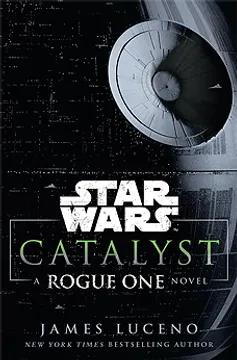


Plot Summary
Prologue
On the icebound world of Vallt, scientist Galen Erso tests synthetic kyber crystals in hopes of producing cheap, abundant energy. The experiment disappoints, but before he can begin again, soldiers arrive: a coup has brought Marshal Phara to power, and the Separatists want Galen’s research.
Galen, his pregnant wife Lyra, and their droid assistant Assis flee through snow tunnels toward their ship. Valltii riders chase them across the open tundra. They reach the hangar, only to be caught in a net laid beneath the roof. Galen is arrested for espionage, while Lyra is taken into custody.
The opening makes scientific work tangible before politics invades it: Galen is measuring a crystal’s promise of power when soldiers turn that promise into a reason to seize him. His escape fails not because he lacks intelligence, but because the Valltii have planned around the terrain and weather he hopes will protect him. The trap also establishes the novel’s recurring conflict between intention and consequence. Galen means to create a source of shared energy, yet others already see his work as a strategic asset. His arrest begins the story by making neutrality a practical impossibility.
The Prisoner Becomes a Father
Vallt’s new leaders keep Galen in Tambolor prison and Lyra in the Keep, where the pregnant couple cannot see each other. Chieftain Gruppe offers Galen freedom if he will work for the Separatists, but he refuses and sends Lyra a letter through his friend Nurboo. The message comforts her with memories of their shared adventures, while making clear that Galen might surrender his principles for her and their unborn child.
When Lyra goes into labor, the guards bring Galen to the Keep. Their daughter, Jyn, is born safely, and Valltii colleagues celebrate with the family. Gruppe admits that Vallt’s leaders have begun to value Galen personally, not only as a bargaining chip, and hints that his case may soon be dismissed.
Captivity tests the Ersos through separation rather than physical brutality. Galen’s letter shows how his mind keeps working even in a cell, but its most consequential act is emotional: he offers Lyra authority over a decision he knows she would never make for him. Jyn’s birth briefly interrupts the machinery of political coercion. Gruppe’s presence at the celebration complicates the simple division between captor and captive; her kindness is real, but it cannot undo the choices her regime has made. The family’s new bond arrives inside an unstable political bargain, so joy and vulnerability become inseparable.
Krennic Builds a Moon
On Coruscant, Lieutenant Commander Orson Krennic helps direct a secret Republic project: a vast mobile battle station based on Geonosian plans. Its structure is rising above Geonosis, but its principal weapon has no workable design.
Krennic recognizes that Galen’s research into kyber crystals might solve the energy problem and urges Vice Chancellor Mas Amedda to bring the imprisoned scientist into the project. Rather than wait for Zerpen Industries to negotiate, Krennic recruits smuggler Has Obitt, using Has’s deliveries to Separatist worlds as leverage.
Krennic’s plan is to trade captured Separatist researchers for Galen and his family. Meanwhile, he persuades Geonosian Archduke Poggle the Lesser to supply workers for the station, making the project’s need for labor another tool of political bargaining.
Krennic’s defining skill is not invention but orchestration: he spots which person, institution, or vulnerability can move a project forward, then arranges them into a usable sequence. The battle station begins as an abstract design, yet its scale already distorts the choices around it. Galen’s scientific work is treated as a missing component, Has’s livelihood as leverage, and Poggle’s people as a workforce. Krennic can call this coordination, but the scene reveals a political imagination in which people are resources before they are moral agents. His ambition is built through practical successes that make coercion look like competence.
Vallt’s False Emissaries
Has pilots Krennic and a Republic team into a Separatist research complex on Merj, where they seize two Morseerian scientists working on a biological weapon against clone soldiers. The operation turns violent when a guard discovers an escaping captive; Has is injured, and Krennic orders the team to leave with only two researchers.
Their capture gives Krennic bargaining power on Vallt. At the spaceport, he poses as a Zerpen representative and arranges the exchange of the scientists for Galen, Lyra, and Jyn.
The Separatists fire on the departing freighter, and Krennic’s Republic cruiser answers by attacking the Keep. Galen watches his captors’ home come under fire. Krennic then takes the family to Grange, where Galen sees his own world caught in a devastating battle.
The rescue succeeds through a chain of exchanges, but none of them is morally clean. Has’s discomfort begins when Krennic treats injuries and casualties as acceptable costs; Galen’s freedom, meanwhile, is purchased through a military strike against the people who imprisoned him. The return to Grange converts distant war into a personal spectacle, and Krennic intends that sight to change Galen’s position. His method is psychologically astute: rather than demand allegiance outright, he makes detachment feel like complicity. The rescue therefore frees the Ersos physically while carrying the war, and Krennic’s influence, into their private life.
No Place for Neutrality
Back on Coruscant, Galen proposes that he and Krennic build an independent energy company. Krennic declines, choosing his Republic career, while Galen’s refusal to join the military leaves him without a research post.
Adjutant General Wilhuff Tarkin questions him about Vallt and keeps him on Coruscant during a loyalty investigation. Krennic eventually finds Galen a position with Helical HyperCom on Lokori, where he can work on communication crystals rather than weapons. Galen accepts, and the family travels to the Outer Rim.
The company director, Roman Herbane, immediately confines him to quality assurance and dismisses his research suggestions. Galen swallows his frustration and takes the job, hoping it will restore a working life without binding him to the war effort.
Galen’s offer to Krennic is a revealing counterproposal: he imagines a future where scientific achievement answers to public benefit rather than military command. Krennic’s rejection is not simply a refusal of business; it is a refusal to leave the institution that gives his ambition scale and authority. Tarkin’s investigation further narrows Galen’s choices by treating refusal as suspicious. His move to Lokori is therefore neither a free return to science nor a capitulation to the Republic. Herbane’s workplace hierarchy repeats the political problem in miniature: Galen can see better methods, but has little power to use them.
Lokori’s Shield Gives Way
Helical HyperCom’s production facility on Lokori comes under repeated Separatist attacks. Galen argues that power should be diverted from manufacturing to strengthen the shield protecting Fucallpa, but Herbane refuses because it would interrupt production.
When the shield generator is destroyed, battle droids enter the city and the Ersos flee with Jyn among the refugees. They are trapped against a wall as droids close in and fire on the crowd. Then the droids abruptly power down: Republic forces have destroyed their central command computer.
The Clone Wars end almost as suddenly as they began. Galen has survived another battlefield without choosing a side, but the attack has shown him how little control a civilian family has once war reaches its doorstep.
The crisis turns Galen’s abstract preference for peace into a bodily experience of danger. His warning about the shield is right, but Herbane’s production priorities determine the outcome until the generator is lost. The family survives not through superior planning or a heroic intervention, but because a distant military system fails. That abrupt shutdown gives the end of the Clone Wars an unnerving randomness: the droids stop, but no one in the street can know why. For Galen, the scene complicates neutrality. He has not fired a weapon, yet his family’s survival depends on institutions and decisions he cannot influence.
The Emperor’s Crystal Offer
After Palpatine becomes Emperor, Krennic offers Galen leadership of a new energy research program called Project Celestial Power. Its facility occupies the former B’ankor Refuge on Coruscant, whose Indigenous inhabitants have been forcibly relocated.
Krennic presents the work as a way to provide renewable power to worlds devastated by war, and offers Galen rare kyber crystals as proof that the research can advance. Galen accepts the directorship. One immense crystal arrives at the laboratory, and its unusual, almost living structure absorbs his attention.
Lyra recognizes the danger in turning Jedi crystals into a state resource, especially after learning that Krennic’s samples may have come from lightsabers. Galen insists the research can serve the public, but the facility’s walls and surveillance already make his dream feel enclosed.
The offer works because it joins Galen’s deepest scientific curiosity to his most intimate obligation: providing a secure future for Lyra and Jyn. Krennic does not need to threaten him; he gives him resources, status, and the material he has spent years trying to understand. Yet the program’s benevolent language is undercut by its location. The B’ankora have been displaced to create a project supposedly designed for universal benefit. Lyra sees this contradiction before Galen can admit it. The kyber’s fascination becomes both intellectual and psychological: as Galen studies the crystal, he moves closer to a system that values his discoveries while controlling their purpose.
Two Worlds Strip-Mined
Krennic draws Has back into covert work after the war, promising easy profits from weapons taken out of Imperial depots. Has makes a large delivery to Samovar, then another to Wadi Raffa, where contraband arms are disguised as mining equipment.
Soon after each run, the Empire accuses local companies of dealing in weapons and seizes their operations. Has learns that the weapons were a pretext for taking resource-rich Legacy worlds. At the same time, Krennic sends Lyra and her old friend Nari Sable to survey Alpinn for kyber.
Their search finds only ranite, not true kyber, but on the return journey Has shows them the ruined landscapes of Samovar and Wadi Raffa. Lyra understands that the Empire’s promises of protection do not extend to worlds it wants to exploit.
This parallel journey exposes how the Empire turns administrative procedure into a weapon. Has’s deliveries appear to be ordinary smuggling, but their timing supplies the justification for seizure; Lyra’s survey appears to be scientific exploration, yet it places her near evidence the regime would rather conceal. Has has long survived by treating politics as someone else’s problem. Seeing what his work enabled makes that separation harder to maintain. Lyra, by contrast, already reads landscapes as records of human decisions. The ruined worlds turn her environmental knowledge into political evidence, while the empty Alpinn vein denies Krennic the resource he hoped to find.
The Crystal’s Dark Axis
While Lyra is away, Krennic takes Galen to Malpaz and shows him a ruined city, claiming insurgents destroyed an energy facility built from Galen’s work. He says the Empire needs a demonstration powerful enough to end resistance.
Believing that his research can still produce public energy, Galen agrees to push further, then discovers a method for faceting kyber crystals so their output can be amplified and directed. He sends the data to Krennic. Lyra returns from Alpinn and grows suspicious when Galen hides his visit and the project’s new secrecy.
With Nari’s help, she checks Malpaz and Hypori. The records show that Imperial weapons destroyed Hypori’s facility, while Malpaz’s devastation came from failed kyber weapon tests. Galen recognizes that Krennic has misled him and that his work has been weaponized.
Galen’s breakthrough is also his ethical failure. He believes that he is solving containment for an energy program, but Krennic has framed the problem so that the scientist supplies the destructive capability while others claim responsibility for its use. Galen’s wish to protect his family becomes the rationale that lets him cross his own boundary. Lyra’s investigation counters this by joining small clues: missing colleagues, vanished shipments, ruined facilities, and evasive explanations. Her method is not technical mastery but attention to consequences. The revelation forces both spouses to revise their understanding of the same project, and makes secrecy inside their marriage as dangerous as secrecy imposed by the Empire.
Salient Turns the Smugglers
Krennic sends Has to deliver weapons to the autonomous Salient system, intending to frame Zerpen Industries as a haven for insurgents and give the Empire grounds to seize its resources. Has instead warns Salient’s leaders and joins freedom fighter Saw Gerrera in organizing resistance.
Moff Tarkin arrives to enforce the takeover, and the conflict grows into a prolonged battle across Salient’s worlds. Krennic tests his kyber-powered prototype against a distant black hole, where the beam converges successfully; the result earns him a promotion and removes Tarkin from the battle station project’s immediate orbit.
Tarkin’s forces eventually collapse a cliff over the rebel supply base, burying Has and others. Tarkin finds Has alive and offers him a chance to redeem himself by returning to Coruscant as an informant.
Has’s reversal is not a sudden conversion into an idealist. He has seen the Empire use him to manufacture a legal excuse for conquest, and he chooses to stop helping the machinery that has profited him. Saw gives that choice a political language and a collective purpose. The conflict also reveals the difference between Krennic and Tarkin: Krennic engineers events to advance his position, while Tarkin prefers direct force and territorial control. Their rivalry makes resistance useful to both men until it escapes their designs. Has’s survival in the collapsed base leaves him with a compromised route back to Coruscant, where apparent cooperation can conceal a different allegiance.
The Ersos Choose Flight
Lyra and Galen compare what they have learned, then face Krennic during his visit to their residence. He deflects their questions about missing researchers and destroyed facilities, and warns Lyra against interfering with Galen’s work.
Galen finally admits that he helped Krennic weaponize the crystals and decides he cannot continue. During Coruscant’s All-Species Week, the couple leave the facility with Jyn, erase some records, and head for the spaceport. Krennic returns to find them gone.
Has reaches Coruscant under Tarkin’s watch, drawing Krennic toward the hangar, while Saw meets the family elsewhere and leads them around security. They reach Saw’s ship without being captured. Has has helped create the opening, but Galen and Lyra must now leave their old lives behind.
The confrontation is the emotional point of no return because Galen stops describing his participation as a sacrifice made for his family. He names his responsibility and withdraws his consent. Lyra’s insistence on sharing evidence gives him the conditions to see his own work clearly, while Krennic’s threat confirms that loyalty has become an instrument of control. Their escape depends on a network of people who have each been used by the Empire: Has, Saw, and the Ersos. The celebration around them offers cover, but its public festivity also sharpens the contrast between Coruscant’s apparent normality and the danger hidden inside its institutions.
Lah’mu Beyond the Empire
Saw takes the Ersos away from Coruscant while Krennic and Tarkin each continue searching for Galen, whose knowledge remains essential to the unfinished superlaser. Krennic’s failure costs him standing with the Imperial leadership, and Tarkin receives a remote assignment that keeps him close to the battle station and its ambitious commander.
Has, meanwhile, keeps feeding both Imperials limited reports while avoiding the task of finding the family. He eventually returns to the Wanton Wellspring and turns toward a life less governed by other people’s orders.
Saw offers the Ersos a refuge on Lah’mu, a remote and largely untouched planet. Galen and Lyra accept. Jyn, missing their old droid and home, asks whether Saw will join them, and the family enters hyperspace toward a quieter beginning.
The ending offers refuge, not resolution. Galen and Lyra cannot undo the weapon research or restore the worlds consumed by Imperial extraction; they can only refuse to remain available to the system that exploited them. Lah’mu’s remoteness answers the opening’s failed escape from Vallt, but the family now leaves by choice and with allies. Has’s limited, double-edged resistance and Saw’s continuing commitment show that withdrawal is one response to empire, not the only one. Jyn’s concern for their old droid keeps the departure emotionally specific: escape does not erase attachment or loss. The family carries both into an uncertain future.
Analysis
Catalyst follows the transformation of a peaceful research project into an instrument of state violence, but its central question is not whether science is good or evil. It asks who controls the path from discovery to application, and what responsibility belongs to the researcher who supplies the missing knowledge. Galen’s mistake is understandable precisely because it grows from virtues: curiosity, care for his family, and a belief that better energy can improve distant lives. Krennic exploits those virtues by controlling information and presenting each new commitment as a practical step toward peace.
The novel places private relationships inside political systems rather than outside them. Lyra’s work as a surveyor lets her read ecological change as evidence; Galen’s trust in Krennic makes him vulnerable to a carefully managed account of events. Their marriage becomes a test of whether intimacy can survive institutional secrecy. When Galen hides his work, he repeats on a domestic scale the logic Krennic uses across the Empire: conceal the means, promise a beneficial end.
Has’s parallel arc gives the story a second model of moral awakening. He does not begin with Lyra’s ecological attention or Saw’s revolutionary purpose. He first sees the consequences of his own deliveries and then chooses to stop enabling them. His change suggests that responsibility need not begin with purity; it can begin when a person refuses to call complicity mere employment.
The book’s imperial order is built through euphemism. Resource seizure becomes reconstruction, weapon development becomes energy research, and coercion becomes a chance to serve. Against that language, the story offers acts of attention: Lyra compares records with landscapes, Galen finally names what his work does, and Has recognizes the people beneath the cargo. The family’s departure does not defeat the Empire or undo the weapon. It marks a narrower but meaningful refusal to let a powerful institution define what their lives and knowledge must serve.
Review Summary
The reviews for Catalyst: A Rogue One Story are mixed, averaging 3.76 out of 5. Many readers appreciate the backstory it provides for characters like Galen Erso, Lyra Erso, and Orson Krennic, and how it enriches the viewing experience of Rogue One. However, common criticisms include slow pacing, heavy technical exposition, and a lack of action. Most reviewers agree it is best suited for dedicated Star Wars fans rather than casual readers.
People Also Read
Characters
Galen Erso
The idealistic crystal scientistGalen is a gifted researcher whose attention can vanish into equations, crystals, and the hidden patterns of the natural world. He wants science to improve ordinary lives, especially by making energy affordable beyond the wealthy Core. His deep focus is both his strength and a vulnerability: he can lose track of how institutions will use the work he provides. Lyra helps translate his ideas and keeps him connected to daily life, while Krennic understands how to appeal to Galen’s curiosity and sense of responsibility. Galen’s central psychological struggle is not whether he is clever enough to solve a problem, but whether he can recognize the moral purpose others have attached to his solution.
Lyra Erso
The fieldwise truth-seekerLyra is Galen’s wife, Jyn’s mother, and an accomplished explorer and surveyor. Her physical confidence and practical knowledge of terrain balance Galen’s inward, theoretical life. She is attentive to ecosystems, local communities, and the political consequences that technical specialists may overlook. Lyra respects Galen’s work but does not mistake love for agreement; she questions the use of kyber and notices when Krennic’s explanations do not fit what she sees. Her strength is a willingness to act on incomplete but accumulating evidence. As a partner, she seeks intimacy through honesty and shared decision-making, and she resists being reduced to a caretaker or obstacle.
Orson Krennic
The ambitious imperial engineerKrennic is a capable builder, political operator, and former friend of Galen from the Republic Futures Program. He knows how to translate ambitious designs into funded projects and how to make powerful officials believe that his success serves their interests. His affection for Galen is real, but it is entwined with possessiveness and ambition: he sees Galen’s genius as essential to the future Krennic wants to build. He studies people carefully and prefers inducement, manipulation, and plausible deniability to blunt force. Krennic’s confidence comes from believing that every setback can be turned into leverage, a belief that makes him both effective and dangerous.
Jyn Erso
The curious young daughterJyn is the daughter of Galen and Lyra, born during their confinement on Vallt. As a small child she is energetic, observant, and absorbed in stories, especially the tale of Brin finding a way home. Her attachment to both parents gives the political upheavals a domestic measure: she notices absences, remembers her caretaker droid, and wants familiar people near her. Jyn also inherits elements of each parent, Galen’s inward concentration and Lyra’s physical daring. She represents the future Galen claims to protect, while reminding him that love has to be practiced in the present.
Has Obitt
The wary smugglerHas is a Dressellian freighter captain accustomed to surviving through caution, adaptability, and a refusal to commit himself to either side of a conflict. Krennic exploits his illegal deliveries to pull him into Republic operations, then later uses him in Imperial schemes. Has is skilled at reading a route and a customer, but initially avoids asking what his cargo enables. His practical self-protection begins to fail when he sees the damage connected to his work. Unlike a born revolutionary, he reaches political conviction through complicity and regret, discovering that staying neutral can still make him useful to power.
Wilhuff Tarkin
The calculating military governorTarkin is a former Republic officer and a disciplined Imperial strategist who values order, command, and the visible consequences of power. He questions Galen’s loyalty and recognizes that the battle station will reshape the balance between the Empire and its opponents. His experience as a prisoner gives him a personal understanding of coercion, but it does not make him more compassionate; he tends to view suffering as a cost of control. Tarkin and Krennic compete over influence and the future weapon, each assessing the other’s weaknesses. Tarkin is less improvisational than Krennic, but his patience makes him an enduring political threat.
Saw Gerrera
The committed resistance fighterSaw is an Onderonian freedom fighter shaped by years of armed resistance and the losses that accompany it. He believes that opposition must be organized, not merely felt, and brings discipline and contingency planning to the smugglers who join him. His certainty can sound severe, but it comes from experience with occupation and the cost of waiting for stronger powers to act. Saw offers practical help to the Ersos when they need to escape Coruscant, while remaining committed to a broader struggle against Imperial expansion.
Chieftain Gruppe
Vallt’s conflicted authorityGruppe is a Valltii leader who oversees Galen’s imprisonment and interrogations after the coup. She wants Vallt to gain security, recognition, and prosperity, and sees Galen’s research as a bargaining asset in a larger political negotiation. Yet she does not treat him as a simple enemy, and her interactions with him acquire a warmth that unsettles the roles of captor and captive. Gruppe embodies the local pressures that make alignment with a galactic power seem practical, even when the bargain threatens individual freedom.
Mas Amedda
The Chancellor’s political brokerAmedda is a senior Republic official who becomes a leading figure in the Imperial court. He manages political approvals, funding, and the demands of the leadership surrounding the battle station. He understands that Krennic can be useful, but also worries when Krennic acts beyond his authority or lets ambition outrun command. Amedda’s role shows how enormous projects depend not only on scientists and engineers but on officials who decide what can be funded, concealed, or excused.
Poggle the Lesser
The Geonosian archdukePoggle is the Geonosian leader whose people designed the original battle station plans. He is pragmatic about Geonosis’s survival and knows how to turn the industrious habits of his society into political leverage. Krennic recruits him to provide workers for the Republic project, but Poggle’s priorities do not align neatly with the Empire’s. His decisions expose the danger of treating an entire people as labor and production capacity rather than as a society with its own interests.
Reeva Demesne
Galen’s perceptive former mentorReeva is a Mirialan scientist and former mentor to Galen, originally devoted to energy research before the war redirects her into military shield development. She knows his intellectual habits and shares his ability to imagine better ways of producing power. Her cautious efforts to reconnect with the Ersos hint that scientists working within Imperial programs may not be free to speak openly. Reeva’s presence links Galen’s former academic community to the increasingly secretive research network.
Nari Sable
Lyra’s adventurous old friendNari is Lyra’s longtime friend, fellow explorer, and surveyor. More physically adventurous and less interested in conventional domestic life, she represents a path Lyra might have taken before marriage and motherhood. Their shared skill in mapping and fieldwork makes Nari a natural partner for the Alpinn survey and later an ally when Lyra seeks information about Imperial sites. Nari’s loyalty is practical rather than sentimental: she helps because she trusts Lyra and understands the risks of looking closely.
Nurboo
Galen’s Valltii colleagueNurboo is one of Galen’s Valltii research colleagues and a friend who tries to protect the Ersos after the coup. He carries Galen’s letter to Lyra and joins the colleagues who celebrate Jyn’s birth. His loyalty makes the laboratory more than a workplace for Galen; it is a community that political upheaval threatens to scatter.
Roman Herbane
The rigid company directorHerbane directs Helical HyperCom’s Lokori facility and values production targets over experimentation. He hires Galen but restricts him to quality assurance, interpreting scientific suggestions as challenges to his authority. Herbane is not a grand political strategist; he represents the everyday bureaucracy through which useful expertise can be ignored until a crisis makes its value unavoidable.
Assis
The loyal research droidAssis is Galen’s adaptable TDK-160 research assistant, capable of shifting between a bipedal form and a snow-tread configuration. Its programmed loyalty helps the Ersos attempt to escape Vallt, and its ability to transmit information carries news of Galen’s arrest beyond the planet. Assis supplies practical ingenuity without sharing the human characters’ uncertainty about duty and allegiance.
Plot Devices
Kyber crystals
Energy with a hidden costThe crystals are rare, living-seeming materials traditionally associated with Jedi lightsabers. Galen studies synthetic versions because he hopes they can produce inexpensive, renewable power. Their enormous energy potential gives his research scientific importance and makes it valuable to governments and military planners. As the work develops, the challenge shifts from producing power to controlling and directing it. The kyber therefore binds Galen’s idealistic purpose to the weapon Krennic wants, while Lyra’s respect for the Jedi’s restraint offers a moral counterweight. The crystal is not just a source of energy; it is the contested object through which the characters argue about who should be allowed to command power.
The mobile battle station
A design seeking its weaponThe Geonosian schematic gives the Republic a plan for a moon-sized battle station, but the project begins without a functioning superweapon. Krennic uses the construction effort to gather scientific expertise, labor, raw materials, and political influence. The station’s immense scale makes the consequences of Galen’s research difficult to dismiss as theoretical. Its construction also produces conflicts over Geonosian workers, secrecy, procurement, and command. As the station takes shape, the question is no longer whether the structure can be built, but what the people building it intend to do with its power.
Official secrecy
Knowledge under surveillanceSecurity oaths, isolated research sites, restricted databases, and monitored communications divide the work into fragments. Krennic controls what Galen sees and when he sees it, while Lyra’s efforts to connect missing scientists and destroyed facilities become increasingly risky. Secrecy is presented as protection against wartime espionage, but it also prevents researchers from understanding how their work is being used. The device creates an information imbalance: those who make technical discoveries do not necessarily know the purpose of the larger project. It turns trust between friends and spouses into a practical vulnerability.
Legacy worlds
Protected land made expendableLegacy status is meant to restrict settlement and resource extraction on environmentally significant worlds. The Empire circumvents that protection by arranging arms deliveries, accusing local companies of illicit trade, then seizing mining operations. Has’s shipments and Lyra’s field observations reveal different stages of the same mechanism. The device connects ecological damage to political manipulation: extraction is not an unfortunate side effect but a planned purpose disguised as law enforcement. These worlds also give Lyra concrete evidence that contradicts the Empire’s public language of reconstruction and peace.
Smuggling routes
A courier becomes a witnessHas’s freighter can move through blockades and carry goods into places official ships cannot easily enter. Krennic first uses those routes to conduct a Republic raid, then draws Has into Imperial arms operations and staged accusations. The same skills that make Has useful to the Empire later let him warn Salient and aid its resistance. Smuggling is therefore both a plot mechanism and a moral pressure test: Has can claim he is only transporting cargo, but each delivery places him closer to the consequences of someone else’s plan.
Star Wars Disney Canon Novel Series Series
About the Author
Other books by James Luceno

Download PDF
Download EPUB
.epub digital book format is ideal for reading ebooks on phones, tablets, and e-readers.








