

Key Takeaways
Treat 'chav' as a class verdict, not a neutral description
A slur with range. Jones opens with a dinner-party joke about where working-class people would shop after Woolworths closed. No one objects, although the same guests would reject openly racist or homophobic insults. The joke works because 'chav' makes class contempt sound like harmless taste. Its meaning shifts by speaker and setting, but it is usually imposed on working-class people, rarely claimed as an identity, and can lump many different lives into one degraded stereotype.
A London gym even advertised a self-defence class that invited wealthy clients to imagine poor teenagers as targets. Such examples show that the caricature is not merely a rude nickname. It turns a whole group into a socially acceptable object of mockery and fear.
What's striking is how the label converts judgments about clothing, speech, or manners into claims about character. Social psychology calls this essentializing: treating a group as if its members share a fixed nature. That move makes individual evidence seem unnecessary, because the category itself appears to explain behavior. The term is not used identically by everyone, and some young people may reclaim it jokingly. But reclamation does not erase the power difference when outsiders use the same word to mark people as inferior.
Notice whose suffering earns national attention and whose becomes a stereotype
Two missing children. In 2007, Madeleine McCann disappeared from a holiday resort in Portugal. In 2008, Shannon Matthews went missing in Dewsbury. Jones compares their first two weeks of coverage: newspapers produced 1,148 stories about Madeleine, while Shannon received about a third as much. The reward for Madeleine reached £2.6 million; Shannon's began at £25,500. The McCanns were a professional, middle-class couple, while Shannon's family lived in a poor northern community.
Shannon was found alive, and her mother was later convicted of arranging the kidnapping for reward money. The crime was appalling. Yet much coverage treated it as evidence against the whole community. Local people who organized searches and raised money were largely pushed out of the story.
The comparison makes media attention itself part of the evidence. News outlets do not simply report events; repeated coverage signals whose lives readers should recognize as familiar and valuable. Still, unequal coverage cannot establish that class alone caused every editorial choice. Familiarity, geography, and the unusual details of each case also shape news judgment. The broader test is whether an individual crime becomes a verdict on a group only when the people involved are poor.
Trace Thatcherism's damage through lost jobs, unions, and local institutions
A community loses its centre. Jones describes Thatcherism as a market-led political project that weakened unions, sold public assets, and dismantled industries. The 1984 to 1985 miners' strike became a decisive defeat for organized labor. Mining communities lost not only jobs, but also institutions and relationships built around the pit. In Ashington, a former mining town, one resident describes the closure as the point when the community began to unravel.
The book does not argue that industrial work was idyllic. It was often dangerous, exhausting, and exclusionary, especially for women. Its argument is that secure, skilled work was not adequately replaced. Many former industrial towns instead faced insecure service jobs, unemployment, and diminished bargaining power. New Labour, Jones argues, largely accepted this economic settlement rather than reversing it.
The strength of this history is its attention to institutions, not just wages. A workplace can also organize time, identity, training, and social ties, so its disappearance has effects beyond the payroll. Yet the account can make political decisions seem more decisive than global trade, technology, or changing demand, all of which also reshape industry. The useful distinction is between change that may be unavoidable and the policy choices that determine who bears its costs and what replaces what was lost.
The working class did not disappear when factories did
Work without control. Jones defines the working class broadly as people who depend on selling their labor and have limited control over how they do it. This includes far more than manual factory workers. By the time of the book, retail employed nearly three million people in Britain, while call centres employed close to one million. Supermarket checkouts and phone desks had become defining workplaces of a changed working class.
These jobs were often cleaner than mining or manufacturing, but they could be poorly paid, insecure, and closely monitored. A call-centre worker described tightly timed breaks, repetitive scripts, and little freedom to manage the work. The workforce was also increasingly female, part-time, and temporary. A different uniform and workplace did not make workers middle class.
This definition shifts attention from a job's appearance to power inside the job. A clean office can still impose rigid targets and close surveillance, while a skilled worker may have more discretion than the job title suggests. The boundary between classes is therefore not perfectly neat. Jones's emphasis on control helps explain why service work belongs in a class analysis, but it should not imply that everyone in the same occupation has identical status, security, or interests.
Compare welfare accusations with the actual number of available jobs
Scapegoats versus scarcity. The book contrasts intense attention to benefit fraud with far less scrutiny of tax evasion. Estimates cited by Jones put benefit fraud below 1 percent of welfare spending, while tax evasion cost the Treasury about seventy times more. The comparison exposes how selective suspicion can become: wrongdoing by poor people is made to stand for a whole population, while larger losses by wealthy people remain abstract.
The jobs picture was just as stark. At the end of 2011, Jones cites twenty-three jobseekers for each vacancy nationwide, with much harsher competition in some towns. Long-term unemployment and disability claims also rose in places where industry had collapsed. The point is not that every claimant is blameless; it is that blaming individuals cannot create jobs that do not exist.
A vacancy-to-jobseeker comparison is a useful reality check on claims that unemployment mainly reflects weak effort. It places policy debate against the labor market people actually face. The same discipline should apply to fraud statistics: estimates have definitions and uncertainty, and one type of misconduct does not cancel another. Structural explanation also has limits. It can clarify why hardship clusters in certain places, but it cannot settle every question about personal responsibility or the best design of support.
Meritocracy can rebrand inherited advantage as deserved success
An uneven starting line. Meritocracy is the idea that people should rise according to ability and achievement. Jones notes that Michael Young coined the term as a warning about a society that ranks people by supposed merit, not as a simple endorsement of that system. In practice, he argues, the language can make existing inequality look fair, even when access to opportunity is sharply unequal.
The advantages begin early. Middle-class parents are more likely to pass on familiarity with books, school expectations, and university pathways, a package Jones calls cultural capital. The book reports that children from England's richest fifth were seven times more likely to attend university than intelligent children from the poorest 40 percent. Unpaid internships add another barrier, since only young people with financial support can readily work for free.
Meritocracy is persuasive because achievement does matter, and institutions need ways to recognize skill. The problem is treating measured achievement as if it arose independently of family resources, school quality, or access to networks. That mistake can turn a real accomplishment into false proof that the system is fair. At the same time, expanding opportunity and improving conditions for people who do not move into elite careers are distinct goals. A fairer society needs both, rather than treating mobility as a substitute for equality.
Treat riots as evidence of fractures, not proof that poverty makes people riot
Context without excuse. The 2011 English riots began after police shot Mark Duggan in Tottenham, a neighbourhood with a long history of fraught relations between police and residents. Jones notes that young Black men faced disproportionate stop-and-search. Government figures later showed that 42 percent of young people arrested were eligible for free school meals, and nearly two-thirds lived in England's poorest areas.
Those figures do not mean poverty caused the riots: most poor people did not take part, and participants had varied motives, including theft, excitement, anger, and hostility to police. But the evidence challenges the claim that the unrest was simply mindless behavior by a distinct underclass. Jones links it to joblessness, lack of prospects, consumer pressures, and mistrust of authorities, while insisting that explanation is not justification.
The distinction between explanation and excuse is essential in public debate. Social conditions can change the likelihood of disorder without determining how any particular person acts. The case also illustrates why one-variable accounts fail: policing, opportunity, peer dynamics, consumer culture, and opportunism can interact. The book is strongest when it resists both extremes, moralizing every participant as a social type or romanticizing illegal acts as political protest. A serious account can recognize harm to residents and still ask what conditions made unrest more likely.
Scarce homes and insecure work make immigrants convenient scapegoats
A real grievance, a false target. In Barking and Dagenham, residents described a shortage of affordable housing, insecure jobs, and the loss of employment once provided by the Ford factory. Some blamed new arrivals for competition over homes and work. Jones argues that the political failure to address scarcity made that explanation attractive, while the far right recast economic insecurity as a conflict between native and immigrant workers.
The book does not claim immigration has no effects. It cites research suggesting that wage effects were generally small but more concentrated among lower-paid, less-skilled service workers. It also stresses that working-class communities include people of many ethnic backgrounds, and that minority workers face additional discrimination. The challenge is to address shared scarcity without denying racism or real differences in experience.
This account avoids a common false choice: either immigration has no economic effects, or immigrants are responsible for working-class hardship. Labor markets can produce uneven pressures, especially where workers have little bargaining power. That is a reason to examine pay, housing supply, and employer practices, not to treat people seeking work as the cause of those conditions. Class language also needs care: a shared economic position does not erase racism, and an inclusive politics must address both common interests and unequal treatment.
Broaden who speaks for Britain, not only who gets represented on paper
A narrow public voice. Jones argues that journalists and politicians often mistake their own experiences for ordinary life. More than half of the top one hundred British journalists had attended private school, while fewer than one in twenty MPs had begun their careers as manual workers. The book links this distance to reporting that turns an exceptional case into a portrait of whole working-class communities.
The consequences reach beyond media coverage. When people rarely hear their working lives described accurately, they may conclude that politics has no place for them. Jones cites a BBC poll in which nearly six in ten white working-class respondents felt that no one spoke for them. Broader representation would not guarantee better policy, but it could make neglected concerns harder to ignore.
Descriptive representation can improve what institutions notice: people who have lived through insecure work or housing shortages may recognize problems that insulated decision-makers miss. But background alone does not guarantee insight, and an individual representative cannot speak for an entire class. The deeper issue is access to influence, including the cost of entering journalism or politics and the networks that reward familiarity. Representation matters most when it changes whose evidence counts, not simply the appearance of the people in the room.
Rebuild collective power where modern work keeps workers isolated
Organization for a changed workforce. Jones's proposed answer is not nostalgia for the old factory or mine, but renewed collective power. Union membership fell from about thirteen million in 1979 to just over seven million by the book's publication. More than half of public-sector workers belonged to unions, compared with about 15 percent in the private sector. That gap matters as more people work in retail, call centres, and other fragmented service jobs.
A new organizing effort would need to reach temporary and part-time workers, connect workplace concerns to local communities, and campaign for secure jobs and affordable housing. Jones also points to housing construction and environmental projects as ways to create useful work. The central political shift is from treating aspiration as individual escape to improving conditions for workers collectively.
Collective bargaining addresses an imbalance that isolated workers cannot easily solve alone: employers usually control schedules, pay, and job security. Yet organizing a modern service workforce requires new tactics, since turnover and dispersed workplaces make older models harder to apply. Community alliances can help, but they must include workers across gender, race, and migration status rather than assume a single shared experience. The book's proposals are strongest as a direction for action, not a turnkey program with every practical tradeoff already resolved.
Analysis
Chavs joins political history, media criticism, and reported testimony to argue that class contempt is not merely a matter of bad manners. It helps make inequality appear deserved. Its most effective move is to place public language beside material conditions: the joke about a poor family, the missing industrial jobs, the welfare accusation, and the absence of secure work become parts of one political story. The accounts of Dewsbury, Ashington, and Barking and Dagenham give that story human scale without reducing residents to symbols.
The book is also careful to distinguish a defense of working-class people from an excuse for every action. That distinction matters in a subject where criticism of crime or anti-social behavior can quickly become group condemnation, while structural explanation can be mistaken for denying harm. Its account of the riots makes the point clearly: poverty and policing help explain context, but they do not describe every participant or erase the experience of those whose shops and neighborhoods were harmed.
The argument is most convincing when it traces mechanisms: deindustrialization weakens communities, housing policy concentrates hardship, restricted union power lowers workers' leverage, and elite media filters which lives seem representative. It is less conclusive when it implies that one political project explains a broad range of cultural changes. Global trade, technology, regional differences, and choices by individuals also matter. The evidence presented is largely British and anchored in the decades around the book's 2011 publication, so its statistics should be read as period evidence, not current measurements.
The enduring contribution is a way to test political stories. Ask whether a claim describes a person, a group, or a structure, and whether the same standard is applied to wealthy and poor people. Then ask who benefits when structural failures are narrated as personal defects. That lens does not settle every dispute about class, race, welfare, or work. It does make the hidden assumptions in those disputes visible, and it makes working-class life harder to dismiss as either an embarrassing remnant or a moral problem.
Review Summary
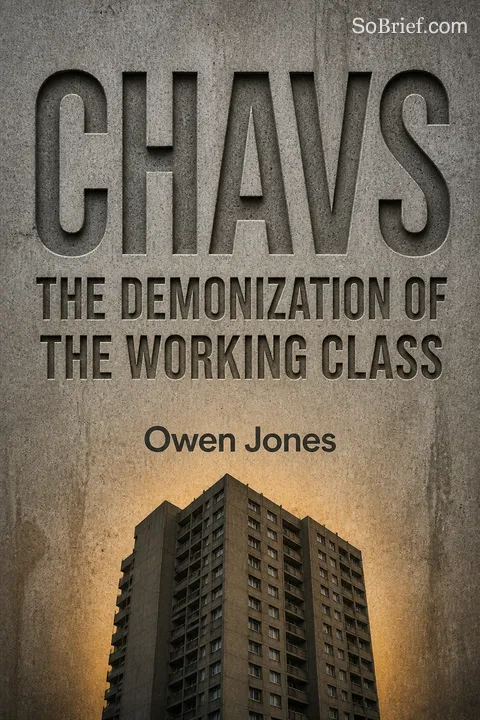
Chavs: The Demonization of the Working Class receives mostly positive reviews for its insightful analysis of class politics in Britain. Readers praise Jones's thorough research and compelling arguments about the media's portrayal of the working class. Many find the book eye-opening and relevant to current social issues. Some criticize its repetitiveness or political bias, while others appreciate its passionate call for social justice. Overall, reviewers consider it an important work that challenges perceptions of class in modern society.
People Also Read







Glossary
chav
class-coded insultA derogatory label applied to people perceived as working class, often carrying associations with vulgarity, laziness, violence, or poor taste. Jones argues that it is usually imposed rather than adopted, and that its meaning can stretch from a stereotype of a small subgroup to a sneer at working-class people more broadly.
Thatcherism
market-led political projectThe political and economic program associated with Margaret Thatcher's governments. In Jones's account, it promoted individual competition and private ownership while weakening trade unions, selling public assets, and overseeing the collapse of many industrial communities. The term describes both a policy direction and a shift in how society explained inequality and personal responsibility.
meritocracy
ability-based social rankingA social order in which people are said to advance according to ability and achievement. Jones notes that Michael Young coined the term as a warning about the consequences of ranking people by supposed merit. The book argues that meritocratic language can make inherited advantages seem deserved while framing poverty as evidence of personal inadequacy.
cultural capital
inherited educational advantageThe resources and familiarity that help people navigate education and professional institutions. In Jones's discussion, these include parents' education, books at home, vocabulary, knowledge of university pathways, and the confidence to seek opportunities. Such advantages can improve a child's prospects before formal examinations begin, even when no one explicitly intends to exclude others.
underclass
stigmatized poor minorityA label used to describe a supposedly separate, morally deficient group at the bottom of society. Jones criticizes its use because it can collapse unemployment, poverty, family hardship, and individual wrongdoing into a single stereotype. That picture then makes a rare or extreme case appear representative of entire working-class communities.
social exclusion
policy label for disadvantageA term used prominently in New Labour's political vocabulary to describe people understood to be outside the mainstream of society. Jones argues that it often obscured the more direct language of poverty and class, while leaving unclear who was excluded, from what, and how many people the label described.
New Unionism
organizing overlooked workersA historical effort to extend trade union organization beyond relatively privileged skilled workers to include larger numbers of unskilled workers. Jones uses the term as a model for renewing unionism among today's service-sector employees, including workers in retail and call centres, who are often temporary, part-time, or difficult to organize.
The Spirit Level
inequality and social outcomesA study by Richard Wilkinson and Kate Pickett cited by Jones to argue that more unequal societies tend to experience worse outcomes across several social measures. The book uses it to challenge the claim that inequality is harmless or simply reflects differences in talent. Jones presents it as evidence for examining social structure, not as proof that inequality alone causes every problem.
FAQ
What's Chavs: The Demonization of the Working Class about?
- Focus on Class Issues: The book examines the stigmatization of the working class in Britain, particularly through the derogatory term "chav." Owen Jones argues that this label dehumanizes working-class individuals.
- Historical Context: Jones provides a historical overview, highlighting the shift from respect to contempt for the working class, especially during the Thatcher era.
- Cultural Representation: The book critiques media and cultural portrayals that reduce working-class people to stereotypes, impacting public perception and policy.
Why should I read Chavs: The Demonization of the Working Class?
- Timely and Relevant: The book addresses ongoing class division and inequality, making it relevant for understanding current social dynamics.
- Engaging Writing Style: Owen Jones writes accessibly, making complex social issues understandable and inviting readers to reflect on their views about class.
- Calls for Change: It encourages readers to challenge narratives about the working class and advocate for social justice and class solidarity.
What are the key takeaways of Chavs: The Demonization of the Working Class?
- Class Relevance: Jones argues that class remains a significant factor in British society, countering the myth of a classless society.
- Demonization: The book illustrates how the term "chav" is used to justify social inequalities and welfare cuts.
- Class Politics: Jones advocates for a revival of class politics to address class-based issues and economic inequalities.
What are the best quotes from Chavs: The Demonization of the Working Class and what do they mean?
- Hatred of Working-Class: “How has hatred of working-class people become so socially acceptable?” challenges the normalization of classist attitudes.
- Systematic Prejudice: “The demonization of working-class people is the legacy of a concerted effort to shift public attitudes.” highlights the systematic nature of class prejudice.
- Upper-Class Contempt: “Chavs is a passionate and well-documented denunciation of the upper-class contempt for the proles.” critiques the disdain of the upper class for the working class.
How does Owen Jones define the term "chav" in Chavs: The Demonization of the Working Class?
- Derogatory Label: "Chav" is a pejorative term used to stereotype the working class with negative traits like laziness and criminality.
- Cultural Implications: The term reflects societal attitudes that reinforce harmful stereotypes and distance the middle class from working-class realities.
- Impact on Identity: The stigma attached to "chav" affects how working-class people perceive themselves and are perceived by others.
What role does media play in the demonization of the working class according to Chavs: The Demonization of the Working Class?
- Stereotypical Representations: Media often reduces working-class individuals to caricatures, reinforcing negative stereotypes.
- Cultural Narratives: Media depictions contribute to narratives that justify marginalization and negative policies against the working class.
- Influence on Policy: Media representations can shape political discourse and policy decisions, leading to a lack of empathy for working-class struggles.
How does Chavs: The Demonization of the Working Class address the historical context of class in Britain?
- Post-War Changes: The post-war period saw greater recognition of the working class, but this shifted with Thatcher's policies.
- Thatcherism's Impact: The 1980s marked a decline in the social standing of the working class due to dismantled support institutions.
- Contemporary Relevance: Historical events are connected to current issues, showing the lasting impact of past policies on working-class communities.
What solutions does Owen Jones propose in Chavs: The Demonization of the Working Class?
- Revival of Class Politics: Jones calls for recognizing and addressing class-based issues through organized movements.
- Challenging Stereotypes: The book encourages challenging stereotypes and advocating for social justice to foster solidarity.
- Political Engagement: Greater political engagement among working-class people is essential for demanding representation and rights.
How does Chavs: The Demonization of the Working Class relate to contemporary social issues?
- Economic Inequality: The book highlights growing inequality, arguing that demonization justifies welfare cuts and public service reductions.
- Cultural Divisions: Political rhetoric exacerbates cultural divisions, emphasizing the need for solidarity among working-class individuals.
- Youth Disillusionment: The book addresses the limited opportunities and bleak prospects faced by young people in working-class communities.
How does Chavs: The Demonization of the Working Class critique the media's portrayal of the working class?
- Stereotypical Narratives: Media often perpetuates negative stereotypes, creating a distorted view of working-class life.
- Lack of Representation: Authentic working-class voices are often absent, leading to misrepresentation and misunderstanding.
- Impact on Public Perception: Media portrayal influences public attitudes and policies, leading to stigmatization and discrimination.
What historical context does Chavs: The Demonization of the Working Class provide regarding the working class in Britain?
- Thatcherism's Impact: Thatcher's policies led to deindustrialization and economic hardship, altering working-class life.
- Rise of Neoliberalism: Neoliberal policies contributed to job insecurity and the erosion of social safety nets.
- Cultural Shifts: Economic shifts led to the demonization of working-class culture and a loss of community and identity.
Download PDF
Download EPUB
.epub digital book format is ideal for reading ebooks on phones, tablets, and e-readers.








