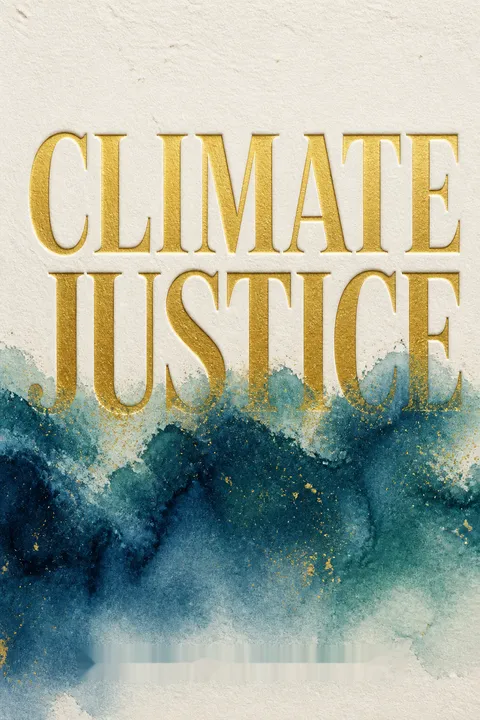


Key Takeaways
Put human rights at the center of climate policy
A grandchild changed the scale. When Robinson held her first grandson, Rory, she began imagining the world he would inherit in 2050. Climate change stopped being a distant scientific topic and became a question of whether children would have food, water, health, and shelter. Her work on human rights led her to recognize that a warming planet threatens those basic rights, especially for people with the fewest resources to protect themselves.
Justice changes the question. Climate justice means placing people at the heart of climate solutions and sharing the costs and benefits fairly. Communities that contributed least to emissions often suffer the worst effects. So climate policy must address both pollution and the poverty and exclusion that make its consequences harder to survive.
What's powerful here is the shift from treating climate change as a technical problem to judging it by its effects on human lives. That connects environmental policy to three familiar dimensions of justice: who bears the harm, who has a voice in decisions, and whose experiences are recognized as credible. This framing can make climate plans more accountable. It also sets a demanding test: a policy that lowers emissions while worsening access to food, energy, or housing cannot be called just merely because its carbon figures improve.
Make historic emissions visible in every climate bargain
The atmosphere keeps a record. Robinson explains climate change through the image of a bathtub: greenhouse gases flow in faster than natural systems can remove them, so the amount already in the atmosphere matters as much as current emissions. Industrialized countries grew wealthy through fossil fuels, while many of the people now facing drought, floods, and rising seas contributed little to the problem. The book argues that responsibility for action should reflect that imbalance.
Development still matters. At the time described, 1.3 billion people lacked electricity and 2.6 billion relied on open fires for cooking. The answer cannot be to deny them energy, but to expand access through renewable power and cleaner cooking. Robinson rejects charity as the frame: fair climate action means reducing emissions while making development possible.
This is a practical case for differentiated responsibility: countries share a climate system, but they do not share equal histories, resources, or exposure. The idea resembles progressive taxation, where contribution depends partly on capacity and past advantage rather than an identical burden for everyone. Yet fairness cannot become a reason to postpone action indefinitely. A durable bargain has to pair historical responsibility from wealthy states with credible emissions cuts and clean development choices across all economies.
Treat frontline testimony as evidence, not merely emotion
Weather became personal testimony. At a 2009 climate hearing, Ugandan farmer Constance Okollet described floods, drought, and seasons so erratic that farming had become a gamble. Kenyan herdsman Omar Jibril reported losing 180 of his 200 cattle to drought. Their accounts showed what climate disruption meant in daily life: less food, lost income, illness, and insecurity. When Robinson asked whether farmers were simply complaining about the weather, Constance answered that these conditions exceeded what her community had known.
Listening can lead to action. After a devastating flood, Constance helped form a women’s group, brought local concerns to officials, and eventually persuaded her council to require five trees planted for each tree cut. Her testimony was not just a record of harm. It carried observations and practical ideas from people adapting on the ground.
Lived experience can function as an early warning system, especially where formal monitoring is sparse. It also challenges a common hierarchy in which scientific measurements count as knowledge but local observations are treated as anecdote. The strongest approach uses both: community testimony identifies changes and consequences, while climate science helps assess causes and scale. There is a further caution. Asking witnesses to tell painful stories can become extractive if institutions collect compelling accounts but do not share decision-making power or resources.
Organize disaster survivors before recovery money is allocated
Katrina exposed unequal recovery. Hurricane Katrina destroyed Sharon Hanshaw’s salon and home in East Biloxi. When she returned, low-income residents were still living with damaged infrastructure and scarce services, while casino rebuilding moved quickly. In 2007, Mississippi had spent $1.7 billion compensating middle- and upper-income homeowners and businesses, but only $167 million on programs for poor residents.
A salon owner built a public voice. Hanshaw helped establish Coastal Women for Change, which brought together women from different racial and ethnic communities. The group pressed officials for representation on planning committees, organized residents, and helped families prepare for future storms. Its work showed that recovery is not only an engineering task. It is also a contest over whose homes, safety, and livelihoods count when public money is distributed.
Disaster recovery can reproduce the inequalities that made some neighborhoods vulnerable before a storm. Community organizing helps expose needs that broad averages conceal, and it gives residents a way to question priorities rather than simply receive them. This resembles participatory budgeting, where affected people help decide how public resources are used. Still, local leadership cannot substitute for competent government or adequate funding. The burden should not fall on survivors to organize their way into basic protection while better-connected interests receive attention by default.
Treat indigenous knowledge and language as survival infrastructure
A changing climate disrupts inherited knowledge. In Alaska, warming and melting ice make travel and hunting more dangerous for Yupik and Inupiat communities. The Yupik language includes precise words for different kinds of ice, but some conditions those words describe are disappearing. Patricia Cochran combines scientific work with community knowledge to help villages prepare for storms, assess local conditions, and decide whether to stay or relocate.
Access requires more than an invitation. Saami reindeer herders in Sweden notice that warmer winters can freeze a hard crust over the lichen their animals need. Jannie Staffansson pursued higher education after seeing that officials discounted her father’s observations. In Chad, Hindou Oumarou Ibrahim brought community knowledge into climate negotiations. These examples show that expertise can come from people who have long observed a place, even when institutions have ignored them.
The stories challenge the assumption that expertise travels only through formal credentials. Languages and practices can encode detailed environmental observations, while scientific methods offer tools for testing and sharing them. The combination is more useful than either source alone. At the same time, tradition should not be romanticized as fixed or infallible. Communities are internally diverse, and conditions can change beyond inherited experience. Respect means treating local knowledge holders as partners who can interpret evidence, not as symbols of an untouched past.
Give forest communities ownership, tools, and a stake in conservation
Conservation works better with local authority. In Vietnam, Vu Thi Hien saw how forest loss harmed both biodiversity and nearby villages, where families depended on forests for food, medicine, and income. Through her organization, CERDA, she helped ethnic minority communities form cooperatives to manage forest land, monitor logging, and measure carbon. With training, GPS devices, and performance-based payments, villagers could use their knowledge to protect the forests they depended on.
The results reached beyond trees. Between 2012 and 2015, seven cooperatives involving 2,459 households managed 4,300 hectares in Thai Nguyen Province. By 2016, the project had helped protect nearly 5,000 hectares across seven communes. Forest recovery brought back water, plants, and animals, while women gained a stronger role in community decisions. The model links climate mitigation to local livelihoods and authority.
This example echoes a core insight from common-pool resource governance: people often have strong reasons to protect shared resources when they have legitimate rights, clear rules, and a meaningful stake in outcomes. Measuring carbon can also connect local stewardship to national climate goals. But payment systems require safeguards. If outside funders define success too narrowly, communities may lose control or bear the costs of restrictions. Conservation is strongest when land rights, transparent decision-making, and locally chosen benefits accompany carbon accounting.
Prepare climate migration as a choice, not a forced scramble
An entire country faces displacement. Kiribati’s islands sit only a few feet above sea level, and king tides have already contaminated water and damaged homes. Former president Anote Tong bought about 6,000 acres of land in Fiji as a possible option for his people. The purchase was a stark signal of the threat, but moving a nation involves far more than finding land: it touches livelihoods, identity, sovereignty, and community ties.
Preparation can preserve agency. Tong’s strategy of migration with dignity included training young people in skills such as nursing and carpentry, so those who chose to leave could do so with better prospects. The goal was to make migration planned rather than a last-minute flight from disaster. Robinson presents this as a human rights issue: people facing displacement should have a say in when, where, and how they move.
Planning ahead can expand choices that disappear during an emergency. It also shifts migration from a story of helplessness to one involving skills, consent, and continuity. That distinction matters because relocation affects culture and political belonging, not just physical safety. However, planning for movement must not make displacement seem inevitable or excuse emissions cuts. Adaptation and relocation can reduce harm, but they cannot replace efforts to address the forces making places uninhabitable.
Turn personal reductions into collective action, not absolution
Small changes made the problem tangible. Natalie Isaacs began after seeing bushfires near Sydney and learning more about climate change. She replaced household lightbulbs, unplugged unused appliances, and hung laundry to dry. Her household electricity use fell by 20 percent. She then changed shopping, food, and waste habits, eventually reducing household waste by nearly 80 percent.
A movement made individual action visible. Isaacs founded 1 Million Women to help women cut household emissions through practical steps and shared tracking. By mid-2017, the movement had more than 600,000 members. Robinson presents these changes as a gateway: seeing results can build confidence and make climate action part of ordinary life. The point is not that household choices can solve climate change alone, but that millions of people living differently can help shift expectations and systems.
Visible personal results can overcome the feeling that climate change is too large for individual action. Social movements add something private behavior cannot: shared norms, imitation, and a sense of collective efficacy. Yet household choices are constrained by transport, housing, energy systems, and income. A consumer campaign should therefore complement policy and business change, not transfer responsibility from institutions to families. The most useful personal action is both a reduction in impact and a route into civic pressure for better options.
Decarbonize with workers, or communities pay twice
A job loss reaches beyond the workplace. Ken Smith spent 33 years at New Brunswick’s Brunswick Mine. Before its closure, his union negotiated retraining, job fairs, and a transition centre. Smith later realized that their plan had missed the town’s economic dependence on the mine. Many residents could not move, local businesses struggled, and unemployment rose. Even workers who found new jobs faced the cost of leaving homes and families.
A fair transition needs a plan for places. The Just Transition approach calls for workers and unions to help shape the shift away from fossil fuels, with training, income support, health care, and investment in affected communities. In Port Augusta, workers and residents helped plan a solar thermal plant intended to replace a coal facility and create 1,800 jobs. The transition is not just about new energy. It is about who can share in its benefits.
Aggregate job growth can hide severe local losses. A new solar job in one region does little for a miner whose family, skills, and community are tied to another place. This is a classic problem of concentrated costs and diffuse benefits: society gains from decarbonization, while particular towns bear the disruption. Worker participation and regional investment make change more legitimate and less frightening. They also need honest limits, since training cannot guarantee that every displaced worker receives an equivalent job nearby.
Treat Paris as a platform, then make every level accountable
The agreement created a shared process. The Paris Agreement brought rich and poor countries into a common framework to limit warming, report progress, and strengthen national plans every five years. Those plans, called intended nationally determined contributions, were voluntary commitments without penalties for noncompliance. Robinson describes the agreement as a breakthrough, but not a finished solution: even if countries met their stated targets, the book estimated warming could still exceed 2.7°C.
Implementation must reach daily life. Robinson points to cities, businesses, communities, and households as additional forces for change. She also stresses that clean energy access matters: renewable systems can help provide electricity and cooking options without repeating the fossil-fuel path. The agreement supplies direction and a basis for cooperation; progress depends on stronger commitments, public accountability, financing, and practical action close to where people live.
The agreement’s strength is its broad participation and recurring review, which can create reputational pressure even without formal penalties. That design resembles a learning system: governments disclose plans, compare results, and revise ambition. Its weakness is the gap between announced targets and sufficient action. Subnational leadership can fill part of that gap, but fragmented initiatives need coordination, reliable finance, and transparent measurement. The treaty is therefore best understood as political infrastructure: essential for organizing action, but incapable of delivering the transition by itself.
Analysis
Robinson’s central move is to change the unit of climate analysis. The problem is not only a rising global temperature or a negotiation among states. It is a chain connecting emissions to unequal exposure, unequal capacity to adapt, and unequal influence over public decisions. The stories give that chain a human scale: a farmer loses crops and food, a town loses its economic anchor, and an island nation confronts the possible loss of home. Together, they make climate justice a framework for asking who caused harm, who experiences it, and who gets to shape the response.
The book’s narrative structure is also an argument about knowledge. Farmers, Indigenous communities, workers, and women are not simply examples of vulnerability. Their observations and organizing reveal where policy fails and what solutions may work. The strongest cases join local experience with institutional tools: community forest management receives technical support, and workers negotiate transition plans rather than merely being told to retrain. This avoids the false choice between expertise and participation.
A tension remains. Stories of resilience can inspire, but they can also make endurance look like an adequate substitute for justice. Constance planting trees or Sharon organizing neighbors should not relieve governments and high-emitting industries of responsibility. Likewise, local stewardship needs secure rights and resources, not praise alone. Robinson’s more persuasive lesson is that resilience becomes meaningful when it is backed by power, finance, and choices.
The book’s policy vision is therefore both moral and practical. Climate action is more durable when it expands access to energy, protects workers, includes affected communities, and reduces emissions together. Its greatest contribution is to show that fairness is not a decorative concern added after the technical plan. Fairness determines whether people can participate in the plan, whether its costs are bearable, and whether its benefits reach those most exposed. Climate policy succeeds not only by changing energy systems, but by changing who has a voice in designing them.
Review Summary
Climate Justice receives mostly positive reviews for highlighting personal stories of those affected by climate change, especially women and indigenous people. Readers appreciate the accessible writing and inspiring narratives, though some criticize Robinson's privileged perspective and wish for more direct voices from those impacted. The book is praised for its focus on climate justice and intersectionality, but some find it lacks depth for those already familiar with climate issues. Overall, it's seen as a good introduction to climate change's human impact.
People Also Read





Glossary
Climate justice
Fair climate actionA way of understanding and responding to climate change that puts people and human rights at the center. It addresses the unequal distribution of climate harms, recognizes the greater historical responsibility of high-emitting countries, and calls for affected communities to participate in decisions. It links emissions reduction with poverty reduction, sustainable development, and fair sharing of costs and benefits.
Just Transition
Fair shift from fossil fuelsAn approach to moving toward a low-carbon economy that protects workers and communities dependent on fossil fuel industries. It calls for workers, unions, companies, and governments to plan together, with measures such as retraining, income support, health care, and investment in affected places. Its goal is to prevent the costs of decarbonization from falling unfairly on workers and towns.
REDD+
Forest protection incentivesA United Nations initiative that provides incentives for developing countries to reduce emissions from deforestation and forest degradation, conserve forests, manage them sustainably, and increase carbon stocks. In the book’s Vietnam example, local communities receive support and training to monitor and protect forests. The approach treats forest stewardship as both a climate measure and a possible source of community income.
intended nationally determined contributions (INDCs)
National emissions plansThe national climate plans countries submitted in preparation for the Paris Agreement, describing how and by how much they intended to reduce emissions. The agreement established a cycle in which countries would return with updated plans every five years and report on progress. In the book’s account, the process created broad participation but had no penalties for countries that failed to meet their commitments.
migration with dignity
Planned, self-directed migrationAn approach to climate-related migration advanced by Anote Tong for the people of Kiribati. Rather than wait until rising seas make movement unavoidable, it prepares people through skills training and aims to let those who choose to migrate do so with opportunity and agency. The idea treats migration as a human decision involving livelihoods and identity, not merely emergency relocation.
Troika Plus
Women leaders climate networkA network that grew from three women leading successive international climate conferences into a broader group of female leaders, ministers, and United Nations officials. Its meetings brought grassroots women into spaces usually occupied by diplomats and senior officials. The network aimed to connect political influence with lived experience and strengthen women’s role in climate action.
Mission 2020
Emissions decline initiativeAn initiative associated with Christiana Figueres that sought to bend the global emissions curve downward by 2020. It organized climate action around energy, transport, infrastructure, land use, industry, and finance, emphasizing solutions already being pursued by governments and businesses. In the book, it represents the urgency of turning long-term climate goals into near-term changes.
protect in place
Defend a threatened communityA designation for Alaskan communities that choose to remain in their current locations despite risks from erosion, flooding, and melting permafrost. Support can include seawalls, revetments, sandbags, and other protective measures. The term contrasts with relocation, though communities seeking protection often face limited funding and may find that a storm destroys the defenses they have built.
FAQ
What's "Climate Justice: Hope, Resilience, and the Fight for a Sustainable Future" about?
- Focus on Climate Justice: The book by Mary Robinson explores the concept of climate justice, emphasizing the human rights aspect of climate change and the need for equitable solutions.
- Stories of Resilience: It shares inspiring stories of individuals and communities worldwide who are facing the impacts of climate change and demonstrating resilience and hope.
- Global Perspective: The narrative includes experiences from various regions, including Africa, the Pacific Islands, and the Arctic, highlighting the global nature of climate challenges.
- Call to Action: Robinson advocates for urgent action to address climate change, focusing on sustainable development and the empowerment of marginalized communities.
Why should I read "Climate Justice: Hope, Resilience, and the Fight for a Sustainable Future"?
- Human-Centric Approach: The book provides a unique perspective by focusing on the human stories behind climate change, making the issue more relatable and urgent.
- Inspiration and Empowerment: It offers stories of individuals who have taken action against climate change, serving as inspiration for readers to engage in climate justice efforts.
- Educational Insight: Readers gain a deeper understanding of the intersection between climate change, human rights, and social justice.
- Practical Solutions: The book discusses practical steps and solutions that can be implemented to combat climate change and promote justice.
What are the key takeaways of "Climate Justice: Hope, Resilience, and the Fight for a Sustainable Future"?
- Climate Justice Defined: Climate justice involves addressing climate change through the lens of human rights, ensuring that those least responsible for climate change are not disproportionately affected.
- Importance of Grassroots Activism: The book highlights the power of grassroots movements and local communities in driving change and influencing policy.
- Role of Women and Indigenous Peoples: It emphasizes the critical role women and indigenous communities play in climate action and the need to amplify their voices.
- Urgency of Action: Robinson stresses the need for immediate and collective action to mitigate climate change and protect vulnerable populations.
How does Mary Robinson define climate justice in the book?
- Human Rights Focus: Climate justice is about ensuring that the rights of those most affected by climate change are protected and that they have a say in climate policies.
- Equitable Solutions: It involves creating fair solutions that distribute the burdens and benefits of climate change mitigation and adaptation equitably.
- Empowerment of Vulnerable Communities: The concept emphasizes empowering marginalized communities to participate in decision-making processes.
- Moral Obligation: Robinson frames climate justice as a moral obligation to address the injustices caused by climate change.
What are some inspiring stories shared in "Climate Justice: Hope, Resilience, and the Fight for a Sustainable Future"?
- Constance Okollet in Uganda: A farmer who organized her community to combat the effects of climate change through tree planting and advocacy.
- Sharon Hanshaw in Mississippi: A salon owner turned activist after Hurricane Katrina, advocating for her community's recovery and resilience.
- Patricia Cochran in Alaska: An Inupiat leader working to help indigenous communities adapt to the impacts of climate change.
- Anote Tong in Kiribati: The former president who sought international attention for his sinking island nation, advocating for "migration with dignity."
What practical solutions does Mary Robinson propose for addressing climate change?
- Empowering Local Communities: Encouraging grassroots movements and local solutions tailored to specific community needs.
- Promoting Renewable Energy: Advocating for a transition to renewable energy sources to reduce carbon emissions.
- Supporting Vulnerable Populations: Providing financial and technical support to communities most affected by climate change.
- Integrating Human Rights: Ensuring that climate policies are aligned with human rights principles to protect the most vulnerable.
How does "Climate Justice: Hope, Resilience, and the Fight for a Sustainable Future" address the role of women in climate action?
- Women as Change Agents: The book highlights the critical role women play in grassroots activism and community resilience.
- Gender Equality in Climate Policies: Robinson advocates for gender-responsive climate policies that empower women and address their specific needs.
- Stories of Female Leaders: The book shares stories of women leaders who have made significant impacts in their communities, such as Hindou Oumarou Ibrahim and Jannie Staffansson.
- Amplifying Women's Voices: Emphasizes the importance of including women's perspectives in climate negotiations and decision-making processes.
What are the best quotes from "Climate Justice: Hope, Resilience, and the Fight for a Sustainable Future" and what do they mean?
- "Putting people at the heart of the solution": This quote underscores the book's central theme of focusing on human rights and justice in climate action.
- "We need to take personal responsibility": Robinson calls for individual and collective action to address climate change, emphasizing personal accountability.
- "A narrative of hope": The book aims to inspire hope and resilience in the face of climate challenges, encouraging readers to believe in the possibility of change.
- "Migration with dignity": Refers to Anote Tong's approach to addressing climate-induced displacement, advocating for respectful and planned migration strategies.
How does Mary Robinson connect climate change with human rights in the book?
- Impact on Vulnerable Populations: Robinson highlights how climate change disproportionately affects those who are already marginalized, exacerbating existing inequalities.
- Rights-Based Approach: She advocates for a rights-based approach to climate policies, ensuring that the needs and voices of vulnerable communities are prioritized.
- Moral and Ethical Responsibility: The book frames climate action as a moral and ethical responsibility to protect human rights and promote justice.
- Global Solidarity: Robinson calls for global solidarity and cooperation to address the interconnected challenges of climate change and human rights.
What is the significance of the Paris Agreement according to "Climate Justice: Hope, Resilience, and the Fight for a Sustainable Future"?
- Historic Turning Point: The Paris Agreement is seen as a landmark global accord that sets the course for reducing carbon emissions and addressing climate change.
- Inclusion of Climate Justice: The agreement acknowledges the importance of climate justice, human rights, and gender equality in climate action.
- Commitment to Action: It represents a collective commitment by countries to limit global warming and transition to sustainable energy sources.
- Challenges of Implementation: Robinson discusses the challenges of implementing the agreement and the need for continued advocacy and action.
How does "Climate Justice: Hope, Resilience, and the Fight for a Sustainable Future" address the concept of "Just Transition"?
- Support for Fossil Fuel Workers: The book emphasizes the need to support workers transitioning from fossil fuel industries to renewable energy sectors.
- Economic and Social Justice: Just Transition is framed as a way to ensure economic and social justice for communities affected by the shift to clean energy.
- Inclusive Planning: Robinson advocates for inclusive planning that involves workers, unions, and communities in the transition process.
- Avoiding Economic Displacement: The concept aims to prevent economic displacement and ensure that no one is left behind in the move towards a sustainable future.
What lessons can be learned from the grassroots activists featured in "Climate Justice: Hope, Resilience, and the Fight for a Sustainable Future"?
- Power of Local Action: The stories demonstrate the impact of local action and community-driven solutions in addressing climate change.
- Resilience and Hope: The activists' resilience and hope serve as powerful examples of how individuals can drive change and inspire others.
- Importance of Advocacy: The book highlights the importance of advocacy and raising awareness to influence policy and bring about systemic change.
- Collaboration and Solidarity: The activists' stories emphasize the need for collaboration and solidarity in the fight for climate justice.
Download PDF
Download EPUB
.epub digital book format is ideal for reading ebooks on phones, tablets, and e-readers.








