

Plot Summary
Prologue
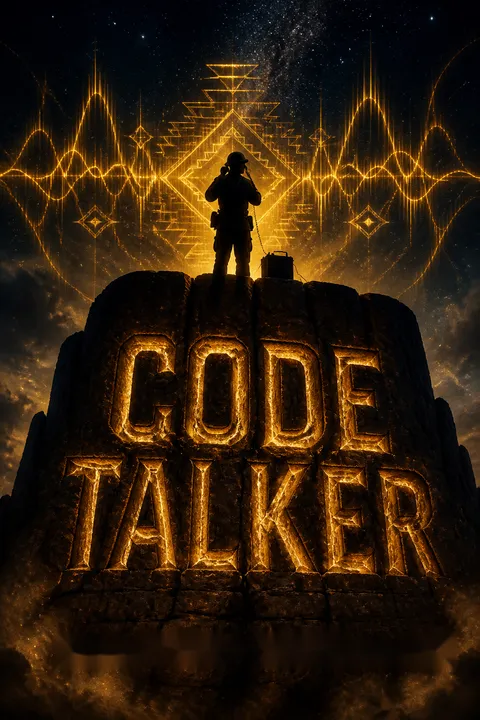
As an old man, Ned Begay1 tells his grandchildren that the medal they have asked about carries a story he was forbidden to share for decades. It recalls Iwo Jima, where his friend Ira Hayes13 helped raise the American flag, and the code talkers who sent word of the Marines’ advance.
Ned1 explains that their language, once punished out of Navajo children, became a secret weapon. To tell how that happened, he turns back to the first separation from his family2 and the beginning of his life as a Marine.
The medal makes memory a form of delayed service: Ned can finally give the public object its missing human history. Beginning with the flag’s fame also establishes a tension between visible recognition and hidden labor. Ira Hayes appears in the image celebrated by the nation, while Ned’s contribution was concealed by military secrecy. The grandchildren are not merely an audience; they are the next generation entrusted with a language and a history that institutions once tried to suppress. Ned’s backward turn makes the book’s central irony legible before its causes are known.
The Wagon Beyond Dinetah
Ned Begay1 is six when his parents2 send him from their Navajo home to Rehoboth Mission School, more than a hundred miles away. His uncle3 explains that learning English may help the family2 live under American law, though their people have already endured forced exile on the Long Walk.
Ned1 leaves with a small bundle, his mother2’s carefully dressed image fixed in his mind, and his great-grandfather’s blessing to be strong. At the school gate, his uncle3 drives away without a conventional farewell.
Navajo children greet one another by clan, briefly rebuilding the kinship order they know. Then a school official silences them, and a Navajo interpreter tells them they must speak English or remain quiet. The institution’s first lesson is that their language has no place there.
Ned’s departure joins two histories of removal: his great-grandfather’s forced journey to Hwééldi and the school’s supposedly benevolent separation of children from home. His uncle frames English as a practical tool for protecting family and land, not as proof that Navajo life is inferior. That distinction gives Ned’s obedience its complexity. He is not simply surrendering to assimilation; he is carrying a family obligation into a hostile institution. The children’s clan introductions briefly restore relationship and orientation, then the school’s language ban reveals that its education begins by disrupting precisely those forms of belonging.
A Name Replaced
At Rehoboth, workers cut the children’s hair, take their jewelry and clothing, and dress them in uniforms. A teacher assigns Ned1 the English name Ned Begay1 after misunderstanding his Navajo explanation that he is the son of a man known as Gray Mustache.
Soon afterward, Ned1 greets a teacher in Navajo and is punished with soap forced into his mouth. His schoolmates Tommy Nez7 and Jesse Chee8 help him back to the dormitory, where Jesse8 secretly comforts him in their language.
Defiant John Roanhorse9 continues speaking Navajo despite beatings and is chained in a basement for a week. Ned1 protects himself differently: he excels in class while speaking Navajo with other students whenever adults cannot hear. The school suppresses the language, but his private use keeps it alive.
The school’s renaming is not a clerical accident in Ned’s experience. It shows how authority can convert a relationship, being someone’s son, into a label it controls. Hair, clothing, and language are similarly treated as removable signs, even though they carry belonging and sacred meaning. Ned and John Roanhorse represent distinct survival strategies: concealed persistence and open refusal. The book does not romanticize either. John’s resistance has a brutal cost, while Ned’s outward compliance risks making him seem assimilated. His private Navajo speech becomes an act of self-definition that can coexist with academic achievement.
Pearl Harbor Changes Everything
Ned1’s strong schoolwork earns him a place at Navajo High School, closer to his family2 and with better classes and a library. He studies Japan, writes about the island nation’s hardship, and joins classmates in collecting food for Japanese civilians.
As Japan expands its war, the Navajo Tribal Council declares its readiness to defend the United States. On December 7, 1941, Tommy Nez7 brings news that Japan has attacked Pearl Harbor. Ned,1 then fourteen, wants to enlist, but his age rules him out.
The attack also follows a fresh humiliation: his teacher had punished him in class for speaking Navajo. Ned1 now faces a country that has treated his language as worthless but may need Navajo men to fight for it. He fears the war will end before he is old enough to serve.
Ned’s earlier interest in Japan complicates the sudden division between homeland and enemy. He has imagined Japanese civilians as people in need of aid before their government becomes the adversary. Meanwhile, the tribal council’s declaration asserts Navajo political judgment, not merely loyalty demanded from above. Ned’s personal contradiction sharpens: he is told that Navajo identity obstructs progress, then hears that his people may be needed in a national emergency. His wish to enlist grows from duty and from a desire to prove himself, but the recent classroom punishment ensures that service cannot be separated from the question of whose language and personhood America values.
One More Winter
When Marine recruiter Frank Shinn comes to Fort Defiance seeking Navajo volunteers, Ned1 is too young to qualify. His parents2 refuse to claim otherwise and ask him to wait another winter.
Meanwhile, the first twenty-nine Navajo recruits leave without telling their families what their special assignment is; months of silence fuel rumors until Corporal Johnny Manuelito5 returns in uniform to recruit more men. His account of the Navajos’ success in training convinces Ned1 that his chance has come.
Ned1 asks his parents2 again, and they agree after a year of waiting, provided he first receives a Blessingway ceremony. Singer Big Schoolboy, also known as Frank Mitchell,4 conducts the all-night rite. The next day Ned1 joins the Marines, with his family2’s blessing and corn pollen carried as a source of spiritual steadiness.
The delay marks a meaningful difference between impulsive enlistment and chosen responsibility. Ned’s parents do not deny his wish; they insist that his age and safety matter, then honor the promise they made after he waits. The Blessingway does not function as a magical guarantee against injury. It places Ned’s departure within a network of family, ceremony, and sacred balance. That framework will travel with him when military life strips away familiar supports. Johnny Manuelito’s return also turns an abstract opportunity into a credible path: Ned sees a Navajo man exercising authority in a uniform rather than merely hearing promises from a recruiter.
The Smallest Marine
At Fort Wingate, Ned1 and the other Navajo recruits begin Marine training after retracing part of the route their ancestors took into exile. In boot camp, barbers shave their heads, oversized boots trouble Ned,1 and drill instructors shout orders that he struggles to interpret at first.
The Navajos handle marches and weapons practice well, drawing on lives already shaped by long walks and hard work, but swimming nearly defeats Ned:1 he sinks to the pool’s bottom and walks along it before learning to float.
He also discovers that Georgia Boy,10 a white recruit, has hidden his inability to read. Ned1 offers to teach him, and their friendship begins. Helping Georgia Boy10 overturns Ned1’s schoolroom assumption that white people naturally know more than Navajos, and turns difference into mutual learning.
Boot camp recasts the traits Ned was taught to regard as signs of deprivation. Endurance learned through reservation life becomes military competence, while a skill he lacks, swimming, exposes the danger of assuming that toughness means mastery of everything. His underwater walk is both comic and revealing: he meets a new environment through the bodily knowledge he already has. The friendship with Georgia Boy changes the moral geometry of Ned’s world. Rather than placing one culture above another, the episode shows that each man possesses knowledge the other lacks. Ned’s offer to teach is an early form of the educator he hopes to become.
Navajo Becomes the Code
After graduating with the 297th Platoon, Ned1 expects combat or ordinary signal training. Instead, the Navajo Marines are taken to a guarded classroom at Camp Elliott, where Johnny Manuelito5 and John Benally6 teach them to convert Navajo words into English-letter codes.
The Marines explain that Japanese listeners have broken existing American codes, while Navajo is little known outside the community and difficult for outsiders to learn. The first platoon created the system; Ned1’s group must memorize its alphabet, extra letter alternatives, and hundreds of military terms.
They keep every scrap of paper collected and every blackboard erased, so the code exists chiefly in their memories. Training also teaches radio and Morse skills. For the first time, Ned1 is ordered to use openly the language his childhood school punished.
The code’s power depends on more than linguistic obscurity. It requires fluent speakers who share cultural knowledge, disciplined memory, and trust in one another under pressure. The Marines’ reliance on Navajo reverses the school’s judgment without undoing its harm: the language is useful to the state, but its speakers still face secrecy and limited recognition. Ned experiences this reversal as pride, yet the code is not simply a symbol of vindication. Its practical demand is exactness. A message misremembered or mistranslated can endanger men, so cultural knowledge becomes both a source of agency and a heavy responsibility.
The Black Sand Landing
After further code briefings in Hawaii, Ned1 joins the Third Marine Division and ships toward Bougainville. He has learned how code teams work: one operator speaks and transmits, while another writes and translates the message at the receiving end.
On November 1, 1943, naval guns and aircraft pound the island before the Marines approach Blue Beach One. The bombardment has missed Japanese defenses hidden in bunkers. Japanese fire hits the landing craft, destroys a neighboring boat, and pins the survivors beneath a steep wall of sand.
Ned1 finds Georgia Boy10 wounded and ties a bandage around his arm before returning to the work of communication. The invasion’s apparent preparation gives way to an ambush, and the Navajo team becomes part of the network keeping commanders informed as Marines struggle ashore.
The landing exposes the gap between a plan on paper and the landscape actually encountered. The bombardment creates confidence without eliminating the hidden defenders, while the black sand obstructs both movement and equipment. Ned’s first response to battle is not heroic spectacle but practical care: he tends Georgia Boy, then returns to his assigned work. The code’s importance is therefore grounded in a chain of specific dependencies. Men need accurate information amid confusion, and the Navajo team must remain functional while under fire. Friendship and duty do not compete here; both require Ned to act despite fear.
A Message Before the Mortar
On Bougainville, the Marines struggle through mud, heat, insects, and steep jungle while Japanese soldiers remain difficult to locate. The death of code talker Harry Tsosie, mistakenly shot by an American medic after leaving his foxhole at night, shows how danger can come from confusion within one’s own lines.
Days later, Ned1 and Bill Toledo learn that Japanese troops are booby-trapping abandoned gear after two Marines are injured retrieving a weapon. They send a coded warning, then move away from their radio site.
A mortar round strikes the spot they have just left. The episode makes the four-part field routine, transmit, receive, confirm, move, a matter of survival. When Ned’s family2 writes from home, he sends back his muddy, bloodstained clothes so they can be included in a protection ceremony.
Bougainville refuses the clean moral map of a war story in which danger comes only from the enemy. Harry’s death arises from the same fear of infiltration that keeps the Marines alive, turning vigilance into an unbearable risk. The booby-trap message offers a different outcome: the code can protect people only when communication is paired with movement and attention to procedure. Ned’s mailed clothing also links the battlefield to home without pretending they are close. His family’s ceremony gives material presence to an absent son, while the code makes his voice useful across physical distance.
Guam’s Night Attack
After delays and weeks of waiting, Ned1’s division lands on Guam on July 21, 1944, following a prolonged naval bombardment. Japanese troops attack at night, and the fighting continues as Marines push inland.
Navajo Marines bring an orphaned Chamorro boy, Johnny, into their tent and share food with him because they refuse to leave a child without a family. During patrols, Wilsie Bitsie12 finds code talker Charlie Begay14 apparently dead after an ambush; the men cover him and report his loss. Charlie14 is actually alive, badly wounded, and later returns after treatment.
Ned1 is hit by a sniper’s bullet in the shoulder and evacuated for care. The island’s cost is personal and communal: the Marines win territory, but Ned1 leaves behind friends, grieving islanders, and a child his unit has tried to protect.
Guam places the code talkers’ work inside a broader ethic of care. Their attention to Johnny is not an official assignment; they make him part of their group because their own kinship principles make abandonment unacceptable. Charlie’s survival complicates the battlefield’s authority to declare who is gone, though the men act on the evidence they have. Ned’s wound then interrupts his role as operator and participant. The section’s emotional force comes from these overlapping limits: military systems can secure an island, but they cannot restore destroyed families or guarantee that the living will be recognized in time.
Rest Is Not Peace
Ned1’s shoulder wound sends him to Hawaii, where he sees other Marines suffering from battle fatigue, including men with no visible injuries who cannot stop crying, speaking incoherently, or staring into space. He understands their distress through the Navajo story of Monster Slayer, who became ill after killing the beings that threatened his people and needed an Enemyway ceremony to regain balance.
Yet Ned1 receives no such healing before he is sent back toward the front. In 1945, he joins fellow Navajo Marines and scouts on Pavuvu, where they share a ceremonial gathering while waiting for orders. The respite is crowded with rats, crabs, disease, and news of kamikaze attacks. When the order comes, they ship out for Iwo Jima.
The idea of battle fatigue gives psychological injury a place in the book’s account of war, resisting the notion that only visible wounds count. Ned’s reference to Monster Slayer makes violence costly even when it is justified as defense; the warrior who destroys danger can still be harmed by what he has done. The Marines’ return to battle before receiving healing exposes a conflict between institutional readiness and human recovery. Pavuvu’s ceremony offers solidarity, not cure. The next deployment therefore begins with accumulated strain rather than a reset, making the coming invasion a continuation of damage as much as a new campaign.
Iwo Jima’s Hidden Guns
Before the invasion, Ned1 learns that Iwo Jima’s Japanese defenders have built deep tunnels and concealed positions beneath months of American bombardment. On February 19, 1945, his landing craft reaches the black volcanic sand with little enemy resistance.
The silence seems to confirm the hope that the island has been subdued. Then Japanese guns open fire on the crowded beach. Loose sand makes the steep terraces hard to climb, and Marines are exposed as they struggle for cover. Smitty11 pulls Ned1 upward through the shifting slope while Ned1 carries his radio.
Once they reach a shallow depression, Ned1 begins sending reports that help command ships direct supplies and support. The code network keeps operating as casualties mount, and the Third Division is summoned. The beach has become a trap, but communication holds the scattered force together.
The island’s apparent quiet is not relief but a tactical deception, and the sudden attack punishes the desire to read silence as safety. The buried defenses also turn the preceding bombardment into a lesson in incomplete knowledge: destructive power cannot guarantee that an enemy has been reached. Smitty’s physical help and Ned’s radio work are complementary forms of survival, one local and immediate, the other distributed across ships and units. The code does not defeat the ambush; it helps the Marines respond to it. This distinction keeps the narrative from treating language as magic and gives its value a credible human scale.
The Flag Is Not Victory
After days of slow advances and heavy losses, Marines reach Mount Suribachi’s summit on February 23. Ned1 is too far down the slope to see the first American flag, but code talker Teddy Draper sends the report that Company E has secured the mountain.
Ned1 continues relaying battlefield information as Marines elsewhere remain under fire. The flag’s rise brings celebration to ships and shore, yet the battle goes on for weeks. On March 4, Georgia Boy10 is shot in the throat while he and Ned1 are under attack. A medic takes over as Ned1 returns to his radio work, uncertain whether his friend will survive.
Organized resistance ends later in March, at enormous cost. Ned1 also knows Ira Hayes,13 whose place in the famous later photograph will make the flag-raising a public image, though the work and losses around it were much larger than that frame.
The flag’s symbolic force and the battle’s actual state diverge sharply. From a distant command perspective, the summit can look like a conclusion; for Marines below, it is one achievement inside continuing danger. Ned’s transmission records the event without granting him the position of witness, emphasizing how military memory is assembled through reports as well as images. Georgia Boy’s wound brings the larger casualty count into the intimate scale of friendship. The distinction between the first flag and the later famous photograph also challenges visual history: an image can preserve courage while narrowing attention to a moment that did not end the fighting.
Okinawa and the Bombs
Ned1 reunites with Georgia Boy,10 who survived his throat wound, and with Smitty11 as the Marines prepare to invade Okinawa. The April 1 landing meets little resistance, but the Japanese soon hold fortified ridges, and the battle lasts eighty-three days.
Kamikaze attacks strike the fleet, civilians die in vast numbers, and the death of President Roosevelt reaches Ned1 through the code network. After Okinawa, American forces continue bombing Japan. Atomic bombs destroy Hiroshima and Nagasaki in August.
Ned1 and other code talkers receive the first report of Japan’s surrender, and the men celebrate in the streets with drums and dancing. The victory ends the fighting, but reports from the bombed cities soon describe burned survivors and flattened homes, making celebration inseparable from grief and dread about what the weapon has done.
The ending of combat is not presented as a clean emotional release. Okinawa’s prolonged losses make invasion of the Japanese home islands seem almost unimaginable, while the atomic bombs stop the war through destruction on a scale the Marines have not seen firsthand. Ned’s mixed response follows from the book’s insistence that enemies remain human, especially when survivors resemble people from his own community. The code network delivers both Roosevelt’s death and Japan’s surrender, carrying public events into the intimate space of listening. Celebration is warranted, yet the news from Hiroshima and Nagasaki prevents victory from becoming moral simplification.
The Secret Comes Home
After his discharge, Ned1 travels home in uniform and stops for a Coca-Cola at a bar near the reservation. A sign bars Indians, and the bartender and customers throw him out despite his service.
The rejection pushes Ned1 toward the work he had imagined before the war: finishing school, using the G.I. Bill, and teaching Navajo children their language and history. Nightmares force him to undergo an Enemyway ceremony led by Big Schoolboy,4 restoring a sense of balance.
Ned1 works in education and tribal life while keeping the code secret; unfair housing rules restrict what Navajo veterans can build on their own land. In 1969, the code is declassified. Ned1 and fellow code talkers can finally tell their story, and the medal becomes a record for grandchildren rather than a silent token.
The bar scene is a compact collision between national service and local exclusion. Ned’s uniform earns recognition in some places, but it cannot protect him from a sign that reduces him to the identity he was punished for as a child. His choice not to answer violence with violence signals a shift in strategy, not acquiescence: he turns toward education, cultural continuity, and community work. The Enemyway acknowledges that surviving combat does not automatically restore the self. Declassification finally joins public recognition to private memory, though it does not erase the discrimination Ned faces after the war.
Analysis
The novel’s central contradiction is historical and intimate: a school system tells Navajo children that their language must disappear, then the Marines depend on that same language to protect American forces. The code’s effectiveness gives Ned1 agency, but it does not retroactively repair the coercion that preceded it. The distinction matters. Navajo is not valuable only because it serves military goals; the code reveals the blindness of institutions that mistake unfamiliar knowledge for uselessness.
Ned1’s story also resists reducing wartime service to a simple narrative of national inclusion. He and his fellow Marines fight for the United States, yet segregation and unequal treatment remain waiting when he returns. His service changes his confidence and skills, not the prejudices of every person he encounters. The bar scene makes that limit concrete, while his decision to teach turns the next struggle toward language, history, and community rather than revenge.
The book’s treatment of violence is equally unsentimental. Battle fatigue, the mistaken killing of Harry Tsosie, civilian deaths, and the atomic bomb survivors all unsettle the clean categories of victory and defeat. Navajo ceremonies offer a language for injury and restoration, not an escape from grief. By ending with Ned1 telling his grandchildren, the narrative makes memory itself a responsibility: the nation’s celebrated symbols can be retained, but they must be accompanied by the less visible labor, losses, and cultural knowledge that gave them meaning.
Review Summary
Code Talker receives praise for its portrayal of Navajo code talkers in World War II, offering a unique perspective on the Pacific theater. Readers appreciate the historical accuracy, cultural insights, and the framing device of a grandfather telling his story. While some find the writing style dry or simplistic, many commend the book for its educational value and accessibility to young adults. Critics note the book's emphasis on military operations and lack of emotional depth, but overall, it's regarded as an important work highlighting the contributions of Native Americans to the war effort.
People Also Read
Characters
Ned Begay
The language-bearing MarineBorn Kii Yázhí, Ned is a small, observant Navajo boy whose family2 sends him to school so he can navigate a world governed by English. He loves learning and geography, but his intelligence develops alongside a careful awareness of how teachers demean Navajo identity. Ned survives by outwardly meeting expectations while privately protecting his language and cultural ties. He is curious rather than boastful, and his humor helps him meet unfamiliar situations without denying their danger. As a Marine, he carries both technical responsibility and a strong sense of obligation to family2 and community. His attention to people who are vulnerable, including fellow recruits and civilians, reveals a compassionate temperament beneath his disciplined reserve.
Ned’s mother and father
The family who gives consentNed1’s parents make the painful decision to send their first son1 to school because they believe he must understand the language of American law. They do not confuse education with abandoning Navajo tradition. Their initial refusal to let Ned1 enlist protects him while he is still very young, and they honor his determination after he has waited. Their prayers and ceremonies keep him connected to home even when the war carries him across the Pacific.
Ned’s uncle
The careful guideThe uncle who takes Ned1 to Rehoboth has attended a white-run school himself and understands why English can be useful. He also explains the Long Walk and the obligation to protect family2 and homeland, giving the child a reason for leaving that does not diminish his grief. His patient explanations model a form of teaching based on context and respect, sharply unlike the school’s commands.
Big Schoolboy
The keeper of balanceAlso known as Frank Mitchell, Big Schoolboy is a respected singer, former tribal council member, and family friend. His modesty and humor make his authority feel welcoming rather than coercive. He performs the Blessingway before Ned1’s enlistment and remains connected to the ceremonies that help Ned1 understand spiritual balance. For Ned1, he represents a living relationship between Navajo practice and the changing demands of the modern world.
Johnny Manuelito
The Navajo Marine modelA serious former student, Johnny Manuelito returns to the reservation as a Marine corporal after serving in the first Navajo platoon. His bearing and confidence impress Ned1, while his recruitment work makes military service feel possible for young Navajo men. Later, as an instructor, he helps prepare code talkers for a duty built on their fluency and discipline. He offers Ned1 an example of Navajo competence recognized within a largely white institution.
John Benally
The code-school instructorA Navajo Marine and one of the instructors at Camp Elliott, John Benally teaches recruits how to translate Navajo words into a military code. His presence at the front of the classroom contrasts with Ned1’s childhood experience of Navajo adults employed to enforce English-only rules. He demands precision because lives will depend on the students’ work, linking cultural knowledge to rigorous technical responsibility.
Tommy Nez
Ned’s first school friendTommy Nez befriends Ned1 at boarding school and helps him recover after a teacher punishes him for speaking Navajo. Tommy later shares Ned1’s excitement and uncertainty as war approaches. He represents the companionship that helps Ned1 endure institutions designed to isolate children from their families and language.
Jesse Chee
The quiet comforterJesse Chee is an older Navajo student who steadies Ned1 after the soap punishment and reminds him, in secret, that his people and spiritual traditions have not vanished. His support is small in scale but decisive to a frightened child. Jesse’s whispered Navajo shows how care can persist even in a place where the language is forbidden.
John Roanhorse
The open resisterA large, stubborn boy at Rehoboth, John Roanhorse refuses to stop speaking Navajo, even when teachers beat and punish him. His resistance exposes the violence behind the school’s claims to educate. He is not a simple emblem of courage: his defiance carries a human cost that Ned1 witnesses and remembers.
Georgia Boy
The generous Southern buddyA tall recruit from the South, Georgia Boy conceals that he cannot read because he fears being dismissed from the Marines. Ned1 discovers the truth when asked to read a family letter and offers to teach him. Their friendship grows through mutual trust, teasing, and shared danger. Georgia Boy’s vulnerability helps Ned1 see that ignorance and need are not confined to one race or community.
Smitty
The steadfast radio buddyJohn Smith, known as Smitty, is a Marine from Boston who becomes one of Ned1’s closest friends. He watches out for Ned1 in a military where brown skin can lead to dangerous misidentification, and he stays near him through repeated campaigns. His humor and practical loyalty offer Ned1 a form of chosen kinship that crosses racial and cultural lines without pretending prejudice has disappeared.
Wilsie Bitsie
The loyal Navajo friendWilsie Bitsie is a Navajo Marine whose ties to home remain important amid the Pacific campaigns. On Guam, he helps care for the orphaned Chamorro child Johnny and shows deep concern for his friend Charlie Begay14. His actions express a kinship ethic that reaches beyond clan and nationality, especially toward children and fellow soldiers in danger.
Ira Hayes
The Pima flag-raiserIra Hayes is a Pima Marine and a friend of Ned1’s who serves in the Pacific war. His presence in the famous flag-raising image links an Indigenous serviceman to a national symbol, while Ned1’s recollections place the photograph within a much larger battlefield experience. Ira’s discomfort with being turned into a public emblem reflects the difference between a celebrated image and a soldier’s private memories.
Charlie Begay
The code-talking comradeCharlie Begay is a Navajo code talker serving alongside Ned1 and Wilsie12. His close friendship with Wilsie12 gives the Guam campaign a personal center, while his work reflects the trust and skill required of the code teams.
Plot Devices
The Navajo code
Memory made military technologyThe code assigns Navajo words to English letters and to frequently used military terms, allowing Marine units to send orders by radio without revealing their meaning to Japanese listeners. It depends on fluent Navajo speakers, rapid memorization, disciplined radio procedure, and constant updates as weapons and operations change. No field codebook accompanies Ned1; the working system must be carried in the talkers’ memories. Its use turns a language that boarding schools tried to suppress into a practical means of protecting troops and coordinating attacks.
Blessingway and Enemyway
Ceremony restores connectionThe Blessingway surrounds Ned1’s departure for military service with family2 care, prayer, and a sense of spiritual balance. Corn pollen becomes a portable reminder of that relationship during the war. The Enemyway, by contrast, addresses the distress that can follow contact with violence. Together, the ceremonies frame Navajo spiritual practice not as a decorative belief but as a system for preparing for danger and responding to its psychological consequences.
The medal and grandchildren
A frame for withheld memoryThe older Ned1 begins by explaining a medal to his grandchildren, then travels back through childhood, military service, and the years of enforced silence. The framing device makes the telling itself part of the story: Ned1 is not only recalling events but transferring knowledge that was once classified. The medal offers a visible object, while his account restores the hidden people, relationships, and labor that the object cannot show by itself.
Ned’s corn pollen pouch
A portable tie to homeNed1 carries corn pollen and uses it in morning prayers, connecting distant islands to his family2, homeland, and sacred directions. The pouch is small enough to travel with him but carries a meaning larger than its size: it reminds him that military duty does not erase his identity. It also gives the narrative a concrete way to show how cultural practice persists in moments when the surrounding landscape and routines are unfamiliar.
FAQ
Synopsis & Basic Details
What is Code Talker: A Novel About the Navajo Marines of World War Two about?
- Navajo boy's journey: The novel follows Ned Begay, a young Navajo boy forced to assimilate at a boarding school, who later becomes a vital code talker in the Marine Corps during World War II.
- Unbreakable code creation: Ned and other Navajo Marines create an unbreakable code based on their native language, which proves crucial in the Pacific theater.
- Balancing war and identity: The story explores Ned's experiences in combat, his struggle to reconcile his Navajo identity with his service to the United States, and the challenges he faces upon returning home.
Why should I read Code Talker: A Novel About the Navajo Marines of World War Two?
- Untold story revealed: The novel sheds light on the largely unknown contributions of the Navajo code talkers, offering a unique perspective on World War II history.
- Cultural insight gained: Readers gain insight into Navajo culture, traditions, and the challenges faced by Native Americans in the 20th century.
- Themes of resilience explored: The book explores themes of cultural resilience, identity, and the psychological impact of war, making it a thought-provoking and emotionally resonant read.
What is the background of Code Talker: A Novel About the Navajo Marines of World War Two?
- Historical context of WWII: The novel is set against the backdrop of World War II in the Pacific, specifically focusing on the island-hopping campaign against Japan.
- Navajo cultural history: It draws on the historical experiences of the Navajo people, including their forced assimilation into boarding schools and their contributions to the U.S. military.
- Linguistic background: The story highlights the unique properties of the Navajo language, which made it an ideal basis for an unbreakable code.
What are the most memorable quotes in Code Talker: A Novel About the Navajo Marines of World War Two?
- "Navajo is no good, of no use at all! Only English will help you get ahead in this world!": This quote from Principal O'Sullivan encapsulates the cultural suppression Ned faces, highlighting the central conflict of the story.
- "You are not going to school for yourself. You are doing this for your family, for our people, for our sacred land.": This quote from Ned's uncle reveals the motivation behind Ned's decision to attend boarding school, emphasizing the theme of sacrifice for the greater good.
- "The lives of many men depended entirely on our memories.": This quote from the prologue emphasizes the immense responsibility placed on the code talkers and the high stakes of their mission.
What writing style, narrative choices, and literary techniques does Joseph Bruchac use?
- First-person narrative: The story is told from Ned Begay's perspective, creating an intimate and personal connection with the reader.
- Simple and direct prose: Bruchac employs a straightforward writing style that is accessible to young readers while still conveying complex emotions and historical details.
- Cultural integration: The author seamlessly integrates Navajo language, traditions, and cultural values into the narrative, enriching the story and providing cultural context.
Hidden Details & Subtle Connections
What are some minor details that add significant meaning?
- Splinter in Kii Yázhí's finger: When Kii Yázhí leaves home, he gets a splinter in his finger and drops it on the ground, symbolizing leaving a part of himself behind while being forced to assimilate. "Although I had to go away, I could still leave a little of myself behind."
- Mr. Reamer's misinterpretation of "Biye'": Mr. Reamer's inability to understand Navajo leads him to mistakenly assign "Begay" as Ned's last name, highlighting the cultural misunderstandings and forced assimilation prevalent at the time. "Because that white teacher could not really understand our language, he did not realize that Biye' in Navajo just means "son of."
- The sign "Tradition is the Enemy of Progress": This sign at the boarding school represents the school's mission to eradicate Navajo culture, a stark contrast to the later importance of the Navajo language in the war. "Anything that belonged to the Navajo way was bad, and our Navajo language was the worst."
What are some subtle foreshadowing and callbacks?
- Ned's geography paper on Japan: Ned's early interest in and empathy for the Japanese people foreshadows his later role in fighting against them, adding complexity to his wartime experiences. "I wrote my paper about their suffering. I discussed how difficult it was for them because there were so many of them on their small group of islands."
- Hosteen Mitchell's stories about Father Duffey: These stories foreshadow the irony of the Navajo language, once ridiculed, becoming a vital tool for the U.S. military. "As a result they sometimes said things that were hilarious without meaning to. I am sure you know what I mean."
- The recurring phrase "Yes, teacher": Ned's frequent use of this phrase in boarding school, while seemingly compliant, foreshadows his later quiet resistance and determination to preserve his Navajo identity. "Yes, teacher! Those were the two words I spoke more than any others when I was in mission school. They were like magic."
What are some unexpected character connections?
- Hosteen Mitchell and Father Duffey: Hosteen Mitchell's stories about Father Duffey, a priest who comically misused Navajo, connect Navajo spirituality with Catholicism, highlighting the syncretism within Ned's family. "There was this one old priest. Father Duffey. He tried to use our Navajo word for people...He meant to say that all human beings are alike. But instead of saying that all people have five fingers, he said that we all had five of something else."
- Georgia Boy and Ned's illiteracy teaching: Georgia Boy's illiteracy and Ned's willingness to teach him create an unexpected bond, subverting racial stereotypes and demonstrating the potential for cross-cultural understanding. "Back home in them mountains, I never learnt no reading...I've managed so far to fool 'em. They all thinks I kin read, but I jes' been putting things to memory."
- The Navajo Tribal Council's resolution and the war: The Navajo Tribal Council's early declaration of readiness to defend the U.S. foreshadows the significant role Navajo men would play in the war effort, highlighting their patriotism and commitment to the country despite past injustices. "We hereby serve notice that any un-American movement among our people will be resented and dealt with severely...the Navajo Indians stand ready as they did in 1918, to aid and defend our government."
Who are the most significant supporting characters?
- Georgia Boy: Georgia Boy's friendship with Ned provides a counterpoint to the prejudice Ned faces, demonstrating the potential for genuine connection and camaraderie across racial lines.
- Smitty: Smitty's protective nature and unwavering loyalty to Ned highlight the theme of brotherhood and the bonds forged in the crucible of war.
- Hosteen Mitchell: As a respected singer and community leader, Hosteen Mitchell provides Ned with spiritual guidance and cultural grounding, reinforcing the importance of Navajo traditions.
Psychological, Emotional, & Relational Analysis
What are some unspoken motivations of the characters?
- Ned's desire for acceptance: Beyond serving his people, Ned is driven by a deep-seated desire to prove his worth and gain acceptance from the white society that has historically marginalized him.
- The teachers' misguided intentions: While their methods are harsh, the teachers at the boarding school believe they are helping the Navajo children by preparing them for the modern world, revealing a complex mix of prejudice and paternalism.
- The Japanese soldiers' fear of dishonor: The Japanese soldiers' willingness to fight to the death stems from a deep-seated fear of dishonoring their families and their emperor, highlighting the powerful influence of cultural values on their actions.
What psychological complexities do the characters exhibit?
- Ned's internal conflict: Ned grapples with the tension between his Navajo identity and his loyalty to the United States, experiencing internal conflict as he navigates these two worlds.
- Ira Hayes's survivor's guilt: Ira Hayes's struggles with fame and alcoholism reveal the psychological toll of war and the burden of being hailed as a hero while grappling with the trauma of combat.
- The code talkers' emotional suppression: The code talkers' stoicism and silence about their wartime experiences reflect a cultural tendency to suppress emotions, but also hint at the deep psychological scars they carry.
What are the major emotional turning points?
- The soap punishment: The first time Ned's mouth is washed out with soap marks a turning point, solidifying his resolve to preserve his language and culture despite the school's efforts to erase them.
- The death of Harry Tsosie: Harry Tsosie's death by friendly fire underscores the tragic consequences of prejudice and the dehumanizing effects of war, deeply affecting Ned and his fellow code talkers.
- The end of the war: The announcement of Japan's surrender brings a wave of relief and joy, but also a sense of uncertainty and the realization that the transition back to civilian life will be challenging.
How do relationship dynamics evolve?
- Ned and his parents: The relationship between Ned and his parents evolves from one of obedience and respect to one of mutual understanding and support as they recognize his determination to serve his people.
- Ned and his white Marine buddies: The bond between Ned and his white Marine buddies deepens over time, transcending racial barriers and demonstrating the power of shared experiences and mutual respect.
- The code talkers' camaraderie: The code talkers form a close-knit community, relying on each other for support and understanding as they navigate the challenges of war and the complexities of their dual identities.
Interpretation & Debate
Which parts of the story remain ambiguous or open-ended?
- The long-term impact of the war on Ned: While the story ends with Ned's commitment to education, the long-term psychological effects of his wartime experiences remain somewhat ambiguous, leaving the reader to ponder the lasting impact of trauma.
- The extent of cultural loss: The novel acknowledges the cultural suppression experienced by Native Americans, but the extent to which this loss is irreversible remains open to interpretation, prompting reflection on the ongoing efforts of cultural preservation.
- The morality of the atomic bombs: The novel presents the dropping of the atomic bombs as a necessary evil, but the ethical implications of this decision remain open to debate, encouraging readers to consider the complexities of wartime morality.
What are some debatable, controversial scenes or moments in Code Talker: A Novel About the Navajo Marines of World War Two?
- The depiction of Japanese soldiers: The portrayal of Japanese soldiers as both formidable enemies and victims of propaganda raises questions about the complexities of war and the dehumanization of the enemy.
- The use of Navajo language as a weapon: The use of the Navajo language as a code, while strategically advantageous, raises ethical questions about the weaponization of culture and the potential for cultural appropriation.
- The justification of the boarding school system: While the novel critiques the boarding school system, it also acknowledges that it provided some Navajos with valuable skills, prompting debate about the long-term impact of assimilation policies.
Code Talker: A Novel About the Navajo Marines of World War Two Ending Explained: How It Ends & What It Means
- Ned's return to education: The ending emphasizes Ned's decision to become a teacher, symbolizing his commitment to cultural preservation and the empowerment of future generations.
- The power of storytelling: The novel concludes with Ned sharing his story with his grandchildren, highlighting the importance of oral tradition and the passing down of knowledge to ensure that the code talkers' legacy is never forgotten.
- Walking in beauty: The final line, "You will never forget what it means to walk in beauty," encapsulates the novel's central theme of cultural resilience and the importance of living in harmony with Navajo values and traditions.
Download PDF
Download EPUB
.epub digital book format is ideal for reading ebooks on phones, tablets, and e-readers.








