

Key Takeaways
Check what people actually believe before conforming to what you think they expect.
A town-wide mirage. In 1928, researcher Richard Schanck found that many residents of Elm Hollow publicly condemned drinking, smoking, and playing cards, while privately doing those things themselves. Most wrongly assumed their neighbors agreed with the public stance. A collective illusion is this gap between what people privately believe and what they mistakenly think most others believe. When residents act on that false picture, they can create a rule nobody truly wanted.
The pattern travels. In a survey of more than 5,200 Americans, 97 percent chose personal fulfillment as their definition of success, while 92 percent thought others would prioritize money, fame, or status. Fame ranked last among personal priorities, yet respondents thought it mattered most to other Americans. The result: people can contort their lives to satisfy an imaginary audience.
The useful move is to separate private preference from perceived social expectation. That distinction can clarify why a norm persists even when few people endorse it. It also discourages a tempting but risky conclusion: assuming every unpopular position is secretly shared by a majority. A real consensus may exist, and some people may simply disagree. The claim needs measurement, not intuition. Anonymous surveys, confidential feedback, and candid conversations each offer imperfect but better evidence than guessing from the loudest voices.
Treat other people's choices as evidence to investigate, not instructions to follow.
A refusal becomes a rumor. One in five donated kidneys is reportedly discarded in the United States, partly because patients infer that an organ rejected by people ahead of them must be poor quality. This is the copycat trap: copying others when uncertain, while lacking the reasons behind their decisions. Someone may have refused a kidney because of a travel problem, not a medical flaw. Asking why can separate useful information from imitation.
Crowds need independence. In the game show Who Wants to Be a Millionaire?, audiences selected the right answer 91 percent of the time. But crowd judgment works best when people decide independently. When each person merely copies the person before them, a copying cascade can turn a few early guesses into apparent proof. The same mechanism can waste healthy kidneys or inflate a speculative investment.
Social learning is not a defect. It lets people benefit from knowledge they do not possess, and ignoring other people's choices can be just as irrational as following them blindly. The crucial question is whether the crowd offers independent information or merely echoes itself. In a cascade, ten visible choices may represent one uncertain judgment repeated ten times. Asking for reasons restores some of the missing information and gives each person a chance to assess whether another person's circumstances apply to their own.
Build several meaningful group ties before one group claims your whole identity.
Belonging has a price. In Jonestown, Christine Miller questioned Jim Jones's demand that followers die, but she was surrounded by a community conditioned to treat dissent as betrayal. More than 900 people died. The identity trap occurs when fear of rejection makes people hide private beliefs or enforce views they do not hold in order to remain accepted. Under extreme coercion, individual choice is severely constrained, but the story shows how group loyalty can make dissent feel impossible.
Spread your affiliations. Belonging to multiple groups, such as a choir, a book club, and a workplace, can make one group's approval less decisive. Researchers call this identity complexity: seeing oneself through several overlapping group memberships. A broader social portfolio can also expose people to different information and reduce the pressure to treat one group's habits as universal truth.
Multiple affiliations offer more than emotional backup. They create points of contact across social boundaries, making it harder for any single group to define reality on everyone's behalf. Yet the prescription has limits: a person facing real threats, economic dependence, or isolation cannot simply join another club and escape coercion. The responsibility therefore falls partly on groups and institutions to make dissent safer. Diversified belonging is protective, but it should not become an excuse to blame people who lack easy alternatives.
Break a false consensus with one careful, honest question or doubt.
Silence looks like agreement. In a classic smoke-filled-room experiment, 75 percent of people alone reported smoke, compared with 38 percent when others present appeared unconcerned. The consensus trap forms when people mistake silence for agreement, then keep quiet because they believe they are outnumbered. Each silent person makes the supposed consensus look stronger to the next.
Make room to speak. A small signal, such as saying that a question remains unsettled or naming a reasonable alternative, can give others permission to share their views. The #MeToo movement illustrates how individual accounts, once expressed publicly, revealed the scale of experiences that many had kept private. Speaking up should be calibrated to the risks: when retaliation is possible, anonymity or trusted allies can help make disclosure safer.
Silence is ambiguous. It can mean agreement, uncertainty, fear, distraction, or a judgment that the moment is unsafe. Treating it as proof of consensus is therefore a poor inference. A modest question can improve the group's information without demanding that anyone deliver a dramatic speech. Still, calls for courage must account for unequal consequences. A person risking a job or personal safety faces a different calculation from someone with security and authority. Safer channels for dissent are part of the solution, not a substitute for individual honesty.
Question inherited norms whose original purpose has disappeared.
Familiar does not mean necessary. The Candide Error is treating a long-standing custom as good simply because it exists. Dining rules, such as pushing peas onto a fork, once signaled social rank more than practical need. A different historical mistake made tomatoes seem poisonous: acidic fruit reacted with lead in aristocrats' pewter plates, but people blamed the tomato rather than the dishware.
Some norms do useful work. The book distinguishes coordination norms, which help people act safely together, from allegiance norms, which signal group membership, and fairness norms, which limit selfish behavior. Psychologist Muzafer Sherif's dark-room experiments showed that people can even develop shared standards to interpret an ambiguous, stationary light. Norms reduce uncertainty, but they can outlive their purpose or preserve a belief nobody has examined.
Norms are not merely decorative. Shared expectations make everyday cooperation possible, from traffic rules to taking turns in a queue. The problem is not conformity itself, but conformity without a check on purpose, fairness, or present-day consequences. A custom's age is weak evidence that it remains beneficial. At the same time, replacing a norm can carry costs: Sweden's switch from left-side to right-side driving required a large public effort, and habits proved difficult to change. Better scrutiny should precede both blind preservation and casual disruption.
Treat online volume as a distorted sample, not a public-opinion poll.
A megaphone is not a majority. The book describes how a small, highly active share of Twitter users generated 80 percent of its tweets in one cited analysis. Repetition can also make a claim feel familiar, and therefore more credible, even when it is false. In a study, seeing a plausible but inaccurate headline a second time increased the number of people who judged it accurate.
Networks magnify the skew. A few highly connected accounts can appear more representative than they are, while bots can simulate support and intensify a spiral of silence. Readers then mistake a curated, repeated stream for a reliable map of what most people believe. Online visibility measures what is being amplified, not how common an opinion is among the public.
Digital platforms turn ordinary sampling problems into emotional experiences. A handful of repeated posts can feel like a crowd because people encounter the same message from several directions, even when the apparent sources are connected or automated. The practical response is not to assume that every viral view is fringe. It is to ask who is represented, who is missing, and whether the evidence comes from an actual survey or a platform's engagement signals. Online attention is a poor substitute for representative measurement.
Judge success by your own considered values, not an imagined audience.
Alignment restores agency. Congruence means harmony between private values and outward behavior. Undercover state trooper Bob Delaney spent three years posing as a mob-connected businessman. He gradually adopted the manner and habits of the criminals around him, while feeling increasingly divided from his former self. The deceit brought severe stress. Afterward, reflection, support, and a return to basketball helped him rebuild a life more consistent with his values.
Success is personal. In Populace research, respondents' ideas of a successful life varied widely, and spending 20 percent more time on personally rewarding activities was associated with a life-satisfaction gain comparable to a 50 percent pay raise. Pursuing status that respondents thought others wanted did not bring the same reported benefit. The practical task is to identify what matters personally, then make room for it in daily choices.
Congruence offers a useful test for decisions: does behavior fit values that have been examined, or merely a role performed for approval? That test links personal integrity to psychological strain, since maintaining a divided public and private self demands continual effort. Still, being true to oneself is not automatically virtuous. People can hold harmful values sincerely. Congruence is strongest when paired with reflection, empathy, and accountability, so that self-consistency does not become a shield against considering how one's actions affect others.
Extend trust where the stakes allow, and design institutions to earn it.
Suspicion can reproduce itself. Paternalism means restricting people's autonomy for their supposed benefit, often on the assumption that they cannot make sound choices. Rose argues that institutions shaped by this outlook can teach people to distrust both authorities and one another. A global lost-wallet experiment in 350 cities found that people often tried harder to return wallets containing more cash, contrary to predictions by surveyed citizens and economists.
Trust can be built into systems. UpTogether gives families facing poverty unrestricted cash and peer networks, rather than prescribing how they must use assistance. The model reflects a bet on people's capacity to direct their own lives. Trust should still be calibrated: high-stakes decisions may require safeguards, but routine interactions often carry little risk and can benefit from treating others as responsible partners.
Trust is not just a warm feeling. It shapes whether people share information, cooperate, and take responsibility. The wallet findings challenge the reflex to assume that self-interest always wins, while the UpTogether example shows how institutional design can express confidence rather than suspicion. Neither example proves that everyone is trustworthy or that oversight is unnecessary. The sharper question is whether a rule protects people from a demonstrated risk or merely restricts them because an institution has learned to expect the worst.
Find local exceptions, then let neighbors demonstrate a better norm.
The solution may already exist. Positive deviance means finding people who succeed despite a harmful norm, using resources already available to their community. In Vietnamese villages where child malnutrition was widespread, the Sternins found poor families whose children were healthy. Their mothers added small local foods, including shrimp and sweet-potato greens, and fed children more often. Neighboring families learned the practices by cooking and eating together. Within two years, up to 80 percent of children in the program received adequate nutrition.
Truth spreads through example. In Václav Havel's account, a Czech shopkeeper stopped displaying a required political slogan, signaling that others could stop pretending too. Such acts can expose a false consensus, but the approach depends on local knowledge and social safety. Begin by asking who is already succeeding, what they do differently, and how others can test that practice for themselves.
Local examples can travel farther than instructions from distant authorities because they make a solution observable, practical, and credible. They also reveal that a group is not trapped by its most common behavior. The approach is especially powerful when the needed resources are already present but overlooked. It should not be romanticized, though: some problems require infrastructure, expertise, or policy change, and a courageous dissenter may face real danger. Positive examples can open a door, but communities need support to walk through it.
Analysis
The book's strongest contribution is its shift from asking what people believe to asking what they believe other people believe. That distinction explains how a norm can persist without genuine consent: people hide disagreement, observe the resulting silence, and mistake it for approval. The sequence links individual psychology to institutions, online platforms, and political behavior without treating conformity as mere weakness. It is a useful model because the proposed remedy is not simply greater willpower. Better information, safer dissent, and credible examples can change the social picture people are responding to.
The model also asks readers to hold two ideas together. Humans need imitation and norms to learn, coordinate, and belong. Those same capacities can make us vulnerable to false consensus, prestige signals, and cascades. The goal is therefore not independence from social influence, which would be neither realistic nor desirable, but more deliberate use of it. Asking for reasons, widening group affiliations, and testing assumptions are ways to keep social learning from becoming automatic obedience.
A necessary caution is that the evidence for private opinion is difficult to interpret. Surveys can reduce pressure, but answers may still shift with wording, context, or respondents' willingness to disclose. Nor does a perceived majority always conceal a silent majority. The book's interventions are most convincing when they test actual beliefs, explain why people acted, or let communities observe a workable alternative. Its broad claims about distrust and paternalistic institutions are more interpretive and deserve case-by-case testing.
The central implication is practical: social reality is partly made by how people interpret one another. That gives individuals some influence, but it does not transfer responsibility for structural coercion onto isolated dissenters. Durable change requires personal honesty alongside institutions that protect voice, share power, and gather better evidence about what people actually value.
Review Summary
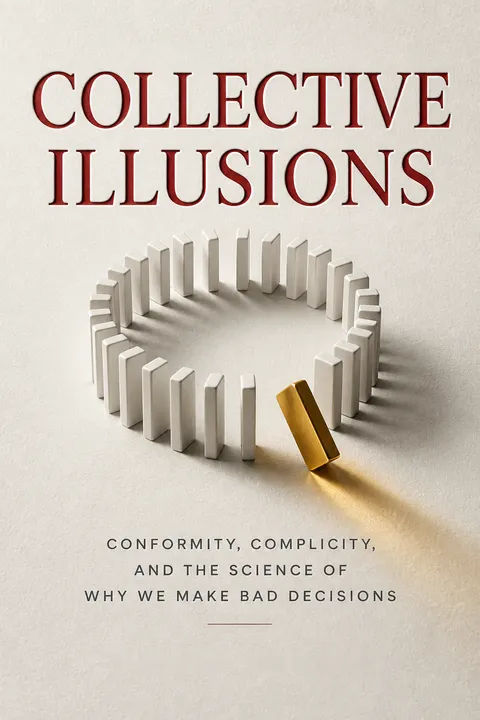
Collective Illusions by Todd Rose explores how conformity and false assumptions lead to bad decisions. Readers found the book thought-provoking, with many praising Rose's insights into group psychology and societal dynamics. Some appreciated the practical suggestions for breaking free from collective illusions, while others felt the book oversimplified complex issues. Critics noted potential bias in Rose's examples and arguments. Overall, reviewers found the book accessible and relevant, offering valuable perspectives on human behavior and decision-making in social contexts.
People Also Read






Glossary
Collective illusions
False beliefs about shared opinionA collective illusion occurs when most people privately reject or doubt a position but mistakenly believe that most others accept it. People then conform to the supposed majority, creating behavior and public norms that may conflict with the group's actual private preferences.
Copycat trap
Copying without knowing whyThe copycat trap occurs when uncertainty leads someone to imitate other people's choices instead of relying on personal judgment. The behavior can be useful when others have relevant knowledge, but it becomes dangerous when the reasons behind their choices are unknown and imitation is mistaken for reliable evidence.
Identity trap
Belonging overrides private valuesThe identity trap describes pressure to conform to an in-group when membership is tightly bound to a person's sense of self. Fear of rejection can prompt people to conceal disagreement, support positions they dislike, or enforce group norms that harm both themselves and others.
Consensus trap
Silence mistaken for agreementThe consensus trap forms when people infer that a quiet group agrees with its apparent majority. Those who privately disagree stay silent because they believe they are isolated, and their silence makes the supposed consensus seem even more convincing to everyone else.
Preference falsification
Publicly masking private preferencesPreference falsification is the public misrepresentation of a person's private beliefs or preferences, often to avoid social or professional costs. Such concealment may seem practical in the moment, but it can reinforce a norm that many people privately oppose and make genuine disagreement harder to detect.
Candide Error
Mistaking persistence for valueThe Candide Error is the assumption that a norm must be good, necessary, or widely desired because it has endured. A custom may persist through habit, status signaling, or mistaken beliefs even after its original purpose has disappeared or its effects have become harmful.
Positive deviance
Local success against a harmful normPositive deviance is an approach to solving social problems by identifying people in a community who achieve better outcomes while working within the same constraints as their neighbors. Their uncommon practices become practical examples that others can observe, test, and spread.
Congruence
Alignment of values and behaviorCongruence is harmony between a person's private values and outward actions. In the book, greater congruence supports self-respect and life satisfaction, while a sustained gap between beliefs and behavior can create distress and encourage further rationalization. It requires reflection, not simply acting on every impulse.
Social portfolio
Several meaningful group identitiesA social portfolio is a person's collection of significant group memberships and relationships. Having several sources of belonging can reduce dependence on one group's approval, expose someone to different perspectives, and provide alternative support when one identity or community feels threatened.
FAQ
What's Collective Illusions about?
- Exploration of Social Behavior: Collective Illusions by Todd Rose investigates how individuals conform to group opinions they privately reject, a phenomenon known as "collective illusions."
- Historical Context: The book begins with a study in Elm Hollow, illustrating how social pressures can distort personal beliefs and behaviors.
- Impact on Society: Rose argues that these illusions affect everything from politics to personal relationships, leading to poor decision-making and social harm.
Why should I read Collective Illusions?
- Understanding Conformity: The book provides insights into why we conform to group norms, even when they contradict personal beliefs, helping navigate social situations.
- Practical Applications: Rose offers advice on reclaiming personal power and resisting conformity pressures, leading to more authentic relationships and better decision-making.
- Cultural Relevance: In an age of social media and polarization, the themes encourage questioning societal norms and thinking critically about personal beliefs.
What are the key takeaways of Collective Illusions?
- Collective Illusions Defined: These are social lies where a majority privately rejects a belief but publicly conforms, leading to misunderstanding and poor outcomes.
- Conformity Traps: The book outlines traps like the "copycat trap" and "consensus trap," helping individuals make informed choices.
- Reclaiming Power: Emphasizes personal congruence and social trust to overcome illusions, fostering open dialogue and questioning norms.
What are the best quotes from Collective Illusions and what do they mean?
- “We suffer more often in imagination than in reality.”: Highlights how fears of social judgment can be more debilitating than actual consequences, encouraging confrontation of fears.
- “If you define situations as real, they are real in their consequences.”: Underscores perception's power in shaping reality, suggesting collective beliefs can significantly impact behavior and norms.
- “Trust yourself. Think for yourself. Act for yourself.”: Emphasizes individual agency in a world of social pressures, encouraging prioritization of personal beliefs over others' expectations.
How does Todd Rose define collective illusions in Collective Illusions?
- Shared Misconceptions: Collective illusions are widely held beliefs that do not reflect reality, creating a false sense of consensus.
- Self-Reinforcing Nature: These illusions become self-reinforcing as individuals remain silent about true beliefs, perpetuating the illusion.
- Impact on Society: They hinder open dialogue and necessary changes in social norms, affecting societal progress.
What are the conformity traps discussed in Collective Illusions?
- Copycat Trap: Occurs when individuals defer to others' behavior due to lack of information or confidence, assuming others have valid reasons.
- Consensus Trap: Involves conforming to perceived majority opinion based on misinformation, perpetuating false beliefs.
- Identity Trap: Leads individuals to suppress true beliefs to fit in, harming both themselves and their social groups.
How does Collective Illusions suggest we can foster a culture of trust?
- Encourage Vulnerability: Emphasizes being vulnerable and trusting others to create a safe environment for expressing true opinions.
- Promote Open Communication: Advocates for open communication within communities to dismantle illusions and build trust.
- Model Trustworthy Behavior: Encourages individuals to act with integrity, creating a positive feedback loop of trust.
How do social media and collective illusions interact according to Collective Illusions?
- Amplification of Illusions: Social media can amplify illusions by creating the illusion of consensus, leading to self-censorship.
- Echo Chambers: Platforms create echo chambers, reinforcing certain viewpoints and distorting reality perceptions.
- Role of Bots: Social bots manipulate public opinion by inflating certain views' popularity, creating false majority support.
How can individuals combat collective illusions as suggested in Collective Illusions?
- Questioning Norms: Encourages actively questioning social norms and beliefs to identify and challenge illusions.
- Engaging in Dialogue: Emphasizes open conversations about differing opinions to create an environment valuing diverse perspectives.
- Building Diverse Social Networks: Suggests engaging with various groups to gain new insights and reduce conformity pressure.
What psychological mechanisms contribute to conformity as discussed in Collective Illusions?
- Cognitive Dissonance: Discomfort from conflicting beliefs leads to conformity as individuals align beliefs with group norms.
- Social Comparison: Comparing oneself to others drives conformity, as people suppress true opinions to fit in.
- Fear of Rejection: Fear of social rejection leads individuals to remain silent about beliefs to avoid ostracism.
What is the "Candide Error" mentioned in Collective Illusions?
- Definition of the Candide Error: Refers to accepting social norms without questioning their validity, following outdated or harmful beliefs.
- Historical Context: Uses the example of the tomato being deemed poisonous to illustrate how misconceptions persist.
- Consequences of the Error: Leads to adherence to harmful norms, stifling progress and perpetuating illusions, highlighting the need for critical thinking.
What is the significance of personal congruence in Collective Illusions?
- Foundation for Authenticity: Personal congruence is key to living authentically, aligning beliefs with actions for greater satisfaction.
- Catalyst for Change: Serves as a catalyst for societal change, inspiring others to challenge illusions and foster honesty.
- Enhancement of Well-Being: Living congruently enhances well-being, reducing anxiety and fostering belonging and purpose.
About the Author


Download PDF
Download EPUB
.epub digital book format is ideal for reading ebooks on phones, tablets, and e-readers.








