Key Takeaways
1. The Three Stories of Our Time: Choosing a Path for Humanity
"By story is meant our version of reality, the lens through which we see and understand what is happening now in our world."
Understanding reality. Humanity currently navigates three overarching narratives that shape our perception of the world. These stories are not mutually exclusive but represent different lenses through which we interpret global events and our role within them. Recognizing which story we align with is crucial for conscious action.
Three dominant narratives:
- Business As Usual: This story, often promoted by political and corporate entities, assumes minimal need for change, focusing on economic growth and individual advancement. It views global challenges as temporary setbacks from which we will recover and profit.
- The Great Unraveling: This narrative, voiced by scientists and activists, highlights the escalating destruction of biological, ecological, economic, and social systems caused by unchecked industrial growth. It presents a stark reality of collapse and unprecedented peril.
- The Great Turning: This is the story of active hope and emergent human responses. It describes the transition from an Industrial Growth Society to a Life-Sustaining Society, driven by collective action for the sake of life on Earth.
Choosing our path. The Industrial Growth Society, fueled by institutionalized greed, aggression, and delusion, is inherently unsustainable, consuming resources and generating waste at an exponential rate. We possess the knowledge and means to create a life-sustaining world, but it requires a collective will to choose life over destruction. This choice involves recognizing the revolutionary nature of our current moment and actively participating in the Great Turning.
2. The Greatest Danger: Our Numbness to the World's Pain
"Yet of all the dangers we face, from climate change to nuclear wars, none is so great as the deadening of our response."
Apathy's true cost. The most profound threat facing humanity is not external catastrophe but our internal "apatheia"—the inability or refusal to experience pain for the world. This numbing response, driven by fear, guilt, and distraction, severs the vital feedback loop between perception and action, rendering us incapable of effective response to global crises.
Roots of repression:
- Fear of Pain/Despair: Our culture conditions us to avoid pain, leading us to believe that fully experiencing global suffering would overwhelm us or drain our lives of meaning.
- Spiritual Traps: Some spiritual paths mistakenly view distress for the world as an obstacle to be transcended, rather than a natural expression of compassion.
- Social Pressure: Fear of not fitting in, appearing emotional, or lacking expertise can silence our concerns.
- Guilt & Powerlessness: We avoid acknowledging our complicity in global harms and the feeling of being unable to change vast systems.
- Hijacked Attention: Mass media and constant digital distractions divert our focus from deep reflection and meaningful engagement.
Consequences of numbing. Blocking our pain for the world diminishes our awareness, understanding, and authenticity. It impedes cognitive functioning, access to intuition, and even our instinct for self-preservation. This repression also cripples our empathy, imagination, and erotic connection to life, leading to a desperate pursuit of superficial pleasures and a tendency to project our fears onto others.
3. Our True Nature: Interconnected Beings in a Living System
"We are not closed off from the world, but integral components of it, like cells in a larger body."
Beyond separation. Modern science, particularly living systems theory, and ancient spiritual traditions converge on a breathtaking new understanding of reality: the universe is not composed of separate "stuff" but of dynamically organized, intricately balanced, and self-organizing systems. This paradigm shift reveals our profound interconnectedness with all life.
Key insights:
- Living Systems Theory: Focuses on wholes, processes, and relationships rather than isolated parts. Systems self-organize, self-stabilize (homeostasis), and evolve through feedback loops.
- Gaia Theory: Views Earth's entire biosphere as a self-regulating living system, transforming our perception of our planet from a mere resource to a conscious, living entity.
- Deep Ecology: Challenges anthropocentrism, asserting the intrinsic right of all life-forms to exist and advocating for a biocentric perspective that recognizes humans as part of, not masters over, nature.
- The Ecological Self: Arne Naess's concept that our identity extends beyond the narrow ego to encompass social, metaphysical, and ecological dimensions, naturally fostering care for the wider world without moralizing.
Ancient wisdom echoes. This scientific paradigm resonates deeply with ancient spiritual teachings from Taoism, Hinduism, Buddhism, and Indigenous traditions. These wisdom paths emphasize the dependent co-arising of all phenomena, the sacredness of life, and our embeddedness in a larger, living whole. This convergence offers a powerful framework for understanding our true nature and the synergistic power available through our relationships.
4. The Work That Reconnects: A Spiral Path to Collective Healing
"The central purpose of the Work That Reconnects is to bring people into new relationship with their world, to empower them to take part in the Great Turning, and to reclaim their lives from corporate rule."
A transformative framework. The Work That Reconnects is a form of personal and group work that emerged in the late 1970s to help individuals integrate new ecological paradigms into their lives and actively participate in the Great Turning. It's an open-source approach, shared globally through workshops, books, and online resources, aiming to foster solidarity and courage in the face of worsening global conditions.
Core aims:
- Reveal our interbeing through insights from systems science, Deep Ecology, and spiritual traditions.
- Reframe pain for the world as evidence of mutual belonging and a source of power.
- Awaken resilience to embrace uncertainty and live with full awareness of both unraveling and turning.
- Affirm that acting for the welfare of all beings can be life's organizing principle.
- Help identify strengths and resources for the world's self-healing.
The Spiral of the Work. The Work That Reconnects unfolds through a four-stage "Spiral," representing a journey of awakening and empowerment. This fractal sequence can repeat within a single session or over a lifetime, providing a dynamic roadmap for engagement. The stages are:
- Coming from Gratitude
- Honoring Our Pain for the World
- Seeing with New Eyes
- Going Forth
The Shambhala Prophecy. This ancient Tibetan prophecy serves as a guiding metaphor, describing "Shambhala warriors" who dismantle "mind-made" weapons (greed, aggression, delusion) using two tools: compassion (fearless experience of pain) and wisdom (insight into radical interdependence). This prophecy underscores the work's emphasis on inner transformation for outer action.
5. Coming from Gratitude: Rekindling Our Love for Life
"Just to live is holy, to be is a blessing."
The starting point. The Spiral of the Work That Reconnects begins with gratitude, recognizing life itself as an inestimable gift. This initial stage helps quiet the mind, ground us in the present, and stimulate empathy and confidence, preparing us to face the world's challenges from a place of appreciation rather than depletion.
Why gratitude matters:
- Spiritual Foundation: It's the originating impulse of all spiritual traditions, reminding us that existence is an unearned benefaction.
- Grounding in Turmoil: In times of crisis, gratitude steadies and grounds us, bringing us into full presence—our best offering to the world.
- Political Subversion: It counteracts consumerism and the dissatisfaction fueled by the Industrial Growth Society, fostering contentment with what we have.
- Indigenous Wisdom: Many indigenous cultures, like the Haudenosaunee, practice daily thanksgiving, demonstrating how gratitude can foster self-respect and resilience.
Practices for gratitude. Activities like "Becoming Present through Breath, Movement, Sound and Silence" help relax and tune into wider currents of knowing. "Introductions with Gratitude" and "Open Sentences on Gratitude" allow participants to share what they love about being alive. The "Mirror Walk" and "Wheel of the Great Turning" deepen sensory awareness and appreciation for collective action, setting an affirmative tone that reverberates throughout the entire work.
6. Honoring Our Pain for the World: Transforming Anguish into Compassion
"Your pain is the breaking of the shell that encloses your understanding."
Facing the truth. This crucial stage of the Work That Reconnects invites us to bring to awareness our inner responses—dread, rage, sorrow, guilt—to the suffering of fellow beings and the destruction of the natural world. These feelings are natural and healthy, but often repressed due to cultural conditioning and fear of being overwhelmed.
The purpose of pain:
- Compassion's Source: Pain for the world is akin to "suffering with," the literal meaning of compassion, a central virtue in every spiritual tradition. It arises from our inherent connectivity with all life.
- Unblocking Feedback: Repressing this pain cuts off vital feedback loops, hindering effective response. Allowing it to surface without shame or apology is essential for collective healing.
- Liberation: Experiencing these feelings fully, rather than intellectualizing them, reveals their fluid, dynamic character and our mutual belonging in the web of life, freeing us from the fear of despair.
Practices for honoring pain. Exercises like "Small Groups on the Great Unraveling" allow people to share personal experiences of global crises. "Open Sentences on Honoring Our Pain" provide a safe structure for voicing censored thoughts and feelings. Rituals such as the "Cairn of Mourning" and "Truth Mandala" offer communal spaces to express grief and anger, transforming private anguish into shared understanding and collective resolve.
7. Seeing with New Eyes: Shifting Perception to Interbeing
"We shift to a new way of seeing ourselves in relation to our world and a new way of understanding our power."
A paradigm shift. After acknowledging and honoring our pain, the mind becomes receptive to new perspectives. This stage involves a "metanoia" or "turning over" into a wider awareness of our identity as interconnected beings within the living body of Earth. It integrates insights from holistic science and ancient wisdom traditions.
Key conceptual shifts:
- Unsustainability of Industrial Growth: Understanding that unlimited economic growth, profit maximization, externalizing costs, and top-down power are inherently destructive.
- Interdependence as Foundation: Recognizing that a life-sustaining society must be built on the interdependence of all things, where power is mutual and synergistic, and economic goals prioritize sufficiency for all.
- Crisis of Perception: The global crisis is fundamentally a crisis in how we perceive reality, not merely a technological problem.
Practices for new vision. Experiential exercises bring these concepts to life:
- The Systems Game: Dramatizes the dynamic, self-organizing nature of open systems and our interdependence.
- Widening Circles: Uses role-playing to explore issues from diverse perspectives (self, adversary, nonhuman, future human), fostering moral imagination.
- The Cradling: A guided meditation on the body that deepens reverence for life and awareness of our shared vulnerability and evolutionary journey.
- Deep Time Practices: "Harvesting the Gifts of the Ancestors" and "The Seventh Generation" vividly connect us with past and future generations, expanding our sense of responsibility and resilience.
8. Going Forth: Empowering Action for a Life-Sustaining World
"The steps we take may be modest undertakings, but when they involve some risk to our mental comfort, they free us from old safe limits."
Translating insight into action. The final stage of the Work That Reconnects bridges the workshop experience with daily life, helping individuals discern their unique role in the Great Turning. It emphasizes that while there's no single blueprint for solving global crises, our collective efforts, however modest, are vital.
Key discoveries for action:
- Heightened Awareness: A greater capacity to face suffering and dangers without numbing out.
- Upsurge of Energy: Unblocked feedback loops release energy, reframing pain as compassion.
- Wider Identity: A sense of self as an integral part of Earth's living body, fostering community.
- Motivation & Confidence: A stronger drive to serve life, trusting in the power of solidarity.
- Diversity of Gifts: Appreciation for varied roles in the Great Turning, valuing personal strengths and limitations.
- Long-term Commitment: Liberation from dependence on immediate, measurable results, embracing a purpose beyond individual lifetimes.
Practices for empowerment:
- Callings and Resources: Helps clarify individual projects and identify inner/outer resources, as well as potential obstacles and first steps.
- Consultation Groups: Provides peer feedback and advice for refining plans.
- Dialoguing with Mara: A Buddhist-inspired practice to confront doubts and fears, strengthening resolve by grounding intentions in the authority of Earth.
- Five Vows: Simple commitments to daily healing, lighter living, drawing strength from life, mutual support, and spiritual practice.
- Circle of Blessings: A ritual to express appreciation and good wishes, reinforcing collective support.
9. Guiding the Work: Facilitating Collective Awakening
"Our task is to provide processes that help people know their pain for the world, their interconnectedness with all life and their power to take part in the Great Turning."
The facilitator's role. Guiding the Work That Reconnects is a crucial task that involves creating a safe, supportive environment for participants to explore deep emotions and new perspectives. Facilitators are not experts providing answers but rather catalysts for collective discovery and empowerment.
Foundations of good facilitation:
- Experience and Understanding: Guides should have participated in workshops and studied the work's theory and practices, understanding the integrated nature of the Spiral.
- Basic Skills: Confident presentation, active listening, pacing, and timing are essential.
- Engaged Activism: Personal involvement in the Great Turning's three dimensions provides practical understanding and authenticity.
Capacities of an excellent guide:
- Warmth and Respect: Trusting participants' honesty and presence, viewing each as a "bodhisattva."
- Emotional Authenticity: Participating in experiential work, having done one's own "despair work" to avoid voyeurism or fear of strong emotions.
- Flexibility: Adapting workshop design to unforeseen needs while staying true to the Spiral's core.
- Engaging Participation: Using tools like talking objects, allowing silence, varying modalities, and taking the group's pulse to ensure everyone is heard and involved.
- Working with Strong Emotions: Respecting feelings, trusting capacity for discharge, and intervening only if someone is acting out a private agenda.
- Ritual Guidance: Conducting rituals with natural authority, clear demarcation, and formal dedication, while remaining fully engaged.
10. Engaging All Generations: Children, Teens, and Communities of Color
"What we most need to do is to hear within ourselves the sounds of the Earth crying."
Breaking the silence. Adults often struggle with how to discuss global crises with children and teens, fearing to burden them. However, children are often more aware and emotionally impacted by global threats than adults realize. Adult silence can convey fatalism, indifference, and reinforce repression, leading to cynicism and alienation.
Supporting younger generations:
- Joy in Nature: Help children connect with nature, music, and art, fostering an innate sense of the sacredness of life.
- Honest Dialogue: Invite children to share their feelings and knowledge, listening deeply without interruption or false reassurance.
- Action and Empowerment: Support their ideas for action, validating their efforts to make a difference in their communities.
- Modeling Engagement: Children feel safer when they see adults actively working to improve the world.
Learning with communities of color. The Work That Reconnects is enriched by the perspectives of communities of color, who often experience the structural impacts of the Industrial Growth Society more acutely. Their historical experiences of oppression, resistance, and resilience offer profound wisdom.
- Decolonizing the Mind: Honoring ancestral lineages helps decolonize the mind from colonial imprints and fosters collective self-esteem.
- Pathologizing Pain: The work helps counter the tendency to pathologize distress in communities of color, reframing it as a healthy response to collective dysfunction.
- Deep Culture Lens: Integrating "deep culture" work (understanding shared behaviors, norms, and worldviews) makes the Work That Reconnects more accessible and resonant for diverse cultural backgrounds.
11. Cultivating Inner Resilience: Meditations for the Great Turning
"We do not need to withdraw from the world or spend long hours in solitary prayer or meditation to begin to wake up to the spiritual powers within us."
Inner work for outer change. Spiritual disciplines are not a luxury but a necessity for sustained engagement in the Great Turning. These practices help us access inner wisdom, build resilience, and maintain clarity amidst the overwhelming challenges of our time, integrating personal transformation with collective action.
Key meditative practices:
- The Web of Life: A guided meditation to experience our interconnectedness with all beings through space and time, fostering a sense of belonging and shared energy.
- Gaia Meditation: A precise identification with the elements (water, earth, air, fire) and evolving life-forms of Earth, deepening our kinship and reverence for the planet.
- Death Meditation: Reflecting on the impermanence of life, which jolts us awake to life's preciousness and the urgency of living boldly.
- Loving-Kindness (Metta): Cultivating a powerful current of goodwill and compassion towards oneself, loved ones, acquaintances, and all sentient beings, fostering motivation for service.
- Breathing Through: A practice to accept and process painful information without numbing out, allowing suffering to flow through the heart and strengthen our sense of belonging.
- The Great Ball of Merit: A visualization to gather and rejoice in the countless acts of goodness performed by all beings, recognizing them as a present resource for transformation.
- The Four Abodes: A meditation to truly see others with loving-kindness, compassion, joy in their joy, and equanimity, fostering intrinsic connectivity.
Daily integration. These meditations are designed to be integrated into daily life, transforming ordinary encounters into opportunities for discovery and connection. They help us remain alert, open, and grounded, drawing on vast spiritual powers to sustain our commitment to the healing of our world.
Last updated:
Review Summary
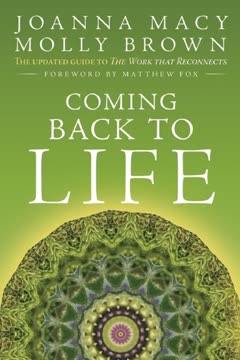
Coming Back to Life receives mostly positive reviews (4.28/5) as a valuable workbook for facilitators leading workshops on Joanna Macy's "Work that Reconnects." Reviewers praise its powerful exercises addressing climate grief, despair, and ecological crisis through systems thinking and Buddhist principles. Many find it life-changing and essential for activists and educators. Critics note it's primarily a workshop guide rather than general reading, with some finding the middle sections dry or repetitive. Several mention concerns about cultural appropriation and overly optimistic messaging. Most agree it's invaluable for those planning retreats or group work.
Similar Books