Key Takeaways
1. Nature's Profound Impact on Well-being and Cognition
On average, study participants are significantly and substantially happier outdoors in all green or natural habitat types than they are in urban environments.
Happiness outdoors. Large-scale data from the Mappiness app, tracking moods and locations of tens of thousands of volunteers, revealed a surprising truth: people are consistently happier, more relaxed, and more alert in natural settings than in urban ones. This difference was more significant than being alone versus with friends, and comparable to engaging in favored activities like sports. Yet, paradoxically, people spend 93% of their time indoors or in vehicles, often underestimating nature's benefits—a "forecasting error."
Evolutionary connection. This innate draw to nature is explained by the biophilia hypothesis, popularized by E. O. Wilson, suggesting humans have an "innately emotional affiliation" to living organisms because our nervous systems evolved in natural environments. This theory, also known as Stress-Reduction Theory (SRT) or Psycho-Evolutionary Restoration Theory, posits that peaceful natural elements helped our ancestors recover from stress, fostering equanimity, cognitive clarity, and empathy. Our brains are built to resonate with natural cues.
Cognitive restoration. Beyond emotional well-being, nature significantly restores our attention-addled brains. The Attention Restoration Theory (ART) by Stephen and Rachel Kaplan suggests that natural environments offer "soft fascination," allowing our directed attention (which is a limited resource) to rest and recover. This enables better cognitive performance, problem-solving, and reduced mental fatigue, making us sharper and more focused.
2. Sensory Immersion: Unlocking Nature's Immediate Benefits
Naturalistic outdoor environments in general remain some of the only places where we engage all five senses, and thus, by definition, are fully, physically alive.
Smell of survival. South Korea's "forest healing" (salim yok) emphasizes engaging all five senses, particularly smell. Phytoncides—aromatic volatile substances emitted by trees like hinoki cypress—have been shown to reduce stress (lowering cortisol) and boost natural killer (NK) immune cells, which fight disease. Geosmin, the earthy smell after rain, also contributes to well-being, likely due to its evolutionary link to water sources and its origin from antibiotic-producing soil bacteria.
Soundscapes as medicine. Noise pollution (anthrophone) from human activities is a pervasive stressor, elevating heart rates and blood pressure even during sleep, and impairing children's cognition. Conversely, natural soundscapes—especially wind, water, and birdsong—are profoundly restorative. Studies show birdsong reduces frustration and arousal, and water sounds can effectively mask urban noise, creating a sense of calm and alertness. Our brains are wired to interpret these sounds as signals of safety and well-being.
Visual fluency. Merely looking at nature, even through a window, yields immediate benefits. Roger Ulrich's hospital study showed patients with tree views recovered faster and needed less pain medication. Frances Kuo's research found greener urban environments correlated with reduced aggression and crime. Richard Taylor's work on fractals suggests our visual system is "hardwired" to process natural patterns (like clouds or coastlines), triggering alpha brain waves associated with relaxation and activating pleasure centers in the brain.
3. The "Five Hours a Month" Prescription for Everyday Health
The more time people spent in the green areas, the better they reported feeling, and the effects were slightly stronger for those in the wilder forest.
Optimal dosage. Finnish research, driven by a national commitment to well-being, suggests a minimum of five hours per month in natural settings is needed for significant psychological restoration and vitality. This translates to roughly 30 minutes a couple of times a week. For even greater benefits, aiming for ten hours a month (30 minutes five days a week) can lead to a new level of improved mood and reduced stress.
Rapid effects. Studies show that positive changes in mood, vitality, and feelings of restoration can occur relatively quickly, within just 15 minutes of sitting in a city park. These feelings continue to increase after a short 30-minute walk. Compared to urban settings, green areas consistently boost positive emotions and lower negative ones, even in managed city parks.
Beyond relaxation. The benefits extend beyond mere relaxation to increased vitality and creativity. While cortisol levels may drop in any setting away from work, nature uniquely enhances feelings of being alive and energetic. This regular, moderate "dose" of nature is a pragmatic approach to combating everyday stress and preventing burnout, especially in populations experiencing high levels of psychological strain.
4. Nature as a Therapeutic Tool for Mental Health Recovery
In the greener areas, though, poorer people did relatively much better, starting to catch up to the longer lives of the rich.
Buffering inequality. Research in Scotland by Richard Mitchell revealed that access to green space acts as an "equigenic" factor, significantly reducing health disparities related to income. In the greenest neighborhoods, poorer individuals experienced lower mortality rates and better mental well-being, narrowing the gap with their wealthier counterparts. This suggests nature can buffer poverty-related stress and promote social equity.
Horticulture therapy. Sweden has pioneered "horticulture therapy" for severe work-related stress and depression. Programs like Alnarp's therapy garden involve patients spending hours cultivating plants, gradually reconnecting with their senses and emotions. This approach helps patients, often on long-term sick leave, transition from profound lethargy and social withdrawal back to functionality, with 60% returning to work within a year.
Ecotherapy in action. Programs like Scotland's "Branching Out" provide mental health care outdoors for ex-felons and addicts, offering three hours per week for twelve weeks in woodland settings. Activities like bushcraft, woodland arts, and trail maintenance reduce depression symptoms, increase physical activity, and boost self-esteem. The social aspect is crucial, providing a safe, supportive group environment for individuals transitioning from institutions back into society.
5. Walking: A Catalyst for Creativity and Mental Clarity
All truly great thoughts are conceived while walking.
Ancient wisdom, modern science. The idea of "solvitur ambulando" (in walking it will be solved) has been embraced by thinkers from Aristotle to Nietzsche, who believed walking in restorative settings fostered mental clarity and genius. Modern neuroscience is catching up, with studies showing that walking, especially in nature, significantly boosts creativity and cognitive performance.
Cognitive reboot. David Strayer's research demonstrated that a 30-minute walk in an arboretum improved recognition memory by 80%, a gain completely wiped out by talking on a cell phone during the walk. This highlights how nature allows the brain's executive network to rest, enabling the default network (responsible for daydreaming and reflection) to engage, leading to enhanced problem-solving and fresh insights.
Reducing rumination. Greg Bratman's Stanford study showed that a 90-minute nature walk significantly reduced blood flow to the subgenual prefrontal cortex—a brain region linked to sadness and self-wallowing—and decreased rumination. This suggests nature helps quiet the brain's self-critical circuitry, allowing individuals to gain perspective and feel happier, effectively saying, "The world is bigger than you. Get over yourself."
6. Wilderness: The Ultimate Brain Reset and Awe Inducer
At the end of the day, we come out in nature not because the science says it does something to us, but because of how it makes us feel.
The "three-day effect." David Strayer's "three-day effect" theory posits that after several days immersed in wilderness, away from technology, senses sharpen, perspective shifts, and cognition improves. This deep immersion allows the prefrontal cortex to rest, activating the default network for profound introspection, creativity, and a sense of connection, which is difficult to replicate with virtual nature or short exposures.
The power of awe. Wilderness experiences often trigger awe, a powerful emotion that "blows your mind" and shifts focus from narrow self-interest to collective well-being. Studies show awe increases generosity, helpfulness, and curiosity, and is uniquely linked to lower levels of inflammatory markers (cytokine IL-6). This suggests awe reinforces social connections, which are known to reduce stress and inflammation.
Transcendent experiences. Awe, historically associated with religious experience, can be secularly induced by vast natural phenomena. Edmund Burke described the "sublime" as inspiring "astonishment" mixed with "horror," leading to humility and an outward perspective. These awe-inspiring moments, whether viewing the Earth from space or a dramatic canyon, can lead to "inverse PTSD"—persisting positive changes in attitudes, moods, and behavior, fostering a sense of unity and purpose.
7. Nature's Healing Power for Trauma and PTSD
Life is better when it’s simple. Here, like in the Army, you don’t have forty different options for toothpaste. You have your place. We all have it.
Adventure therapy for veterans. Wilderness programs, like Higher Ground's river trips for veterans with PTSD, offer a unique therapeutic environment. These trips provide intense physical activity, sensory engagement with nature, and forced social bonding, which are crucial for recovery. Participants often find a laser focus in adventure sports, a welcome distraction from intrusive thoughts, and improved sleep from exertion.
Rewiring the traumatized brain. PTSD is a memory disorder where the brain remains locked in amygdala hyperdrive, unable to distinguish real from perceived threats. Chronic stress from PTSD leads to physiological changes like higher blood pressure and inflammation, and cognitive deficits. Wilderness immersion, by providing novel, challenging, yet supportive environments, helps veterans gradually rewire their brains, reducing symptoms like flashbacks, emotional numbing, and hyperarousal.
Building resilience and connection. The shared challenges and mutual dependence in wilderness settings foster deep bonds, mirroring the camaraderie of military units but in a healing context. This supportive group dynamic, combined with the restorative power of nature, encourages veterans to re-engage with life, seek further treatment, and develop new coping mechanisms. Many report finding new passions and a renewed sense of purpose, transforming their "life sentence" into a path of recovery.
8. Outdoor Play: Essential for Children's Brain Development
Children cannot bounce off the walls if we take away the walls.
ADHD and nature. Children with ADHD, who often struggle with hyperactivity, impulsivity, and distractibility, thrive in outdoor adventure-based learning environments. Studies show that exposure to nature can reduce ADHD symptoms threefold and improve memory and attention as effectively as medication. This is because nature allows the prefrontal cortex, which is less active in ADHD brains, to recharge, boosting focus.
Evolutionary imperative. The human brain evolved outdoors, craving novelty and exploration. This restlessness, now often pathologized as ADHD, was once adaptive, driving species expansion. Confined, sedentary environments, like traditional classrooms, can exacerbate ADHD symptoms and hinder proper frontal lobe development, as seen in lab rats whose restricted play led to impulse control problems.
The kindergarten ideal. Friedrich Fröbel, the founder of kindergarten, envisioned education rooted in nature and art, where children learn through "self-activity," exploration, and sensory engagement. Modern forest kindergartens in Europe embody this, allowing children to play outdoors in all weather, fostering physical dexterity, teamwork, and a profound sense of interconnection. This approach enhances cognitive and emotional development, leading to better social skills and academic readiness.
9. The Urban Nature Imperative: Building Biophilic Cities
If man is not to live by bread alone, what is better worth doing well than the planting of trees?
The urban challenge. With over half the global population now living in cities and billions more expected to move there, urban planning faces the critical challenge of preventing "hell on earth" scenarios. Overcrowded urban environments are linked to increased anxiety, mood disorders, and a doubled risk of schizophrenia, with heightened activity in the brain's fear centers. Optimism and coping strategies also decline in "gray space."
Singapore's green vision. Singapore, a hyperdense city-state, offers a model for "city in a garden" planning. Through aggressive tree planting, green roofs, vertical gardens, and daylighting canals, it has increased its green cover to 50% of its land area, aiming for 80% of residents to live within 400 meters of green space. This biophilic design improves air quality, reduces energy consumption, and creates a more livable, aesthetically pleasing environment, even if some of it is "constructed nature."
The power of urban trees. Urban trees are a critical tool for city salvation, providing not just aesthetic pleasure but concrete health benefits. A study on the emerald ash borer found that counties losing ash trees experienced 15,000 additional deaths from cardiovascular disease and 6,000 from respiratory disease. Higher tree density in neighborhoods correlates with lower incidence of heart and metabolic disease, with the health boost equivalent to a significant increase in median income.
10. The Nature Pyramid: A Spectrum of Doses for Optimal Human Flourishing
But are not exercise and the open air within the reach of us all?
A holistic approach. The "nature pyramid" offers a comprehensive framework for integrating nature into human life, recognizing that different "doses" serve different needs. At its base are daily interactions with nearby nature (parks, trees, houseplants) for stress reduction and focus. Weekly outings to larger parks or waterways provide deeper calm. Monthly excursions to forests boost immune systems and offer escapism.
Wilderness at the pinnacle. At the apex of the pyramid are rare but essential multi-day wilderness immersions, recommended yearly or biyearly. These intense experiences can profoundly rearrange our core being, catalyzing hopes, fostering awe, strengthening human connection, and providing spiritual reflection. They are particularly beneficial during adolescence, grief, or trauma, offering a powerful reset for the mind and spirit.
Accessibility and policy. The challenge lies in making this full spectrum of nature accessible to everyone, especially in urban areas where green space is often unequally distributed. Initiatives like "ParkScore" indices, pediatricians prescribing park visits, and community-led greening projects are crucial. By consciously valuing and integrating nature into urban planning, education, and healthcare, cities can become more resilient, and all people can benefit from the profound, multifaceted healing power of the natural world.
Last updated:
Review Summary
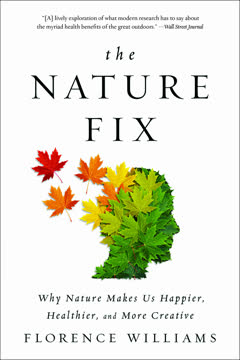
The Nature Fix by Florence Williams explores scientific research on how spending time in nature benefits human health, creativity, and wellbeing. Reviews are mixed: supporters appreciate the compelling evidence that nature reduces stress, improves cognition, and enhances mood, with practical recommendations like spending five hours monthly outdoors. Critics found the writing journalistic and disjointed, with excessive travel anecdotes, awkward humor, and insufficient depth. Some objected to perceived biases against medication and cities, particularly the audiobook's narration. Most agreed the core message—that nature is essential for human health—is valid and important, though execution varied in appeal.
Similar Books