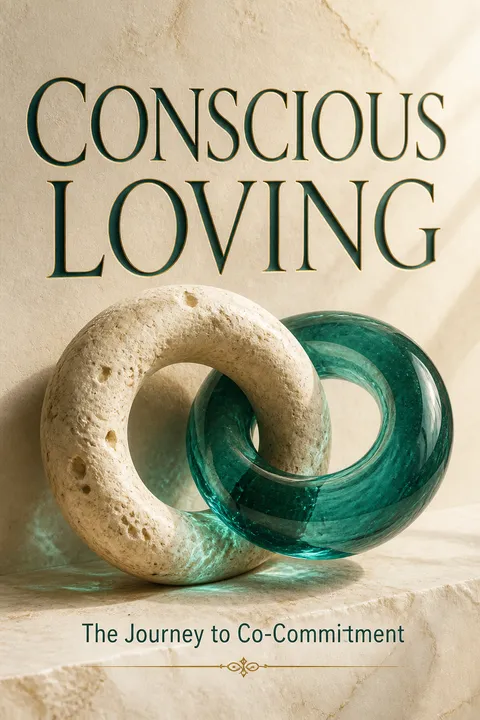


Key Takeaways
Build love around two whole people, not a shared system of helplessness
The central contrast. The book distinguishes co-dependence, an implicit arrangement in which people protect familiar, limiting patterns, from co-commitment, a relationship where each person takes responsibility for their own life and supports the other's growth. The aim is not to need nobody. It is to relate as equals instead of becoming tangled in rescue, control, or blame.
From intimacy to creation. The Hendrickses call the richer possibility co-creativity: partners free up energy otherwise consumed by recurring conflict and use it for shared work, family life, or individual ambitions. They describe how their own relationship became a source of books, workshops, and family projects. Their approach draws on decades of work with couples, though clinical experience is not the same as controlled evidence that one model suits every relationship.
The book's strongest idea is that closeness should enlarge each person's capacity, not shrink it. This resembles differentiation in family systems theory, where a person stays emotionally connected without surrendering a distinct self. That is a more useful goal than either total independence or constant togetherness. Still, equality cannot be created by good intentions alone. Money, caregiving, safety, and social power affect whose needs prevail, so a couple may need to address practical imbalances alongside emotional habits.
Recognize the childhood script before it turns a new partner into an old character
Patterns can feel like fate. The authors argue that early experiences shape what people expect from closeness, and that adult relationships can reactivate those expectations. Gay Hendricks describes fearing abandonment after becoming close, then accusing partners of planning to leave. He eventually connected the fear to being separated from his mother as an infant. That history made his suspicion understandable, but it did not make each partner responsible for it.
Nine traps to notice. The book names recurring patterns that can keep people stuck:
1. Enabling another person's destructive behavior.
2. Choosing people who enable one's own destructive behavior.
3. Repeating a parent's relationship style.
4. Choosing partners who resemble a parent.
5. Building relationships in reaction against one's parents.
6. Replaying childhood trauma.
7. Seeking conflict or avoiding it completely.
8. Undermining success as it approaches.
9. Preserving dependence instead of developing autonomy.
The pattern lens can replace moral condemnation with curiosity: instead of asking why someone keeps choosing badly, it asks what familiar emotional bargain the relationship reproduces. That is compatible with attachment research, which finds that early caregiving can influence expectations of availability and trust. But resemblance is not proof of a childhood cause. People can repeat patterns for many reasons, and retrospective memories can be uncertain. A script is best treated as a hypothesis to examine, not a verdict about one's family or partner.
Treat closeness and solitude as alternating needs, not competing loyalties
A healthy rhythm. The book portrays intimacy as a movement between connection and space. Closeness can bring up fear of rejection, engulfment, or losing one's identity. Time apart can bring up fears of abandonment or helplessness. Neither need automatically means the relationship is failing; both deserve honest discussion and room to be met.
Watch the evasions. The authors describe people who start arguments, get busy, become numb, or develop convenient worries when they need distance but cannot ask for it. They also describe people who cling when a partner needs space. Their alternative is to notice the cue, name the need, and agree on a form of separation that does not punish or threaten the other person. Solitude is presented as part of intimacy, not its opposite.
This model usefully resists the idea that a good relationship requires constant access to one another. Attachment research distinguishes secure connection from anxious pursuit and avoidant withdrawal, while still recognizing that real people move between wanting company and wanting room. The practical difference is communication: space requested directly is not the same as disappearing to provoke pursuit. The framework also needs flexibility. Partners can have different rhythms, and neither should have to defend a basic need for privacy or connection as evidence of love.
Own your part without confusing responsibility with blame
Agency is not culpability. The authors urge each partner to examine how they contribute to a recurring conflict rather than compete over who is the victim. They describe this as taking full responsibility for one's role, not dividing responsibility into a neat half-and-half. That can mean noticing a hidden fear, asking indirectly for reassurance, or avoiding a hard conversation. It gives a person choices where blame can leave them feeling powerless.
Keep the boundary clear. Responsibility for one's present choices does not mean causing another person's behavior. A person is not responsible for being abused, coerced, or betrayed. In an unsafe relationship, immediate protection and outside support matter more than treating harm as a shared communication problem. The authors' agency principle is most useful when it helps someone recover options, not when it is used to excuse the person causing harm.
The distinction between agency and blame is essential to using this idea safely. Research on learned helplessness and self-efficacy suggests that believing one can take meaningful action can support persistence and recovery. But agency becomes harmful when it is stretched into the claim that people create everything that happens to them. That claim confuses influence over one's response with control over other people's choices or unjust conditions. The useful question is not who deserves fault, but what action is available without denying what happened.
Name the feeling in your body before arguing about its cause
Report experience, not accusation. The book's specialized term microscopic truth means describing one's immediate internal experience as specifically as possible: a tight jaw, fear, sadness, or a thought that a partner may leave. It contrasts that report with a judgment about another person's character or a claim that the other person caused one's feelings. The aim is to make hidden experience discussable without turning it into a prosecution.
Feel without acting automatically. The authors encourage people to distinguish feelings from thoughts, notice bodily sensations, and allow feelings to run their course without immediately suppressing or acting on them. In one example, a client traced apparent irritation with a partner to older anger toward a parent. Such inquiry can reveal useful connections, but bodily sensations alone do not prove a specific memory or cause, and persistent physical symptoms may need medical attention.
Specific emotional language can improve communication because it separates observation from interpretation. Laboratory research on affect labeling, the act of putting feelings into words, has found changes in emotional responses under some conditions. That supports the value of naming, not the stronger claim that a sensation reliably reveals its historical source. The book's invitation to be curious about the body is useful when held lightly. A tight chest might signal fear, exertion, illness, or several things at once.
Use seven questions to turn recurring fights into specific work
Look below the argument. The authors' co-committed problem-solving process shifts attention from who is right to what the conflict is doing. A couple might discover that a fight about chores hides resentment, fear of closeness, or a wish to avoid a neglected ambition. Turning complaints into clear requests helps move from accusation to an action another person can actually consider.
Ask in sequence. The process uses seven questions:
1. What am I feeling?
2. What do I want?
3. How is the past shaping this moment?
4. What do I gain by staying stuck?
5. What do I need to say?
6. Which agreements have I broken?
7. How can I be of service?
The questions are prompts, not a script that must be completed every time. The authors' clients Larry and Ruth used them to uncover withheld truths and redirect energy from fighting toward a shared community project.
The sequence is strong because it moves from emotional awareness to concrete action, then asks what function the stalemate serves. That last step can expose the hidden benefits of conflict, such as avoiding a risky decision. It also echoes interest-based negotiation, which distinguishes stated positions from underlying needs. The service question is most productive after each person's needs are heard. Asked too early, it can become another invitation for one partner to accommodate, rescue, or erase themselves.
Make agreements explicit, then repair them honestly when you miss
Trust lives in follow-through. The book treats broken agreements as more than logistical mistakes. Repeatedly promising to call when late, share chores, or disclose relevant contact, then failing to do so, can weaken trust and feed recurring arguments. The authors describe one client who realized that he often agreed to things he did not want, hid his anger, and then arrived late as an indirect protest.
Make commitments workable. A useful agreement names what each person will do and when they will check in. If it cannot be kept, the person should say so, acknowledge the impact, and explore what made the agreement fail. That is different from making a vague promise to do better or using an apology to end discussion. Agreements work best when both people freely consent and can renegotiate them without retaliation.
This emphasis connects intimacy to reliability, a principle shared by organizational psychology and contract theory: expectations coordinate behavior only when people understand them and can count on follow-through. The book also notices that lateness or forgetfulness can carry unspoken resentment. Not every missed commitment, however, is a covert message. Memory, workload, illness, and unclear expectations matter too. Treat the failure as information to investigate, not automatic evidence of bad intent.
When happiness makes you uneasy, pause instead of creating a crisis
The positive-energy ceiling. The authors call the Upper Limits Problem the tendency to disrupt a good period when positive feeling or closeness exceeds what feels familiar. They describe worry, criticism, arguments, emotional withdrawal, and broken agreements as possible ways people bring themselves back to a known emotional range. One couple noticed a pattern of fighting after weekends of closeness and began taking quiet time apart before they reconnected.
Integrate, do not sabotage. Their practical alternative is to notice early cues, breathe, move, accept appreciation, or take clearly communicated space. The intended rhythm is closeness followed by rest, not closeness followed by punishment. This concept is a useful prompt to examine timing, but the book's examples linking illness or accidents to hidden motives should not be treated as medical explanations. Illness deserves appropriate care, not automatic psychological interpretation.
The idea captures a familiar regulation problem: change, even welcome change, can feel destabilizing when it exceeds a person's learned range. A pause can prevent a temporary overload from becoming a destructive interaction. The phrase should not be used to dismiss legitimate concerns as mere sabotage. A fight after a happy period may reveal an unresolved problem, not just fear of feeling good. Timing is a clue worth checking, while the substance of the disagreement still deserves attention.
Build self-respect and finish old business without surrendering your boundaries
Love is not a reward. The authors argue that people who depend on a partner to fill an inner void can place an impossible burden on the relationship. Their self-love practice means accepting oneself while still changing behavior that causes harm. They also define true independence as the capacity to be close without losing a sense of self, rather than simply standing alone.
Clear unfinished business. Their Completions work asks people to identify feelings they have avoided, communications they have not made, promises they have broken, debts they owe, and appreciation they have withheld. One client found that old unpaid debts and excuses were occupying attention; making a plan to repay them helped him feel more available to present goals. Completion can include private reflection, a changed agreement, or contact with someone, but contact is not always safe or necessary.
Self-acceptance paired with behavioral accountability avoids two familiar traps: treating shame as motivation, or treating self-compassion as permission to do nothing. The emphasis on finishing small unresolved tasks also resembles the psychological cost of open loops, where unfinished intentions continue to demand attention. Yet closure is not always a conversation with the person who caused harm. Trauma-informed care recognizes that distance, legal protection, or no contact can be the healthiest completion. A person can reclaim agency without offering reconciliation.
Analysis
Conscious Loving is both a relationship theory and a practical workbook. Its narrative begins with an unsettling proposition: intimacy does not merely reveal whether a couple is compatible, it can activate learned defenses that each partner may mistake for facts about the present. From there, the book moves through recognizable loops, a choice between concealment and disclosure, skills for emotional awareness, and a structured method for repairing conflict. Its organizing concepts give readers a vocabulary for recurring patterns that can otherwise feel mysterious or inevitable.
The book's most durable contribution is its shift from accusation toward observable experience. Naming a sensation, stating a want, or admitting a broken agreement gives a couple something more workable than a character judgment. The focus on both closeness and autonomy is similarly strong: intimacy is not fusion, and independence need not mean withdrawal. The book is unusually concrete for a relationship guide, offering exercises that use movement, breathing, listening, and written reflection rather than relying on insight alone.
Its claims, however, vary in reliability. The authors draw on extensive clinical experience, but anecdotes cannot establish that childhood events explain adult patterns, or that a particular body sensation identifies a buried memory. The claim that illness or accidents can serve hidden relational purposes is especially risky if used to delay medical assessment. The book's insistence on taking responsibility also requires careful limits. Agency over a response is not responsibility for abuse, discrimination, or another person's conduct. In those situations, safety, external support, and boundaries take precedence over mutual pattern analysis.
The model is most useful as a set of questions, not a universal diagnosis. A partner's distance might reflect a learned defense, a genuine incompatibility, exhaustion, or a reasonable boundary. The same conflict may have several causes. Readers can retain the book's practical strengths by testing interpretations against evidence, making specific agreements, and seeking professional help when trauma, coercion, or serious mental health concerns exceed a couple's capacity. Its central promise is not frictionless love, but a more conscious way to meet friction without letting old scripts write the entire relationship.
Review Summary
Conscious Loving receives mostly positive reviews for its insights on transforming codependent relationships into co-committed ones. Readers appreciate the practical advice, psychological insights, and exercises provided. Many find the book life-changing, praising its emphasis on accountability and honesty in relationships. However, some critics find it heteronormative, overly simplistic, or pseudo-scientific. The book's concepts of "microscopic truth" and "upper limits" are frequently highlighted as valuable. Despite mixed opinions, many readers consider it a profound and essential read for improving relationships.
People Also Read





Glossary
Co-Commitment
Mutual support for wholenessA relationship pattern in which people support each other's development while taking responsibility for their own choices and lives. It contrasts with co-dependence, where partners can sustain limiting habits, unequal roles, or avoidance. In the book, co-commitment depends on emotional honesty, meaningful agreements, and room for both closeness and individuality.
Co-Creativity
Shared energy for creationThe enhanced capacity for creative action that the authors associate with a co-committed relationship. When partners spend less energy managing secrecy, resentment, and repeated conflict, they can direct more attention toward shared projects and individual ambitions. The book presents this as a possible outcome of mutual support, not as a guarantee that every couple will share the same goals.
Microscopic Truth
Specific present-tense self-reportA way of communicating one's immediate inner experience in precise, personal terms. It may describe an emotion, a bodily sensation, a thought, or an action, rather than judging another person or assigning them responsibility for the speaker's feelings. The method aims to make concealed experience easier to discuss and to reduce arguments based on blame or interpretation.
Lasso Principle
Replaying a personal patternThe authors' term for the idea that people can enter relationships that recreate unresolved patterns from earlier life. A person may unconsciously participate in selecting or responding to situations that resemble an old emotional drama. The concept is intended to shift attention from seeing oneself as merely acted upon to examining recurring choices, expectations, and responses.
Upper Limits Problem
Disrupting unfamiliar positive feelingThe authors' name for a tendency to interrupt periods of happiness, closeness, or positive energy when they exceed what feels familiar. They describe strategies such as worry, criticism, conflict, withdrawal, or broken agreements. Their suggested response is to notice early cues, rest or take space, and learn to tolerate positive experiences without turning the concept into a diagnosis of every disagreement.
Co-Committed Problem-Solving Process
Seven-question conflict inquiryA structured set of prompts for exploring a relationship problem without making fault the first question. It asks what a person feels and wants, how past experience may shape the present, what staying stuck provides, what needs to be said, which agreements were broken, and how one can be of service. The sequence is a flexible guide, not a mandatory checklist.
Stuckness Process
Inquiry into feeling stuckA guided practice for treating stuckness as information rather than a defect. The person identifies the experience, notices its bodily sensations, considers what earlier situations it resembles, asks what might need to be learned or done, and identifies possible support. The process is designed to replace self-judgment with reflection and action.
Completions
Resolving unfinished businessThe authors' term for addressing unresolved feelings, communications, agreements, debts, or tasks that continue to occupy attention. Completion may involve expressing a feeling, repairing a promise, repaying money, or acknowledging appreciation. The book treats completion as a way to become more available to present relationships, while the appropriate form can include private reflection or maintaining distance.
FAQ
What's Conscious Loving: The Journey to Co-Committment about?
- Focus on Relationships: The book delves into the dynamics of love and relationships, distinguishing between unconscious and conscious loving.
- Co-Commitment Concept: It introduces co-commitment, where partners support each other in being whole individuals, taking responsibility for their lives.
- Practical Guidance: Offers exercises and insights to help readers transform relationships from co-dependence to co-commitment.
Why should I read Conscious Loving?
- Transformative Insights: Provides insights into unconscious patterns that sabotage relationships, helping readers overcome these issues.
- Practical Exercises: Includes exercises for personal growth and improved relationship dynamics, making it a hands-on guide.
- Expert Authors: Written by experienced therapists Gay and Kathlyn Hendricks, grounded in real-life experiences and therapeutic practices.
What are the key takeaways of Conscious Loving?
- Awareness of Patterns: Recognizing the nine traps of unconscious loving is crucial for growth.
- Seven Steps to Co-Commitment: Outlines steps like making clear commitments and self-love.
- Continuous Positive Energy: Emphasizes maintaining positive energy in relationships through awareness and practice.
What are the nine traps of unconscious loving in Conscious Loving?
- Destructive Behavior Tolerance: Allowing self-destructive behaviors without accountability.
- Choosing Similar Personalities: Forming relationships mirroring parental flaws.
- Conflict Addiction: Engaging in or avoiding conflict, hindering intimacy.
- Messing Up Success: Sabotaging oneself due to fear of positive energy.
What are the seven steps to co-commitment in Conscious Loving?
- Commitment: Partners must commit to closeness and work through intimacy barriers.
- Learning to Love Yourself: Self-love is essential for healthy relationships.
- Learning to Feel: Recognizing and expressing feelings is crucial for connection.
- Claiming Creativity: Taking responsibility for one's reality and actions.
What is the Upper Limits Problem in Conscious Loving?
- Definition: Refers to self-sabotage when approaching positive experiences or success.
- Patterns of Behavior: Creating conflicts or illnesses to lower positive energy.
- Awareness and Integration: Encourages awareness of Upper Limits and integrating positive energy.
How does Conscious Loving define co-commitment?
- Mutual Support: Partners support each other in being whole individuals.
- No Victims: Both partners acknowledge their role in creating their reality.
- Enhanced Creativity: Leads to co-creativity, enhancing energy and creativity.
What is the Co-Commitment Program in Conscious Loving?
- Structured Approach: Series of activities to deepen connection and commitment.
- Focus on Communication: Emphasizes clear and honest communication.
- Integration of Concepts: Activities integrate book concepts for daily practice.
What are some practical exercises from Conscious Loving?
- The Harmonizing Process: Synchronizes breathing and movements to build connection.
- The Healing Dialogue: Explores feelings in a safe space, promoting intimacy.
- The Completions List: Identifies unfinished business, promoting accountability.
What does Conscious Loving say about nonsexual touch?
- Importance of Nonsexual Touch: Essential for emotional health and intimacy.
- Health Benefits: Improves health, reduces stress, and promotes connection.
- Encouraging Affection: Encourages more nonsexual touch like hugs and cuddling.
What are the best quotes from Conscious Loving and what do they mean?
- “Love is a powerful force.”: Emphasizes love's transformative potential.
- “Co-dependence is an agreement...”: Highlights the need to break harmful patterns.
- “You are 100 percent the source...”: Encourages taking responsibility for one's reality.
How can I apply the concepts from Conscious Loving to my own relationships?
- Self-Assessment: Assess current relationship patterns and identify unconscious traps.
- Practice the Steps: Implement the seven steps to co-commitment, focusing on commitment and communication.
- Engage in Activities: Use practical exercises to foster growth and intimacy with your partner.
About the Author
Other books by Gay Hendricks


Download PDF
Download EPUB
.epub digital book format is ideal for reading ebooks on phones, tablets, and e-readers.








