

Key Takeaways
Consciousness is many drafts, not a finished show for an inner witness
No master screen. The Cartesian Theater is the tempting picture of a central place in the brain where experience arrives for an inner observer. Dennett rejects it: the brain has no single headquarters where perception, thought, and feeling are assembled. The Multiple Drafts model instead describes many parallel processes interpreting information, revising it, and influencing action. Some traces persist into memory or speech; others fade without a final, official version of what happened.
A moving spot. In one experiment, two flashes of different colors can seem like a single spot that moves and changes color between them. The brain uses the later flash to shape the reported experience of the earlier one. Dennett argues that no hidden theater needs to display a completed scene. The brain’s distributed revisions are enough to explain the report.
The model’s strength is architectural: it replaces an unexplained inner witness with interacting processes that can be investigated. That resembles distributed computing, where coordination can emerge without one central processor supervising every operation. The analogy does not prove the theory, however. Its force depends on whether memory, attention, report, and behavior capture everything worth calling conscious experience. Critics may accept the distributed machinery while arguing that a first-person dimension remains unexplained. The theory is most persuasive when used as a research strategy, not treated as a finished neural account.
Ask what information changed behavior, not exactly when it became conscious
Experience has no stopwatch. The cutaneous rabbit illusion shows why timing can resist a single answer. A person receives several taps at the wrist, then others farther up the arm. The sequence can feel like taps hopping along evenly spaced points, even though the taps were delivered at separate locations. The brain combines information across time and revises its interpretation as new signals arrive.
Reports do not date experience. Benjamin Libet reported that brain activity associated with a voluntary movement began roughly 350 to 400 milliseconds before subjects said they formed the intention. Dennett argues that a later report cannot identify an exact instant when an intention entered consciousness. Brain activity, memory, and reporting unfold on different timelines. Libet’s findings are also disputed, so they do not by themselves prove that conscious choice is powerless.
This analysis helps separate two questions that are easily confused: when the brain processes a signal, and when the signal is represented as having occurred. Similar distinctions arise in memory research, where recollection reconstructs events rather than replaying a flawless recording. The caution is valuable for debates about free will, but it is not a shortcut to resolving them. Showing that conscious intention lacks a precise timestamp does not show that deliberation never influences action. It shows that simple timing experiments cannot settle agency by locating a mental moment on a clock.
Treat introspection as evidence about appearances, not infallible access
Reports are data. Heterophenomenology is Dennett’s method for studying experience through what people say and do, while remaining neutral about what their reported experiences are made of. Researchers interpret recordings, instructions, and responses to construct a careful account of how the world seems to each subject. The method does not dismiss reports as false, but it does not treat them as perfect descriptions of brain processes.
The story is not the mechanism. A subject who says a mental image is vivid provides evidence about the experience as reported, not proof that a picture is displayed inside the head. Dennett compares this to studying a fictional world: readers can agree about what happens in a story without believing its characters exist. Scientific investigation can then ask what real processes explain the reported world.
The method offers a practical middle path between trusting every introspective claim and excluding subjective reports from science. It resembles careful qualitative research: first record what participants report, then distinguish those observations from explanations of their causes. Its weakness is that neutrality can feel like withholding the very fact under investigation. The distinction between how an experience seems and what it is may itself be philosophically contested. Still, a disciplined separation of report from mechanism makes disagreements clearer and gives experiments a shared starting point.
Explain hallucinations through expectation and noisy feedback, not an inner playwright
The brain can improvise. Dennett illustrates a possible route to hallucination with a party game. One person asks yes-or-no questions about a dream that no one actually had. The group answers according to an arbitrary rule, while avoiding contradictions. The questioner’s own prompts gradually shape a strange but coherent story. The story has no hidden author; it emerges from the interaction between questions and answers.
Expectation supplies the plot. Dennett proposes that perception can work partly through expectations tested against sensory signals. If sensory input is weak or noisy, accidental signals may be treated as confirmation. The person’s current concerns then influence what seems to appear. A hunter intensely searching for a deer, for example, may mistake another shape for one. The proposal explains how a detailed experience might arise without an internal storyteller composing it in advance.
The account anticipates a central idea in modern predictive approaches to perception: the brain actively interprets incoming signals rather than passively recording them. That connection makes the proposal intuitive, but it does not establish that the party-game mechanism accurately describes clinical hallucinations. Hallucinations differ across conditions, and sensory noise is not a complete explanation of their variety. Dennett presents a mechanistic sketch, not a settled clinical theory. Its lasting contribution is to show how expectation and limited evidence could generate experience without requiring a miniature person inside the brain.
Culture installs the mind's software faster than genes can rewrite brains
Three layers of design. Dennett traces human consciousness through genetic evolution, individual learning, and cultural evolution. The Baldwin Effect names one link between learning and genetics: when individuals can learn a useful behavior, natural selection may favor inherited traits that make learning it easier. Cultural transmission can move useful practices much faster, passing them between people without requiring them to be genetic relatives.
A virtual machine. A meme is a replicating unit of culture, such as a tune, phrase, or technique. Language and other memes reshape the brain’s habits and help create a serial, rule-guided organization Dennett calls the Joycean machine. It is a virtual machine because learned patterns run on the brain’s parallel biological machinery. This account explains why human thought is powerfully shaped by language, writing, and shared practices, not just by anatomy.
The cultural layer is a distinctive strength of the theory. It places language and shared practices inside the explanation of mind, rather than treating them as decorations added to a finished biological system. This connects naturally to research on cognitive scaffolding, where notebooks, diagrams, and social routines extend what individuals can remember and reason through. The memetic lens also needs care: cultural ideas do not reproduce independently of people’s intentions, institutions, and power relations. Memes are useful for tracking transmission, but can make culture sound more biologically automatic than it is.
Let meaning emerge from competing word-makers, not a central author
No single speech boss. Dennett challenges the idea that a fully formed thought waits inside the mind for a central thinker to translate it into words. Speech can instead emerge from many partly independent processes that activate words, memories, goals, and grammatical patterns. Their competition produces an utterance that reflects the speaker’s current state without requiring one inner author to specify every sentence in advance.
Words can shape thought. A slip of the tongue may combine ideas in an unexpected but revealing way. The writer Patricia Hampl described composing by continuing to write until useful language emerged, then discovering what the developing text seemed to mean. Confabulation and some speech disorders show that fluent language can also occur without reliable self-knowledge. These cases do not prove that all speech is uncontrolled, but they weaken the picture of a central author directing every word.
Distributed speech production helps explain a familiar fact: people often discover their thoughts while speaking or writing. This has implications beyond philosophy, including for models of creativity, where candidate ideas are generated and evaluated through interaction rather than issued fully formed by a single planner. The account should not be mistaken for the claim that people never intend what they say. Deliberate speech clearly exists. The stronger point is that intention can be shaped during production, and responsibility need not require an inner executive who consciously dictates each word.
Replace private qualia with the learned dispositions that make sensations matter
No color-stuff inside. Qualia are supposed intrinsic, private qualities of experience, such as the special redness of red or painfulness of pain. Dennett argues that this private mental material is unnecessary. Brains discriminate colors, connect them to memories and actions, and produce judgments about them. Color itself is not simply a wavelength: different surfaces and lighting conditions can yield similar color judgments, while the same surface can appear different under changed conditions.
Color and observer cooperate. Dennett argues that color categories make sense in relation to creatures equipped to detect them. Plant colors and insect vision, for example, evolved in relation to each other. Thought experiments about a scientist who knows all the physical facts yet supposedly learns what red feels like, or about swapped color experiences, seem decisive only if a private feel can be separated from every disposition to discriminate and respond.
The argument is especially powerful against a quale defined as private, causally idle, and impossible to investigate. Such a property cannot explain why people report, remember, or act as they do. Color science also supports a relational view: perception depends on both properties of light and the visual system that interprets it. Yet Dennett’s conclusion is broader than this evidence alone compels. Some philosophers argue that describing discrimination and behavior still leaves out phenomenal character. The disagreement turns on what counts as an explanation, not on whether brains process color information.
Treat the self as a maintained story, not a hidden soul
A center made by stories. The Center of Narrative Gravity is Dennett’s name for the self as an organizing abstraction, not a separate object hidden in the brain. People build self-understanding through memories, actions, language, and the stories they tell others and themselves. Like a center of gravity, this abstraction is not a chunk of matter, yet it helps explain and predict real patterns.
More than one is possible. Dennett discusses multiple personality disorder as an extreme response to severe childhood trauma, in which people describe distinct identities sharing one body. Split-brain research, by contrast, is often exaggerated: most patients do not display two fully developed selves. These cases challenge the assumption that a body must contain exactly one indivisible inner owner. They do not make responsibility disappear; they redirect attention to how stable, accountable selves are developed and maintained.
This view connects personal identity to social life: a self is partly made through other people’s recognition, shared language, and repeated commitments. The analogy to a center of gravity captures how an abstraction can be real without being a discrete object. That move is clarifying, but it risks underplaying the body’s role in identity, including emotion, habit, and nonverbal memory. A narrative model is strongest when treated as one level of explanation, not a claim that people are merely stories or that suffering can be edited away by changing the plot.
Judge animal minds by their capacities and needs, not a consciousness switch
Mind varies by task. Dennett argues against treating consciousness as a single switch that divides all creatures into the fully conscious and the empty. A bat’s echolocation, for example, supports specific forms of perception, but its sensory limits constrain what it can detect. Careful studies of behavior and physiology can reveal what an animal is likely to discriminate and use, even when it cannot describe its experience in words.
Ethics needs evidence. Research on hens found that they preferred access to litter, where they could scratch, but did not spend much time or effort reaching it when food and water were elsewhere. The finding suggests that preference alone does not establish severe suffering. Dennett’s broader point is to evaluate what an animal can want, learn, avoid, and pursue, rather than inventing identical human feelings for every species or denying experience because speech is absent.
This approach offers a more useful basis for animal ethics than either sentimental projection or blanket skepticism. It asks what an animal’s nervous system and behavior reveal about its interests, then treats those interests as morally relevant. Modern welfare science similarly uses choice, effort, and stress indicators, while recognizing that no single measure captures an animal’s experience. The caution is that a failed choice test may reflect fear, unfamiliarity, or limited opportunity rather than indifference. Ethical inference should combine methods and avoid treating silence as proof of an empty mind.
Analysis
Dennett’s central move is methodological as much as metaphysical. He shifts the question from what private substance experience is made of to how a brain’s distributed processes generate perception, memory, report, and action. The Multiple Drafts model makes the absence of a central witness an explanatory advantage: it avoids the regress of asking who watches the watcher, and it treats timing, introspection, and selfhood as problems for empirical investigation rather than clues to a second mental substance.
The book’s most durable contribution is its insistence that cognitive explanation needs intermediate levels. Neural events alone are difficult to interpret, while everyday concepts such as a unified thought or inner image can smuggle in a miniature theater. Information-processing models, evolutionary narratives, and cultural transmission offer a bridge between those levels. Dennett’s account also takes seriously the fact that human minds are culturally assembled. Language is not merely an output channel; it alters the resources with which thought is organized and communicated.
The argument is less conclusive when it moves from rejecting a causally inert quale to denying phenomenal character altogether. The first claim is strong: a property that makes no difference to any process cannot explain any observable fact. The second is a philosophical interpretation of what explanation must accomplish. Critics may accept Dennett’s account of access, attention, and report while maintaining that these functions do not exhaust what experience feels like. Current consciousness research still faces a related challenge: theories can predict neural and behavioral correlates without agreeing on what would count as a complete explanation.
That tension does not undo the book’s value. It clarifies the burden of proof. Rather than treating mystery as evidence for a special inner ingredient, investigators must specify what that ingredient explains, how it could be detected, and what observations would distinguish its presence from its absence. Dennett’s account is best read as a powerful, test-oriented challenge to inherited intuitions, not as the final word on consciousness.
Review Summary
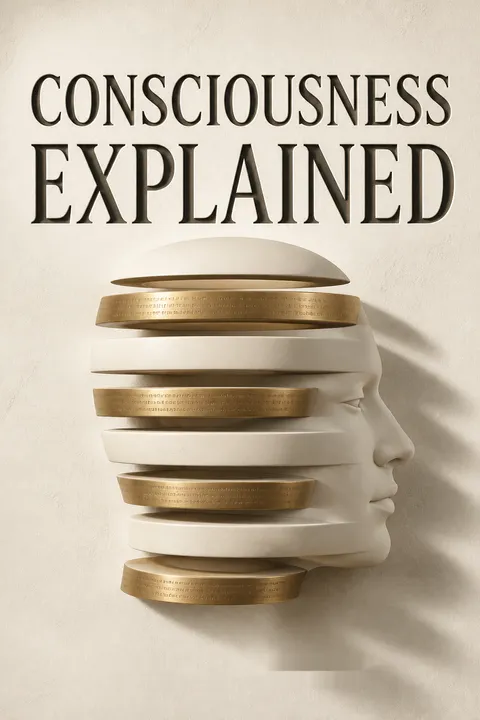
Consciousness Explained receives mixed reviews. Some praise Dennett's innovative ideas and scientific approach, while others criticize his reductionist view and writing style. Many find the book challenging but thought-provoking, appreciating Dennett's attempts to demystify consciousness. Critics argue he fails to fully explain consciousness or address the hard problem. The multiple drafts model and rejection of the Cartesian theater are seen as key contributions. Overall, readers find the book ambitious and influential, even if they disagree with its conclusions.
People Also Read









Glossary
Multiple Drafts model
Distributed ongoing interpretationsDennett’s model of consciousness as parallel, distributed brain processes that interpret and revise information over time. There is no single place where every experience is assembled into a final version for an inner observer. Some processes influence action, memory, or speech, while others leave little lasting trace.
Cartesian Theater
Imagined inner viewing stageThe picture of consciousness as a central place in the brain where completed perceptions are presented to an internal witness. Dennett argues that this metaphor survives even among thinkers who reject mind-body dualism. It creates a regress, since the supposed witness would need another observer to experience the presentation.
heterophenomenology
Neutral study of reported experienceDennett’s method for studying what experience seems like to a person without assuming that reports perfectly reveal what is happening in the brain. Researchers interpret speech and behavior to construct a careful account of the subject’s reported world, then investigate what mechanisms explain it. The method aims to respect reports without treating them as infallible.
intentional stance
Interpret behavior through beliefsA strategy for explaining or predicting a system by treating it as an agent with beliefs, desires, and goals. The stance is useful when an agent’s behavior becomes intelligible through what it appears to know and want. Dennett applies it to human subjects while keeping open the question of what their mental states are physically made of.
Joycean machine
Culturally installed serial mindDennett’s name for the roughly serial organization of thought that develops in human brains through language, learning, and cultural practices. It runs on a brain whose underlying activity is largely parallel. The metaphor emphasizes that human consciousness depends partly on acquired habits and shared cultural tools, rather than on a dedicated, fully formed inner executive.
meme
Replicating cultural information unitA unit of cultural transmission that spreads through imitation or communication, such as a tune, phrase, idea, or technique. Dennett adopts Richard Dawkins’s term to describe how cultural items compete for attention and replication in human minds. A meme’s ability to spread is not necessarily the same as its value to the people who carry it.
Center of Narrative Gravity
Abstract organizing self-modelDennett’s account of the self as an abstract organizing point created by the stories, interpretations, memories, and expectations associated with a person. It is not a separate object located inside the brain. Like a center of gravity, it is not a material component, yet it helps organize explanations of a real system’s behavior.
qualia
Supposed intrinsic feel-propertiesQualia are proposed private, intrinsic qualities of experience, such as the felt redness of red or the awfulness of pain. Dennett argues that the idea of qualia adds an unexplained inner property beyond a person’s patterns of discrimination, memory, report, and response. The term is central to debates about whether explaining those functions fully explains experience.
Baldwin Effect
Learning alters selection pressuresAn evolutionary process in which an ability to learn a useful behavior can change which inherited traits are favored. Individuals who are better positioned to learn the behavior may leave more descendants, gradually making learning it easier for later generations. The effect does not mean that acquired traits are directly passed through genes.
FAQ
What's Consciousness Explained about?
- Exploration of Consciousness: Consciousness Explained by Daniel C. Dennett examines the nature of consciousness, aiming to demystify it through scientific and philosophical perspectives. It challenges traditional views like the Cartesian Theater, which suggests a central place in the brain for consciousness.
- Multiple Drafts Model: Dennett introduces the Multiple Drafts model, proposing that consciousness is not a singular experience but a series of parallel processes that interpret sensory inputs.
- Critique of Qualia: The book critiques the concept of qualia, arguing that they do not exist as separate, intrinsic properties of experiences. Instead, they are the results of complex interactions in the brain.
Why should I read Consciousness Explained?
- Challenging Perspectives: The book encourages readers to rethink their assumptions about consciousness and the mind, offering a fresh perspective that combines philosophy with empirical science.
- Interdisciplinary Approach: Dennett integrates insights from philosophy, neuroscience, and cognitive science, making it a rich resource for anyone interested in understanding the mind.
- Engaging Writing Style: Dennett's accessible prose and thought-provoking arguments make complex ideas understandable and engaging for a broad audience.
What are the key takeaways of Consciousness Explained?
- Consciousness is Complex: Consciousness is not a simple, unified experience but a complex interplay of various cognitive processes. Understanding this complexity is crucial for grasping how consciousness functions.
- Rejection of Dualism: Dennett rejects dualism, advocating for a materialistic view that consciousness arises from physical processes in the brain.
- Heterophenomenology as Method: Introduced as a way to study consciousness objectively, heterophenomenology involves interpreting individuals' reports of their experiences while remaining neutral about their reality.
What is the Multiple Drafts model in Consciousness Explained?
- Parallel Processing: The model posits that consciousness arises from multiple parallel processes in the brain that interpret sensory information, allowing different aspects of an experience to be processed simultaneously.
- No Central Theater: Unlike the Cartesian Theater model, the Multiple Drafts model argues that there is no single point in the brain where consciousness occurs.
- Dynamic Editing: The brain continuously edits and revises these drafts, leading to a fluid and dynamic experience of consciousness.
How does Dennett address the problem of qualia in Consciousness Explained?
- Qualia Disqualified: Dennett challenges the traditional notion of qualia by arguing that they do not exist as independent entities but are results of cognitive processes and interpretations.
- Focus on Function: He emphasizes the functional role of experiences in consciousness rather than their subjective qualities.
- Empirical Approach: Dennett advocates for scientific investigation to provide insights into the mechanisms behind what we perceive as qualia.
What is heterophenomenology, and how is it used in Consciousness Explained?
- Definition of Heterophenomenology: It is Dennett's method for studying consciousness that involves interpreting individuals' reports of their experiences while maintaining a neutral stance.
- Constructing a Fictional World: This approach allows for a systematic exploration of consciousness by treating subjects' reports as creating a fictional world.
- Avoiding Bias: Heterophenomenology helps avoid biases from personal beliefs or assumptions about consciousness, focusing on what subjects report.
How does Dennett explain hallucinations in Consciousness Explained?
- Internal Stimulation: Hallucinations occur due to internal stimulation of the brain's perceptual systems, generating vivid experiences without external reality.
- Passivity in Hallucinations: Individuals experiencing hallucinations often exhibit passivity, not actively engaging with the hallucinated content.
- Cognitive Processes: Hallucinations are understood as the brain's attempts to make sense of internal signals, leading to experiences that feel real.
What are the implications of Consciousness Explained for understanding free will?
- Materialistic View of Free Will: Free will is seen as a product of complex brain processes, challenging traditional notions of it as separate from physical reality.
- Conscious Decision-Making: Conscious decision-making arises from the brain's ability to process information and generate options, grounded in neural activity.
- Revising Responsibility: Understanding the mechanisms behind decision-making can inform views on accountability, encouraging a nuanced understanding of human behavior.
How does Consciousness Explained relate to contemporary debates in cognitive science?
- Integration of Disciplines: Dennett's work bridges philosophy, neuroscience, and psychology, contributing to ongoing discussions about the nature of consciousness.
- Challenging Traditional Views: The book challenges established theories, prompting researchers to reconsider their assumptions about consciousness.
- Influence on Future Research: Dennett's ideas have influenced subsequent research, particularly in areas related to perception, memory, and the nature of consciousness.
How does Dennett define the self in Consciousness Explained?
- Self as Narrative: The self is defined as a "Center of Narrative Gravity," shaped by the stories we tell about ourselves, emphasizing language and social interaction.
- Dynamic and Evolving: The self is a dynamic construct that evolves over time as we accumulate experiences and memories.
- Interconnectedness: The self is interconnected with various cognitive processes and social contexts, highlighting the importance of relationships in shaping identities.
What role does language play in Consciousness Explained?
- Language as a Tool: Language is crucial for constructing and expressing thoughts and experiences, shaping our understanding of self.
- Influence on Consciousness: Language influences how we perceive and interpret experiences, affecting consciousness.
- Cultural Context: Language is embedded in cultural contexts, shaping narratives and identities, emphasizing that consciousness is socially constructed.
What is the significance of the "Center of Narrative Gravity" concept in Consciousness Explained?
- Identity Formation: It highlights how identities are formed through narratives, emphasizing storytelling in understanding who we are.
- Dynamic Self: The self is a dynamic construct that evolves over time, reflecting the fluid nature of identity.
- Social Interaction: The concept underscores the role of social interactions in shaping narratives and identities, influenced by shared stories.
About the Author




Download PDF
Download EPUB
.epub digital book format is ideal for reading ebooks on phones, tablets, and e-readers.








