

Key Takeaways
Learn craft from generous practitioners, not expensive promises
A workshop with stakes. Palahniuk’s education came from decades of kitchen-table workshops, especially the Portland group led by Tom Spanbauer. There, writers read their work aloud and received practical suggestions. His first workshop, by contrast, asked students to debate one another’s work while its expensive instructor offered little beyond praise. The difference is not polish or prestige. It is whether the teacher helps a writer make the next draft better.
No diploma, no guarantee. The book presents writing advice as a conversation passed between generations, not a recipe for getting published. Palahniuk’s blunt warning is that talent does not guarantee a finished book, a lasting career, or a living wage. The useful question is whether a practice keeps producing work, learning, and companionship even when the market offers no reward.
The workshop contrast is really a distinction between feedback that changes behavior and feedback that merely manages feelings. Learning research often separates specific, task-focused guidance from general approval: one gives a learner something to test, the other can leave ability mysterious. A generous teacher need not be gentle at every moment, but should be attentive to the work. The model also has limits. Kitchen-table mentorship depends on time, access, and social trust that not every aspiring writer can find. Its strongest portable lesson is to seek communities where critique is concrete, reciprocal, and tied to revision.
Change the story's texture before the reader feels the seams
Use more than description. Palahniuk treats prose as a stream whose rhythm can shift among three kinds of communication: description shows what happens, instruction directly tells the reader how to do something, and exclamation or sound imitates an event. A recipe inserted into a scene, for instance, briefly turns narrative into practical directions before returning to action. That change can interrupt the flow, then make the next moment feel sharper.
Shift the camera. Stories can also move among first person, which feels personally accountable; second person, which recruits the reader; and third person, which can widen the view. The book calls immediate physical action little voice and reflective commentary big voice. Mixing these textures can create the conversational movement of spoken storytelling, while long stretches of commentary can slow a scene or tell readers what to think.
The useful insight is not that every story needs a fixed recipe of devices. It is that form directs attention. Instruction can make a narrator sound capable, while a sudden sound or shift in address changes the reader’s distance from the action. This resembles editing in music: contrast can renew attention, but random changes sound like noise. A writer can therefore ask what each shift accomplishes. Does it add intimacy, authority, comic timing, or a pause? If it only announces cleverness, the texture becomes decoration rather than storytelling.
Describe the world through the character's body and history
Perception is personal. A character does not encounter an objective room, temperature, or distance. A plumber and a painter notice different things; a person might judge a stranger’s height by comparison with a familiar relative rather than by inches. Palahniuk urges writers to make description arise from what the character knows, fears, and values, including mistaken beliefs that have shaped their lives.
Let sensation lead. Spanbauer’s term burnt tongue means language deliberately shaped by the character’s habits, errors, and emotional intensity, rather than polished into a generic literary voice. Palahniuk recalls standing still for a tailor and feeling an inexplicable comfort, later connecting the sensation to his mother measuring and sewing clothes when he was young. Physical memory supplied the clue that conscious thought had missed.
This approach links point of view to embodied cognition: perception is not a camera recording neutral data, but an interaction between a body, its history, and its current goals. That makes description a form of characterization rather than scenery. The tailor story shows how sensation can retrieve meaning before a character can explain it. Still, avoiding all standardized measurement would be a constraint, not a universal rule. A scientist, engineer, or athlete may naturally notice units. The deeper test is whether a detail belongs to this person’s way of knowing.
Earn belief with precise facts, gestures, and emotional risk
Small truths support large ones. Palahniuk compares believable storytelling to a stained-glass window: viewers first trust the detailed ground-level elements, then accept the miracle depicted above them. In Shirley Jackson’s The Lottery, careful attention to an ordinary box helps make its terrible use feel credible. A wrong detail can break that trust: one reader found a character’s preferred ice cream flavor implausible because it felt like an old man’s choice.
Two kinds of authority. Head authority comes from knowledge a character can demonstrate, such as technical facts. Heart authority comes from emotional honesty or vulnerability, including an ugly truth the character might rather conceal. Both are stronger than insisting that a character is wise or likable. Physical gestures can also complicate dialogue, letting behavior confirm or contradict what someone says.
Credibility is built cumulatively. Precise particulars act like evidence: readers accept a larger invention when the smaller world feels observed rather than assembled from clichés. Gesture is especially valuable because it can carry conflict without explanatory commentary. Yet specificity alone is not proof of insight. A writer can bury a scene in researched detail that has no emotional consequence. The strongest particulars do double duty: they locate the reader in a plausible world and reveal what the character notices, misunderstands, or cannot admit.
Make each plot event deepen pressure, not merely add another event
Plot moves; tension climbs. The horizontal of a story is its sequence of events. Its vertical is the growing emotional, physical, or psychological pressure attached to those events. Without that increase, a narrative can feel like one thing happening after another. Reusing a limited cast of characters, settings, and objects can make each return matter more rather than requiring fresh explanation.
Plant an ending mechanism. A clock is a limit that measures how long a story can continue, such as the dwindling fuel on the airplane in Survivor. A gun is an earlier planted threat that can trigger a later crisis, such as the faulty furnace in The Shining. Palahniuk also warns against dialogue that neatly answers a tense question. An evasive reply, or a scene that shows an important revelation instead of reporting it, keeps pressure alive.
The distinction between sequence and intensification is a compact diagnostic for stories that feel busy but emotionally flat. A deadline gives the audience a temporal boundary; a concealed threat makes the past active in the present. Together, they create expectation, which is the engine of suspense. These devices need not be literal countdowns or weapons. A relationship can have a clock, and an unspoken betrayal can function as a gun. The limitation is that constant escalation exhausts attention. Lulls matter when they alter the reader’s expectations, not when they merely postpone the next event.
Let readers infer the truth before the narrator explains it
Build the bridge gradually. Cultural precedent is the audience’s existing knowledge of a kind of story or experience. A writer can begin with something familiar, then move through increasingly strange steps toward an extreme event the reader might reject if presented immediately. Palahniuk describes shaping his story Guts from escalating anecdotes that first invite laughter, then make the audience reinterpret what it has been laughing at.
Stage, then reveal. A scene should give readers concrete actions and details without prematurely announcing their meaning. In Fight Club, a confrontation first appears to be a cruel robbery; new information changes the reader’s understanding of the scene. The point is not to trick people arbitrarily. It is to let them form a plausible interpretation, then discover evidence that changes it. Explaining the revelation before readers can reach it steals their participation.
Inference makes a reader an active participant. The mind predicts what comes next, and a well-earned reversal forces it to revise the story already built from the evidence. This can make surprise feel more powerful than a twist delivered from outside the scene. Cultural precedent helps because unfamiliar events become legible through familiar patterns. But misdirection has an ethical contract: the final explanation should clarify earlier details rather than erase them. If a twist requires the reader to ignore what the story showed, surprise becomes a cheat instead of a discovery.
Repeat objects and rituals until they become a story's emotional grammar
Return with a difference. Palahniuk’s technique of recycling an object brings it back at changing moments so its meaning accumulates. In Nora Ephron’s Heartburn, a diamond ring moves from a symbol of marriage to an object tied to danger, memory, and finally the money needed to leave a failing relationship. Each appearance asks the reader to remember what the ring meant before, then notice what has changed.
Give people rules. Repeated group rituals can also create a social model: a set of roles and behaviors that lets characters know how to belong. Fight Club’s rules, for example, give its members a shared structure. The anthropologist Victor Turner’s term communitas describes the sense of temporary equality and belonging that can form in such a shared ritual. Fiction can let readers experience that community from the inside.
Repetition is powerful because it turns memory into structure. An object can carry the residue of earlier scenes without requiring a character to explain its significance; a ritual can let a group demonstrate its values through behavior. Together, they give a reader something to recognize and anticipate. This connects narrative technique to social learning: patterns help people understand what a group rewards, forbids, or mourns. The risk is mechanical symbolism. An object that returns without changing the stakes feels like a planted clue. Each recurrence should revise the meaning, not merely remind the reader that the writer is being symbolic.
Test stories on people, then listen for the stories they return
Anecdotes reveal patterns. Crowd seeding is Palahniuk’s practice of sharing a personal story and listening for similar stories that other people contribute. He recalls being sent around a truck factory to find a nonexistent tool. When he told the episode at a party, people answered with their own first-day pranks, from searching for imaginary equipment to being handed impossible tasks. The variations showed that the underlying experience was widely shared.
Use response as information. A workshop or public reading can show where a story earns laughter, silence, confusion, or new memories. Palahniuk stresses that the writer should listen rather than treat the audience as a source to exploit. A story can give people permission to speak about experiences they had kept private, but their trust and identifying details still deserve protection.
This turns audience response into a kind of qualitative research. The goal is not to take a vote on whether a story is good, but to notice what it helps people recall and how they explain those memories. Similar stories expose a shared social pattern that an isolated writer might miss. The method also distributes authorship in a limited, generative sense: listeners recognize themselves in a story and extend its field of meaning. The boundary matters. Resonance is not permission to publish someone else’s private experience without consent.
Build novels from scenes that work before they join the whole
Make the work modular. Palahniuk gathers images, phrases, and observations in notebooks, then arranges them into scenes that can stand on their own. He prints and revises drafts by hand, tests material in workshops, and reads it aloud to discover where energy fades or a surprise lands. Short, self-contained scenes can then accumulate into a larger structure, with their order adjusted to improve pacing.
Keep the next step visible. This process borrows from assembly work: smaller parts are made and tested before they feed into the whole. It also makes room for experimentation, because each scene can help establish the narrator’s voice or reveal a missing transition. Palahniuk recommends learning through imitation, too, but treats it as an apprenticeship. Writers borrow techniques, combine influences, and eventually need to make choices their models would not make.
Modular drafting reduces the psychological cost of an unfinished novel. A scene can produce a local sense of completion while still contributing to a larger design, much like a prototype that reveals whether a component works before a whole system depends on it. Reading aloud adds a practical test that silent revision cannot provide: the writer hears pacing as an audience experiences it. The method is not compulsory. Some writers discover structure through continuous drafting. Its broader value is to make process observable, so that revision becomes a series of decisions rather than a test of inspiration.
Treat writing as a trade, with deadlines, promotion, and uncertainty
Books need a business plan. Bookseller Bob Maull advised Palahniuk not to go more than sixteen months without publishing something new, because readers stop asking for the next book. That was one experienced bookseller’s practical judgment, not a universal law. Palahniuk’s larger point is that authors must finish, revise, promote, and manage the work, not only generate ideas.
Attention takes labor. He turned readings into events with prizes, props, and audience participation, because he wanted people to leave with an experience they would tell others about. Yet no promotional trick guarantees sales. The book notes how a popular genre can collapse when publishers flood the market with imitations, and how piracy can harm income while sometimes expanding a work’s reach. Commercial decisions involve trade-offs, not sure bets.
The business frame corrects a romantic picture of authorship as solitary inspiration followed by effortless recognition. Writing is also a sequence of production and distribution tasks, and an audience often encounters the book through promotion. The showman strategy is memorable because it makes an event shareable, but it is expensive and temperament-dependent. A quieter author should not mistake spectacle for a prerequisite. The durable point is to understand the labor around the work and choose promotional forms that fit both the audience and the writer’s resources.
Write toward the unresolved experience that still has a pulse
Use the problem as material. Spanbauer’s Dangerous Writing approach treats fiction as a way to explore a troubling, unfinished part of life. Palahniuk turned a neighbor’s intrusive music into the premise of Lullaby, exaggerating the irritation into a fictional crisis. He compares the process to prolonged exposure: staying with an anxiety on the page can reduce its hold, though he does not promise that writing will solve an external problem.
Notice what changes perception. The memoir circles moments when an ordinary event suddenly alters the meaning of a life, from a movie watched alone at Christmas to the spectacle of a mechanical elephant moving through London. Such events become stories people repeat, sometimes helping strangers feel less alone. The writer’s task is not merely to invent a plot, but to find the experience that makes the world look different afterward.
Writing can function as a form of meaning-making: a difficult experience becomes something that can be examined, shaped, and shared. That does not make fiction a substitute for therapy, nor does every painful subject become useful material simply because it is painful. The distinction is whether the writer can transform experience rather than reproduce it unprocessed. Palahniuk’s emphasis on changed perception also gives the title its force. A consequential moment need not be spectacular; its importance lies in how it reorganizes what a person believes is possible.
Analysis
Consider This is both a craft manual and a memoir of how craft knowledge travels: from readers, editors, booksellers, fellow writers, and decades of workshop conversation. Its deepest unity is not a single prescriptive method, but a way of directing attention. Notice what bodies do, what objects return, where tension rises, how audiences react, and which ordinary details make an implausible event credible. Those observations become formal choices. A story earns force by arranging evidence so readers participate in producing meaning.
The book’s most useful practices are often deliberately restrictive. Limiting a story’s elements makes repetition visible. Avoiding easy abstractions forces a writer to inhabit a character’s perception. Delaying explanation preserves suspense. Such constraints resemble training drills: they exaggerate a skill so the writer can later use it with judgment. Palahniuk sometimes presents these drills as hard rules, especially his warnings against particular verbs, dreams, or dialogue. They are more convincing as counterweights to default habits than as laws. Realist fiction, comic narration, and reflective prose can all need the very techniques he discourages.
The book also refuses to separate literary technique from social life. A workshop is not only a place to improve sentences; it is a durable community organized around shared attention. A story is not only a product; it can prompt listeners to contribute their own experiences. This social account is compelling, though it should not obscure the unequal conditions of publishing or assume every writer has a welcoming workshop or an audience ready to gather.
What remains is an unusually practical conception of authorship: imaginative work requires curiosity, tolerance for unresolved problems, repeated revision, and an appetite for the unglamorous business around books. The result is not a guarantee of success. It is a way to make the writing life more deliberate, more connected, and more responsive to the strange particulars that make an experience worth telling.
Review Summary
Consider This is widely praised as an excellent writing guide, offering practical advice and entertaining anecdotes from Palahniuk's career. Readers appreciate its conversational tone, unique insights, and blend of personal stories with writing tips. Many consider it on par with Stephen King's "On Writing." The book is valued for its concrete techniques, lack of pretension, and focus on storytelling craft. While some note it's most useful for those interested in Palahniuk's style, most find it engaging and helpful for writers at various levels.
Glossary
Big voice
Reflective commentaryThe reflective layer of a story that interprets events, muses, or offers a character’s subjective understanding. It contrasts with immediate, scene-based action. Big voice can supply context, mark time passing, or frame the meaning of an event, but extended commentary may slow momentum or dictate a response the reader could have reached independently.
Little voice
Immediate physical actionThe scene-level mode of storytelling that records actions and sensory details as they happen. It behaves like a camera close to the physical world, showing people moving through settings. Palahniuk favors it for opening scenes because concrete action can engage a reader before reflective commentary asks for attention.
Burnt tongue
Character-shaped flawed languageA term Gordon Lish used for language deliberately shaped by a speaker’s habits, errors, slang, and emotional state. Rather than polishing every sentence into standard literary prose, a writer gives the voice distinctive imperfections that feel native to the character. The language should express a particular person’s way of understanding and speaking.
Cultural precedent
Familiar bridge to the strangeA recognizable story pattern or common experience that helps a reader accept a more unusual event. The writer begins with what the audience already understands, then escalates through intermediate steps toward something extreme or fantastic. Familiarity makes the unfamiliar legible without requiring the story to announce its final meaning in advance.
Vertical
Increasing story pressureThe developing emotional, physical, or psychological intensity of a narrative. It differs from the horizontal sequence of plot events. A story’s vertical grows when events deepen risk, feeling, or significance, rather than merely adding another action to the timeline.
Horizontal
Sequence of plot eventsThe order in which a story’s events occur, such as characters meeting, moving, or encountering obstacles. Palahniuk contrasts this with vertical development, the growing pressure beneath those events. A story with horizontal movement but little vertical change can feel like a list of happenings without accumulating emotional force.
Clock
Time-limiting story deviceA condition that gives a story a defined time span or marks time passing. A pregnancy, a journey, or a plane running out of fuel can serve as a clock. It helps constrain the narrative, increase urgency, and orient readers to how long the story can continue.
Gun
Planted source of crisisA threat or consequential detail introduced early and held in reserve until it can trigger a later crisis. Unlike a clock, which openly measures time, a gun may recede from the reader’s attention before returning as a surprising but prepared development. The term draws on the familiar dramatic principle that an important introduced object should matter.
Crowd seeding
Stories that elicit storiesPalahniuk’s practice of sharing an anecdote, then listening for related stories from other people. Their responses reveal whether the experience resonates and may expose a broader pattern behind the original incident. The method can also give listeners permission to speak, so it requires care not to appropriate private experiences without consent.
Dangerous Writing
Fiction as personal explorationTom Spanbauer’s approach to writing, as Palahniuk describes it, uses fiction to explore unresolved fears, conflicts, or experiences. A writer need not begin with a deepest secret; even a persistent, manageable frustration can provide material. The process may help the writer examine an issue, but it does not guarantee that writing will resolve real-world circumstances.
Communitas
Temporary ritual-based belongingA term associated with anthropologist Victor Turner for a sense of shared equality and connection that can arise within a temporary social event or ritual. Palahniuk applies the idea to fictional groups whose rules and repeated practices give members roles, belonging, and a structure for sharing experience.
FAQ
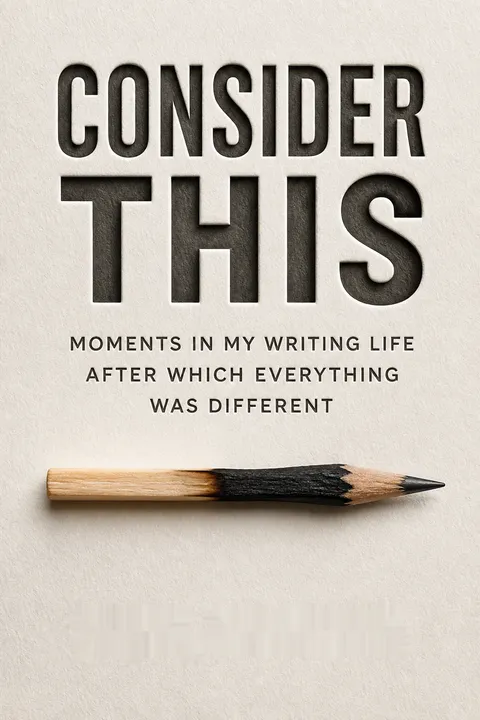
What's "Consider This: Moments in My Writing Life After Which Everything Was Different" about?
- Author's Journey: The book is a memoir by Chuck Palahniuk, detailing pivotal moments in his writing career that changed his perspective and approach to storytelling.
- Writing Advice: It offers practical advice and insights into the craft of writing, drawing from Palahniuk's experiences and those of his mentors.
- Personal Anecdotes: The book is filled with personal stories and anecdotes that illustrate the lessons Palahniuk has learned throughout his career.
- Creative Process: It explores the creative process, including the challenges and triumphs Palahniuk faced while developing his unique voice and style.
Why should I read "Consider This" by Chuck Palahniuk?
- Insightful Guidance: The book provides valuable insights into the writing process from a successful and experienced author.
- Inspirational Stories: Palahniuk shares inspiring stories about his journey, offering motivation to aspiring writers.
- Practical Tips: It includes practical tips and techniques that writers can apply to improve their craft.
- Unique Perspective: Readers gain a unique perspective on the writing world, enriched by Palahniuk's distinctive voice and experiences.
What are the key takeaways of "Consider This"?
- Authority in Writing: Establishing authority is crucial for engaging readers and making incredible stories believable.
- Tension and Conflict: Creating and managing tension is essential for maintaining reader interest and driving the narrative forward.
- Writing from Experience: Using personal experiences and unresolved issues can fuel compelling storytelling.
- Community and Feedback: Engaging with a community of writers and seeking feedback is vital for growth and improvement.
What is Chuck Palahniuk's advice on establishing authority in writing?
- Authority Speech: Characters can demonstrate authority by delivering a speech filled with technical knowledge, surprising the audience.
- Get Small Details Right: Accurate details in storytelling help make the incredible seem believable to readers.
- Use Truisms: Incorporating universally recognized truths can lend credibility and relatability to a narrative.
- Nonfiction Forms: Borrowing structures from nonfiction can make fiction more plausible and engaging.
How does Chuck Palahniuk suggest creating tension in a story?
- Vertical vs. Horizontal: Balance the progression of plot events (horizontal) with increasing emotional and psychological tension (vertical).
- Clocks and Guns: Use time constraints (clocks) and hidden plot devices (guns) to build suspense and drive the narrative.
- Avoid Quick Resolutions: Prevent dialogue from resolving tension too quickly; instead, introduce larger conflicts.
- Occupatio Technique: Introduce threats by denying their possibility, creating suspense through implied danger.
What is the "Kitchen-Table MFA" mentioned in "Consider This"?
- Informal Education: Palahniuk describes his writing education as a "kitchen-table MFA," gained through informal workshops with other writers.
- Collaborative Learning: These workshops provided a space for writers to share work, receive feedback, and learn from each other's successes and mistakes.
- Mentorship: The workshops were led by experienced writers like Tom Spanbauer, who offered guidance and support.
- Community Building: The gatherings fostered a sense of community and camaraderie among writers, encouraging growth and experimentation.
What are some of the best quotes from "Consider This" and what do they mean?
- "Establish your authority, and you can do anything." This emphasizes the importance of credibility in storytelling, allowing writers to take creative liberties.
- "Action carries its own authority." Suggests that clear, physical actions in a narrative can engage readers and lend authenticity to the story.
- "Write about the moment after which everything was different." Encourages writers to focus on transformative experiences that drive character development and plot.
- "Language is not our first language." Highlights the importance of nonverbal communication and physicality in storytelling.
How does Chuck Palahniuk use personal anecdotes in "Consider This"?
- Illustrative Stories: Palahniuk shares personal stories to illustrate writing techniques and lessons learned.
- Relatable Experiences: His anecdotes make the advice more relatable and grounded in real-life experiences.
- Humor and Honesty: The stories are often humorous and candid, providing an engaging and entertaining read.
- Learning from Mistakes: Palahniuk openly discusses his mistakes and failures, offering valuable insights for aspiring writers.
What is the significance of "textures" in storytelling according to Chuck Palahniuk?
- Variety in Communication: Textures refer to the different forms of communication—description, instruction, and exclamation—that can be mixed in storytelling.
- Engaging Style: Using a variety of textures creates a natural, conversational style that keeps readers engaged.
- Authority and Intimacy: Shifting between first-, second-, and third-person points of view can control the authority and intimacy of a story.
- Big Voice vs. Little Voice: Alternating between objective descriptions (little voice) and subjective commentary (big voice) adds depth and meaning to a narrative.
How does Chuck Palahniuk suggest using objects in storytelling?
- Recycling Objects: Introduce and conceal objects throughout the story, allowing them to gain new meanings and significance with each appearance.
- Symbolic Evolution: Objects can morph into symbols that reflect character development and plot progression.
- Emotional Resonance: Recycled objects can evoke emotions and create connections with readers as they recognize their importance.
- Narrative Cohesion: Consistently revisiting objects helps maintain narrative cohesion and reinforces themes.
What is Chuck Palahniuk's perspective on writing workshops?
- Permission to Write: Workshops provide writers with the validation and encouragement needed to pursue their craft.
- Feedback and Growth: They offer a platform for receiving constructive feedback and learning from peers.
- Community Support: Workshops foster a sense of community and camaraderie among writers, promoting collaboration and support.
- Learning Environment: They create a space for experimentation and growth, allowing writers to refine their skills and develop their unique voice.
What are some unconventional writing techniques suggested by Chuck Palahniuk?
- Unconventional Conjunctions: Use unique conjunctions to create run-on sentences that mimic natural speech and build momentum.
- Subverting Expectations: Allow readers to anticipate outcomes, then surprise them with unexpected twists and revelations.
- Occupatio Technique: Introduce threats by denying their possibility, creating suspense through implied danger.
- Burnt Tongue: Use flawed language to create authentic, character-driven narratives that resonate with readers.
About the Author
Other books by Chuck Palahniuk


Download PDF
Download EPUB
.epub digital book format is ideal for reading ebooks on phones, tablets, and e-readers.








