

Key Takeaways
Write from private urgency, not the fantasy of instant fame
Begin with an inner necessity. Hamand argues that the strongest reason to write is a subject, character, or question that keeps returning to the writer. Tolkien spent years creating the history, languages, and geography of an imaginary world without expecting an audience. When his publisher asked for a follow-up to The Hobbit, he drew on that private work to create The Lord of the Rings, which connected with readers on a vast scale.
Let readers come later. Publication, prizes, and income depend on forces a beginner cannot control. The practical first task is to write what genuinely interests you, then learn to communicate it well. Try several forms before deciding whether your material belongs in a poem, story, novel, play, or nonfiction piece.
What's useful here is the distinction between the source of a project and its eventual test. Intrinsic interest supplies stamina when the work is difficult; attention to readers helps shape the finished piece. Those motives need not compete if they are handled in sequence. The caution is that writing only for oneself can become a shield against revision. Private urgency starts the work, but a reader's confusion or indifference is information about how well the work travels beyond its author.
Build a routine that gets words down before judgment takes over
Make writing repeatable. A dependable time and place reduce the daily negotiation that lets chores, email, and errands take over. Hamand recommends writing regularly, even in short sessions, and adapting the workspace to real life: a desk, a quiet corner, a library, or a café can all work. The book cites violinist research by Anders Ericsson, in which serious performers had accumulated extensive practice. The comparison is a reminder that writing improves through work, not wishful thinking, not a guaranteed hour-count for every writer.
Start before you feel ready. Blank-page fear often comes from perfectionism, self-consciousness, or fear of failure. Timed freewriting, a random-word prompt, or a simple opening sentence can loosen the first lines. Keep drafting and editing separate: the first pass creates material, and later passes decide what deserves to stay.
The routine advice treats creativity less like a lightning strike and more like a condition that can be made easier to enter. That is a valuable correction to the romantic image of the inspired writer. Small sessions also make progress visible, which can reinforce persistence. Still, regularity should serve the work rather than become another measure of personal worth. A disrupted schedule can reflect caregiving, illness, or precarious work, not a lack of seriousness. Flexible consistency is more humane than a rigid daily quota.
Turn experience into story by selecting and reshaping its emotional core
Use life as material. Memories, family stories, photographs, relationships, and ordinary encounters can all generate writing. But a record of everything that happened is rarely a story. Select moments of change, conflict, or decision, and leave out details that do not deepen the reader's understanding. Hamand also notes that memory is reconstructed: diaries, conversations, and photographs can prompt recollection, but they do not guarantee a perfect record.
Move beyond literal copying. Writing from a different point of view, changing a character's age or setting, or turning a personal incident into fiction can create distance from overwhelming emotions and free the writer to shape events. Research can fill gaps in experience. The aim is not to preserve every fact unchanged, but to make the central feeling and its consequences clear to someone who was not there.
This approach joins emotional honesty with formal invention. The distinction matters because readers cannot access the private intensity of an event unless the writer gives it shape, context, and consequence. Fictional transformation can also protect people and widen a story beyond one person's biography. Yet changing facts carries ethical responsibilities when a work is presented as nonfiction. The useful question is not merely whether a scene feels true, but what kind of truth the work promises and whether its label makes that promise clear.
Reveal character through choices, objects, and dialogue with competing aims
Make personality observable. A protagonist is the central character; an antagonist opposes that character's aims. Readers understand both through appearance, speech, thoughts, possessions, and especially actions. A character's worn clothes, carefully arranged room, or unexplained keepsake can imply a history without a biography inserted into the story. Background matters because childhood experiences may shape what a character fears, wants, or repeatedly gets wrong.
Give conversations a purpose. Strong dialogue is not a transcript of ordinary speech. Each speaker should want something, and their aims should complicate the exchange. A person may discuss the weather while avoiding a painful subject, creating subtext: meaning conveyed beneath the literal words. Keep dialogue selective and concise, and let gestures or pauses carry some of the pressure. Distinct voices should sound plausible without burying the reader in phonetic accents.
The emphasis on inference gives readers an active role. A revealed object or inconsistent behavior invites them to assemble a person, much as they do in everyday social life. This is often more persuasive than a narrator's verdict. The approach also helps avoid flat moral categories: a character can be generous in one relationship and selfish in another. The challenge is to distinguish complexity from obscurity. If every motive is withheld, readers may stop interpreting and simply lose their bearings.
Choose a viewpoint that limits knowledge and intensifies reader involvement
Decide who can know what. First person gives the story a character's direct voice but restricts the reader to that character's knowledge. Third-person limited uses he or she while staying close to one person's perceptions. An omniscient narrator can move among characters and reveal more, but may feel distant if handled without control. Free indirect style is a technique in which third-person narration briefly takes on a character's thoughts or idiom without announcing a switch.
Protect the chosen perspective. A viewpoint shift within a scene can confuse readers about whose experience organizes the moment. A narrator may also be unreliable, whether through deliberate lies or a limited understanding of events. Kazuo Ishiguro's The Remains of the Day uses a butler's narrow interpretation to let readers notice truths he cannot acknowledge. The gap between what he says and what readers infer creates meaning.
Point of view is not just grammatical choice. It is an information design decision: every revelation, misunderstanding, and withheld fact depends on whose mind is available. Restriction can create intimacy and suspense, while a wider narrator can clarify social patterns that no single character sees. The trade-off is worth making consciously. A narrator's blind spot should generate interpretation rather than feel like the author is hiding basic facts arbitrarily. Readers enjoy solving a puzzle when they can see the pieces.
Make settings tangible with exact details and all five senses
Choose details that matter. A specific cup, room, street, or smell gives readers more to imagine than a general label. Description also signals importance: a carefully described object may become a clue, a memory trigger, a symbol, or a plot device. Use sight, sound, smell, taste, and touch, but avoid crowding every sentence with adjectives. A few precise details often create a clearer scene than an inventory of everything present.
Earn the reader's trust. When a story depends on a medical procedure, a job, or a historical setting, research the details that knowledgeable readers will notice. Hamand points to Ian McEwan's surgical descriptions in Saturday as an example of convincing specificity. Metaphors and similes can make familiar things newly visible, but stale or strained comparisons distract. Setting becomes most vivid when it affects a character's choices, mood, or danger.
Concrete description is a form of selection, not decoration. A well-chosen detail lets readers infer class, history, mood, and risk at once, giving prose an efficiency that exposition often lacks. The sensory emphasis also reminds writers that people encounter places bodily, not as photographs. The limit is that precision alone does not produce significance. A perfectly researched street remains inert unless it matters to someone in the scene. Details become memorable when they alter what a character can feel, understand, or do.
Give each story a question, a goal, obstacles, and a consequential ending
Build a line of pressure. A plot is more than events in sequence. A character wants something, meets resistance, makes choices, and experiences consequences. The central story question keeps readers looking ahead: will the character reach the goal, uncover the truth, or lose what matters? Conflict can be internal, between people, social, or on a larger scale. The climax brings the decisive pressure into the open; the resolution shows what follows.
Use structure without becoming mechanical. A common three-act structure introduces characters and conflict, develops complications, then resolves the central problem. A story can also draw on recurring patterns such as a quest, a romance, a rise and fall, or redemption. Subplots add depth when they affect the main story. Coincidence may start events, but piling on coincidences weakens belief. Suspense grows when obstacles intensify and the outcome remains uncertain.
This model links narrative propulsion to human agency. Readers care not simply because something happens, but because a person wants something and must decide what to risk. That principle works in literary fiction as well as thrillers, even when the external action is quiet. Structure is best treated as a diagnostic tool, not a compulsory template. A story may resist conventional closure, but it still needs to create a meaningful change in what readers understand or expect.
Draft freely, then rebuild before polishing the prose
Finish a workable draft. Early pages are not the book; they are material for discovering what the book might be. Hamand advises beginners not to endlessly revise the opening while the rest remains unwritten. After completing a draft, put it aside briefly, then read it from beginning to end to see the whole structure. Mark scenes to cut, expand, move, or replace before spending time correcting minor errors.
Edit in distinct passes. Structural revision asks whether the story holds together. Line editing sharpens sentences, removes repetition, strengthens verbs, and trims overlong description or dialogue. A trusted reader can reveal confusing transitions, missing information, and moments that do not land. Listen carefully, especially when several readers identify the same problem, but do not treat every preference as a command. The writer must decide which changes serve the work.
Separating invention from evaluation protects two different mental tasks. Drafting tolerates uncertainty; editing applies judgment. Trying to do both at once can make every sentence feel like a final exam. The staged process also recognizes that readers experience a work sequentially, while authors know the intention behind every passage. Outside feedback helps correct that asymmetry. But consensus is not proof of artistic error: readers may share a taste, while a deliberate formal risk may be doing exactly what it intends.
Choose the form whose constraints sharpen your material
Let the material find its shape. A short story often concentrates on one turning point or revelation; a novel has room for broader change and interwoven plots. A novella sits between them, retaining a concentrated focus while allowing deeper development. Poems rely on sound, rhythm, imagery, and deliberate line breaks. Plays depend on dialogue and action that can be staged, while screenplays tell stories primarily through images and behavior.
Respect the reader's situation. Writing for children means matching vocabulary, length, and subject to a particular age, rather than merely simplifying adult prose. Journalism prioritizes clear, accurate facts and often answers who, what, where, when, why, and how. Narrative nonfiction combines researched events with storytelling techniques. Travel writing needs more than a destination: it needs a fresh angle and the sensory particulars that make a place distinct. Each form has its own demands, so study examples before submitting work.
Form acts like a set of productive limits. A short story's compression forces selection; a play makes speech and visible behavior carry weight; a news article puts the most consequential facts early. These constraints can expose what a subject is really about. They also warn against treating genre conventions as mere gatekeeping. A format helps readers know how to approach a work, but conventions can be bent when the writer understands the effect of bending them.
Treat publication as a second craft, not the reason to write
Learn how the route works. Mainstream publishers often rely on agents to filter submissions, while smaller independent presses may read unsolicited work and give each title closer attention. A submission usually needs a polished manuscript, a concise synopsis, and a professional letter. Editors, sales staff, marketing teams, and bookshops all influence a book's path. The economics are tight: a paperback's cover price is divided among production, distribution, retailer discounts, royalties, overhead, and profit.
Protect both the work and the writer. Research agents and publishers to find those suited to the book. Expect rejection, keep submitting, and treat feedback as evidence rather than a verdict on talent. Self-publishing gives the writer control but also makes the writer responsible for production, sales, and publicity. Vanity publishers charge authors while offering little incentive to sell the book, so payment demands deserve scrutiny. Networking and a clear pitch help, but the manuscript must still do the work.
The publishing chapters make a useful distinction between artistic effort and commercial infrastructure. A book is also a product moving through institutions with finite budgets, schedules, and incentives. Understanding those forces can prevent writers from interpreting every rejection as a judgment of literary worth. At the same time, market knowledge should not be mistaken for a reliable prediction machine. Editors cannot know every future readership, and a commercially sensible choice can still miss an unusual book. Professionalism means informed persistence, not surrendering the work's purpose.
Analysis
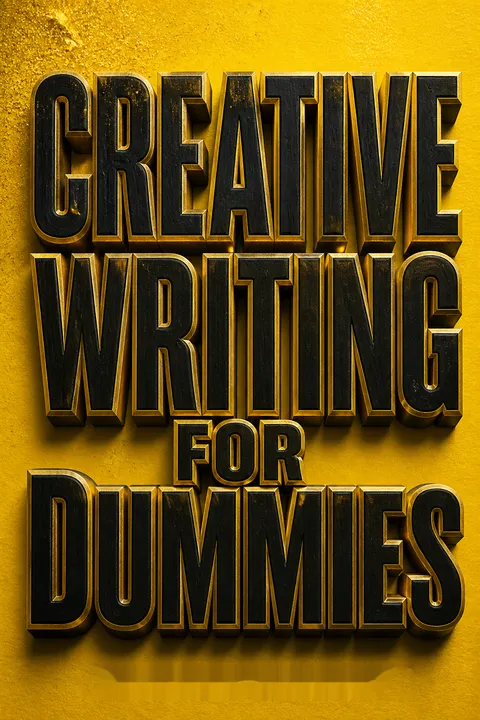
Creative Writing For Dummies is a broad reference manual rather than a single argument or memoir. Its 128,706 words range from the writer's first session to the mechanics of agents, print runs, and publicity. That breadth makes compression difficult: the book teaches both durable principles and highly specific techniques for distinct forms, and those cannot all be reduced to one formula without losing useful differences.
Its most coherent argument is practical: writing is a learned craft built through attention, practice, experimentation, and revision. The writer begins with personal curiosity, gathers material from life and observation, then uses point of view, character, dialogue, setting, and plot to make experience legible to others. The movement from private impulse to public communication gives the book its narrative arc. Its most memorable examples reinforce this transition, from Tolkien's private world-building to the careful staging of scenes and the commercial realities that await a finished manuscript.
The guide is strongest when it explains the reader's experience. A detail can signal importance, dialogue can conceal as well as reveal, and point of view determines what information is available. These are practical craft principles because they connect a writer's decisions to an audience's attention and inference. Its advice to draft before judging and to revise structure before sentences also offers a plausible process for managing a demanding task.
The book's breadth sometimes risks making craft sound more rule-bound than it is. Three-act plotting, sensory detail, and active verbs are useful tools, not universal laws. A quiet, fragmented, or deliberately opaque work may refuse conventional momentum and still succeed. The book is also rooted in the publishing landscape of 2010, so named outlets, technology, and business conditions should be treated as period-specific rather than current guarantees. Its lasting value lies less in its market directory than in its central discipline: understand the effect of a choice, then make it deliberately.
Review Summary
Creative Writing For Dummies receives mostly positive reviews, with readers praising its comprehensive coverage of various writing genres and practical advice. Many find it helpful for beginners, offering encouragement and confidence-building tips. The book is commended for its wide range of topics, including fiction, non-fiction, poetry, and publishing guidance. Some reviewers note that while it provides a good overview, it lacks in-depth information on specific areas. Overall, readers appreciate its accessibility and consider it a valuable resource for aspiring writers.
People Also Read
Glossary
Free indirect style
Character thought in third personA narrative technique that lets third-person narration briefly absorb a character's language, thoughts, or judgments without switching to first person or explicitly introducing a thought. It can move readers close to a character while retaining the flexibility of an author's narrative voice.
Unreliable narrator
A narrator readers should questionA narrator whose account cannot be accepted as fully accurate or complete. The narrator may lie, misunderstand events, or fail to recognize what the reader can infer. Writers can use the gap between the narrator's version and the evidence in the story to create irony, suspense, or a gradual revelation.
Inciting incident
The event that starts the storyThe event that disrupts the characters' existing situation and sets the main story in motion. Without it, the central conflict or relationship would not develop in the same way. It often appears near the opening, giving the audience a concrete reason to follow what happens next.
Narrative non-fiction
Fact told through storytellingWriting based on real people, places, and events that uses techniques associated with fiction, including scenes, characterization, dialogue, description, and narrative structure. Its storytelling should not obscure its factual basis. It often selects and organizes researched material around a central question or human story.
Subtext
Meaning beneath spoken wordsThe unspoken meaning or motive beneath a character's literal dialogue. Characters may conceal feelings, avoid a subject, or pursue conflicting aims while discussing something ordinary. Subtext lets readers infer tension from what is said, what is left unsaid, and how characters behave.
Pathetic fallacy
Weather reflecting human moodA descriptive device in which weather or the natural world appears to echo a character's emotional state. Rain may accompany distress, or bright weather may contrast with grief. The contrast can be just as purposeful as the echo, provided the setting contributes to the scene's effect.
Three-act structure
Setup, complication, resolutionA common dramatic organization with a beginning that introduces characters and conflict, a middle that complicates and escalates the conflict, and an ending that brings the central struggle to a climax and resolution. It is a flexible planning aid, not a requirement that every story follow an identical pattern.
Novella
A concentrated work between story and novelA work of fiction longer than a typical short story but shorter than a full-length novel. Hamand describes it as usually above 20,000 words and below roughly 40,000. Like a short story, it tends to maintain unity of purpose, while allowing more room for character development and a longer span of events.
Download PDF
Download EPUB
.epub digital book format is ideal for reading ebooks on phones, tablets, and e-readers.








