

Key Takeaways
An outline can save a novel from eight months of wandering.
Planning can prevent costly detours. Weiland describes spending eight months writing just 50 pages of Dreamlander without a plan. The pages wandered, despite a promising premise and characters she liked. She then spent two and a half months outlining the story, which gave her a workable route. Earlier, outlining Behold the Dawn for three months had made drafting feel unusually smooth. These are personal examples, not a guarantee that every writer will work the same way, but they show how a small plan can prevent large rewrites.
A map, not a mandate. Outlining means deciding enough about the story to make progress, not locking every future sentence in place. Writers who discover stories while drafting may prefer less planning; others find that a blank page invites aimless scenes. The useful method is the one that helps a writer finish stronger work.
What's striking is the comparison between the scale of planning and the scale of the problem it is meant to prevent. A novel is a long chain of dependent choices, so a weak early decision can become expensive once it is embedded in thousands of words. That makes outlining resemble prototyping: test the structure while changes are cheap. The caveat matters too. One writer's time savings do not prove that outlining is universally faster. A plan earns its keep only when it reduces uncertainty without replacing the writer's energy for the actual scenes.
Turn a what-if spark into a one-sentence story with stakes.
A premise sentence focuses the idea. It is a compact statement of the protagonist, central conflict, and direction of the plot. Start with a question that opens possibilities, such as what if dreams were events happening in another world? Weiland's Dreamlander premise turns that question into a story: journalist Chris Redston discovers his dreams are memories of a world he must help save. The question sparks invention; the sentence tests whether the idea can sustain a plot.
Challenge the obvious version. List what readers might expect, then consider which expectations to fulfill and which to overturn. Orson Scott Card's Enchantment, as Weiland describes it, complicates a time-travel romance by bringing its medieval princess into the modern world. The premise can change as better ideas emerge. Its job is to guide exploration, not freeze the story.
Compression is useful because it forces a writer to distinguish a vivid situation from a story engine. A premise that names a person, a desire, and resistance already suggests why scenes might follow one another. This resembles the role of a research question: it narrows inquiry without dictating every finding. But a sentence can also overstate how tidy a story is. Some novels depend on ambiguity, ensemble casts, or atmosphere more than a single protagonist's clear objective. The premise is a diagnostic tool, not a test that every kind of fiction must pass in the same form.
Explore wildly first, then compress the discoveries into a usable map.
Separate invention from organization. Weiland's process begins with a list of scenes already imagined, including incomplete ideas and obvious gaps. In her General Sketches, the exploratory stage of the method, she records possibilities, marks what needs work, and asks questions rather than pretending to know every answer. Freewriting, mind maps, pictures, and maps can all help generate material. A character interview, a set of prompts about a character's history, habits, fears, and relationships, can uncover useful surprises. A looser freehand interview can help when a character seems resistant to tidy questions.
Then make a practical version. The Extended Outline develops scenes in detail, while the Abbreviated Outline condenses them into a quick reference for drafting. The exploratory notes may be long and messy; the working guide should make the next step easy to find. No formal format is required.
This sequence makes an important distinction between generating options and judging them. If evaluation begins too early, unusual ideas can be discarded before their value is clear. If exploration never ends, the writer can accumulate possibilities without making a story. Moving from a broad, permissive phase to a concise guide gives each mode a job. The same principle appears in design work, where divergent brainstorming is followed by selection and testing. The risk is treating a detailed outline as proof that a story is ready. A plan still needs to be tested in scenes, where tone, emotion, and character voice become real.
Make a character's motive drive the goal readers watch them pursue.
Action needs a reason. A character may do something dramatic, but readers care more when they understand what the character means to accomplish. Motive gives rise to desire, desire becomes a goal, and obstacles to that goal create conflict. For example, Weiland describes Annan, the protagonist of Behold the Dawn, as wanting to die in battle because he believes guilt makes life unbearable. The goal matters because the reason beneath it reveals who he is.
Give the outer plot an inner consequence. The workbook distinguishes what a character wants from what the character needs to confront or change. In Dreamlander, Chris wants his dreams to stop, while his deeper need is to accept responsibility for the harm his choices can cause. The character's change should appear in decisions and behavior, not just in a final declaration.
Motivation gives plot events psychological continuity. Readers can accept surprising behavior when it follows from a character's fears, values, or mistaken beliefs. This is close to a useful principle in behavioral models: actions become more intelligible when the goal and the perceived obstacle are visible. The distinction between what a character wants and needs can deepen that model, especially when the two conflict. It can also become mechanical if every arc is forced into a lesson and a cure. Some characters resist change, change for the worse, or remain unresolved, and those outcomes can be dramatically coherent too.
Let the past explain present choices, but reveal it only when needed.
Backstory is a cause, not a detour. It is the history that shapes a character's present decisions. Weiland recommends exploring that history deeply, then bringing only the relevant pieces into the novel. One way to begin is at the inciting event, the change that sets the plot in motion, and ask what in the character's past makes this event matter. A key event is the moment the protagonist becomes personally involved. In a detective story, for example, the crime may happen first, and the detective's decision to take the case may be the key event.
Discover more than the reader needs to hear. While developing Annan, Weiland uncovered his past in a monastery, an unexpected history that changed her understanding of the character and plot. By contrast, Athos's secret in The Three Musketeers is withheld until it becomes dramatically useful. Knowing a character's history does not require narrating all of it.
The distinction between private knowledge and presented information is one of the strongest practical ideas here. A writer can use backstory as a causal model, understanding why a character reacts as they do, while allowing readers to infer some of that model through behavior and dialogue. This creates depth without pausing the present action for a biography. There is a balance to strike: withholding context can create curiosity, but withholding too much can make a character's choices feel arbitrary. A clue should make readers wonder, not leave them unable to understand what is happening.
Let character choices carry the theme instead of speeches.
Theme grows from consequences. A theme is the story's underlying concern or view of human experience. Weiland argues that it becomes convincing when it develops through characters facing difficult choices, rather than through an author explaining the lesson. In Lord Jim, as she reads it, a sailor's failure to help passengers haunts him; his later actions give the story's concern with betrayal and responsibility dramatic force. The idea is embedded in what Jim does and what those actions cost.
Let images reinforce, not replace, the drama. In The Patriot, toy soldiers belonging to the protagonist's son are melted down and used to make ammunition. Their changing role echoes the character's movement through grief, anger, and commitment. Repeated images can deepen a theme, but they work best when they arise naturally from the plot. Weiland's planning questions focus on what the protagonist believes, how events challenge that belief, and what the character's final actions demonstrate.
Stories persuade through consequence more readily than through instruction. When an idea is tested by choices, readers can experience its costs and still decide what they think it means. That gives theme a dramatic rather than merely argumentative form. Recurring images can also act as memory cues, linking distant moments without spelling out their connection. The challenge is that a clean character arc can make a moral claim seem more settled than real life. Leaving room for ambiguity, competing values, or partial change can preserve the story's force without turning it into a verdict.
Make setting shape what characters can do, not merely where they stand.
Place can create story pressure. Setting becomes powerful when it affects the plot, shapes mood, or reveals how a character sees the world. Weiland points to J.G. Ballard's Empire of the Sun, where the Shanghai setting and prisoner-of-war camp are inseparable from the story. A different location would change the events themselves, not just the scenery.
Choose fewer places and use them well. Returning to a few distinctive locations lets readers learn their possibilities and notice how characters change within them. Combining settings can avoid a parade of locations that each require fresh explanation. For speculative fiction, worldbuilding questions about landscape, customs, government, technology, and natural laws help make a world coherent. The practical test is whether these details affect people's choices. A map can be rough; its value lies in clarifying where people can go and what barriers they encounter.
Treating place as a constraint turns description into causality. A prison, city, or invented world shapes what characters can reach, whom they encounter, and which plans are plausible. That is why a memorable setting often feels active even when it has no literal agency. This also offers a useful check on worldbuilding: details are most vivid when they change the costs or opportunities of action. The limitation is not that every novel needs an elaborate setting. A deliberately ordinary place can be exactly right, provided its social or emotional meaning is specific to the characters.
Link scenes by consequence, and cut scenes that change nothing.
A novel is more than a scene collection. Each scene should affect what can happen next, through new information, a decision, a setback, or a changed relationship. Weiland compares the sequence to falling dominoes: if a scene has no effect on later events, it may be unnecessary or need a stronger function. One way to test the chain is to outline backward from a known event. When she knew a character would be seriously injured but did not know why, working back from the injury helped her invent a plausible lead-up instead of inserting unrelated events.
Check both shape and pace. A three-act structure can help organize a beginning, escalating complications, and a decisive ending. Scene breaks, varied chapter lengths, and endings that raise a question can control pace. Not every scene needs a cliffhanger, but readers need a reason to continue.
The cause-and-effect test is a powerful editing tool because it asks what a scene does, not merely whether the writer enjoyed drafting it. Backward planning is especially useful when the story has a fixed destination, such as a revelation or injury, and the route is unclear. It can expose missing causes before they become patchwork explanations. Still, not every scene's value is reducible to plot advancement. A quiet encounter may establish atmosphere, relationship, or a pattern that only becomes meaningful cumulatively. The better question is whether the scene changes the reader's understanding, not only whether it moves an event.
Give the viewpoint to whoever has most at stake.
Point of view controls access. A narrator determines what readers know, what remains hidden, and whose emotions give a scene its force. Weiland recounts struggling with a scene in Dreamlander until she shifted it from the hero, who had already absorbed tragic news, to another character more deeply affected by it. That perspective gave the moment fresh tension. A character with an interesting voice may also be a better narrator than the most obvious candidate.
Keep each viewpoint necessary. Multiple perspectives can reveal different parts of a story, but too many can scatter attention and weaken the reader's attachment to any one character. Before adding a narrator, consider what that viewpoint contributes that an existing one cannot. Audience, tone, and tense matter too: these choices influence the experience of the whole book, so they are worth testing before drafting.
Point of view is not just a camera position. It is an allocation of knowledge and emotional attention. Choosing the person with the most to lose often makes a scene more immediate because the information is new to that character, not merely repeated for the reader. This is a form of information design: suspense depends on what is known, by whom, and when. Yet rotating perspective can be valuable for stories built on contrast or distributed knowledge. The criterion is not minimizing viewpoints at all costs, but making each shift earn the cognitive and emotional reset it asks of the reader.
Analysis
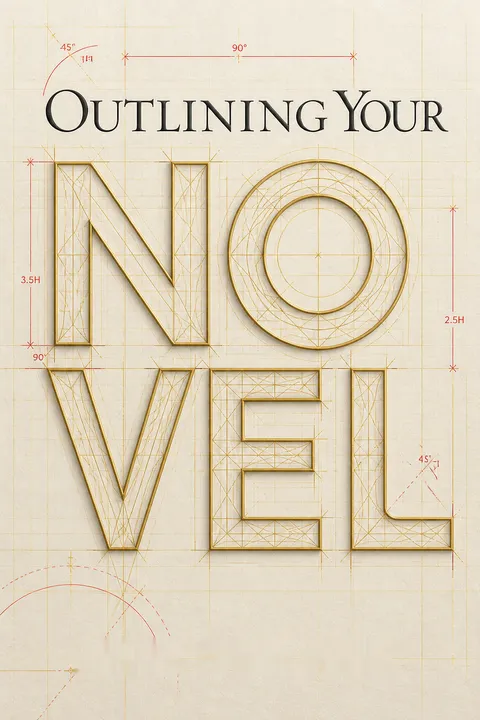
Outlining Your Novel treats planning as a way to move discovery into a cheaper, more revisable stage. Its central move is not to prescribe a single rigid format, but to break novel-making into different kinds of thought: generate raw possibilities, test character and plot logic, order scenes, then condense the result into a drafting guide. The companion workbook makes that process concrete through questions and exercises, from the premise sentence to scene checks and setting maps. This gives the book unusual practical value: it does not merely praise preparation, it supplies repeatable prompts for doing it.
The strongest underlying idea is that structure can protect imaginative work rather than oppose it. A writer who has tested the large-scale logic may have more attention available for voice, description, and emotion while drafting. The book's examples make this case vivid, particularly the contrast between Weiland's wandering early pages and the later outline that clarified their direction. Still, the evidence is chiefly craft experience and testimony from working writers, not a controlled demonstration that outlining improves every novel or saves every writer time. The book acknowledges variation, and that qualification is essential.
Its most useful tension is between a map and a script. Extensive planning can expose weak causality, thin motives, timeline errors, and scenes that contribute little. It can also tempt a writer to defend a plan simply because it took months to make. A strong process therefore needs a revision rule: when drafting reveals a better route, update the map. The exercises also tend toward legible goals, arcs, and causal structure. That is a strong fit for many plot-driven stories, but a less natural fit for fiction organized around ambiguity, voice, or associative form. The best use of the method is selective. Borrow the questions that expose uncertainty, ignore procedures that add friction, and keep the outline subordinate to the story it is meant to serve.
Review Summary
Outlining Your Novel receives mostly positive reviews for its practical advice on novel planning. Many readers found it helpful for organizing their writing process, though some felt it was too detailed. The book is praised for its clear explanations, examples, and tools for character and plot development. Some reviewers noted it changed their perspective on outlining, while others felt it was more suited for certain genres. Overall, it's recommended for writers seeking to improve their novel structuring skills.
People Also Read



Glossary
Premise sentence
Story idea in briefA compact statement that identifies the protagonist, central conflict, and basic direction of a story. It develops an initial concept or what-if question into a testable story idea. The premise can guide outlining and help reveal whether the concept has enough conflict and possibility to sustain a novel. It may be revised as the story develops.
General Sketches
Exploratory story notesWeiland's name for an early, open-ended stage of outlining. The writer records known scenes, plot possibilities, character ideas, and unresolved questions without yet constructing a detailed scene-by-scene plan. Its purpose is to reveal gaps and generate connections, while allowing incomplete or unlikely ideas to remain available for further exploration.
Extended Outline
Detailed scene planA developed account of a novel's scenes and their sequence, written without the full dialogue and narrative prose of a draft. It lets the writer test motivations, cause and effect, pacing, foreshadowing, and plot plausibility before committing to a manuscript. It can include exploratory notes and alternatives while the story's structure is being worked out.
Abbreviated Outline
Condensed drafting guideA shorter, organized version of the extended outline, containing the decisions and scene information needed during drafting. It removes much of the exploratory discussion and repetition, making the plot easier to scan and details easier to find. Writers can use it as a reference while drafting, then revise it when the story changes.
Inciting event
Plot-changing disruptionThe event that disrupts the protagonist's existing situation and begins a consequential chain of change. It should affect the story that follows and create a reason for conflict, but it may occur before the protagonist directly engages with the central problem. The writer can use it as a starting point for tracing what in the character's past shaped their response.
Key event
Protagonist enters conflictThe event that brings the protagonist personally into the plot's central conflict. It may follow the inciting event rather than coincide with it. In a detective story, for example, the crime can begin the chain of events, while the detective's choice to take the case makes the conflict personally active.
Character interview
Character discovery questionsA set of prompts used to explore a character's background, relationships, beliefs, appearance, habits, fears, and goals. The writer answers to uncover motivations, generate story possibilities, and keep details consistent during drafting. Weiland also describes a freehand version, in which the writer questions a character conversationally instead of following a fixed list.
Reverse outlining
Plan backward from an eventA way of developing a plot sequence by starting with a known later event and asking what must plausibly happen immediately before it, then continuing backward. It is useful when a writer knows a scene's outcome but cannot find a convincing route to it. Once the causal chain is clear, the writer can plan the scenes in forward order.
FAQ
What's "Outlining Your Novel: Map Your Way to Success" about?
- Purpose of the book: "Outlining Your Novel: Map Your Way to Success" by K.M. Weiland is a guide for writers to understand and implement the outlining process in their novel writing.
- Focus on outlining: It emphasizes the importance of outlining as a tool to organize thoughts, structure stories, and enhance creativity.
- Comprehensive approach: The book covers various aspects of outlining, including choosing the right type of outline, brainstorming plot ideas, discovering characters, and structuring scenes.
- Interviews and insights: It includes interviews with ten respected authors, providing diverse perspectives on the outlining process.
Why should I read "Outlining Your Novel: Map Your Way to Success"?
- Enhance writing skills: The book offers practical advice and techniques to improve your writing process through effective outlining.
- Organize your story: It helps writers organize their thoughts and ideas, making the writing process more efficient and less overwhelming.
- Learn from experts: With insights from successful authors, readers gain valuable perspectives on how outlining can transform their writing.
- Boost creativity: The book dispels misconceptions about outlining, showing how it can actually enhance creativity rather than stifle it.
What are the key takeaways of "Outlining Your Novel: Map Your Way to Success"?
- Outlining benefits: Outlining helps writers create a cohesive story structure, prevent plot holes, and maintain consistent character development.
- Types of outlines: The book discusses different outlining methods, allowing writers to choose the one that best suits their style and needs.
- Character and plot development: It emphasizes the importance of understanding characters' backstories and motivations to drive the plot forward.
- Flexibility in outlining: Outlining is presented as a flexible tool that can be adapted and changed as the story evolves.
How does K.M. Weiland suggest choosing the right type of outline?
- Personal preference: Weiland suggests that the right type of outline depends on the writer's personality, lifestyle, and writing preferences.
- Trial and error: She encourages writers to experiment with different methods to find what works best for them.
- Visual learners: For those who are visual learners, she recommends using tools like colored note cards or mind maps.
- Comprehensive method: For writers ready to dive deep, she offers a detailed step-by-step process for creating an extensive outline.
What is the "what if" question in "Outlining Your Novel"?
- Story inspiration: The "what if" question is a tool to spark creativity and generate story ideas by posing hypothetical scenarios.
- Exploration of possibilities: Writers are encouraged to ask "what if" questions to explore different plot directions and character developments.
- Uncovering unique angles: This method helps writers uncover unique angles and unexpected twists in their stories.
- Foundation for premise: The "what if" question often serves as the foundation for crafting a strong premise sentence.
How does K.M. Weiland define a premise sentence?
- Concise summary: A premise sentence is a concise summary that conveys the characters, plot, and theme of the story in one or two sentences.
- Focus and direction: It provides focus and direction for the story, helping writers stay on track during the outlining and writing process.
- Key elements: The premise sentence should include the protagonist, their objective, the main conflict, and the stakes involved.
- Guiding tool: It acts as a guiding tool for writers to ensure their story remains cohesive and engaging.
What are the misconceptions about outlining according to K.M. Weiland?
- Formal formatting: One misconception is that outlines require formal formatting, like those learned in school, which can stifle creativity.
- Limiting creativity: Some writers believe outlining limits creativity, but Weiland argues it actually enhances it by providing a framework.
- Robbing discovery: Another misconception is that outlining robs the joy of discovery, but it simply shifts the discovery phase to the outline.
- Time-consuming: Outlining is seen as time-consuming, but it ultimately saves time by preventing extensive rewrites and plot holes.
How does K.M. Weiland suggest using character interviews?
- In-depth exploration: Character interviews are used to explore characters' backgrounds, motivations, and personalities in depth.
- Comprehensive questions: Weiland provides a comprehensive list of questions to help writers understand their characters fully.
- Character development: This process aids in developing well-rounded, believable characters that drive the story forward.
- Fact-checking tool: Character interviews serve as a reference for fact-checking details during the writing process.
What is the role of backstory in "Outlining Your Novel"?
- Foundation for characters: Backstory provides the foundation for understanding characters' motivations and actions in the story.
- Influence on plot: It influences the plot by explaining characters' past experiences and how they shape their present decisions.
- Balance in storytelling: Weiland emphasizes the importance of balancing backstory with the main narrative to maintain pacing and interest.
- Strategic revelation: She advises revealing backstory strategically, using it to enhance character development and plot progression.
How does K.M. Weiland address the concept of theme in outlining?
- Integral to story: Theme is presented as an integral part of the story that should naturally emerge from character actions and plot.
- Character-driven: The theme is often driven by the protagonist's internal conflict and character arc.
- Subtlety over preaching: Weiland advises against overtly preaching the theme, instead allowing it to unfold subtly through the narrative.
- Symbolism and subtext: She suggests using symbolism and subtext to reinforce the theme without being heavy-handed.
What are some unconventional outlining methods mentioned by K.M. Weiland?
- Mind maps: Mind maps help writers visualize story elements and explore connections between them.
- Pictorial outlines: Collecting images related to the story can inspire settings, characters, and plot points.
- Maps for world-building: Drawing maps of fictional worlds aids in creating realistic and immersive settings.
- Perfect review: Writing a "perfect review" of the story helps writers focus on their goals and the story's strengths.
What are the best quotes from "Outlining Your Novel" and what do they mean?
- "Outlining has transformed my own writing process from hit-and-miss creativity to a reliable process of story craft." This quote highlights how outlining can bring consistency and reliability to the writing process.
- "The outline is the tool of the responsible author who understands that story is as much about structure as it is about inspiration." It emphasizes the balance between creativity and structure in successful storytelling.
- "A good outline should be a spur for creativity, not a stumbling block." Weiland dispels the myth that outlining limits creativity, instead presenting it as a tool to enhance it.
- "Stories are about balance." This quote underscores the importance of balancing various story elements, such as conflict, character development, and theme, to create a compelling narrative.
Helping Writers Become Authors Series
About the Author
Download PDF
Download EPUB
.epub digital book format is ideal for reading ebooks on phones, tablets, and e-readers.








