

Key Takeaways
Give readers a safe rehearsal for dangers they cannot safely practice.
Story as rehearsal. The book opens with an imagined village boy facing a tiger that threatens his people. Before the hunt, he has heard the village’s story of a boy confronting the same danger. The tale gives him a pattern for action when fear makes clear thinking difficult. The point is not that stories replace real experience, but that they let readers feel a character’s danger without suffering its real-world consequences.
Different dangers, same engine. A romance, for example, can put a relationship at risk rather than a life. The kind of threat changes, but the reader still shares the pressure from inside someone else’s experience. For the writer, the practical aim is to make each scene emotionally involving, not merely informative.
What's useful here is the distinction between describing danger and staging an experience of it. A reader can understand that a character is frightened without feeling the scene's pressure; access to the character's perceptions and choices creates a closer form of engagement. The tiger parable makes that idea memorable, though it should be read as an illustration, not proof that storytelling evolved for survival. The craft principle stands without the evolutionary claim: emotional involvement is something a scene must actively create.
Give every scene a want, an obstacle, and a visible exit.
A small crucible. A Crucible is whatever keeps a character from getting what they urgently want. The book distinguishes the Story Crucible, which pressures the lead across the novel, from a Scene Crucible, which traps one character in a specific situation for one scene. For Michael Corleone at the hospital, the immediate danger is that his unguarded father may be killed before help arrives.
Keep the scene present. Give readers enough setting, history, and rules to understand the current problem, but resist explaining the entire world before it matters. Each scene should change the situation: Michael gets his father moved, but now must face the danger outside. The larger story emerges through these local pressures, rather than through a block of background that asks readers to wait for the action.
The scene-level problem is a powerful compression device. It makes exposition answer a live question: why is this detail relevant to what the character must do now? That is close to the logic of information design, where context is most useful at the moment it changes a decision. The rule also guards against static scenes that exist only to explain. Its limit is that some fiction deliberately uses atmosphere or reflection as an event in itself. Those passages still need purpose, but their purpose need not always look like an external obstacle.
Put the reader with whoever has the most at stake.
Choose the emotional anchor. The point-of-view, or POV, character is the person through whom readers experience a scene. A useful test is to ask who has the most to lose. In a bank robbery, that might be the robber, a security guard near retirement, or a teenage hostage. Each choice makes the same event feel different because readers inherit different fears and hopes.
Control the camera. The book surveys first-, second-, and third-person narration, third-person objective, head-hopping, and omniscient narration. It also distinguishes past, present, and future tense. These are not interchangeable decorations: each controls what readers can know and how close they feel. Head-hopping can expose multiple characters’ emotions, but frequent shifts may disorient readers. Choose a viewpoint and tense deliberately for the scene’s intended experience.
Point of view is both a technical choice and an ethical one: it determines whose experience receives attention, whose motives remain hidden, and whom readers are invited to understand. The most-at-stake test is an efficient default because it usually locates strong emotional material. It is not a universal law, however. A writer may choose a less endangered observer to create irony, distance, or suspense. The key is consistency of effect: readers should understand why this particular consciousness is the best route into the scene.
State a scene-sized goal before the reader loses the thread.
Make success legible. A Proactive Scene follows a character trying to accomplish something specific. The goal should fit the scene’s time, be possible for this character, and still be difficult. It should also connect to the character’s Values, Ambition, and Story Goal: the beliefs they prioritize, the broad life outcome they desire, and the concrete result they pursue in the novel.
Use a testable target. Katniss, trapped in a tree above armed opponents, decides to drop a dangerous nest onto them. The task is immediate, risky, and physically achievable with the tools she has. Readers can tell what success would look like. Establishing this goal early gives the scene direction; if it takes several paragraphs to identify what the character is trying to do, consider moving that information forward.
A concrete goal gives readers a working hypothesis: they know what outcome to watch for, so each obstacle can revise their expectations. This is a basic engine of suspense, and it makes scene pacing easier to diagnose. The connection to a character’s larger values keeps the goal from feeling arbitrary. Still, goals do not always need to be announced explicitly. Michael’s intention to delay the killers is inferred from his actions. Clarity matters more than a formal statement, and inference can itself be part of the pleasure.
Make every attempt collide with resistance, then raise the pressure.
Build through friction. In a Proactive Scene, the character tries something that might achieve the goal, meets resistance, and tries again. Obstacles can come from the environment, another person, or the character’s own competing beliefs. Each round should make the task harder, reveal new information, or force a change in tactics. When the obstacles are exhausted and tension has reached its useful limit, the scene is ready to end.
Match the genre. Katniss struggles to cut a branch holding the dangerous nest while her hands are injured and her enemies wait below. Michael tries to hold off armed attackers without a weapon, only to be confronted by police. The pressure in these scenes comes from successive complications, not simply from a character repeating the same effort. The appropriate intensity depends on the kind of story and the experience its readers expect.
The repeated attempt-and-resistance pattern turns a static problem into a sequence of consequential choices. It also gives the writer a practical revision question: does each obstacle alter the character’s options, or is it merely another delay? Escalation need not mean louder danger every time. A new complication can narrow choices, expose a weakness, or increase the cost of success. The framework is especially useful for suspense and action, though quieter fiction may generate pressure through social discomfort or uncertainty rather than physical peril.
Let most scene victories carry a cost that keeps the story open.
End with a turn. The book recommends that many Proactive Scenes finish with a setback for the novel’s protagonist, even when the scene’s POV character is someone else. The result is measured by how it affects the protagonist’s aims, not simply by whether the POV character wins. A setback creates an unresolved question that encourages the reader to continue. The book connects this pull to the Zeigarnik effect, a term for the heightened attention people may give to unfinished tasks.
Complicate the win. Katniss escapes danger and gains weapons, but she is injured, disoriented, and troubled by leaving Peeta behind. Her success carries new costs. A clean victory can be satisfying, but repeated easy resolutions may release the tension too soon. A mixed outcome preserves the pleasure of progress while creating a reason to keep reading.
The emphasis on unresolved consequences explains why a successful scene can still feel dramatically incomplete. In cognitive terms, readers are tracking questions about what a character will do and what a choice will cost. The named Zeigarnik effect offers a useful analogy, but it is not a guarantee that every open question compels attention. Readers can also experience too many unresolved threads as frustration. The more reliable craft lesson is to close the immediate scene problem while leaving a meaningful consequence or decision unsettled.
After a setback, show the feeling before asking for a plan.
Let the blow register. A Reactive Scene follows a major setback. It begins with the character’s emotional response, then gives space to consider what to do, and ends when the character commits to a choice. The reaction should fit the character’s temperament and the severity of the loss. A brief shock may need only a few lines; a near-fatal injury can justify a longer recovery.
Do not overstay. After Katniss is stung and blacks out, she wakes in pain, slowly regains her strength, and begins to see a path forward. Michael’s response to a broken face is shorter, but his controlled anger reveals his character. Reactive scenes can also be summarized or skipped when the next move is obvious. The writer should know the character’s response and decision even when the reader sees only a compressed version.
This structure recognizes that a decision after trauma is not simply a chess move. Emotion shapes what options seem possible, and skipping the response can make a character appear implausibly untouched. At the same time, the book’s warning against dwelling is important: emotional intensity can become repetitive if it does not change the character’s understanding or behavior. The strongest reaction is therefore not necessarily the longest one. It is the one that makes the setback’s personal meaning visible and prepares the next choice.
Make the final choice reveal a character's deepest priority.
Make the options costly. In a Reactive Scene, the character weighs possible plans, usually finding that every route has a serious drawback. A dilemma can be reasoned through directly, worked out with another character’s help, or explored indirectly while the character performs ordinary tasks. What matters is that the choice grows from the character’s situation and gives the reader a clearer view of their priorities.
Commit to a direction. In The Godfather, Michael considers the danger of killing a rival and a corrupt police captain, then volunteers for the job because he believes his family cannot survive otherwise. The choice exposes a conflict between his law-abiding life and loyalty to his family. A strong decision is risky, acknowledged as risky, and specific enough to launch the next scene. It should reduce the opponent’s options, much like a forcing move in chess.
Dilemmas are character tests disguised as planning sessions. Under pressure, a person’s competing values stop being abstract and become a ranking: which principle survives when preserving both is impossible? This is why a decision can be narratively compelling even when readers reject its morality. The story asks for comprehension, not endorsement. One caution is that a character’s stated reasoning may be self-serving or incomplete. That gap between what someone claims to value and what their actions reveal can add complexity, provided the choice remains understandable.
Judge scenes by what they do, not by the labor they cost.
Triage the draft. When revising, label each scene Yes, No, or Maybe. Keep scenes that work as complete emotional units and have a clear Scene Crucible. Remove scenes that no longer fit the story or cannot be made into stories. Redesign the uncertain ones: decide whether each should show a character pursuing a goal or recovering and choosing after a setback, then specify the scene’s central pressure and intended emotional effect.
Save the useful pieces. Ingermanson and his coauthor found that a planned rescue rendezvous in their science-fiction novel Oxygen would solve the crew’s survival crisis too early, leaving too much story without enough conflict. They changed the scene so the rendezvous failed. That setback forced them to invent a riskier path forward. They kept the valuable story material, but changed the scene’s function.
Triage separates attachment to a draft from judgment about its role. This resembles iterative design: test the current version against its purpose, preserve what works, and rebuild what does not. The Oxygen example is especially instructive because a technically clever solution can be structurally damaging if it removes the central problem before the story is ready. Yet a setback should not be inserted mechanically just to prolong a book. The revised crisis must follow plausibly from the world and deepen the story, rather than merely delaying its resolution.
Analysis
Ingermanson’s central contribution is a practical unit of narrative design: treat the scene not as a stretch of prose, but as a small system of desire, pressure, and change. The distinction between a character’s immediate objective and the larger novel-level predicament helps writers locate why a passage feels inert. The paired movement from action to response also supplies a useful rhythm. A protagonist cannot press forward constantly without becoming emotionally weightless, and cannot reflect indefinitely without exhausting momentum.
The method is strongest as a diagnostic tool. A writer can ask who anchors the scene, what that person wants, what blocks the goal, and what changes by the end. The guidance about scene goals and setbacks can clarify pacing, while the revision triage converts vague dissatisfaction into decisions about keeping, cutting, or redesigning. The examples from The Hunger Games, Outlander, and The Godfather show that the pattern can accommodate physical danger, romantic conflict, and moral corruption.
Its main limitation is that the claim that every scene must be a miniature story is more prescriptive than the range of fiction warrants. Some novels create value through atmosphere, voice, contemplation, or deliberate stasis. Such passages need not be discarded, but they do need an intelligible artistic function and a reason for their placement. The framework works best when its labels are treated as questions, not laws.
The book’s language of emotional muscle memory is persuasive as a metaphor for narrative simulation, but it should not be mistaken for established evidence that fiction reliably trains readers for real crises. Its more defensible craft insight is that embodied access to a character’s perceptions and choices can make invented events feel consequential. Writers can use the method to create that experience, while still allowing form, genre, and the demands of a particular story to determine how tightly each scene follows the pattern.
Review Summary
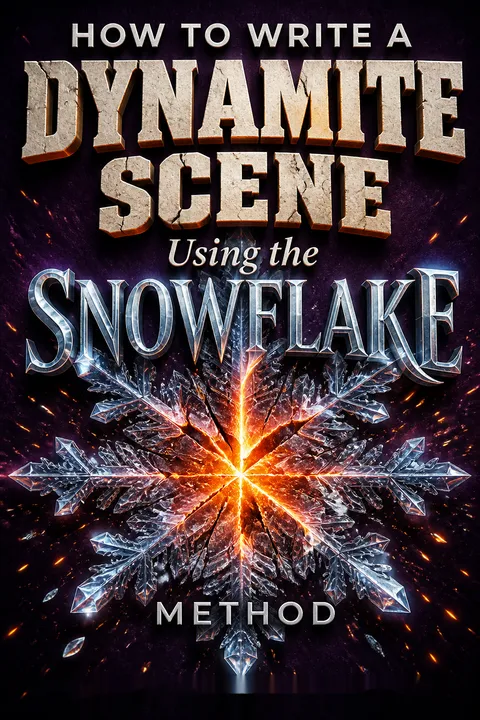
How to Write a Dynamite Scene Using the Snowflake Method receives an overall 4.32/5 rating. Readers praise Ingermanson's clear breakdown of proactive and reactive scene structure, noting the book's accessibility and practical examples from well-known novels like The Hunger Games, Outlander, and The Godfather. However, several reviewers find the title misleading, as the book doesn't extensively apply the Snowflake Method to scenes but rather teaches standard scene-writing techniques. Some felt it offered little new information beyond what's available in other writing books or online resources, while beginners found it invaluable for understanding scene fundamentals and emotional impact.
People Also Read





Glossary
Snowflake Method
stepwise novel designA ten-step process for planning a novel before drafting it. Each step develops the story in greater detail, helping the writer decide what creative task comes next. In this book, designing individual scenes is identified as one step within the larger method, though writers are not required to use every step.
Story Crucible
novel-wide pressureThe combined conditions that prevent the lead character from getting what they want across the full story. It may include the story world, other characters, past events, and the protagonist’s own limitations. Readers learn its full shape gradually, as individual scenes reveal the parts that matter to the immediate action.
Scene Crucible
scene-specific pressureThe immediate set of dangers, obstacles, or constraints that keeps a scene’s POV character from reaching a goal or moving forward. It may come from the setting, another character, or the POV character’s inner conflict. The scene ends when this particular pressure changes or breaks, though the larger story problem remains.
Proactive Scene
goal-driven sceneA scene in which the POV character pursues a specific, achievable goal while meeting resistance. The character’s attempts form the central action, and the scene ends in either a win or a loss. The book recommends that many such scenes end with a setback for the novel’s protagonist, creating consequences that carry into what follows.
Reactive Scene
response-and-choice sceneA scene centered on a character’s response to a major setback. The character first experiences the emotional consequences, then considers difficult options, and finally commits to a course of action. The decision supplies a goal for future action. Writers may present this process fully, summarize it, or omit it when the next move is clear.
Interior Emotion
physicalized emotional responseA technique for showing a character’s feelings through bodily sensations, expressions, and actions rather than merely naming an emotion. Shaking hands, a clenched jaw, or a physical response to pain can help readers experience the emotion from within the character’s viewpoint. The specific expression should suit the character and the severity of the event.
Zeigarnik effect
attention to unfinished tasksA psychological effect named for Bluma Zeigarnik, which the book describes as heightened attention to incomplete tasks compared with completed ones. Ingermanson applies it to scene endings: an unresolved consequence or question can encourage readers to continue. It is presented as an explanation for the appeal of an open narrative thread, not as a guarantee that every unresolved question will hold attention.
Values
ranked personal prioritiesIn the book’s scene-design vocabulary, Values are a character’s deeply held priorities, expressible as what matters more than anything else. A character may hold several Values that conflict. Scenes become revealing when pressure forces the character to act in a way that shows which priority takes precedence.
Ambition
broad life aspirationA character’s abstract desired outcome in life, such as a general vision of peace or success. Unlike a concrete scene goal, an Ambition can mean different things to different people and cannot necessarily be observed directly. It helps explain why a character pursues particular goals in the story.
Story Goal
concrete novel objectiveThe specific, observable outcome a character pursues in the larger story, based on what they believe will fulfill their broader Ambition. It should be concrete enough that a reader could tell whether it has been achieved. Individual scene goals can function as steps toward this larger objective.
emotional muscle memory
remembered emotional rehearsalIngermanson’s metaphor for the lasting familiarity readers gain by experiencing a character’s fear, effort, and choice through a story. Fiction gives readers an emotionally vivid rehearsal of situations they may never face directly. The term describes the book’s theory of storytelling, rather than a literal claim that reading guarantees real-world performance.
About the Author
Other books by Randy Ingermanson
Download PDF
Download EPUB
.epub digital book format is ideal for reading ebooks on phones, tablets, and e-readers.








