

Key Takeaways
Treat creativity as a condition you can build, not a talent you either have.
Creativity is learnable. Cleese first encountered his own creative ability at Cambridge, where he joined the Footlights, a student performance club, for the company. Its friendly, low-pressure shows gave him room to try writing sketches. The surprise was not that he had discovered a hidden artistic identity, but that his own ideas could make people laugh. Earlier, his schooling in science and law had offered little encouragement to think creatively.
Build the setting. Cleese defines creativity broadly as finding new ways to think or do things, in fields from science to sport. His claim is not that everyone will produce the same work, but that people can learn to create conditions that make original thinking more likely. A welcoming group, time to experiment, and permission to try are part of the method, not merely pleasant extras.
The Footlights story makes creativity less mysterious by locating it in a social environment, not a rare personal essence. This connects with research on psychological safety: people tend to take more intellectual risks when mistakes do not invite humiliation. The implication is practical for classrooms and workplaces. Leaders can expand creative participation by changing the cost of trying, rather than waiting to identify a few supposedly gifted people. Still, access to a safe setting cannot substitute for craft, resources, or domain knowledge. The useful claim is modest but important: talent may vary, yet the conditions that let it show are often designable.
Use slow, playful thinking when the problem has no clear instructions.
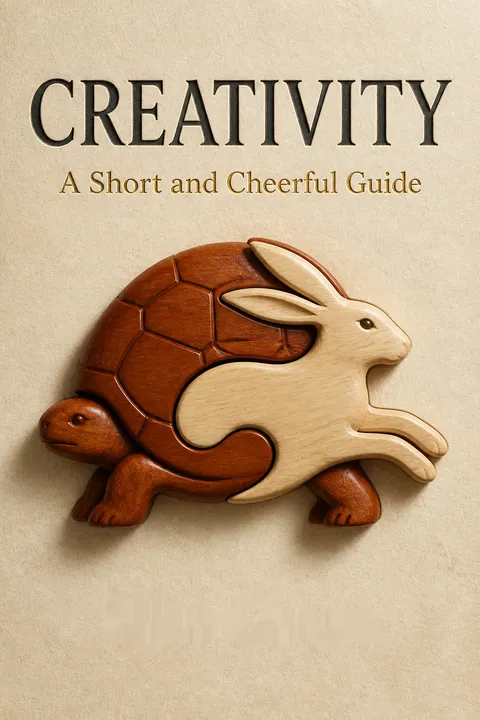
Two modes, two jobs. Drawing on psychologist Guy Claxton, Cleese distinguishes Hare Brain, quick, deliberate reasoning used to solve defined problems, from Tortoise Mind, slower, less directed thought suited to ambiguity. A mechanic tracing a fault has a clear question; someone exploring an unfamiliar design may not yet know which questions matter. For the second task, sustained analysis can be premature because it forces uncertain material into familiar categories.
Choose the mode to fit. Tortoise Mind is not laziness or a rejection of logic. It lets possibilities surface before they are judged. Hare Brain remains essential for checking evidence and practical constraints. The mistake is treating fast, verbal reasoning as the only respectable form of intelligence, especially when the problem itself is still taking shape.
This distinction resembles the difference between divergent thinking, generating possibilities, and convergent thinking, selecting among them. Those are complementary operations, not competing theories of intelligence. The distinction is useful because many institutions reward visible analysis while treating wandering thought as wasted time. Yet slow thinking is not automatically insightful; it can become rumination. A productive pause stays connected to a question, even when the route is loose. The reader can ask a simple diagnostic: is the task well specified enough to calculate, or does it first require discovering what the task is?
Play first, and postpone decisions until reality demands an answer.
Curiosity beats premature closure. Psychologist Donald MacKinnon compared architects regarded by colleagues as creative with less creative peers. In Cleese's account, two differences stood out: the creative architects knew how to play, and they delayed decisions when possible. Play meant becoming absorbed in exploring a puzzle, rather than treating it only as an obstacle to clear. It allowed ideas to develop without demanding an immediate verdict.
Wait for useful information. Delay is not indecision when a real deadline exists. Until that deadline, new facts or better ideas may arrive. People often decide early because uncertainty feels uncomfortable, then mistake relief for good judgment. The practical move is to identify when a decision truly must be made, and leave it open until then, provided delay does not create avoidable harm.
The architects' behavior points to a broader decision-making advantage: preserving options has value when information is still arriving. In organizations, early commitment can create escalation, where teams defend a choice partly because they have already invested in it. A deliberate pause can lower that pressure and make revision less costly. The boundary matters, however. A reversible design choice can often wait; a safety-critical decision may not. The point is not to postpone everything, but to distinguish deadline-driven action from anxiety-driven closure. Play helps because it keeps exploration active while the decision remains unresolved.
Guard uninterrupted time so faint ideas can become audible.
Make room to wander. Cleese argues that interruptions disrupt the mental state needed for playful thought. He cites research suggesting that returning to a previous state of focus can take around eight minutes, and regaining deep concentration can take as long as twenty. Distractions can be external, such as a message, or internal, such as remembering an errand or fearing failure.
Protect space and time. Set aside a defined period, perhaps ninety minutes, in a place where interruptions are unlikely. When stray obligations pop up, write them down rather than chasing them. A short note naming the problem being explored can also help bring attention back after it drifts. The first session may feel mentally noisy. Cleese treats this as normal: the quiet needed for creative work often arrives only after the mind has had time to settle.
This advice anticipates the modern problem of attention residue: after switching tasks, some mental effort remains attached to the previous one. Protected time is therefore not simply a productivity preference; it can preserve the continuity that complex thought requires. The note-taking tactic also externalizes reminders, reducing the need to rehearse them mentally. The cited recovery times should not be treated as a universal stopwatch. People and tasks differ, and a brief interruption is not always costly. The robust principle is to reduce avoidable switching during work that depends on connecting ideas over time.
Read feelings and images as clues from thought you cannot verbalize.
The mind speaks indirectly. Cleese uses unconscious to mean ordinary mental work outside awareness, not a hidden store of troubling impulses. In one experiment he recounts, people could not reliably identify unfamiliar Chinese characters they had seen before, yet preferred those previously shown. Their minds appeared to register familiarity as a feeling rather than a clear memory.
Notice, then investigate. Cleese also describes chemist August Kekule imagining a snake-like shape that suggested a ring, helping him conceive benzene's structure. Such stories illustrate how images, moods, and associations can prompt ideas before they can be explained. They do not make every hunch correct. Treat an odd image or sense of attraction as a lead: give it attention, clarify what it might mean, and test it against the problem.
The example of unrecognized familiarity captures a real feature of cognition: people can respond to information without being able to report how they know it. That makes intuition useful as a signal, especially when expertise has supplied rich patterns for the mind to detect. But a signal is not a verdict. Feelings can reflect bias, fatigue, or recent exposure as easily as insight. The strongest use of intuition is therefore provisional: let it suggest where to look, then bring evidence and explicit reasoning to bear. This preserves the generative value of unconscious processing without turning it into an oracle.
Separate invention from evaluation, then cycle between them.
Do not judge too soon. Early ideas are often vague and fragile. If analytical criticism arrives before an idea has taken shape, it can reject possibilities simply because they are unfamiliar. Cleese recommends first allowing a creative period, then using deliberate analysis to identify what works, what fails, and what needs clarification.
Revise in both modes. After evaluation, return to imaginative exploration to improve the promising parts. Cleese calls this back-and-forth iteration. His screenplay for A Fish Called Wanda went through thirteen drafts, with each pass combining fresh invention and practical correction. A new idea may prove poor, useful, or partly both. The aim is not to protect the first version, but to let it become clear enough to assess and flexible enough to change.
The sequence offers a useful defense against two opposite errors: criticism that kills an idea before it develops, and enthusiasm that mistakes novelty for quality. Many creative processes benefit from separating generation and selection, even if the separation is temporary rather than absolute. In practice, a team can make this explicit by first collecting possibilities without ranking them, then evaluating them against stated criteria. The framework should not become rigid ritual. Some discoveries require rapid testing, and evaluation can itself inspire new options. Its deeper value is permission to use different kinds of thought at different moments.
Start while anxious, and treat blank stretches as work in progress.
Begin before confidence arrives. Cleese describes feeling fear when facing a difficult writing problem. His response is to start with low-stakes notes, without expecting them to be good. This turns anxiety into motion and gives the mind material to work on. He also notes that mood shapes thought: worry narrows attention, while a more open frame makes play easier. A walk or a pause may help after an initial effort.
Expect uneven output. Cleese and Graham Chapman once worried over unproductive mornings, then noticed that their weekly output remained fairly steady at about fifteen to eighteen good minutes of comedy. They learned not to treat every slow spell as evidence of failure. A blocked period may be part of the process, rather than a reason to abandon it or attack oneself.
Starting with disposable work resembles exposure: approaching a feared task in a small, manageable way can reduce avoidance without requiring confidence first. The account of uneven output also challenges the assumption that visible progress should be constant. Creative work often has a delayed feedback loop, so judging a session only by what it produces can reward shallow, easy tasks over difficult exploration. Still, not every stall is secretly productive. A useful distinction is whether the person remains engaged with the problem, even loosely, or has stopped and needs a different strategy, clearer constraints, or rest.
Borrow a spark, then transform it through your own play.
Influence is a starting point. For beginners who cannot yet generate a strong idea, Cleese suggests taking inspiration from work they genuinely admire. Working with that idea can build skill and reveal personal interests. The boundary is transformation: copying someone else's finished choices teaches imitation, not original creation.
Make the material yours. Cleese points to Shakespeare as an example of a writer who drew on existing plots and reshaped them into distinctive work. The lesson is not that all borrowing is harmless, but that originality often grows through engagement with prior work. A beginner can borrow a premise, structure, or technique, then alter it through practice, knowledge, and individual judgment until the result has its own direction.
Creativity is rarely creation from nothing. In fields from music to science, new work often emerges through recombination: familiar elements are placed in a new relationship or adapted to a new problem. This makes influence a legitimate learning tool, while also making attribution and transformation important. The reader can ask what is being learned from a model: a technique, a structure, or merely its surface. Copying can be a useful exercise when its purpose is study, but public work needs a clearer account of what has been changed and why.
Keep learning without letting expertise sand away your beginner's eye.
Knowledge can both help and narrow. Creative work in science, architecture, and medicine depends on years of learning; originality needs material to work with. Yet familiarity can also make people repeat established patterns. Cleese describes a recurring arc in some artists: early freshness, a mature period of strong work, and then a decline in novelty as familiar insights take over. He invokes Beginner's Mind, a Buddhist idea about meeting experience without letting familiarity dull attention.
Keep the mind playful. Cleese credits people such as physicist Richard Feynman and mathematician John Conway with maintaining freshness through play. Feynman played drums; Conway enjoyed games. These activities were not substitutes for expertise. They offered a way to remain curious and less bound by the habits that mastery can create.
The tension between expertise and freshness is productive rather than contradictory. Expertise supplies patterns that make subtle recognition possible, while excessive confidence can cause those patterns to become rigid templates. Play may help by moving attention outside the narrow routines of professional evaluation. The challenge is not to imitate a famous scientist's hobby, but to preserve activities where exploration is not immediately graded for usefulness. Beginner's Mind should also not romanticize ignorance: new eyes are valuable, but they become more powerful when paired with enough knowledge to distinguish a genuine possibility from a familiar mistake.
Ask where readers lose the thread, not whether they like it.
Seek useful reactions. Cleese recommends asking readers where they became bored, confused, unconvinced, or emotionally lost. These questions identify the point where a piece stops working for its audience. For a story, tell the outline aloud and notice when attention fades. For a speech, show an early draft to several people, then seek fresh readers for the next version.
Keep authorship of the fix. Feedback can diagnose a problem, but the writer must decide how to solve it. A reader's proposed solution may not fit the work. The same flexibility applies to favorite ideas: as a project changes, a once-beloved passage may no longer belong. Revision means judging which idea serves the strongest current version, not protecting every clever first thought.
This approach separates feedback about experience from feedback about solution. Readers are often excellent sensors of confusion or boredom, but less reliable as designers of the repair, since they see only a slice of the work. Asking for specific points of friction produces more actionable evidence than asking for a broad verdict. Multiple readers can also reveal whether a difficulty is individual or recurring. Still, feedback is not a referendum: the intended audience, the work's aims, and the writer's own judgment determine which signals deserve a change.
Make the work serve its audience, then cut what does not help.
Know what the work must do. Cleese advises writers to consider who will receive a piece, what it needs to communicate, and whether the audience is likely to resist its argument. A specialized audience may need precision; a general audience may need more explanation and momentum. Writing starts to improve when the creator can state the central point and distinguish it from supporting material.
Edit for attention. Once a draft exists, remove material that does not serve the purpose and avoid repeating points without reason. Cleese treats brevity as difficult labor, not a shortcut: a shorter piece often takes more thought because the writer must decide what matters. The aim is not minimal length for its own sake. It is to keep the reader's attention on the ideas that earn it.
Audience awareness is a form of design: the work is not complete when the creator understands it, but when the intended reader can follow and use it. This is especially important because experts often omit steps that have become automatic to them. The advice to cut also guards against confusing effort with value; a sentence can be hard-won and still be unnecessary. Yet concision has limits. Some topics require context, repetition, or deliberate pacing. The sound test is not whether every word is short, but whether each part advances understanding, evidence, or experience.
Analysis
Cleese's central contribution is not a mysterious recipe for producing brilliant ideas. It is a practical account of how to make room for ideas before asking them to prove their worth. His argument moves from the personal discovery of creativity in a welcoming student club to a repeatable sequence: protect attention, explore without premature judgment, let associations develop, then use analysis and feedback to shape the result. The strongest insight is the separation of mental tasks. People often demand certainty from a process whose first job is to discover what might be possible. Cleese gives uncertainty a role rather than treating it as a defect.
The book is also unusually democratic about creativity. It places originality in engineering and sport as well as art, and makes the conditions for creative work teachable. This shifts responsibility from innate talent toward time, environment, play, and practice. The claim should not be inflated into a promise of equal achievement: skill, opportunity, domain knowledge, and material constraints still matter. Nor is every pause productive; waiting can become avoidance. Cleese's own account supplies the needed balance by returning to evaluation, deadlines, and audiences.
Its examples are memorable because they show different kinds of evidence. The architects illustrate behavior, the Chinese-character experiment illustrates tacit recognition, Kekule illustrates imagery, and the thirteen drafts of A Fish Called Wanda illustrate revision. Anecdotes make the ideas vivid, but they do not all establish general causal rules. The book is best used as a field guide, not a laboratory manual. Its durable lesson is a disciplined openness: make a protected space for unfinished thought, then bring craft and judgment to bear without confusing either with the whole of creativity.
Review Summary
Creativity by John Cleese receives mixed reviews, with an average rating of 3.88 out of 5. Many readers appreciate the book's brevity and cheerful tone, finding it inspirational and full of practical advice on fostering creativity. Cleese's insights on tapping into the unconscious mind and the importance of play are highlighted. However, some critics feel the book lacks substance and originality, considering it overpriced for its length. Despite these critiques, many readers value Cleese's expertise and find the book a quick, enjoyable read with useful tips for aspiring creatives.
People Also Read
Glossary
Hare Brain
Fast analytical thoughtA term from Guy Claxton's account of thinking, used for quick, purposeful reasoning. Hare Brain weighs evidence, constructs arguments, and solves clearly defined problems. Cleese treats it as essential for analysis and testing, but poorly suited to generating possibilities when a problem is still ambiguous.
Tortoise Mind
Slow, exploratory thoughtA term from Guy Claxton for slower, more playful or contemplative thinking. Rather than forcing an immediate answer, Tortoise Mind allows a person to mull over an uncertain problem and notice unexpected connections. Cleese associates this mode with creativity and recommends it when the right questions or categories are not yet clear.
iteration
Repeated creative revisionCleese's term for moving back and forth between imaginative exploration and critical assessment. A creator develops possibilities, evaluates what works, revises the material, and returns to invention when needed. The process is repeated rather than treated as a single leap from inspiration to finished work.
Beginner's Mind
Fresh attention without familiarityA Buddhist phrase Cleese uses for a way of approaching experience without allowing familiarity to dull perception. In creative work, it describes the freshness that can accompany learning and experimentation. Cleese warns that expertise may encourage conventional habits, and sees play as one way to preserve curiosity while continuing to learn.
MacKinnon's architect study
Comparison of creative architectsA study described by Cleese in which psychologist Donald MacKinnon asked architects identified by peers as especially creative, and a comparison group, to describe their daily working lives. Cleese reports two distinguishing habits among the creative architects: they played with problems and delayed decisions when circumstances allowed.
unconscious
Mental work outside awarenessCleese uses unconscious to refer to ordinary mental processes that operate without deliberate awareness, such as language retrieval, practiced skills, and associations formed while attention is elsewhere. He distinguishes this usage from the idea of a hidden repository of unacceptable feelings, and argues that unconscious thought often communicates indirectly through images, feelings, or preferences.
FAQ
What's "Creativity: A Short and Cheerful Guide" by John Cleese about?
- Overview of Creativity: The book explores the concept of creativity, emphasizing that it is not limited to the arts but is present in all areas of life, including science, business, and sports.
- Debunking Myths: Cleese challenges the myth that creativity is an innate talent, arguing that anyone can be creative with the right mindset and environment.
- Educational Insights: The author reflects on his own educational experiences, noting the lack of emphasis on creativity in traditional schooling.
- Purpose of the Book: Cleese aims to teach readers how to create circumstances that foster creativity, making it accessible to everyone.
Why should I read "Creativity: A Short and Cheerful Guide"?
- Practical Advice: The book offers practical tips and insights on how to cultivate creativity in everyday life.
- Humorous Approach: Written by a renowned comedian, the book is infused with humor, making it an enjoyable read.
- Broad Applicability: The concepts discussed are applicable across various fields, not just the arts, making it relevant for a wide audience.
- Personal Anecdotes: Cleese shares personal stories and experiences, providing a relatable and engaging perspective on creativity.
What are the key takeaways of "Creativity: A Short and Cheerful Guide"?
- Creativity is Universal: Creativity is not confined to the arts; it can be applied in any field where improvement is possible.
- Teachability of Creativity: Creativity can be taught by creating the right conditions and mindset.
- Role of the Unconscious: The unconscious mind plays a significant role in the creative process, often working on problems without conscious effort.
- Importance of Play: Playfulness and the ability to defer decisions are crucial traits of creative individuals.
How does John Cleese define creativity in the book?
- New Ways of Thinking: Creativity is defined as finding new ways to think about and approach problems.
- Beyond the Arts: It extends beyond traditional artistic fields to include science, business, and sports.
- Not Innate: Cleese argues that creativity is not something one is born with but can be developed.
- Creating Conditions: The focus is on teaching people how to create conditions that foster creativity.
What is the "Hare Brain, Tortoise Mind" concept in the book?
- Two Types of Thinking: The concept distinguishes between fast, logical thinking ("Hare Brain") and slow, contemplative thinking ("Tortoise Mind").
- Suitability for Creativity: "Tortoise Mind" is more suited for creative tasks that require patience and subtlety.
- Scientific Backing: Cleese references scientific evidence supporting the effectiveness of slower, less deliberate thinking in creative processes.
- Application: Understanding and applying this concept can enhance one's ability to generate creative ideas.
What advice does John Cleese give for overcoming creative blocks?
- Accepting Setbacks: Cleese emphasizes that creative blocks are a natural part of the process and should not be seen as failures.
- Creating a Safe Space: Establishing boundaries of time and space can help minimize interruptions and foster creativity.
- Playfulness: Engaging in playful activities can stimulate creativity and help overcome blocks.
- Iterative Process: Creativity involves an iterative process of generating and refining ideas, which requires patience and persistence.
How does John Cleese suggest using the unconscious mind for creativity?
- Unconscious Problem-Solving: Cleese shares personal experiences of his unconscious mind solving problems overnight.
- Non-Verbal Communication: The unconscious communicates through images and feelings, not words, requiring interpretation.
- Creating Opportunities: By setting the stage for creativity, one can coax the unconscious to contribute ideas.
- Trusting the Process: Trusting that the unconscious is working on problems can lead to unexpected creative insights.
What role does play have in creativity according to John Cleese?
- Childlike Curiosity: Creative individuals maintain a childlike ability to play and explore without fear of mistakes.
- Absorption in Tasks: Play involves becoming deeply absorbed in a task for its own sake, not just to solve a problem.
- Freedom from Anxiety: Playfulness allows for freedom from anxiety, enabling more spontaneous and creative thinking.
- Practical Application: Cleese highlights that creative professionals often incorporate play into their work routines.
What are some practical tips from the book for fostering creativity?
- Deferring Decisions: Creative people often delay decisions to allow more time for new information and ideas to emerge.
- Avoiding Interruptions: Minimizing both internal and external interruptions is crucial for maintaining a creative mindset.
- Starting with Familiarity: Writing about what you know can be a good starting point for creative endeavors.
- Borrowing Ideas: It's acceptable to be influenced by others' ideas as a way to learn and develop one's own creativity.
What are the dangers of over-confidence in creativity as discussed in the book?
- Stifling Growth: Over-confidence can lead to a belief that there is nothing more to learn, stifling creativity.
- Falling into Patterns: Confident individuals may rely on established patterns, reducing the likelihood of creative breakthroughs.
- Importance of Feedback: Seeking feedback and being open to criticism can help counteract the effects of over-confidence.
- Continuous Learning: Maintaining a mindset of curiosity and willingness to learn is essential for sustained creativity.
What does John Cleese mean by "Kill Your Darlings"?
- Letting Go of Ideas: The phrase advises writers to let go of cherished ideas that no longer fit the evolving work.
- Adaptability: Creative works often change during development, requiring flexibility and willingness to adapt.
- Avoiding Attachment: Being overly attached to initial ideas can hinder the creative process and final outcome.
- Experienced Writers: More experienced writers are typically better at discarding ideas that don't serve the overall work.
What are the best quotes from "Creativity: A Short and Cheerful Guide" and what do they mean?
- "Creativity is not a talent. It is a way of operating." This quote emphasizes that creativity is a process that can be cultivated, not an innate ability.
- "The greatest killer of creativity is interruption." Cleese highlights the importance of uninterrupted time and space for fostering creativity.
- "You can’t have a new idea ’til you’ve got rid of an old one." This suggests that letting go of outdated ideas is necessary for new creative insights to emerge.
- "Brevity is the soul of wit." This classic advice underscores the importance of conciseness and clarity in creative expression.
Download PDF
Download EPUB
.epub digital book format is ideal for reading ebooks on phones, tablets, and e-readers.








