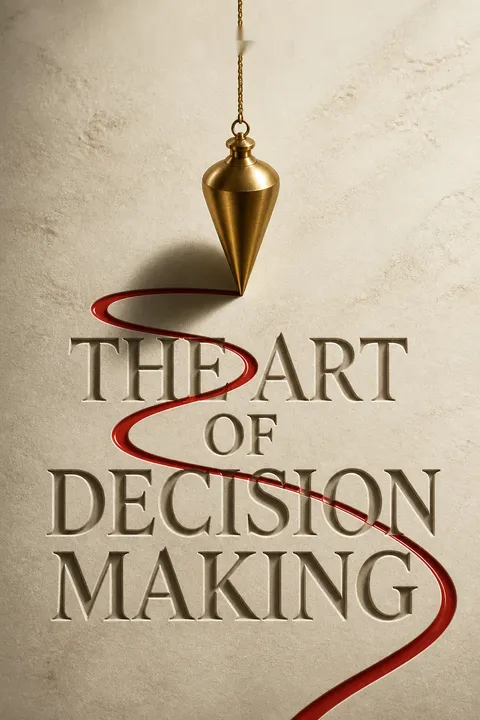


Key Takeaways
Treat hard choices as the doorway from imagined possibility into authorship.

A choice changes you. Bikart opens with Hamlet, whose familiar dilemma asks what to do, while an early printed version makes the crucial fact that someone must choose more prominent. The point is not that every decision has a perfect answer. It is that choosing means leaving some possibilities behind and entering the world of consequences. Avoiding that moment can feel protective, but it also hands influence over to habit, circumstance, or someone else.
Freedom takes practice. The book treats decision-making as a capacity that can be strengthened, not a personality trait reserved for confident people. A difficult choice can mark a transition: away from familiar comforts and toward a more conscious, self-directed life. Its discomfort may be evidence that something meaningful is at stake, not proof that the decision is wrong.
What's compelling here is the shift from treating a decision as a puzzle with a correct answer to treating it as an exercise of agency. That perspective connects choice with autonomy: people become more capable by practicing the act of choosing, not simply by waiting for certainty. Still, agency is never unlimited. Money, health, discrimination, and obligations can sharply narrow the available paths. A useful reading is therefore not that people control every outcome, but that they can often reclaim some responsibility for how they respond within real constraints.
Stop calling delay neutral: tomorrow's choice will be different.

Delay has consequences. Postponing a decision can masquerade as keeping every option open. But time changes the people, facts, and opportunities involved, so the later choice is not identical to the one available now. Procrastination may quietly select the status quo, or allow an option to expire, while preserving the comforting story that no choice has been made.
Perfection can disguise avoidance. Bikart recounts a hotel leader celebrating a 92 percent quality score. When asked what was wrong with the remaining eight percent, the leader warned that chasing perfection could bankrupt the business. The same logic applies to decisions: gathering information is useful when it can change the answer, but endless research can become a respectable-looking way to avoid commitment. Identify what information is actually missing, seek it, and set a decision date.
The distinction between productive waiting and avoidance is more useful than the blanket instruction to act quickly. In decision science, delay can have value when new information is likely to arrive and the choice is reversible. It becomes costly when information is unlikely to improve, while opportunities or attention are being consumed. A practical test is to name the specific fact that would change the decision and when it can be obtained. If no such fact exists, postponement may be emotional relief rather than better analysis.
Name the fear beneath a choice before trying to solve it.

Fear wears disguises. The book identifies fears of missing a better option, choosing badly, failing, succeeding, being defined by one's work, going unrecognized, or seeming selfish. These anxieties can pull in opposite directions: a person may dread both being noticed and being overlooked. The resulting paralysis may be less about comparing options than about what each option seems to say about the self.
Look below the surface. Bikart connects such fears to deeper worries about abandonment or being overwhelmed by others. He also draws on the concept of life traps, recurring patterns in which early experiences shape adult expectations, such as expecting rejection or feeling incapable of acting independently. These ideas invite honest self-examination, not self-diagnosis. Ask what consequence feels unbearable, and whether that consequence belongs to the present decision or to an older pattern.
This lens is valuable because it treats indecision as information. A repeated block can point toward a fear that ordinary pros-and-cons lists will never address. The caution is that childhood explanations can become overly persuasive stories: not every hesitation comes from an old wound, and not every remembered pattern is clinically significant. The strongest use of the framework is exploratory. Treat a suspected fear as a hypothesis, then test it against the present facts, the person's history, and the actual stakes.
Prepare for uncertainty without letting loss aversion run the meeting.
Loss changes the calculation. Prospect theory, developed by Daniel Kahneman and Amos Tversky, describes how people react differently to possible gains and losses. Someone may prefer a guaranteed $100 gain to a coin toss for $200 or nothing, yet gamble to avoid a certain $100 loss. The book notes that studies often find losses weigh about twice as heavily psychologically as equivalent gains. That imbalance can make a familiar situation feel safer simply because its risks are easier to picture.
Balance defense with investment. A Harvard study of almost 5,000 companies across three recessions found that roughly 9 percent outperformed peers after a downturn. The stronger strategies combined selective cost control with investment in future growth. Applied to personal choices, consider ways to reduce, transfer, accept, or avoid risk, while also planning for both good and bad outcomes.
The key contribution is not a promise that risk can be eliminated, but a reminder to examine how it is being perceived. Loss aversion helps explain why preserving the status quo can feel rational even when it carries substantial hidden costs. Contingency planning can improve judgment by turning a frightening unknown into a set of manageable scenarios. The corporate findings are suggestive rather than a personal formula: organizations and individuals face different risks, and a balanced strategy still depends on resources, values, and the consequences of being wrong.
Generate more routes before deciding which one fits your real priorities.
Begin with more than a list. Bikart argues that a decision should not start by treating the visible options as the whole world. First notice what you want, including the less articulate feelings and possibilities that a purely logical inventory may miss. Then look for alternatives beyond the apparent A-or-B choice. The example of the Camp David negotiations shows how reframing a dispute around underlying interests can reveal a workable path that the original positions concealed.
Find the self in the process. Bikart's COSARC Pyramid is a map of the different kinds of work involved in deciding, from imagining possibilities to choosing, acting, sustaining effort, and recognizing completion. Its practical lesson is diagnostic: when stuck, ask which part of the process is missing. Are there too few options, unclear priorities, hesitation to act, or difficulty letting a finished matter end?
This approach resembles a useful distinction in negotiation: positions are the demands people announce, while interests are the needs those demands attempt to protect. Reframing around interests can create options without requiring either side to abandon what matters. Internally, the same move can uncover compromises between competing needs, such as security and growth. There is a limit, however. Some choices really are mutually exclusive, and generating alternatives should not become another excuse to delay. Creativity is most useful when it expands the field, then gives way to selection.
Let intuition inform analysis, but distinguish it from impulse.
The body contributes evidence. Bikart distinguishes intuition from instinctive reaction and impulse. Intuition is a quiet, wordless judgment shaped by experience; impulse is often a response to an immediate trigger. He draws on Antonio Damasio's work on somatic markers, bodily signals that help flag options as promising or troubling. In one case Damasio describes, stimulating a brain area produced visible sadness, then a feeling of sadness, then thoughts about hopelessness, illustrating how body and thought interact.
Check the source. Intuition can compress years of experience, as when a seasoned person notices that a room's mood makes a prepared joke inappropriate. But a gut reaction can also reflect fear or bias. Give important choices room for reflection, quiet, and sleep. Use intuition as a signal to investigate, not as an unquestionable verdict or a substitute for relevant facts.
The strongest interpretation is that intuition is a form of rapid pattern recognition, especially in a domain where someone has substantial experience and receives meaningful feedback. It can be less reliable in unfamiliar situations, where confidence may outrun knowledge. This is why the distinction from impulse matters: both can feel immediate, but only one may be integrating a rich history of relevant observations. A useful practice is to ask what experience the feeling draws on and what evidence could contradict it.
Put your decision into words, then make your actions match.
Turn thought into commitment. The book traces a path from emotion, through feeling and thought, into speech and action. A decision that stays private and vague can remain an attractive possibility rather than become a real commitment. Expressing it plainly, even in a sentence written for oneself, can reveal whether the choice is clear and what it requires next. The standard is not flawless certainty, but greater consistency between what a person thinks, says, and does.
Protect the flow. Bikart draws on psychologist Mihaly Csikszentmihalyi's account of flow, a state of deep involvement that becomes more likely when a task is challenging but matched to one's skills. Excessive self-consciousness, distraction, and attempts to control what cannot be controlled can disrupt that focus. Once deliberation has done its work, identify the next action and give it attention instead of reopening the same debate by habit.
Putting a choice into words can expose contradictions that remain blurred in silent thought. It also makes a commitment communicable, which can create accountability and coordination with other people. The caution is that verbal confidence is not the same as sound judgment. A polished declaration can conceal weak evidence or social pressure. Speech is most useful when it specifies an action, a reason, and a review point, leaving room to learn without allowing every passing doubt to undo the commitment.
Borrow distance to see the choice without surrendering your judgment.
Change the viewpoint. Ignatius of Loyola advised people facing difficult decisions to step back from their preferred option, imagine advising someone else in the same situation, or picture how they might assess the choice near the end of life. These exercises create distance from immediate emotion without requiring emotion to be ignored. A simpler version is to consider how the decision may feel soon, months from now, and years later.
Reframe the real problem. At Camp David, Egyptian President Anwar Sadat sought the return of Egyptian sovereignty over Sinai, while Israeli Prime Minister Menachem Begin wanted security. Carter asked whether Sinai could return to Egypt while remaining demilitarized. The proposal addressed the interests behind each leader's position. For personal decisions, define the scope, identify the real needs, and notice which concerns are central rather than merely loud.
Distance is not objectivity in a pure form; it is a tool for changing which features of a problem are salient. Advising an imagined stranger can loosen self-protective reasoning, while a future perspective can make short-term discomfort easier to compare with long-term values. Reframing works best when it clarifies interests rather than disguising costs. Some conflicts have no clever third option, and perspective-taking should sharpen a decision, not pressure someone to accept an outcome that violates important boundaries.
Judge each decision by the thread it builds, not one outcome.
Treat choices as evidence. Ariadne's thread in Greek myth guides Theseus through the Minotaur's labyrinth and helps him find his way back. Bikart uses it as an image for the pattern connecting decisions over time. A single result can reflect luck, timing, or forces outside a person's control; repeated choices reveal more about priorities, habits, and direction. Reviewing an outcome is useful when it improves the next decision, rather than turning into punishment for not having predicted everything.
Finish, then learn. The book rejects the idea that every choice can be judged as simply right or wrong. It still calls for action, persistence, and recognition when a task is complete. A disappointing result can be feedback, but that does not make every mistake secretly beneficial. Keep what the experience teaches, repair harm where possible, and let the finished decision stop consuming attention.
The thread metaphor offers a powerful alternative to judging a life by isolated wins and losses. It is compatible with learning theory, where feedback updates future behavior rather than merely assigning blame. Yet a coherent personal story can also become a trap: people may reinterpret every outcome to confirm the identity they already prefer. A disciplined review separates what was known at the time from what became clear afterward, then asks what action or belief should change.
Analysis
The book's unusual strength is its refusal to reduce decision-making to a calculation. It treats a choice as a meeting point between desire, fear, identity, social pressure, and uncertain consequences. That makes its account richer than a checklist, especially for decisions whose difficulty comes from conflicting values rather than missing facts. Its literary and philosophical excursions keep returning to a practical question: what is the person avoiding when the options remain unresolved?
The same breadth creates a risk. Terms such as the Self, the Will, and individuation can illuminate experience, but they are not operational measures. A reader could mistake a compelling interpretation of inner conflict for evidence that it is true. The most useful method is to translate those abstractions into observable questions: Which value is at stake? What consequence is feared? What information would change the choice? What action follows from the answer?
A second tension concerns the celebration of decisiveness. Action can restore agency, but speed is not inherently wise. Decisions differ in reversibility, cost, ethical impact, and the value of waiting for evidence. A low-cost experiment can be made quickly; an irreversible choice affecting other people deserves more consultation. Decisiveness should mean ending unproductive rumination, not dismissing uncertainty or accountability.
The book is most persuasive when it holds two truths together: a person cannot control every outcome, yet can take responsibility for preparation, attention, and response. Its recurring metaphors of paths, rooms, and threads help readers notice where momentum breaks. The practical payoff is not certainty or a universal formula. It is a more honest process: broaden possibilities, identify the real conflict, choose with imperfect knowledge, act consistently, and use the result to refine the next choice without pretending that every consequence was foreseeable.
Review Summary
The Art of Decision Making receives mixed reviews. Some readers praise its insightful exploration of psychology, philosophy, and history, finding it thought-provoking and helpful for personal growth. Others criticize its complexity, lack of practical advice, and tendency to digress into tangential topics. Positive reviewers appreciate the book's depth and unique approach, while negative reviews cite its wordiness and difficulty in extracting actionable information. The book's interdisciplinary nature and intellectual content are seen as both strengths and weaknesses, depending on the reader's expectations and preferences.
People Also Read



Glossary
Decisiology
Decision-making coaching methodBikart's approach to coaching people through important decisions. It aims to improve a particular decision, strengthen a person's ability to decide independently, and identify recurring patterns behind the choices they find especially difficult. Rather than supplying universal answers, it emphasizes self-reflection and questions that uncover motives, fears, and priorities.
COSARC Pyramid
Six-part decision mapBikart's model of decision-making as a set of connected chambers: creativity, options, selection, action, resolve, and completion. It is intended to help locate where a person is stuck, such as failing to imagine alternatives, hesitating to act, or struggling to recognize that a task is finished.
life traps
Recurring self-defeating patternsA term used by psychologists Jeffrey Young and Janet Klosko for persistent patterns of thought and behavior shaped by painful early experiences. Examples discussed in the book include expecting abandonment, feeling defective, depending excessively on others, or imposing unrelenting standards on oneself. These patterns can influence adult relationships and decision-making.
fear of heights
Fear of succeedingBikart's term for anxiety about achieving a desired goal and facing the changes that success may bring. The fear is not simply of being elevated or visible. It concerns what achievement demands, whether the person can handle a new situation, and what direction remains once a long-pursued goal is reached.
somatic markers
Bodily signals guiding judgmentAntonio Damasio's term for bodily impressions associated with possible outcomes. These signals can make an option feel promising or troubling and can help guide attention before a person has consciously reasoned through every detail. They may support decision-making efficiency, but they do not replace deliberate thought or guarantee a sound choice.
conatus
Drive to persist in beingA concept from Spinoza describing the striving by which each thing seeks to continue and express its existence. In the book's discussion, will, appetite, and conscious desire are related aspects of this drive. The concept frames decisions as expressions of a living person, not merely detached calculations about alternatives.
decision flow
Unbroken movement toward actionBikart's application of the idea of flow to decision-making. It describes progress from recognizing a need to choose toward action without repeatedly circling back to the same unresolved ground. Flow depends less on raw speed than on directed movement, attention, and a workable fit between a task's challenge and a person's abilities.
active form
Present-tense committed willingBikart's term for willing that joins present desire to intended action. It contrasts with forms of wishing dominated by regret about the past or fear about an imagined future. In the active form, a person acknowledges the present situation and expresses intention through choices and actions rather than leaving desire as fantasy.
FAQ
What is "The Art of Decision Making" by Joseph Bikart about?
- Explores the psychology and philosophy of decision making, focusing on why we struggle to make choices and how to overcome indecision.
- Introduces the concept of "Decisiology," a methodology developed by Bikart to help individuals move from will to action.
- Examines the interplay between will, volition, and action, drawing on insights from psychoanalysis, philosophy, and neuroscience.
- Uses metaphors from literature, art, and history to illustrate the anatomy of decision making and the obstacles we face.
Why should I read "The Art of Decision Making" by Joseph Bikart?
- Gain a deeper understanding of the internal and external factors that influence your decisions, including fears, biases, and psychological patterns.
- Learn practical tools and reflective questions to improve your decision-making skills in both personal and professional contexts.
- Discover a unique blend of philosophical, psychological, and practical perspectives not found in typical self-help books.
- Benefit from Bikart’s experience coaching leaders and his innovative approach to overcoming indecision and achieving greater resolve.
What are the key takeaways from "The Art of Decision Making"?
- Indecision is often rooted in deeper psychological fears and defense mechanisms, not just a lack of information or willpower.
- Effective decision making requires self-awareness, the ability to manage risk, and the courage to accept imperfection and uncertainty.
- The process of decision making is dynamic, involving creativity, intuition, discernment, action, resolve, and completion.
- The quality of your decisions shapes your life’s narrative, and learning to decide well is essential for personal growth and fulfillment.
How does Joseph Bikart define "Decisiology" in "The Art of Decision Making"?
- Decisiology is Bikart’s methodology for understanding and improving decision making, developed through years of coaching and research.
- It aims to improve specific decision outcomes, empower individuals to make better decisions independently, and uncover the deeper threads behind challenging choices.
- The approach is heuristic, focusing on asking the right questions rather than providing pre-packaged answers.
- Decisiology integrates insights from psychoanalysis, philosophy, and practical coaching to address both the mechanics and the meaning of decision making.
What are the main psychological barriers to decision making discussed in "The Art of Decision Making"?
- Fear of making the wrong choice, missing out, failure, success, identification, lack of recognition, and selfishness.
- Defense mechanisms such as procrastination, perfectionism, outsourcing decisions to others or fate, and habitual avoidance.
- Deep-seated childhood fears of insufficiency (not enough) and engulfment (too much), which can manifest as "life traps."
- The tendency to remain in a pre-decision state for comfort, avoiding the pain of "cutting off" other options.
How does "The Art of Decision Making" explain the role of fear in indecision?
- Fear is both a protective and inhibiting force, often leading to risk aversion or irrational risk-taking depending on context.
- Bikart identifies seven categories of decision-related fears, grouped into fears about choices and fears about consequences.
- Fear of regret, failure, and even success can paralyze action, while fear of selfishness or lack of recognition can distort priorities.
- Understanding and naming these fears is the first step to overcoming them and making more authentic decisions.
What is the COSARC Pyramid in "The Art of Decision Making" and how does it structure decision making?
- The COSARC Pyramid is a six-chamber model: Creativity, Options, Selection, Action, Resolve, and Completion.
- Each chamber represents a stage in the decision-making process, from generating ideas to seeing a decision through to its end.
- The model emphasizes the importance of creativity and intuition at the start, discernment in selection, and resolve in following through.
- It also highlights where the Self can get "stuck" in the process, offering strategies to regain momentum and clarity.
How does Joseph Bikart recommend using intuition in decision making?
- Intuition is described as a profound, wordless source of insight, distinct from both instinct and rational thought.
- Bikart suggests creating conditions for intuition to flourish: allowing time, seeking quiet, and reflecting away from immediate pressures.
- Intuition is informed by experience and empathy, often providing a "feel-right" factor that complements rational analysis.
- He advises using intuition as a check on rational decisions, especially in complex or ambiguous situations.
What practical skills and strategies does "The Art of Decision Making" offer for better decision making?
- Managing risk by accepting, reducing, transferring, or avoiding it, and preparing for both positive and negative outcomes.
- Attaining detachment to act authentically and ethically, balancing personal and collective interests.
- Using reframing, seeking multiple options, and consulting others to break deadlocks and expand possibilities.
- Accepting imperfection, learning from feedback, and recognizing when a decision or project is truly complete.
How does "The Art of Decision Making" connect decision making to personal growth and individuation?
- Bikart argues that decision making is central to individuation—the process of becoming one’s true Self.
- Challenging decisions are opportunities for self-discovery, growth, and the integration of unconscious desires and fears.
- The narrative of your life is shaped by the "thread" of your decisions, not just individual outcomes.
- Embracing both chaos and order in decision making leads to greater maturity, fulfillment, and authenticity.
What are some of the most powerful quotes from "The Art of Decision Making" and what do they mean?
- “Where you are today, in your personal and professional life, is the result of decisions you once made. Where you will be in the future depends on the decisions you are about to take.” — Emphasizes the foundational role of decisions in shaping destiny.
- “The opposite of a decision is not the opposite decision. It is renouncing: renouncing our essential ability and duty to decide.” — Highlights the danger of passivity and the importance of agency.
- “We are only truly alive, as human beings, when we accept to stand at the edge of the abyss, ready to face our decisions.” — Suggests that growth and meaning come from confronting difficult choices.
- “The best decision making is not necessarily the most direct: it depends on the nature of your goals.” — Encourages openness to indirect paths and the value of process over immediate results.
How does "The Art of Decision Making" by Joseph Bikart differ from other self-help or decision-making books?
- Focuses on asking deep, reflective questions rather than providing formulaic answers, making it a heuristic rather than prescriptive guide.
- Integrates philosophy, psychoanalysis, neuroscience, and art, offering a multidimensional perspective on decision making.
- Addresses the existential and narrative aspects of decisions, not just the mechanics or outcomes.
- Provides a unique methodology (Decisiology) and practical frameworks (like the COSARC Pyramid) grounded in real-world coaching experience.
Download PDF
Download EPUB
.epub digital book format is ideal for reading ebooks on phones, tablets, and e-readers.








