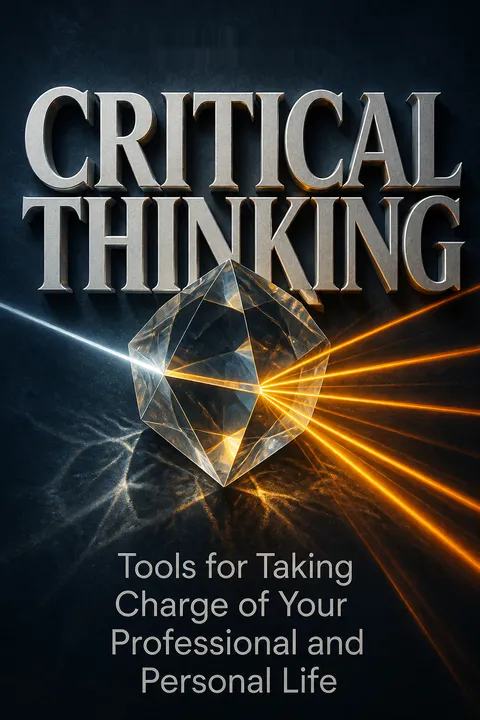


Key Takeaways
Treat your thinking as something to inspect, not an authority to obey
Thought shapes experience. Paul and Elder argue that decisions, emotions, relationships, and ambitions all depend partly on how people interpret events. A disappointing new job, for instance, can seem like proof that a life choice was a mistake, or a difficult transition that still offers room to learn. The interpretation influences what someone feels and does next. Much of this thinking runs unnoticed, so its errors can quietly steer a life.
Make thinking visible. Critical thinking means deliberately examining and improving reasoning rather than trusting its first, familiar version. It is useful at work, at home, and as a citizen because ordinary choices depend on judgments about what is happening and what to do. The aim is not perfect certainty, which the authors consider unattainable, but more defensible conclusions and fewer avoidable mistakes.
The book’s central move is to make thought an object of thought. That resembles metacognition, the capacity to monitor and adjust one’s own mental processes, and it gives readers a practical route from vague dissatisfaction to specific questions. The claim that thinking shapes emotional life is useful, but it should not be mistaken for the claim that circumstances are merely interpretations. A hostile workplace or a serious loss can cause distress independently of anyone’s framing. Reflection can improve a response without making real constraints disappear.
Separate what happened from what you inferred, assumed, and expect next
Reasoning has moving parts. The authors call its recurring components the elements of thought: the aim and question, the perspective and concepts involved, the information considered, the assumptions made, the conclusions drawn, and the consequences that may follow. Making these parts explicit helps locate a weak link instead of dismissing a whole argument as simply wrong.
Test each link. Jack and Jill argue after a party where Jack spent much of the evening talking with Susan. Jill calls his conduct flirting; Jack calls it friendliness and labels Jill paranoid. They have the same basic observation but different interpretations, assumptions, and concepts. More evidence about what happened would be needed to judge between them. The authors pair this analysis with standards such as clarity, accuracy, relevance, depth, breadth, logic, significance, and fairness. Ask what is known, what is being presumed, and what actually follows.
This framework is powerful because it separates observation from interpretation, a distinction central to scientific inquiry and careful conflict resolution. In practice, the question is not only whether an inference follows, but whether the initial description left out relevant facts. Jack and Jill’s dispute illustrates why apparently obvious labels can conceal an unresolved question. The framework is best used as a diagnostic aid, not a mandatory form to complete before every decision. Under time pressure, even identifying one hidden assumption can materially improve judgment.
Apply the same evidence rules to your side and your opponents
Skill needs a conscience. The book distinguishes strong-sense critical thinking from weak-sense thinking. A weak-sense thinker can analyze arguments skillfully while using that skill mainly to win, defend a group, or expose flaws in opponents. A strong-sense thinker applies standards to personal beliefs as rigorously as to opposing ones and tries to understand the strongest version of a contrary view.
Cultivate intellectual virtues. Fair-mindedness depends on habits including humility about what one knows, courage to question cherished beliefs, empathy for other perspectives, integrity in applying standards consistently, perseverance through difficulty, confidence in reason, and intellectual independence. These qualities support each other. Understanding a view one dislikes takes effort; admitting its strengths may require courage. The goal is not automatic agreement, but willingness to revise a position when better evidence or reasoning warrants it.
The distinction between debating skill and truth-seeking character is one of the book’s most important contributions. It anticipates a familiar problem in expert argument: people can become better at defending a position without becoming more accurate. The virtues offer a corrective by making intellectual conduct part of reasoning itself. Fairness does not require treating every claim as equally credible, however. A viewpoint deserves serious consideration, but its evidence and consequences still require scrutiny. Empathy is a way to understand a position, not a substitute for evaluating it.
Trace anger and desire back to the story your mind is telling
Three functions interact. Paul and Elder describe the mind as thinking, feeling, and wanting. Thinking gives events meaning, feelings evaluate that meaning, and desires direct energy toward or away from action. These functions continually influence one another. Someone who interprets a colleague’s promotion as proof of unfairness may feel resentment and want the colleague to fail, even before checking the evidence.
Examine the interpretation. The authors call the self-centered tendency to privilege one’s own wants, beliefs, and perspective egocentrism. It can make selfish reasoning feel entirely reasonable. When a strong reaction appears, ask what interpretation is feeding it, what evidence supports that interpretation, and whether another explanation fits. This does not mean every emotion is irrational. It means emotional intensity alone cannot establish that the story behind the emotion is accurate.
This account makes emotion available for examination without treating it as an enemy. It also connects naturally to cognitive approaches that ask people to identify the interpretations between an event and a reaction. The colleague example shows how a feeling can be real while its explanation remains uncertain. There is an important limit: emotions can carry information about needs, threat, or past experience that conscious reasoning has not yet articulated. A careful thinker investigates emotion rather than either obeying it automatically or dismissing it as defective.
Audit group loyalties before they turn conformity into certainty
Groups supply ready-made beliefs. Sociocentrism is group-centered thinking that treats a community’s beliefs and interests as naturally correct. It can arise within a family, profession, political movement, religion, or nation. The book describes children who assume their own country is more intelligent simply because it is theirs, while recognizing that children elsewhere may make the same claim about their own nation.
Notice the framing. Group identity shapes language, taboos, and judgments about outsiders. The authors argue that media can reinforce these habits by describing a country’s allies favorably and its opponents harshly. They recommend seeking alternative accounts and reading writing from earlier periods, which can reveal assumptions that seem invisible in the present. The practical test is to ask what a group expects members to believe, whom it casts as an enemy, and whether the same standards apply to both.
The analysis makes social belonging part of the problem of reasoning, not merely background context. That is valuable because beliefs are often reinforced by rewards, shared vocabulary, and loyalty pressures, rather than evidence alone. The advice to compare sources is strongest when applied symmetrically: a source outside the mainstream can also have its own loyalties and omissions. Distance from one group’s assumptions does not guarantee neutrality. The more useful aim is a habit of checking competing accounts against evidence and asking what each leaves out.
Slow major decisions until alternatives and downstream costs are visible
Decisions build a life. The authors distinguish conspicuous choices, such as a career or partner, from less visible choices repeated through habits. A single decision to avoid exercise or spend impulsively may seem small; repeated over time, such choices shape well-being. Immediate gratification often wins because long-term effects require deliberate attention.
Make the choice explicit. A sound decision begins by noticing that a decision exists, naming realistic alternatives, comparing them against important goals and the welfare of others, and following through on the best-supported option. If someone sees only one or two possible paths, the authors suggest that the search may be too narrow. Gathering more information and considering both benefits and costs helps. After acting, monitor consequences and revise the plan as new information appears. Reflection takes time, but poor choices can consume far more of it.
This approach usefully treats decisions as patterns, not isolated dramatic moments. It also combines personal welfare with the effects on other people, preventing the idea of rational choice from collapsing into mere self-optimization. The call to slow down is especially apt when consequences are difficult to reverse. Still, deliberation has costs, and not every minor choice deserves extensive analysis. A practical extension is to reserve the full examination for consequential or repeated decisions, while using habits and trusted procedures for routine ones.
Judge conduct by harm and rights, not merely custom, religion, or law
Ethics is not conformity. The book grounds ethical reasoning in the effects actions have on other people’s welfare and rights. It separates ethical principles from religious teachings, social conventions, and legal rules, all of which can vary or conflict with ethical obligations. A practice does not become just simply because a culture accepts it or a government permits it. The authors point to slavery, torture, and discrimination as examples of practices that warrant ethical condemnation despite social or legal approval.
Reason through hard cases. Clear abuses are not the only ethical questions. In a complex case, such as whether assistance in ending terminal suffering can be justified, relevant concepts may point in different directions. A reasoned judgment requires accurate facts, attention to competing principles, and fair consideration of opposing arguments. Ethical confidence is not enough; the reasoning behind it must also be examined for self-interest and group bias.
The distinction between morality and mere convention gives readers a way to criticize unjust rules without assuming that every inherited standard is worthless. Its appeal to shared human rights provides a moral baseline, while its method recognizes that difficult cases still require judgment. The tension is that claims about universal principles need careful defense, especially when cultures disagree about their application. That tension does not erase the value of the framework. It makes clear why principled criticism should combine attention to harm with humility about facts and context.
Treat expertise as valuable but fallible, especially when incentives distort it
Knowledge has limits. Professionals can offer disciplined methods and specialized understanding, but they remain human, work within institutions, and may face incentives involving money, status, or conformity. The authors distinguish questions with verifiable answers from questions requiring judgment. Engineering calculations may be tightly constrained by established mathematics; decisions about the public consequences of an engineering project involve broader social and political considerations.
Compare ideals with practice. The book cites medical history to show that established opinion can resist new evidence: Ignaz Semmelweis argued that physicians’ unwashed hands contributed to fatal infections, but his insight met resistance. It also reports a National Academy of Sciences estimate, from the period discussed, of up to 98,000 unnecessary deaths annually from medical errors. That is a historical figure in the book, not a current estimate. Evaluate a profession by its methods, evidence, safeguards, and incentives, not its prestige alone.
The book avoids two easy extremes: blind deference to credentials and blanket distrust of experts. Its distinction between technical facts and broader judgments is especially helpful when professional authority is used to settle political or ethical questions. Semmelweis’s case illustrates that institutions can lag behind evidence, though an anecdote cannot establish how common such resistance is. Skepticism should therefore be calibrated to a field’s verification practices and track record. Expertise remains indispensable, but its claims are strongest when transparent methods allow independent checking.
Challenge organizational routines that protect status quo over mission
Institutions have self-interest. Organizations can drift from their stated purpose as power struggles, group assumptions, and bureaucracy accumulate. Bureaucracy appears when fixed procedures replace informed judgment and rules become ends in themselves. The authors describe how this can stifle innovation and make change feel threatening, even when evidence suggests that existing practices no longer work.
Do not confuse success with soundness. A policy can produce short-term gains while creating lasting harm. The book uses Nazi Germany’s early economic and military successes to show how apparent effectiveness can coexist with profoundly defective and unethical reasoning. In ordinary business, it points to industries and companies that resisted changing conditions, including American automakers that lost ground after neglecting demand for smaller cars. Ask whether a policy serves the organization’s mission, who benefits, what evidence is ignored, and what long-term costs are being deferred.
This section connects individual reasoning to institutional design: good judgment is difficult when dissent is punished and routines reward compliance. The examples underscore that efficiency and moral legitimacy are separate measures of success. A system can meet its targets while damaging people or undermining its purpose. The analysis also cautions against assuming that every rule is pointless or every change is wise. Procedures can preserve safety and fairness. The key distinction is whether a rule remains answerable to its purpose and open to evidence-based revision.
Practice thinking on ordinary days, before a crisis demands it
Improvement takes practice. The book presents development as a progression from unreflective thinking, through awareness and initial effort, toward regular practice and increasing skill. Reading about good reasoning is not the same as using it under pressure. The authors recommend manageable exercises: review one day’s decisions, keep notes on emotionally important situations, focus on one thinking standard at a time, and work deliberately on a trait such as humility.
Turn insight into action. Strategic thinking connects an idea about the mind to a plan for changing behavior. When jealousy or discouragement appears, identify the feeling, trace the reasoning behind it, test that reasoning, and rehearse a more defensible response. This does not guarantee an easy life or remove external obstacles. It builds a repeated capacity to notice distortions, consider alternatives, and choose a response rather than simply replaying the mind’s first impulse.
The emphasis on repetition gives the book a credible account of change: intellectual habits, like practical skills, develop through use and feedback. Journaling can make tacit patterns available for review, while small exercises reduce the temptation to treat reflection as a grand but temporary resolution. The proposed progression is a useful map, not a validated diagnostic scale in the material presented. Practice should also include feedback from other people, since self-review can reproduce the very blind spots it is meant to expose.
Analysis
Paul and Elder’s deepest contribution is to treat critical thinking as both a method and a moral discipline. The method makes reasoning inspectable: clarify the question, identify assumptions and evidence, test conclusions, and follow their implications. The moral discipline asks whether those skills serve truth and fairness or merely sharpen persuasion. This combination explains why the book treats self-interest, group loyalty, professional incentives, and organizational power as central to reasoning rather than as distractions from it.
Its architecture is unusually portable. The same diagnostic habits can be applied to a jealous reaction, a career decision, a media account, or a corporate policy. That portability is also a risk. A compact checklist can create an illusion of rigor if users fill in categories mechanically or assume that naming a bias has corrected it. The book’s own insistence on practice and self-scrutiny helps address this, but reflection alone cannot compensate for missing evidence, unequal power, or lack of access to alternatives.
The account of emotion is useful but somewhat intellectualist. Interpretations can shape feelings, yet feelings also arise from bodily states, history, and circumstances that a person may not be able to revise through reasoning alone. Likewise, the appeal to universal ethical principles offers a needed standard beyond convention, but disagreements over how those principles apply remain substantial. The strongest reading is therefore neither relativist nor self-certain: claims about fairness need transparent reasoning, concrete attention to harm, and willingness to revise.
The book’s enduring practical lesson is not that a sufficiently analytical person can control every outcome. It is that people can become less captive to unexamined interpretations and more accountable for how they judge others. That matters privately, where it can reduce needless conflict, and publicly, where unchecked group and institutional reasoning can scale harm. Critical thinking is best understood here as a habit of justified judgment joined to intellectual humility and ethical responsibility.
Review Summary
Critical Thinking receives mixed reviews, with an average rating of 3.96 out of 5. Many readers find it insightful and practical, praising its comprehensive approach to improving thought processes. Some appreciate its usefulness as a reference book and its potential for personal development. However, others criticize the writing style as repetitive, dense, and occasionally patronizing. Despite these drawbacks, most reviewers agree that the book offers valuable tools for enhancing critical thinking skills, decision-making abilities, and overall self-awareness. Many recommend it for students, professionals, and anyone seeking to improve their analytical capabilities.
People Also Read








Glossary
Critical thinking
Self-correcting reasoningDisciplined thinking that examines and improves its own reasoning. It analyzes the parts of thought, evaluates them using standards such as accuracy and fairness, and revises conclusions when reasons or evidence require it. In this book, critical thinking is not simply the ability to argue effectively. It also requires intellectual virtues that direct reasoning toward fair-mindedness.
Elements of thought
Parts of reasoningThe recurring components present whenever people reason: their purpose, the question or problem, point of view, information, concepts, assumptions, inferences, and implications. Making these components explicit helps reveal where reasoning may be unclear, unsupported, narrow, or inconsistent. The framework can be applied to personal decisions, public arguments, and professional judgments.
Intellectual standards
Tests for reasoning qualityCriteria used to assess the quality of reasoning. The book emphasizes clarity, accuracy, precision, relevance, depth, breadth, logicalness, significance, and fairness. Standards are applied to the elements of thought: for example, whether a question is clear, information is accurate, or a conclusion follows from its evidence. Their appropriate use depends on the issue and context.
Strong-sense critical thinking
Fair-minded critical reasoningThe fullest form of critical thinking in Paul and Elder’s account. It combines intellectual skill with a commitment to examine one’s own beliefs, represent opposing views accurately, and apply comparable standards to allies and opponents. It contrasts with weak-sense thinking, which uses analytical skill selectively to defend self-interest or defeat competing arguments.
Egocentrism
Self-centered distortionThe tendency to treat one’s own interests, beliefs, feelings, and perspective as central, often without recognizing the bias. Egocentric thinking can ignore evidence, discount other people’s needs, and make self-serving conclusions feel reasonable. The authors regard it as a natural tendency that must be noticed and corrected through deliberate reflection and fair-minded reasoning.
Sociocentrism
Group-centered distortionThe tendency to treat a group’s beliefs and interests as inherently correct or superior. It can shape assumptions, language, loyalties, and judgments about outsiders in families, professions, political groups, religions, or nations. Like egocentrism, it can appear reasonable to those influenced by it, making independent examination and comparison with other viewpoints important.
Activated ignorance
False belief put to useInformation that a person believes to be true and actively uses, though it is false or misleading. Unlike information that is merely memorized without understanding, activated ignorance guides interpretation and action. The authors emphasize its danger when people act confidently on mistaken beliefs in ways that cause avoidable harm to themselves or others.
Activated knowledge
Understood, usable knowledgeInformation that is understood well enough to guide reasoning and support further learning. It is more than memorized language or facts repeated on command. The book uses scientific and mathematical methods as examples: when their principles are understood and applied, they help people test claims, reach justified conclusions, and build further knowledge.
FAQ
What's Critical Thinking: Tools for Taking Charge of Your Professional and Personal Life about?
- Focus on Thinking Skills: The book emphasizes the importance of critical thinking in both personal and professional contexts, aiming to improve readers' decision-making and problem-solving abilities.
- Core Skills Introduction: It introduces essential skills for effective thinking, which can lead to better decision-making, increased wealth, and greater confidence in achieving personal goals.
- Self-Analysis and Improvement: The authors encourage self-analysis to identify and improve thinking habits, ultimately leading to a more fulfilling life.
Why should I read Critical Thinking: Tools for Taking Charge of Your Professional and Personal Life?
- Enhance Decision-Making: The book provides strategies to develop skills for making informed decisions, reducing frustration, and increasing success.
- Overcome Cognitive Biases: It offers tools to recognize and overcome egocentric and sociocentric thinking, which can cloud judgment.
- Lifelong Learning: Promotes lifelong learning and self-improvement, making it a valuable resource for personal and professional growth.
What are the key takeaways of Critical Thinking: Tools for Taking Charge of Your Professional and Personal Life?
- Understanding Thinking: Understanding the nature of your thinking is crucial for personal growth and effective decision-making.
- Intellectual Standards: Introduces intellectual standards like clarity, accuracy, and relevance to assess and improve reasoning.
- Stages of Development: Outlines stages of thinking development, encouraging progression from unreflective to master thinkers.
What are the best quotes from Critical Thinking: Tools for Taking Charge of Your Professional and Personal Life and what do they mean?
- "You are what you think.": Highlights the impact of thoughts on emotions, actions, and life quality.
- "No intellectual pain, no intellectual gain!": Emphasizes the necessity of effort and discomfort in improving thinking skills.
- "Critical thinking is self-directed, self-disciplined, self-monitored, and self-corrective thinking.": Defines critical thinking as an active, reflective process ensuring quality reasoning.
How does Critical Thinking: Tools for Taking Charge of Your Professional and Personal Life define critical thinking?
- Disciplined Art: Describes critical thinking as the disciplined art of using the best thinking possible in any situation.
- Self-Assessment: Involves self-assessment and applying intellectual standards to evaluate reasoning quality.
- Goal-Oriented: Emphasizes that critical thinking is directed toward achieving specific goals or solving problems effectively.
What are the stages of thinking development mentioned in Critical Thinking: Tools for Taking Charge of Your Professional and Personal Life?
- Stage One: Unreflective Thinker: Individuals are unaware of significant problems in their thinking and often take beliefs for granted.
- Stage Two: Challenged Thinker: Recognizes problems in thinking and the need for improvement, but may struggle with self-deception.
- Stage Three: Beginning Thinker: Actively decides to improve thinking, recognizing egocentric tendencies, and commits to practice.
- Stage Four: Practicing Thinker: Commits to regular practice and develops a systematic approach to improving thinking skills.
What are the intellectual standards discussed in Critical Thinking: Tools for Taking Charge of Your Professional and Personal Life?
- Clarity: Ensures thoughts and statements are clear and understandable.
- Accuracy: Checks that information is true and reliable.
- Relevance: Assesses whether information and reasoning are pertinent to the issue at hand.
- Depth: Considers the complexities of the issue and addresses them adequately.
How can I apply the concepts from Critical Thinking: Tools for Taking Charge of Your Professional and Personal Life in my daily life?
- Daily Reflection: Engage in daily reflection to assess thinking and decision-making processes, questioning assumptions and conclusions.
- Practice Intellectual Standards: Regularly apply intellectual standards to reasoning in personal and professional contexts to improve clarity, accuracy, and relevance.
- Seek Feedback: Encourage open discussions to gain different perspectives and challenge your thinking, fostering a culture of critical inquiry.
How does Critical Thinking: Tools for Taking Charge of Your Professional and Personal Life address the issue of egocentrism?
- Self-Monitoring: Encourages self-monitoring of thoughts and behaviors to recognize egocentric tendencies that may distort reasoning.
- Intellectual Humility: Developing intellectual humility is crucial for acknowledging limitations and biases, allowing for fair-minded thinking.
- Engaging with Others: Actively engaging with diverse perspectives helps counteract egocentric thinking and fosters a comprehensive understanding of issues.
What specific methods does Richard Paul suggest for improving critical thinking?
- Self-Assessment Techniques: Regularly evaluate your thinking processes, questioning goals, assumptions, and the information used in reasoning.
- Socratic Questioning: Use Socratic questioning to deepen understanding and challenge assumptions, probing the reasoning behind beliefs.
- Developing Intellectual Virtues: Cultivate virtues like intellectual humility, empathy, and integrity, essential for fair-minded critical thinking.
How does Critical Thinking: Tools for Taking Charge of Your Professional and Personal Life address personal conflict in the workplace?
- Analyzing Personal Conflict: Provides frameworks for analyzing personal conflicts, encouraging assessment of underlying issues and rationality.
- Strategies for Resolution: Focus on one's thinking to manage stress and avoid conflicts, emphasizing constructive resolution methods.
- Long-Term Perspective: Advises taking a long-term view in workplace conflicts to navigate challenges without compromising values.
How does Richard Paul suggest we develop a culture of critical thinking in organizations?
- Leadership Commitment: Leaders should commit to fostering a culture of critical thinking, modeling behaviors, and encouraging open dialogue.
- Training and Development: Advocates for ongoing training in critical thinking skills, focusing on practical applications and reasoning strategies.
- Encouraging Diverse Perspectives: Highlights the importance of inviting diverse viewpoints in decision-making for robust discussions and better outcomes.
Download PDF
Download EPUB
.epub digital book format is ideal for reading ebooks on phones, tablets, and e-readers.








