Key Takeaways
1. Born into Slavery, Forged by Adversity
Her mother was a deeply religious woman whose convictions about the essential dignity of man developed under the cruelties of slavery.
Early life. Ida B. Wells was born into slavery in Holly Springs, Mississippi, in 1862, just before the Civil War's end. Her parents, Jim and Elizabeth, were formerly enslaved individuals who remarried after emancipation, with her father becoming a skilled carpenter and her mother a renowned cook. Her father, the son of his master, had a relatively less cruel experience of slavery, while her mother, sold young, instilled in her children the importance of education and dignity.
Family tragedy. In 1878, a devastating yellow fever epidemic swept through Holly Springs, claiming the lives of both of Ida's parents and her youngest sibling. At just sixteen years old, Ida found herself the eldest of six surviving children, suddenly thrust into the role of family head. Despite offers from friends and neighbors to separate the children, she was steadfast in her determination to keep her family together.
New responsibilities. To support her siblings, Ida passed the teacher's examination and secured a position in a rural school, earning twenty-five dollars a month. This early adversity, coupled with her parents' independent spirit and emphasis on education, profoundly shaped her character, instilling in her a fierce determination and a deep sense of responsibility that would define her later crusades for justice.
2. Early Fight Against Segregation
I have firmly believed all along that the law was on our side and would, when we appealed to it, give us justice.
Personal experience. In May 1884, while traveling to her school in Woodstock, Tennessee, Ida B. Wells was forcibly removed from a "Whites-only" train car on the Chesapeake and Ohio Railroad, despite holding a first-class ticket. She refused to move to the smoking car, which was designated for all Negroes, and bit the conductor's hand in self-defense during the altercation. This incident ignited her personal fight against racial discrimination.
Legal challenge. Upon returning to Memphis, Wells sued the railroad, initially winning a five-hundred-dollar judgment in a local court. This victory, which made headlines, was significant as it was the first case in the South where a Black plaintiff appealed to a state court after the 1883 repeal of the Civil Rights Act. The court's decision affirmed her right to equal accommodations, challenging the prevailing "separate but equal" facade.
Disillusionment and resolve. However, the triumph was short-lived. In 1887, the Supreme Court of Tennessee reversed the lower court's decision, forcing Wells to pay court costs. This reversal shattered her belief in the law's ability to deliver justice for her people, leading to profound discouragement but also a renewed determination to fight for redress outside the conventional legal system.
3. The Power of the Press: "Iola" and Free Speech
I had an instinctive feeling that the people who had little or no school training should have something coming into their homes weekly which dealt with their problems in a simple, helpful way.
Journalistic calling. While teaching in Memphis, Ida B. Wells discovered her talent for writing, initially contributing articles to a church paper about her railroad lawsuit. Her plain, common-sense approach to discussing issues affecting Black people, under the pen name "Iola," quickly gained traction, leading to invitations from other Negro newspapers. This marked the beginning of her influential journalistic career.
Editorship and advocacy. In 1889, she became a co-owner and editor of the Free Speech and Headlight in Memphis, investing her savings into the venture. Her editorials, particularly those criticizing the Memphis Board of Education for the inadequate conditions in segregated Black schools, were bold and uncompromising. This advocacy, however, came at a cost.
Dismissal and dedication. In 1891, her outspoken criticism led to her dismissal from her teaching position, a job she had held for seven years. Undeterred, she fully committed herself to the newspaper, shortening its name to Free Speech. She traveled extensively throughout the Mississippi Delta, Arkansas, and Tennessee, expanding the paper's circulation and influence, proving her ability to make a living through journalism and cementing her role as a voice for her community.
4. The Memphis Lynching and Exile
I felt that I owed it to myself and my race to tell the whole truth.
Tragic catalyst. In March 1892, a pivotal event shattered Ida B. Wells's life and intensified her crusade: the lynching of three Black businessmen—Thomas Moss, Calvin McDowell, and Henry Stewart—in Memphis. These men, including her close friend Thomas Moss, owned a successful grocery store that competed with a white-owned establishment. After a dispute escalated, they were accused of attacking law enforcement officers and brutally murdered by a mob.
Newspaper's response. In response, the Free Speech published a scathing editorial, penned by Wells, urging Black residents to leave Memphis, a town that "will neither protect our lives and property, nor give us a fair trial in the courts, but takes us out and murders us in cold blood when accused by white persons." This call to action, combined with Moss's dying words to "tell my people to go West," led to a significant exodus of Black citizens and a severe economic downturn in the city.
Exile and renewed purpose. While Wells was away in Philadelphia, a white mob, incited by the Commercial Appeal, destroyed the Free Speech office and threatened her life if she returned. Forced into exile, she channeled her outrage into a broader anti-lynching campaign. This personal loss and threat solidified her resolve to expose the truth about lynching, not just as an act of violence, but as a tool of racial terror and economic suppression.
5. Unveiling the Truth: Challenging the "Old Thread-Bare Lie"
Nobody in this section believes the old thread-bare lie that Negro men assault white women.
Exposing the lie. After her exile, Ida B. Wells dedicated herself to investigating lynchings, challenging the pervasive narrative that they were justified responses to the rape of white women by Black men. Her meticulous research revealed that this accusation was often a pretext for violence against Black men who were economically successful or challenged racial hierarchies. She found that many alleged "rapes" were, in fact, consensual relationships or fabricated charges.
Investigative journalism. In June 1892, the New York Age published her seven-column article, detailing names, dates, and places of numerous lynchings, conclusively demonstrating the falsehood of the "old thread-bare lie." She highlighted cases where:
- Accusations were baseless or exaggerated.
- White men who engaged in illicit relationships with Black women faced no consequences.
- The cry of "rape" was raised only when relationships between Black men and white women were discovered.
Moral outrage. Wells argued that the true motive behind lynching was to "keep the nigger down" by terrorizing the Black community and suppressing their economic and political advancement. Her work exposed the hypocrisy of Southern white men who, while creating a "race within a race" through their own sexual exploitation of Black women, condemned Black men for similar acts, even with willing white women. This revelation was a direct assault on the moral justifications for lynching.
6. International Advocacy: The British Crusades
America cannot and will not ignore the voice of a nation that is her superior in civilization, which makes this demand in the name of justice and humanity.
Seeking global support. Recognizing the silence and indifference of the American press and pulpit, Wells accepted an invitation in 1893 to speak in England, Scotland, and Wales. Her goal was to inform the British public about the horrors of lynching in America and to rally international moral sentiment against these atrocities. She believed that external pressure could compel America to address its "national crime."
First tour success. Her first tour in 1893, organized by Miss Catherine Impey and Mrs. Isabella Fyvie Mayo, was met with widespread sympathy and excellent press coverage. She spoke to crowded audiences, detailing the barbarity of lynch law and the flimsy evidence often used to justify it. The "Society for the Recognition of the Brotherhood of Man" was formed, and strong resolutions condemning lynching were passed, sending a clear message across the Atlantic.
Second tour and impact. A second, more extensive tour in 1894, during which she served as a paid correspondent for the Chicago Inter-Ocean, further amplified her message. She directly challenged prominent American figures like Frances E. Willard and D. L. Moody for their perceived condonation of segregation and silence on lynching. This international pressure, particularly from the British press and religious leaders, forced American media and institutions to confront the issue, contributing to a decline in lynching statistics and a shift in public discourse.
7. Balancing Public Duty and Private Life
I honestly believe that I am the only woman in the United States who ever traveled throughout the country with a nursing baby to make political speeches.
Marriage and motherhood. In 1895, Ida B. Wells married Attorney Ferdinand L. Barnett, a fellow crusader and owner of the Chicago Conservator. She initially retired from public life to focus on her roles as wife and mother, believing that a mother's presence was crucial during a child's formative years. She gave birth to four children: Charles Aked, Herman Kohlsaat, Ida B. Jr., and Alfreda M.
Returning to activism. Despite her commitment to family, the ongoing injustices against Black people repeatedly drew her back into public work. She famously traveled across the country with her nursing baby to deliver political speeches, a testament to her unwavering dedication and the unique challenges she faced as a Black woman activist. This experience highlighted the immense personal sacrifices required for her activism.
The "divided duty." Susan B. Anthony, a close friend and suffrage leader, once rebuked Wells for her "divided duty," suggesting that marriage and motherhood distracted from her "special call for special work." While Wells acknowledged the challenges, she also found profound fulfillment in motherhood, recognizing it as a profession in itself. Her life exemplified the complex balancing act of a woman committed to both family and a relentless fight for justice.
8. Founding and Leading Organizations
What you need in each community is a solid organization to fight race prejudice wherever shown.
Early club movement. Inspired by the civic groups she observed in England, Ida B. Wells became a driving force in establishing women's clubs among Black women in the United States. She organized the first civic club for Black women in Chicago, which later took her name, the Ida B. Wells Club. These clubs aimed to empower women to become active in community, city, and national affairs.
Negro Fellowship League. In 1910, she founded the Negro Fellowship League in Chicago, a social center and reading room located in a high-crime area on State Street. This initiative provided:
- Employment assistance
- Counseling
- Housing aid
- A safe space for reading and social networking
- Lodging for homeless men at low cost
NAACP and beyond. Wells was also a co-founder of the National Association for the Advancement of Colored People (NAACP) in 1909, though she faced internal politics and was initially excluded from its founding committee. Her vision for organized action against racial injustice extended to various movements, including the Equal Rights League and the Alpha Suffrage Club, which she organized to mobilize Black women voters in Illinois.
9. Confronting Apathy and Opposition
I’d rather go down in history as one lone Negro who dared to tell the government that it had done a dastardly thing than to save my skin by taking back what I have said.
Uncompromising stance. Ida B. Wells consistently faced opposition, not only from white supremacists but also from within the Black community and from white allies. Her refusal to compromise on truth and justice often put her at odds with those who prioritized expediency or feared retribution. She challenged:
- White Christian leaders who condoned lynching.
- Booker T. Washington for his accommodationist approach.
- Susan B. Anthony for excluding Black women from the suffrage movement.
Internal resistance. She encountered significant resistance from some Black leaders and organizations who felt her tactics were too radical or feared alienating white benefactors. For instance, her efforts to establish a kindergarten were initially opposed by Black community members who feared it would "draw the color line." Similarly, her attempts to secure federal intervention against lynching were sometimes undermined by Black politicians who prioritized party loyalty over racial justice.
Personal attacks. Wells was subjected to relentless personal attacks, including attempts to discredit her character and threats against her life. Despite these challenges, she remained steadfast, famously declaring her preference to "go down in history as one lone Negro who dared to tell the government that it had done a dastardly thing" rather than remain silent. Her unwavering commitment to truth, even when unpopular, defined her activism.
10. The Price of Liberty: Unfinished Battles
Eternal vigilance is the price of liberty, and it does seem to me that notwithstanding all these social agencies and activities there is not that vigilance which should be exercised in the preservation of our rights.
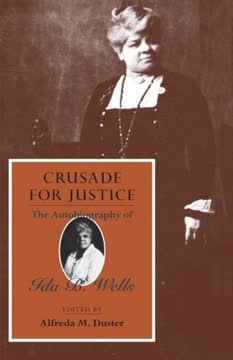
Lifelong struggle. Ida B. Wells's autobiography, Crusade for Justice, ends abruptly mid-sentence, symbolizing the unfinished nature of her life's work and the ongoing struggle for racial justice. Her final reflections emphasize the need for "eternal vigilance" in preserving rights, lamenting the complacency she observed even among those dedicated to social change.
Continuing injustices. Throughout her later years, Wells continued to fight against various forms of discrimination and violence, including:
- The East St. Louis riot (1918), where 150 Black people were slaughtered.
- The Arkansas riot (1919), where 12 Black men were sentenced to death after a mock trial.
- The segregation of Black soldiers during World War I and the unjust execution of Black servicemen.
Legacy and future. Despite her immense contributions, Wells often felt that her efforts were met with insufficient support or were undermined by internal divisions. Her autobiography serves as a powerful testament to her unwavering commitment to justice, even when facing overwhelming odds and personal sacrifice. Her descendants continue her legacy, ensuring that her story and the battles she fought remain relevant for future generations striving for true equality.
Last updated:
Review Summary
Crusade for Justice is highly praised as a powerful autobiography documenting Ida B. Wells' tireless efforts against lynching and racial injustice. Readers appreciate her straightforward writing style, detailed accounts of interactions with prominent figures, and insights into grassroots organizing. Many express frustration at Wells' relative obscurity compared to other civil rights leaders, given her significant contributions. The book is seen as essential reading for those interested in African-American history, though some note it can be dense and could benefit from editing. Overall, reviewers find Wells' story inspiring and relevant to contemporary issues.