

Key Takeaways
Treat culture as something citizens make, not a product brands sell
A campaign exposed the imbalance. Culture jamming is the use of media interventions, parody, and direct action to challenge commercial messages and reclaim cultural influence. Lasn traces his own turn toward it to a dispute over logging in British Columbia. A timber industry campaign promised responsible forestry, while activists’ counter-ad was refused by broadcasters. The activists publicized the refusal, drew press attention, and helped force the CBC to pull the industry campaign. The episode convinced them that challenging who gets heard could matter as much as having a better argument.
The larger claim is political. Lasn argues that citizens increasingly receive culture as branded entertainment rather than shape it through communities and public debate. Culture jamming aims to interrupt that one-way flow and make room for a less commercial culture.
What's striking is the book's shift from protest as a demand for better policy to protest as a contest over who gets to define reality. That anticipates a central problem of platform politics: visibility is not evenly distributed, and access can matter before persuasion even begins. The forest campaign also shows how a rejected message can become more newsworthy than an aired one. Yet a successful media intervention is not the same as durable change. Attention must lead to organization, policy, or altered practice, or the disruption risks becoming another brief spectacle.
Protect your attention as shared mental ecology
The mind has an environment. Lasn extends environmental language to the information people absorb: noise, rapid edits, fear, advertising, and endless disconnected updates. In the book's 1990s examples, MTV is said to deliver up to sixty visual or audio changes per minute, while a rough estimate puts daily marketing messages at thousands per person. These figures belong to the period and are not presented as modern measurements. The point is that repeated stimulation can train people to expect constant novelty and leave less room for quiet attention.
Attention has a public cost. Lasn compares this mental environment to shared air and water. He suggests reducing unwanted exposure by switching off background media, seeking quiet, and spending time in the physical world. He also calls for studying media effects with the care given to physical pollution.
The ecological metaphor is useful because it makes attention more than a private self-control problem. In cognitive science, working memory is limited, and frequent interruptions make sustained thought harder; an environment designed to capture attention can therefore shape what people are able to notice. The analogy also supports collective remedies, such as rules for advertising in schools. Its limit is that not every intense or mediated experience is harmful. Media can educate, connect, and mobilize. The stronger question is not whether stimulation is bad, but who controls it, for what purpose, and with what room for choice.
Choose lived experience over the branded signals that imitate it
The spectacle stands between people and life. In the Situationist tradition, a spectacle is a social world in which direct experience is displaced by images, performances, and commodities. Lasn shows how this can happen in ordinary entertainment: laugh tracks cue viewers when to laugh, product placements blur a story with advertising, and public figures become symbols people consume through coverage. His examples include viewers laughing along with a staged television mishap and grieving a celebrity they did not personally know.
The concern is agency. When images repeatedly tell people what is funny, desirable, or worth caring about, the boundary between personal preference and commercial scripting becomes harder to see. Lasn asks readers to notice where they experience something directly and where they mainly consume its representation.
This argument usefully distinguishes having access to images from having meaningful experience. A photograph, broadcast, or online persona can enrich memory and help people connect; the problem arises when representation becomes the test of whether something counts. That distinction remains relevant in a culture of constant documentation. Still, the book sometimes treats authenticity as if it were a stable inner truth waiting to be recovered. Identity is also social and changing. The practical value of the idea is less in policing what is real than in asking whether media expands participation or substitutes for it.
Follow the money behind culture, especially who controls the microphone
Commercial incentives shape coverage. Lasn argues that dependence on advertisers can narrow what media organizations are willing to publish or broadcast. He cites a 1992 survey in which 90 percent of surveyed news editors reported direct pressure from advertisers, and more than a third said they had yielded at some point. He also describes Adbusters' repeated attempts to buy airtime for advocacy ads, including campaigns about consumption, food, and cars. Networks rejected many of them while continuing to accept commercial advertising.
Access is part of the message. The book's concern is not simply that advertisers lie, but that issues challenging commercial interests may struggle to enter public debate at all. The result, Lasn says, is a public sphere where citizens can speak in theory but have limited access to the channels with the greatest reach.
The analysis is strongest when it treats media ownership and advertising as structural incentives rather than imagining a single coordinated conspiracy. Political economy asks who finances institutions, who bears the cost of dissent, and which topics reliably attract resources. Those questions help explain why self-censorship can occur without an explicit order. At the same time, a rejected advertisement does not by itself prove censorship: broadcasters also make editorial and legal judgments. The democratic issue is whether those decisions are transparent, consistent, and open to meaningful alternatives.
Judge prosperity by what it preserves, not only what it sells
Growth can hide damage. Lasn challenges the Gross Domestic Product, or GDP, as a complete measure of progress because it counts market activity without reliably distinguishing benefits from costs. An oil spill can generate cleanup spending that raises GDP, while unpaid care, volunteering, and a healthy forest may contribute little or nothing to it. The book contrasts GDP with the Index of Sustainable Economic Welfare, or ISEW, which adjusts economic activity for selected social and environmental costs. Lasn says its historical estimates show welfare flattening or falling even as GDP rose.
The argument is about accounting. If pollution, resource depletion, and health costs are excluded, an economy can appear to improve while drawing down the conditions that support life. The book uses a pyramid scheme as a metaphor for passing ecological costs to future generations.
The measurement critique matters because indicators do not merely describe an economy; they help define what policymakers optimize. This is a familiar issue in public administration: what is counted becomes easier to defend, while omitted costs can disappear from debate. The ISEW makes hidden tradeoffs visible, but no single alternative index settles what counts as welfare or how unlike values should be combined. A sound response is not to replace one unquestioned score with another. It is to use several transparent measures, including ecological limits and distribution, and make their assumptions contestable.
Use anger as an alarm, then choose a strategic act
Anger can reveal a boundary. Lasn recounts jamming a shopping-cart coin slot in frustration with a supermarket routine, then choosing a local produce shop instead. He interprets the moment as a break from automatic compliance. The book distinguishes anger directed at a system from anger dumped on workers who have little power over it. Rage, in this account, can interrupt cynicism when it becomes a deliberate response rather than a reflex.
Small acts can rehearse agency. Lasn proposes actions such as refusing wasteful packaging, challenging a corporation's procedure, or questioning a sponsor's presence in a school. He treats these as practice in seeing oneself as a citizen rather than only a customer. His strongest caution is practical: decide what risks are acceptable before confronting an institution, and do not begin a fight that cannot be followed through.
The useful psychological move is from helpless irritation to a specific, chosen response. Research on collective action often distinguishes anger at injustice from generalized hostility: the former can clarify a shared grievance and motivate participation, while the latter can scatter attention or harm bystanders. This helps explain why target selection matters. Yet a single dramatic gesture can feel more consequential than it is. Anger is a signal, not proof that an interpretation is correct. Pairing it with evidence, allies, and a clear objective makes it more likely to produce repair rather than merely release tension.
Change the feedback loop, not just the visible behavior
Look for leverage. A leverage point is a place in a system where a small intervention can alter how the whole system behaves. Lasn illustrates the idea with a housing cooperative whose residents would not reduce electricity use despite repeated requests. After the electricity meters were moved to a visible place near the entrance, residents could see their consumption and use reportedly fell by 30 percent. The change did not add another lecture; it gave people feedback they had not previously received.
Apply the same logic culturally. To reduce dependence on cars, for instance, Lasn argues that activists should question the rituals and symbols that make driving feel inevitable, not only urge individuals to cycle more. Effective intervention changes the cues, incentives, or shared assumptions that reproduce a behavior.
This systems view is more powerful than blaming individuals because it asks how behavior is maintained. In control theory, feedback makes the consequences of an action visible, allowing a system to adjust; the meter example gives that abstract idea a simple human form. The caution is that a successful intervention in a small cooperative may not scale unchanged to a complex society. Visibility can also create shame or surveillance. Good leverage points make consequences legible while preserving dignity and choice, and they should be evaluated for who gains power as the system changes.
Make resistance visible, repeatable, and paired with practical alternatives
Disruption needs a plan. Lasn's Strategic Pincer is a campaign approach that combines public-facing media challenges with grassroots action and sustains both over time. One side might use an anti-ad or a television spot to question an industry's image; the other might organize local groups, petitions, or public events. The idea is to keep pressure on an issue from multiple directions rather than rely on one protest that fades from view.
Offer a way to live differently. Buy Nothing Day and TV Turnoff Week give people a shared, concrete action, while farmers' markets and community food schemes offer alternatives to industrial food habits. Lasn's concept of demarketing means using marketing's persuasive tools to encourage less consumption and different values, not merely urging people to feel guilty about buying.
The combination of symbolic action and practical alternatives addresses a common weakness in protest: it can make a problem visible without showing what to do next. Repeated public rituals lower the coordination barrier because people can recognize the action and join without designing a campaign from scratch. The book also grasps that identity and status shape consumption, so a cultural counter-message can matter alongside a policy demand. The challenge is to avoid turning resistance into a new lifestyle brand. Durable alternatives need affordability, access, and institutions that make the less commercial choice genuinely workable.
Make corporations answerable to the people who charter them
Corporations are designed institutions. Lasn argues that corporations are legal structures built to organize economic activity, not moral beings that can be persuaded to feel remorse. He traces an early American tradition of limiting corporate charters, then describes how corporate rights and influence expanded over time. The book treats the 1886 Santa Clara County case as a turning point in that history, though its account should be read as Lasn's political interpretation rather than a complete legal analysis.
Accountability must change incentives. Lasn proposes stronger liability for shareholders, penalties for repeat corporate misconduct, and revocation of charters in severe cases. His principle is that public authorities should not rely only on voluntary responsibility when institutions profit from harmful conduct. The proposal shifts the debate from asking companies to behave better to asking what rules make responsible behavior enforceable.
The institutional insight is compelling: organizations respond to the incentives, legal permissions, and constraints built around them. That is more precise than treating corporate misconduct as a failure of individual virtue. However, assigning personal liability to shareholders could penalize people with little influence over a company's decisions and might destabilize investment in useful enterprises. The broader question is how to make responsibility track control and benefit. Strong disclosure, enforceable penalties, and public oversight can pursue that goal without assuming that every corporate harm justifies dissolution.
Demand a public voice where commercial media controls access
Communication is a democratic resource. Lasn calls Media Carta the campaign for a citizen's right to communicate through mass media, not just to receive information. He argues that a large number of channels does not guarantee a diverse public conversation if ownership and commercial incentives concentrate control. His proposal for a Two-Minute Media Revolution would reserve two minutes of each broadcast hour for citizen-produced messages.
A crisis briefly showed another model. During a major snowstorm in Victoria, British Columbia, local radio station CFAX invited residents to share urgent information about neighbors who needed help or supplies. The broadcasts turned the station into a practical communication network. Lasn sees this as a glimpse of media serving public needs rather than simply selling attention. He argues for expanding public participation while leaving room for commercial speech.
The chapter raises a durable distinction between freedom to speak and effective access to an audience. A right that cannot reach the places where people form common knowledge may be formally real but politically weak. The snowstorm example shows how a communication network can coordinate assistance when shared information has immediate value. Still, a mandated access rule raises difficult questions about selection, moderation, and fairness. The principle is strongest when paired with transparent criteria and plural ownership, so that public access does not become another gatekeeper's discretionary favor.
Analysis
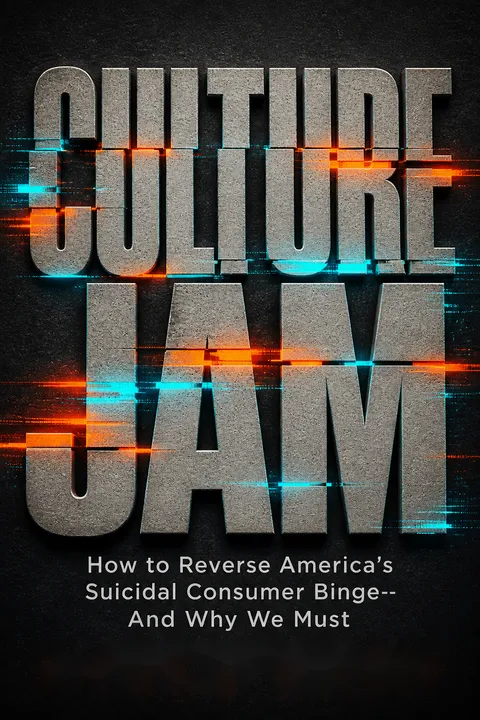
Culture Jam is a political intervention as much as a book of cultural criticism. Its seasonal structure moves from diagnosis to strategy: first, commercial media and consumer routines are presented as forces that shape attention and desire; then corporate influence and economic growth are challenged; finally, readers are offered methods for resisting and redesigning those systems. The central shift is from consumer choice to cultural power. Buying differently matters, but the deeper question is who controls the stories, institutions, and incentives that make some choices feel natural.
The book's most durable contributions are its practical vocabulary and its insistence that communication infrastructure is political. Détournement, leverage points, demarketing, and the Strategic Pincer turn abstract dissatisfaction into tactics. The forestry campaign gives that argument a concrete narrative: refusal of access became a public controversy and weakened a polished industry message. The book also anticipates contemporary concerns about attention capture, platform concentration, branded identity, and the inability of GDP to represent ecological costs.
Its weaknesses follow from its urgency. Lasn sometimes moves too quickly from correlation to causation, especially when discussing media exposure and mental health. Several cited statistics are period-specific, and some claims about corporate legal history are rhetorically forceful but legally compressed. Its proposed tactics also vary in ethical and practical risk. A parody campaign, a boycott, a law suit, and disruption of a company's operations are not interchangeable forms of action. They require different evidence, safeguards, and measures of success.
The book is best read as a manifesto that asks readers to examine both what they consume and the systems that shape consumption. Its strongest test is not whether every diagnosis is proven, but whether a proposed intervention increases public understanding, expands genuine choice, and reduces harms without replacing one unaccountable authority with another. That standard preserves its rebellious energy while making its call for cultural democracy more rigorous.
Review Summary
Culture Jam receives mixed reviews, with ratings ranging from 1 to 5 stars. Supporters praise its critique of consumer culture and call for social change, finding it eye-opening and inspiring. Critics argue it's dated, hypocritical, and lacks nuance. Many readers appreciate Lasn's analysis of advertising's impact and his call for cultural resistance, but some find his proposed solutions simplistic or ineffective. The book's relevance in the age of social media is debated, with some finding it prophetic and others outdated. Overall, it remains a polarizing work that challenges readers to reconsider their relationship with consumerism.
People Also Read








Glossary
Culture jamming
Disrupting commercial messagesA form of media activism that interrupts or reworks commercial images, slogans, and public rituals to expose their assumptions and challenge corporate influence. Tactics in the book include parody advertisements, public campaigns, and efforts to reclaim media access. The goal is not only to criticize consumer culture but to help people participate in shaping culture themselves.
spectacle
Life mediated as showA Situationist term for a social order in which experiences and relationships are increasingly encountered through images, entertainment, and commodities rather than directly. In Lasn's use, the spectacle includes advertising, television, celebrity culture, and branded events. It offers apparent choice while encouraging people to consume representations of life instead of actively shaping it.
détournement
Reversing an image's meaningA Situationist technique that takes a familiar image, message, or setting and redirects it so its expected meaning is challenged or inverted. Culture jammers use it to make commercial imagery reveal the interests or assumptions it normally hides. A subvertisement that imitates an advertisement while arguing against its message is one example.
dérive
Unplanned urban explorationA Situationist practice of moving through a city without a fixed destination, remaining receptive to the places, moods, and encounters that arise. Lasn presents it as a way to experience an environment outside the usual routines of work, shopping, and programmed entertainment. The practice aims to make everyday life more exploratory and less governed by prescribed purposes.
meme
Replicating unit of informationA term for an idea, phrase, tune, image, or style that spreads from person to person through imitation. In the book, memes compete for attention and can influence behavior or collective beliefs. Lasn applies the idea to social movements, arguing that a memorable message can travel widely and help shift how people interpret an issue.
meme warfare
Competition between public ideasLasn's term for the struggle between competing messages, values, and visions of the future in mass communication. Activists try to challenge corporate narratives with ideas that are memorable enough to spread and change public assumptions. The book's examples include anti-smoking campaigns and advocacy advertisements designed to make an industry's image less appealing.
demarketing
Marketing reduced consumptionThe use of marketing methods to encourage people to consume less, question commercial desires, or adopt different lifestyles. Lasn presents it as turning persuasion away from expanding sales and toward reducing the cultural authority of consumerism. Buy Nothing Day and campaigns against high-consumption products illustrate the approach.
Strategic Pincer
Two-front campaign strategyA campaign method that applies pressure on an industry through media interventions and grassroots action at the same time. One front challenges the industry's public image through advocacy advertising or parody; the other organizes citizens, local groups, petitions, and events. Lasn argues that sustained pressure from both directions is more effective than a single protest.
true cost
Price including hidden harmsA proposed way to price products by including environmental and social costs that ordinary market prices often leave out. Lasn's examples include pollution, road construction, health effects, and damage passed on to future generations. The aim is for prices to reflect more than production and sale, so consumers and institutions face clearer incentives.
Media Carta
Citizen right to communicateLasn's name for a movement to make public communication a practical democratic right. It seeks more than freedom to receive information: citizens should have meaningful ways to contribute messages through influential media. The book proposes measures such as reserving broadcast airtime for citizen-produced advocacy and reducing concentrated control over media.
Index of Sustainable Economic Welfare
Adjusted measure of economic welfareAn alternative indicator discussed in the book that adjusts conventional economic activity by accounting for selected social and environmental costs. Unlike GDP, it aims to distinguish market growth from changes in broader welfare, including resource depletion and pollution-related costs. Lasn uses it to argue that some economies' apparent growth can coexist with stagnating or declining well-being.
FAQ
What's Culture Jam about?
- Critique of Consumerism: Culture Jam by Kalle Lasn critiques the pervasive consumer culture in America, highlighting how it manipulates individuals into a "Manchurian Consumer" state.
- Call for Change: The book advocates for culture jamming, a movement aimed at disrupting consumerism and reclaiming individual autonomy from corporate control.
- Four Seasons Framework: Lasn structures the book into four parts—Autumn, Winter, Spring, and Summer—each representing different stages of understanding and action against consumerism.
Why should I read Culture Jam?
- Awareness of Manipulation: It helps readers recognize the deep embedding of consumerism in their lives and its impact on identity and choices.
- Empowerment through Knowledge: The book empowers individuals to take action against corporate manipulation and encourages reclaiming their lives and communities.
- Cultural Relevance: As consumer culture dominates, Lasn's insights remain crucial for anyone interested in social change and activism.
What are the key takeaways of Culture Jam?
- Consumerism as a Trap: The book emphasizes that consumerism creates a false sense of identity, leading to disillusionment and mental health issues.
- Culture Jamming as Resistance: Lasn introduces culture jamming as a method to disrupt corporate narratives and reclaim personal and cultural identity.
- Collective Action Importance: It stresses the need for collective action and grassroots movements to challenge corporate power and create a more authentic society.
What are the best quotes from Culture Jam and what do they mean?
- "America is no longer a country. It’s a multitrillion-dollar brand." This highlights how corporate interests have overtaken national identity.
- "Revolution is not showing life to people, but making them live." True change comes from active participation rather than passive consumption.
- "We will strike by unswooshing America™." This encapsulates the goal of culture jamming: dismantling corporate branding to replace it with authentic experiences.
What is culture jamming as defined in Culture Jam?
- Disruption of Corporate Messaging: Culture jamming is activism that seeks to disrupt and subvert corporate advertising and media messages.
- Creative Resistance: It involves using creativity and humor to challenge the status quo through art, media, and public performances.
- Empowerment of Individuals: The practice aims to empower individuals to reclaim their identities and resist consumerism pressures.
How does Culture Jam address mental health issues?
- Mood Disorders Discussion: Lasn links the rise of mood disorders to the alienation fostered by consumer culture.
- Ecopsychology Perspective: The book suggests detachment from nature contributes to mental health crises, advocating for reconnection with the natural world.
- Call for Authentic Living: Lasn emphasizes living authentically to combat feelings of despair and disconnection.
How does Culture Jam relate to environmental issues?
- Critique of Consumerism's Impact: Lasn argues that rampant consumerism is unsustainable and contributes to environmental degradation.
- Call for Ecological Awareness: The book emphasizes a cultural shift towards sustainability and ecological responsibility.
- Connection to Mental Health: Lasn links environmental issues to mental health, suggesting disconnection from nature exacerbates alienation.
What is the significance of the Situationist movement in Culture Jam?
- Historical Context: Lasn draws on the Situationist movement to illustrate the roots of culture jamming, focusing on spontaneity and authenticity.
- Philosophical Influence: The Situationists' ideas about the spectacle and direct action resonate throughout Culture Jam.
- Inspiration for Activism: The movement inspires contemporary activists to challenge consumerism and reclaim their lives.
How does Culture Jam propose to change the narrative around consumerism?
- Reframing the Conversation: Lasn advocates for a shift from acceptance to critical examination and resistance of consumerism.
- Empowering Individuals: The book encourages individuals to take ownership of their narratives, rejecting the passive consumer role.
- Collective Action for Change: Lasn emphasizes the importance of grassroots movements in challenging corporate power.
What is the "Doomsday Meme" mentioned in Culture Jam?
- Concept of the Doomsday Meme: It refers to the idea that the global economy is a destructive force needing reprogramming.
- Cognitive Dissonance: The meme challenges individuals to confront the unsustainable nature of their consumption habits.
- Call to Action: It serves as a rallying point for culture jammers and activists seeking societal change.
How can individuals take action after reading Culture Jam?
- Engage in Culture Jamming: Lasn encourages creating subvertisements, organizing events, and engaging in grassroots activism.
- Promote Sustainable Practices: Adopt sustainable practices like reducing consumption and supporting local businesses.
- Raise Awareness: Share information and foster conversations about consumerism and corporate power to inspire action.
How does Culture Jam address the issue of corporate power?
- Corporate Control of Culture: Lasn discusses how corporations prioritize profit over social responsibility, leading to a homogenized culture.
- Legal Personhood of Corporations: The book critiques corporations' legal status as "persons," calling for reevaluation to limit their influence.
- Strategies for Resistance: Lasn provides strategies like grassroots organizing and media activism to resist corporate power.
Download PDF
Download EPUB
.epub digital book format is ideal for reading ebooks on phones, tablets, and e-readers.








