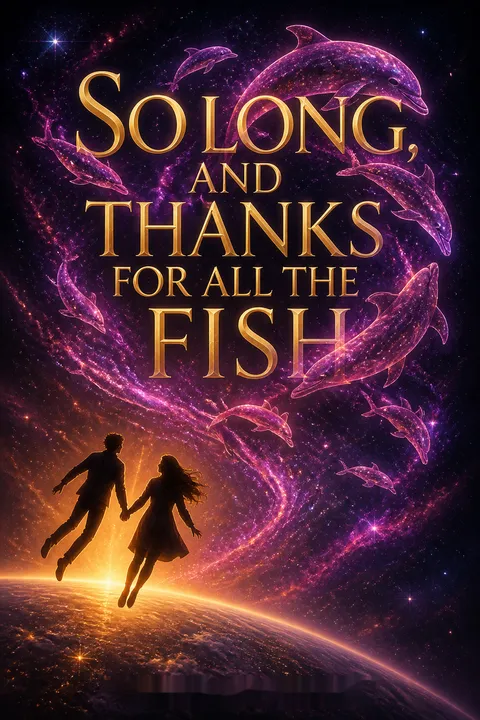


Plot Summary
Prologue
Earth’s people are unhappy, and a girl in a Rickmansworth café suddenly sees a way to make the world good. Before she can tell anyone, a catastrophe wipes out the moment and its answer. The story that follows belongs to that girl, though neither she nor the man who will meet her can yet explain what happened.
The opening gives the novel a mystery before its plot has a protagonist in view: what did the girl understand, and what catastrophe erased her chance to share it? Her private insight is set against the scale of ordinary unhappiness, but the abrupt interruption refuses to treat revelation as a cure that can simply be announced. The reader is primed to look for an answer in events that seem absurd or accidental. The frame also turns the novel’s later concern with a vanished Earth into a personal loss: the catastrophe did not only destroy a world, it broke a moment of understanding.
A World That Survived
A soaked hitchhiker climbs into a Saab driven by Russell, a brusque man taking his sedated half-sister home from hospital. The girl, Fenchurch, briefly wakes and says a puzzling word before drifting off again. Arthur Dent is stunned by the familiar roads: he remembers Earth being destroyed by Vogons, yet Russell explains that people now believe the yellow ships were mass hallucinations caused by a government experiment.
Arthur’s eight years of travel have cost only months on Earth. His astonishment makes Russell lose control of the car, and Arthur ends up walking toward his old village alone, unable to prove that the world beneath his feet should not exist.
Arthur’s return makes home uncanny rather than comforting. The gulf between his lived experience and public memory leaves him without a shared account of reality: everyone else can explain away the invasion, while he remembers surviving it. Russell’s irritation turns this epistemic isolation into a social one, since Arthur cannot persuade even a stranger to take his history seriously. The mismatch in time also makes the return emotionally uneven. Arthur has endured years of dislocation, but Earth has barely noticed his absence. His first problem is therefore not simply where he is, but how to inhabit a world that denies what he knows.
The Bowl in the Dust
Arthur reaches his cottage and finds the house still standing, buried under years of junk mail. Beside his old television sits a beautifully made grey glass fishbowl, engraved with the beginning of a farewell message. He fills it with water and drops in the Babel fish he has carried in his ear, then tries to sleep.
Instead, he senses the Earth’s living minds and the rhythms of its landscape. One fractured consciousness feels like Fenchurch; another suggests that two versions of Earth have somehow met. In the morning, Arthur resumes ordinary life, deciding to ignore the impossible details. The bowl remains beside his television, an unexplained object he cannot bring himself to discard.
The bowl gives Arthur a tangible mystery where his account of the Vogons has only met disbelief. Its beauty and incomplete inscription invite attention without explaining themselves, a quiet counterpoint to the noisy, implausible claims he would have to make to other people. Meanwhile, his new sensitivity to the Earth suggests that returning has changed him, even if he longs to resume familiar habits. His choice to set the anomalies aside is psychologically understandable: ordinary routines offer shelter when evidence threatens to undo his sense of reality again. Yet the strange perception of two Earths keeps his private experience connected to Fenchurch’s, laying a subtle trail toward their shared past.
Ford Finds the Earth
Far from Earth, Ford Prefect escapes a dangerous bar by using his Hitch Hiker’s Guide credentials to secure his safety. When the Guide’s database updates, he expects his Earth entry to disappear, since the planet was destroyed while he was working there. Instead, the entry remains, full of the material he wrote during his fifteen years on Earth.
The impossible survival of that record convinces Ford that something extraordinary is happening, and he decides to investigate. He steals an unattended police helicopter, reaches the spaceport, and trades the craft for a first-class ticket. For the first time since leaving Earth, Ford has a clear purpose: find out why the Guide still treats the vanished planet as real.
Ford’s discovery echoes Arthur’s return, but through the machinery of an institution rather than memory. The Guide’s continued record is not proof that Earth survived, yet it gives Ford a stubborn piece of evidence that resists official erasure. His response is characteristically impulsive: he turns a stolen helicopter into transport because curiosity has become more compelling than caution. Beneath the comic escape is a serious shift in motivation. Ford has spent years treating Earth as an assignment and an inconvenience; now its persistence pulls him back toward unfinished business. The book lets a bureaucratic data update become an instrument of wonder, exposing how even an unreliable guide can preserve what reality seems to have deleted.
The Hitchhiker Named Fenchurch
After two months of trying to settle back in, Arthur stops for coffee at a motorway service station. He meets Rob McKenna, a lorry driver convinced that rain follows him everywhere, then spots a young woman hitchhiking nearby. It is Fenchurch, now awake and vivid, and Arthur offers to drive her toward London.
At a station pub, their conversation is repeatedly interrupted by a raffle seller, but Fenchurch tells him her preferred name and gives him a way to contact her. She leaves for her train before Arthur can explain why he recognized her. He tries to find her afterward and fails. Her brief appearance gives Arthur a new reason to remain in the world he had been prepared to treat as a bewildering accident.
Fenchurch’s first conscious meeting with Arthur shifts his attention from the puzzle of Earth to the possibility of attachment. He has no reliable explanation for recognizing her, and his awkwardness makes that uncertainty visible rather than romanticized. Fenchurch, by contrast, sets the terms of their contact: she corrects the name her brother uses and chooses when to leave. The raffle’s comic interruptions frustrate their conversation, but they also keep the encounter grounded in ordinary social life. Arthur’s failure to reach her afterward turns longing into action. He is no longer merely enduring his return; he begins trying to find someone whose experience may make his own less solitary.
A Revelation Lost
Unable to locate Fenchurch by ordinary means, Arthur buys a computer and plots the stars to find the prehistoric cave where he once lived. His improvised calculations lead him to her Islington home. As they spend time together, Fenchurch describes a sudden insight she had in a café, followed by the apparent destruction of the world and her repeated hospital stays.
She cannot recover the thought that came to her, but she knows the episode was not a hallucination. She also tells Arthur that the dolphins disappeared on that same day. Fenchurch recognizes the battered Hitch Hiker’s Guide Arthur lost on the night he returned, and they decide to follow its clues beyond Earth.
Fenchurch’s lost revelation mirrors Arthur’s missing certainty: both remember a rupture that the world around them has rewritten as something manageable or unreal. Her account gives the mystery a second witness, but not a complete explanation, preserving the tension between testimony and proof. The vanished dolphins make the catastrophe harder to dismiss as a private mental crisis, while the recovered Guide turns memory into a route forward. Arthur’s absurd astronomical project matters less for its scientific rigor than for the faith it expresses. He accepts a nearly impossible search because finding Fenchurch has made the effort worth undertaking. Their relationship begins to function as a shared method of inquiry.
Learning to Leave Ground
At Fenchurch’s converted stable, Arthur tries to identify what is unusual about her. He notices that her feet do not touch the floor. When he steps outside and floats in the alley, he realizes that he can fly again, as he once did on Krikkit, and encourages Fenchurch to try. She rises too.
Their first flight through London is joyous until Fenchurch loses control and drops; Arthur catches her, and together they learn to redirect their fall into flight. They spend the night in the clouds, free of the rules that usually govern their bodies. Fenchurch is delighted, but the missing insight still troubles her. She wants to know what she understood before the world seemed to break.
Flight turns the couple’s private strangeness into a shared physical fact. Arthur does not teach Fenchurch through expertise so much as through uncertainty: his willingness to act without knowing exactly how makes a space for her to test what her body can do. Their fall briefly exposes the risk hidden inside exhilaration, and Arthur’s rescue shows that trust has practical consequences. The sky also offers a temporary escape from the social explanations that have confined them, but it cannot answer Fenchurch’s central question. Their freedom is real, yet incomplete. The novel keeps wonder from becoming a substitute for understanding, allowing intimacy and investigation to advance together.
Dolphins' Farewell Bowl
Arthur and Fenchurch fly to California to meet John Watson, who calls himself Wonko the Sane and lives in a house built inside out. Wonko says he withdrew from ordinary society after deciding that a civilization needing instructions for toothpicks had lost its judgment. He has studied dolphins and owns a grey glass bowl like Arthur’s; Fenchurch recognizes another from her past.
When the three hold the bowls to their ears, they hear that the dolphins sent them as a farewell and had acted to save humanity. Wonko also confirms that Rob McKenna’s rain diary has attracted scientific attention, though officials disguise their uncertainty in technical language. On the flight home, Arthur gives Fenchurch the coordinates of God’s Final Message.
Wonko’s house literalizes his refusal to accept society’s definition of sanity, but his eccentricity is paired with disciplined observation. He does not claim that his odd beliefs prove themselves; he shows Arthur and Fenchurch evidence and lets them attend to it. The bowls transform private gifts into a communication system, revealing that the dolphins anticipated humanity’s danger and left a message for survivors. This discovery reframes the opening catastrophe as an act of rescue, not merely destruction. The rain-god subplot sharpens the same critique: institutions often answer the unexplained by renaming it, protecting their authority instead of admitting uncertainty. Fenchurch’s search now has a destination.
A Saucer Over Harrods
Back in England, Arthur and Fenchurch wait for a spacecraft. Ford eventually returns, exhausted, after reaching Earth aboard a vast silver ship. The craft lands in London and releases a giant robot that demands to be taken to the planet’s lizard leaders.
The robot’s society elects reptilian rulers because voters fear that abstaining might let a worse lizard win. After its service robots find iguanas at the zoo, the giant visitor declares its diplomatic work complete and travels to Bournemouth for a holiday.
Ford uses his electronic control device to interrupt the ship’s departure. He recruits Arthur and Fenchurch, disguises their supplies as scientific equipment, and gets them aboard through the confusion. The three leave Earth together to reach the coordinates Arthur found.
The enormous landing makes the planet’s supposedly impossible history public, but its comic scale does not produce immediate understanding. Instead, the robot’s search for lizard leadership exposes a political logic built on fear of a worse choice, a neat enlargement of familiar democratic evasions. Ford converts spectacle into opportunity, using his knowledge of alien technology and human crowds to get Arthur and Fenchurch aboard. His return also reconnects the novel’s two storylines: the Guide’s stubborn record and Arthur’s personal search now travel in the same ship. The departure is a point of no return for the couple’s investigation. They are no longer asking only what happened to Earth; they are moving toward an answer.
The Answer in Fire
Arthur and Fenchurch reach the red plain beneath the Quentulus Quazgar Mountains, where God’s Final Message burns above the landscape. On the way, they find Marvin, an ancient, corroded robot who has endured unimaginable time and refuses help even as they carry him onward. The message gives Fenchurch the same sudden sense of reassurance she once felt in the café; she recognizes that this is the insight she lost.
Arthur and Fenchurch help Marvin use a telescope to read the words, which amount to an apology for the inconvenience caused to creation. Understanding arrives not as a grand command but as a modest admission. Marvin finally feels at peace, and his long existence ends beside them.
The final message answers Fenchurch’s mystery by shrinking cosmic authority rather than magnifying it. Its meaning is not a design for perfect happiness, but an acknowledgment that existence has imposed trouble on those living through it. That modesty recalls the opening girl’s lost insight and explains why it felt so relieving: the world need not be flawless to be bearable. Marvin’s presence makes the answer emotionally costly. He has crossed ages without companionship or purpose, yet Arthur and Fenchurch include him in the act of reading. His final peace comes through participation, not repair. The novel’s resolution thus joins cosmic scale to ordinary care, letting an exhausted machine share the couple’s moment of comprehension.
Epilogue
Blart Versenwald III, a gifted genetic engineer, is ordered to design superwarriors against approaching invaders. Easily distracted, he instead invents a fly that can navigate a half-open window and an off-switch for children.
The invaders arrive, admire his work, and abandon their attack in favor of trade and cultural exchange. Everyone prospers, though the narrator loses track of the story’s point.
The epilogue gives the book’s closing joke a second form: a crisis does not resolve through the weapon everyone demanded, but through an achievement nobody considered relevant. Blart’s distraction becomes useful precisely because he refuses to confine invention to the purpose assigned by frightened authorities. The invaders, meanwhile, are not monsters so much as a society carrying its own domestic troubles into the stars. Their response to unexpected ingenuity creates a peaceful outcome without claiming that anyone planned it. The narrator’s lost point is part of the design. The story trusts the reader to notice that useful meaning can emerge even when no one can neatly summarize why.
Analysis
The novel asks how people live when the facts of their lives cannot be reconciled with the world’s accepted account. Arthur has seen Earth destroyed, Fenchurch remembers a revelation followed by catastrophe, and both discover that public explanations have converted the impossible into hallucination. Their difficulty is not simply that they lack information. It is that experience has become socially illegible, leaving them with private certainty and no common language for it.
The book’s comic devices make this problem sharper rather than softer. A Guide that records the supposedly nonexistent Earth, a rain diary dismissed until experts arrive, and Wonko’s inverted house all expose the habits by which institutions defend normality. The joke is often directed at confident explanations: calling an anomaly by a technical name does not make it understood. Against this reflex, Wonko’s scientific principle is to observe first and interpret afterward. The bowls embody that discipline, asking their owners to listen before deciding what kind of object they hold.
Arthur and Fenchurch’s romance is therefore also an alliance of witnesses. Arthur’s willingness to follow an improbable trail gives Fenchurch room to pursue her own missing memory; her account, in turn, confirms that his history is not merely a private delusion. Their flight makes trust exhilarating, but its near-disaster shows that intimacy does not remove risk. They must keep responding to one another rather than assume that shared wonder guarantees safety.
The final message offers no elaborate theology. Its apology is moving because it is so small beside the universe’s scale. It does not erase suffering or explain every event, but it recognizes the inconvenience imposed on living beings. That modest recognition completes the novel’s emotional movement: from isolation in the face of an impossible world toward companionship, attention, and a form of understanding that does not require everything to be put right.
Review Summary
So Long, and Thanks for All the Fish receives mixed reviews. Some praise its romantic storyline and character development, finding it a satisfying addition to the series. Others criticize the departure from the previous books' style, noting less humor and sci-fi elements. Many appreciate Adams' writing and specific scenes, like Arthur and Fenchurch flying. Some readers consider it the weakest in the series, while others rank it highly. The book's focus on Earth and Arthur's love story divides opinions, with some enjoying the change and others missing the galactic adventures.
People Also Read



Characters
Arthur Dent
Reluctant cosmic returneeArthur is an ordinary Englishman whose modest habits have repeatedly carried him through events too large to make sense of. He is cautious, socially awkward, and inclined to postpone decisions until circumstances make them for him. Yet his politeness and apparent passivity conceal a stubborn capacity to keep going, whether he is walking home from a roadside or following a nearly impossible trail through space. His return to Earth leaves him unable to share the history that defines him, and his attachment to Fenchurch draws him out of isolated bewilderment. Arthur’s development is less a transformation into a conventional hero than a growing willingness to act while uncertainty remains.
Fenchurch
Keeper of a lost insightFenchurch is intelligent, self-possessed, and alert to the ways other people impose easy explanations on experiences they cannot understand. Her half-brother Russell treats her unusual perceptions as illness, but she retains a strong sense that something real happened to her. She dislikes the nickname he gives her and insists on being addressed on her own terms. Her sudden shifts between reserve and warmth make her difficult for Arthur to read, while her curiosity gives their relationship direction. Fenchurch is not simply a mystery for Arthur to solve: she actively searches for the lost thought that matters to her, and expects him to meet her as a partner rather than a rescuer.
Ford Prefect
Restless Guide researcherFord is an alien field researcher whose charm, nerve, and appetite for improvised escape have kept him alive in places where good manners are a liability. He treats danger as a problem to negotiate, often using his professional credentials, quick theft, or sheer confidence to alter the odds. His attachment to the Hitch Hiker’s Guide is practical, but his discovery about its Earth entry awakens a deeper curiosity. Ford’s friendship with Arthur is expressed through impatience and practical intervention rather than sentiment. He remains irreverent and self-interested, yet he repeatedly risks trouble when a strange development catches his attention.
John Watson, Wonko the Sane
Dolphin-keeping outsiderJohn Watson, who calls himself Wonko the Sane, is a scientist who has chosen an eccentric life outside what he sees as a society that has lost its judgment. His upside-down house gives physical form to his refusal to accept ordinary assumptions, but his oddness is grounded in a careful respect for evidence. He studies dolphins, welcomes visitors, and is willing to show them what he has observed instead of asking for blind trust. Wonko’s self-mockery protects his independence without making him cynical. He offers Arthur and Fenchurch a place where unusual claims can be examined without being dismissed in advance.
Rob McKenna
Unwilling rain magnetRob McKenna is a lorry driver who has catalogued the rain encountered across years of work. His persistent gloom is understandable: he drives for a living and believes the weather follows him from place to place. Other people treat his record as a joke, but the evidence eventually attracts serious attention. Rob’s role turns a complaint that sounds self-absorbed into a measurable anomaly. He is irritable and difficult company, yet his meticulous diary reveals an observant mind underneath the grumbling.
Russell
Fenchurch's dismissive brotherRussell is Fenchurch’s brusque half-brother, who drives her home from hospital and frames her unusual experiences as evidence that she is unwell. He prefers simple explanations and practical management, even when they fail to address what Fenchurch is trying to communicate. His impatience shapes her distrust of being defined by other people. Though he is not a central antagonist, his attitude establishes the social pressure she has had to resist.
Marvin
Ancient, unhappy robotMarvin is a robot built with extraordinary intelligence and a relentlessly bleak outlook. His long service has left him battered, cynical, and preoccupied with how little anyone values his mind. He turns routine tasks into occasions for complaint, but beneath the sarcasm lies a history of endurance few beings could imagine. Marvin’s presence makes the costs of time and neglect visible in a story otherwise quick to leap between worlds. His dry perspective cuts through other characters’ certainty, even when he is too exhausted to care about their plans.
The dolphins
Humanity's vanished guardiansThe dolphins are intelligent, playful beings who have observed humanity more closely than humans understood. They communicate selectively and leave behind an unusual form of farewell for those capable of listening. Their concern for people is real, though it does not make them sentimental or easy to understand. In the novel, their absence becomes a clue that something larger happened on the day Fenchurch’s life changed.
Blart Versenwald III
Distracted genetic engineerBlart is a brilliant genetic engineer whose attention wanders from the urgent military assignment given to him. He follows his own curiosity into inventions that seem irrelevant to the approaching danger, embodying the epilogue’s playful faith in unexpected usefulness.
Enid Kapelsen
Curious passengerEnid is an elderly passenger who notices Arthur and Fenchurch during their flight. Her curiosity and willingness to accept an extraordinary sight make her a small but telling example of how wonder can interrupt a life that has begun to feel too predictable.
Plot Devices
The Hitch Hiker's Guide
Records the impossibleFord’s electronic guide supplies practical information about the Galaxy, but its uneven editorial standards make it an unreliable authority. Its most important use here is unexpected persistence: after Earth is supposedly destroyed, Ford finds the planet’s entry and his own writing still present. The Guide also connects Arthur to his history and helps Fenchurch identify the object he lost. It functions as a memory device that refuses to align with public consensus, giving the characters a clue without resolving the mystery for them.
The grey glass bowls
Carry a farewellThe bowls appear as exquisite, unexplained gifts in separate homes. Their inscriptions are incomplete, and their sound when struck suggests that they are more than decorative objects. Wonko’s example teaches Arthur and Fenchurch to listen to the glass itself, turning the bowls into a channel for the dolphins’ message. Their identical design links the characters before they understand why, while their ordinary use as containers contrasts with the extraordinary communication hidden in them.
The replacement Earth
Explains the vanished worldArthur remembers the Vogons destroying Earth, while people on the planet recall the event as a mass hallucination. Fenchurch’s breakdown and the dolphins’ disappearance point toward the same catastrophe from a different angle. The bowls eventually reveal that the dolphins acted to save humanity by drawing a substitute Earth into place. This device makes the central mystery both cosmic and intimate: the characters’ memories are true, but the world around them has been altered so thoroughly that ordinary evidence contradicts them.
The gift of flight
Makes trust physicalArthur can fly by suspending certainty about how flight works, a skill he has used before. When he discovers that Fenchurch does not quite touch the ground, he helps her attempt the same impossible act. Flight creates a private freedom for the pair and gives their trust a physical test: Fenchurch must risk rising, and Arthur must respond when she falls. It also lets them experience the familiar Earth from an unfamiliar height without resolving the questions that drew them together.
God's Final Message
Restores Fenchurch's insightPrak’s account leads Arthur to the coordinates of a message located beyond the Quentulus Quazgar Mountains. The journey gives Fenchurch a destination for the revelation she lost in the café. The message’s content is not a command or a complete explanation of the universe; it is a brief acknowledgment of the trouble existence has caused. For Fenchurch, its meaning restores the reassurance she remembers feeling before the catastrophe. For Marvin, reading it becomes a final act of participation.
FAQ
Basic Details
What is So Long, and Thanks for All the Fish about?
- Return to Earth: Arthur Dent unexpectedly finds himself back on Earth, a planet he thought was destroyed, and struggles to reconcile his experiences in space with his seemingly normal life.
- Mysterious Connection: He meets Fenchurch, a woman who shares a strange connection to the universe and a forgotten revelation, leading them on a quest for answers.
- Search for Meaning: Together, they embark on a journey to understand the disappearance of the dolphins and the meaning behind a cryptic message, exploring themes of love, loss, and the search for truth.
Why should I read So Long, and Thanks for All the Fish?
- Unique Blend of Humor: The book offers Douglas Adams' signature wit and absurd humor, making it an entertaining and thought-provoking read.
- Exploration of Themes: It delves into deeper themes of identity, purpose, and the nature of reality, providing a more philosophical experience than the previous books.
- Character-Driven Story: The focus on Arthur and Fenchurch's relationship and their personal journeys adds an emotional depth that resonates with readers.
What is the background of So Long, and Thanks for All the Fish?
- Post-Apocalyptic Setting: The story is set on an Earth that was previously believed to be destroyed, creating a sense of displacement and questioning of reality.
- Cultural References: The book is filled with references to popular culture, science, and philosophy, reflecting Adams' eclectic interests and adding layers of meaning.
- Personal Journey: The narrative explores Arthur's personal journey of reintegration and his search for love and meaning after his cosmic adventures.
What are the most memorable quotes in So Long, and Thanks for All the Fish?
- "So long, and thanks for all the fish": This phrase, engraved on a glass bowl, is a poignant farewell from the dolphins, symbolizing their departure and sacrifice.
- "I seem to be having tremendous difficulty with my lifestyle": This quote encapsulates Marvin's perpetual state of existential angst and his struggle with his own existence.
- "The point is, you see, that there is no point in driving yourself mad trying to stop yourself going mad": This quote reflects the book's theme of embracing the absurd and finding peace in the face of chaos.
What writing style, narrative choices, and literary techniques does Douglas Adams use?
- Humorous and Absurdist: Adams employs a witty, satirical, and often absurd style, using humor to explore deeper philosophical themes.
- Nonlinear Narrative: The story often deviates from a straightforward plot, incorporating digressions, flashbacks, and unexpected twists.
- Metafictional Elements: Adams frequently breaks the fourth wall, addressing the reader directly and commenting on the nature of storytelling itself.
Hidden Details & Subtle Connections
What are some minor details that add significant meaning?
- Rain God: Rob McKenna's constant experience with rain foreshadows his role as a "Rain God," a minor detail that adds a layer of absurdity and cosmic influence to his character.
- "My other car is also a Porsche": This recurring sign on Will Smithers' car highlights his superficiality and the cyclical nature of his life, a detail that connects to the theme of stagnation.
- The Babel Fish: Arthur's casual disposal of the Babel fish symbolizes his attempt to return to a normal life, but also hints at the impossibility of truly leaving his past behind.
What are some subtle foreshadowing and callbacks?
- The Fish Bowl: The mysterious fish bowl that Arthur receives foreshadows the dolphins' message and their connection to the Earth, a subtle hint at the larger cosmic events.
- The American Express Card: Ford's American Express card, acquired through a computer error, is a callback to his time on Earth and a symbol of his chaotic past.
- The Speaking Clock: The London Speaking Clock being broadcast on the ship is a callback to the mundane aspects of Earth, juxtaposed with the absurdity of space travel.
What are some unexpected character connections?
- Arthur and Fenchurch: Their connection is not just romantic but also deeply rooted in their shared experiences of cosmic events, suggesting a preordained destiny.
- Rob McKenna and Arthur: Their repeated encounters in the service station highlight the interconnectedness of seemingly random lives, with McKenna's rain following Arthur.
- Wonko and the Dolphins: Wonko's deep connection to the dolphins and his understanding of their message reveal a hidden layer of cosmic awareness.
Who are the most significant supporting characters?
- Rob McKenna: As the "Rain God," he embodies the absurdity of cosmic forces influencing everyday life, adding a layer of humor and chaos.
- Arcane Jill Watson: Wonko's wife, her cryptic messages and calm demeanor add to the mystery surrounding Wonko and the dolphins.
- The Woman with the Raffle Tickets: Her persistent presence and the raffle tickets she sells serve as a catalyst for Arthur and Fenchurch's connection, highlighting the role of chance.
Psychological, Emotional, & Relational Analysis
What are some unspoken motivations of the characters?
- Arthur's Desire for Belonging: Arthur's unspoken motivation is to find a place where he truly belongs, a desire that drives his search for meaning and connection.
- Fenchurch's Need for Understanding: Fenchurch's unspoken motivation is to understand her lost revelation, driven by a deep sense of incompleteness and a need for self-discovery.
- Ford's Yearning for Purpose: Ford's chaotic actions and his return to Earth suggest an unspoken yearning for a purpose beyond his aimless wandering.
What psychological complexities do the characters exhibit?
- Arthur's Existential Angst: Arthur's constant bewilderment and his struggle to reconcile his experiences highlight his existential angst and his search for meaning.
- Fenchurch's Trauma: Fenchurch's mental breakdown and her fear of sudden revelations reveal her psychological trauma and her struggle to regain her lost insight.
- Marvin's Depression: Marvin's chronic depression and his longing for meaning highlight his psychological complexity and his search for a purpose in his existence.
What are the major emotional turning points?
- Arthur's Return to Earth: His return is a moment of both relief and confusion, setting the stage for his emotional journey and his search for a new sense of belonging.
- Fenchurch's Revelation: Her sharing of her lost insight is a turning point, creating a deep emotional bond with Arthur and setting them on their quest.
- Marvin's Acceptance: Marvin's reading of God's Final Message and his subsequent peace mark a significant emotional turning point, resolving his long-suffering existence.
How do relationship dynamics evolve?
- Arthur and Fenchurch: Their relationship evolves from a shared sense of bewilderment to a deep emotional bond, driven by their mutual search for truth and understanding.
- Arthur and Ford: Their relationship is characterized by a mix of camaraderie and exasperation, with Ford's chaotic energy often clashing with Arthur's placid nature.
- Arthur and Marvin: Their relationship is marked by a mix of pity and annoyance, with Arthur often trying to help Marvin despite his constant complaints.
Interpretation & Debate
Which parts of the story remain ambiguous or open-ended?
- The Nature of the Message: The exact nature of God's Final Message remains open to interpretation, allowing readers to ponder its meaning and significance.
- The Dolphins' Destination: The dolphins' ultimate destination and their new purpose remain ambiguous, leaving readers to imagine their fate.
- The True Nature of Reality: The book leaves the true nature of reality open to debate, blurring the lines between hallucination and truth, and challenging readers to question their perceptions.
What are some debatable, controversial scenes or moments in So Long, and Thanks for All the Fish?
- The Demolition of Earth: The fact that the Earth was seemingly destroyed and then restored raises questions about the nature of reality and the reliability of perception.
- The Flying Ability: The sudden ability of Arthur and Fenchurch to fly defies the laws of physics, challenging the reader's understanding of the world.
- Wonko's Sanity: Wonko's eccentric behavior and his inside-out house raise questions about the nature of sanity and the validity of his insights.
So Long, and Thanks for All the Fish Ending Explained: How It Ends & What It Means
- The Message: Arthur and Fenchurch find God's Final Message, which is revealed to be "We apologize for the inconvenience," a humorous yet profound statement about the nature of existence.
- Marvin's Peace: Marvin finally finds peace after reading the message, symbolizing the resolution of his long-suffering existence and the end of his journey.
- Open Future: Arthur and Fenchurch's future is left open-ended, suggesting that their adventures are far from over and that the universe is full of endless possibilities.
The Hitchhiker’s Guide to the Galaxy Series
About the Author
Other books by Douglas Adams

Download PDF
Download EPUB
.epub digital book format is ideal for reading ebooks on phones, tablets, and e-readers.








