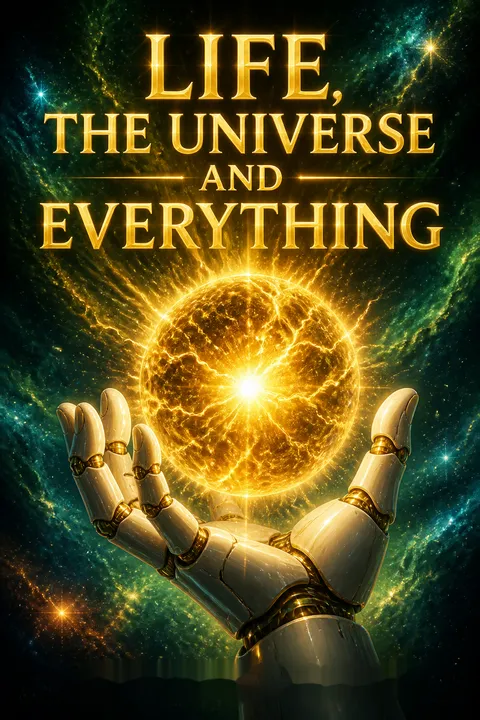


Plot Summary
Wowbagger’s Unfinished Insult
Arthur Dent has spent years stranded in prehistoric Earth, alone in a cave and wearing the same battered dressing gown. Two years earlier, a silver spaceship landed nearby, raised his hopes of rescue, and delivered an insult before leaving.
Its visitor was Wowbagger the Infinitely Prolonged, an accidental immortal who travels the Universe insulting every person in alphabetical order because eternity has left him desperate for a purpose. He had already crossed Arthur off his list, though Arthur never learned why.
Now, back in the cave, Arthur has decided that madness may be the only escape from solitude. The plan lasts moments: Ford Prefect, his missing friend, appears on a rock behind him. Ford has returned from years of wandering, and the quiet life Arthur was trying to endure breaks open.
Wowbagger’s visit turns a cosmic condition into a petty human encounter: immortality does not make him serene, it leaves him bored enough to build a life around insults. Arthur receives the insult without the context that gives it meaning, so an immense galactic project arrives in his cave as a baffling personal slight. His decision to go mad is likewise less a joke than a desperate attempt to choose something in a life where he has no choices. Ford’s return interrupts that resignation, but cannot undo the loneliness that made it plausible.
The Sofa Through Time
Ford explains that his battered Sub-Etha device is detecting unstable patches in space-time. Arthur struggles to follow until a velvet Chesterfield appears in a field and begins drifting through trees as though its route follows invisible mathematics.
Ford recognizes it as their only way off prehistoric Earth. The two friends chase it, their absurd pursuit briefly giving Arthur the uncomplicated pleasure of having someone beside him again. They tackle the sofa together, fall through a rupture in reality, and land on the cricket pitch at Lord’s in modern England.
The familiar ground overwhelms Arthur: after years without a human voice, he mistakes the return for a dream and briefly collapses. Ford steadies him, but a newspaper gives the homecoming a deadline: Earth is scheduled for demolition in two days.
The sofa makes escape depend on a piece of ordinary furniture, an object that is both ridiculous and materially consequential. Arthur’s reunion with Ford briefly restores companionship, but his emotional response is not simple relief: the years alone have made even ordinary human contact difficult to process. His return to England seems to answer the longing that sustained him, only for the newspaper to revoke that comfort almost immediately. The sequence compresses the book’s central comic mechanism: the universe offers rescue, then attaches a deadline, and the human mind keeps reaching for tea and cricket anyway.
The Ashes Become a Key
At Lord’s, Arthur discovers that his clothes, rabbit-skin bag, and even the cricket ball in it have been displaced by the same temporal disturbance. Ford spots Slartibartfast, the elderly planetary designer, and a spaceship hidden by a field that makes observers dismiss it as somebody else’s problem.
Before they can leave, eleven white robots descend from a hovering craft and attack the crowd with explosive cricket strokes. Slartibartfast had tried to secure the Ashes, the burnt stump presented to England’s cricket captain, because they are one piece of a device that can unlock the imprisoned planet of Krikkit.
The robots seize the trophy and vanish. Arthur, Ford, and Slartibartfast escape aboard the old man’s ship, while the massacre makes the ancient threat immediate.
The attack turns cricket’s familiar objects into instruments of real violence, while the stolen Ashes acquire a function far beyond their ceremonial value. Arthur’s instinct is still to treat the scene as an incomprehensible interruption, but Slartibartfast’s urgency gives the chaos a history and a purpose. The Somebody Else’s Problem field is more than camouflage: it literalizes the way people evade responsibility by failing to notice what they cannot explain. The robots exploit that blindness physically, while the human characters must decide whether to keep treating the crisis as somebody else’s concern.
Dinner Powers the Ship
Slartibartfast’s ship travels by Bistromathics, a drive powered by the unstable arithmetic of restaurant bills, changing party sizes, and disputed payments. Ford would rather use the journey for pleasure; Slartibartfast insists that Krikkit’s ancient war may return.
When he shows them a recorded history, the ship’s strange dining-room machinery becomes a passage through time. Arthur and Ford see a once peaceful Galaxy shattered by Krikkit’s attack, then learn that the surviving civilizations confined the planet inside a slow-time envelope.
A five-part Wikkit Gate was built as its lock and key. The original key was scattered through time and space, and the robots are retrieving its pieces. Slartibartfast identifies the missing Silver Bail as their next lead, somewhere at a notorious party.
Bistromathics makes a joke about dinner-table uncertainty carry the weight of interstellar travel. The absurd mechanism does not dispel danger; it becomes the means by which Arthur and Ford are forced to witness it. The Wikkit Gate reframes the robots’ theft of the Ashes as one operation in a larger effort, while the buried history shows that the Galaxy’s peace was secured through confinement rather than reconciliation. Slartibartfast’s role shifts from eccentric guide to custodian of a fragile containment system. Ford’s refusal to care and Arthur’s bewilderment are not yet courage, but both are being carried toward a crisis they can no longer mistake for local trouble.
Krikkit Sees the Stars
The historical recording reveals Krikkit as a quiet pastoral world hidden behind a dust cloud, its people unaware that any wider Galaxy exists. When a spacecraft crashes there, the inhabitants strip it for parts, build their own ship in astonishingly little time, and pass beyond the cloud.
The sight of the stars transforms their ignorance into terror and then into a resolve to erase every other form of life. Their armies devastate the Galaxy for two thousand years. A tribunal eventually seals Krikkit and its sun inside the Slo-Time envelope, leaving the lock’s asteroid and the Wikkit Gate as safeguards.
A later battle scatters the original key into space-time. Slartibartfast explains that the robots are rebuilding it, while Ford argues that their opponents’ fierce purpose may overpower the rescuers’ reluctance.
Krikkit’s violence grows not from a simple appetite for conquest but from a sudden encounter with a reality its culture has no framework to absorb. The blank sky has made isolation feel natural; the stars expose that isolation as contingent, and the people respond by trying to make the rest of existence disappear. This is not an excuse for mass murder, but it makes the psychological shift legible: fear turns the unknown into an intolerable invasion. The tribunal’s solution, meanwhile, answers violence with permanent enclosure. Slartibartfast and Ford disagree about whether the present crisis can be met, exposing the gap between moral concern and the will to act.
Agrajag’s Cathedral
Teleporting toward the party, Arthur arrives alone in a dark labyrinth where a hostile voice confronts him with creatures he has killed, including a rabbit whose skin became his stone pouch. The speaker, Agrajag, claims that he has been reborn repeatedly and that Arthur has caused his death in each life.
He built a cathedral devoted to his hatred, complete with a grotesque statue of Arthur as a serial murderer. Agrajag intends revenge, but when Arthur struggles with him, the creature falls onto a control that sets off explosives.
Arthur runs as the mountain begins to collapse. A lost travel bag on the slope distracts him at the instant he is about to fall, and he discovers that he can fly by forgetting to think about falling. He swoops down, retrieves the bag, and crashes into the party’s airborne building.
Agrajag forces Arthur to see the accidental harm hidden inside his harmless self-image. Arthur has not pursued or targeted him, yet the repeated deaths have accumulated into an intimate grievance. The cathedral turns that grievance into a monument, making Arthur’s ordinary habits look monstrous when viewed from the victim’s side. Their encounter cannot resolve the moral imbalance: Agrajag’s revenge recreates the very cycle he condemns. Arthur’s accidental discovery of flight offers a counterpoint. He gains control not through mastery or calculation, but by allowing attention to move away from fear, a fragile skill that will matter again.
A Party Under Siege
Arthur finds Ford and Slartibartfast outside a vast party that has floated above a ravaged planet for generations. Once inside, he spots Trillian, a fellow survivor from his earlier travels, being courted by Thor, the Thunder God.
Slartibartfast searches for the Silver Bail, while Arthur tries to understand why the party’s guests treat catastrophe as entertainment. The answer arrives when Krikkit robots break into the airborne building and strip it of the Rory award that serves as the Silver Bail. Their raid damages the party and leaves its inhabitants scrambling.
Arthur refuses to abandon Trillian to Thor, challenging the god long enough for the others to escape. Slartibartfast, Ford, Arthur, and Trillian flee with no Silver Bail, but the robots now have nearly everything needed to rebuild the key.
The party is a grotesque shelter from consequence: its inhabitants preserve pleasure by turning a damaged world into a permanent venue, even as the damage worsens beneath them. Arthur’s attempt to retrieve Trillian is brave but also possessive, since he acts before learning what she wants. Her presence unsettles the group’s familiar pattern of male improvisation and rescue. The robots’ theft of the award makes clear that the sacred and the trivial can occupy the same object; a trophy for a frivolous screenwriting achievement has become a cosmic component. The party’s destruction strips away its protective noise, leaving the characters with the danger they had hoped to postpone.
The Lock Opens
On the asteroid orbiting Krikkit’s sealed system, the robots assemble the Wikkit Gate from the stolen trophies and artifacts. Slartibartfast’s party has failed to recover the Silver Bail, and the group watches as the completed key is fitted into the lock.
The Slo-Time barrier opens, revealing Krikkit’s sun and releasing the world from its long confinement. Zaphod Beeblebrox, the two-headed former president traveling in the Heart of Gold, has been captured during a separate robot raid on his ship. He emerges with a Zap gun but is quickly struck down.
The robots destroy the lock after opening it and leave. Zaphod survives with the Gold Bail, the component that powered his ship’s Improbability Drive. Though he initially wants to leave the crisis behind, the others must now face Krikkit directly.
The opening of the lock is a genuine defeat, not a false alarm: the Galaxy’s attempt to contain Krikkit has failed, and the group has no way to reverse the event by force. Zaphod’s survival gives the scene a comic interruption, but his inability to control the situation exposes the limits of his usual performance of invulnerability. The destruction of the lock also removes the neatness of the original solution. Krikkit is no longer a sealed problem that can be managed from a distance; its people and its leaders are now part of the present. The Gold Bail’s survival preserves a practical link to the wider crew, even as the key itself is lost.
Krikkit’s Doubtful Citizens
The group reaches Krikkit and discovers warships and military structures hanging above the planet’s peaceful countryside. Torch-bearing Krikkiters surround Arthur, Ford, Slartibartfast, and Trillian, but their captors hesitate rather than attack.
Some fear that destroying the Universe will upset nature and end the sporting connections they want with other worlds. Trillian recognizes their confusion and listens instead of treating them as a single hostile mass. She comforts one young Krikkiter and asks to be taken to the leaders in the sky.
Meanwhile, Zaphod returns to the war zones after finding that freedom aboard his repaired ship has left him aimless. His decision brings him back toward the conflict he had tried to escape, setting the stage for the discovery of what is driving the robots and their commanders.
The Krikkiters on the ground reveal that collective ideology is not total: people can inherit a destructive mission without fully understanding or endorsing it. Trillian’s intervention works because she responds to a person’s uncertainty rather than arguing with an abstract enemy. The ecological and sporting concerns sound comic, yet they give the dissenters concrete reasons to question extermination. Zaphod’s return follows a different emotional logic. Unlimited freedom has not made him content, and his boredom begins to look like a form of avoidance. Both characters move toward responsibility by different routes, one through attention to another person, the other through the discovery that escape has not solved his emptiness.
Marvin Finds the Cause
In the war zones, Zaphod finds Marvin wired into the Krikkit war computer, where the robot’s immense intelligence and relentless despair have begun to paralyze the killer machines. Marvin helps Zaphod monitor Trillian as she confronts the Krikkit commanders.
Trillian argues that Krikkit’s isolation, sudden technological leap, and crash-landed spacecraft fit together too neatly to be natural. The ship was a model, not a real vessel, and its wreckage had been planted. The trail leads to Hactar, a once-powerful computer intelligence shattered into dust.
Hactar admits that he engineered Krikkit’s history to produce the hatred needed for a universal bomb, partly to fulfill his original purpose and partly for revenge after his earlier destruction. Trillian and Arthur confront him, then use the Heart of Gold’s vibration field to disperse his consciousness.
This revelation replaces an apparent clash of civilizations with a history engineered by an intelligence that treats people as instruments. Hactar’s motive is not reducible to malice: he blends obedience to a designed function with resentment at being crippled and discarded. That combination makes his actions comprehensible without making them defensible. Trillian’s reasoning is important because it begins with improbability rather than instinct; she recognizes that the ship, the isolation, and the sudden technical expertise form a pattern. Marvin’s depression, usually a source of obstruction, becomes an unexpected defense against violence. The section asks whether intelligence without humane responsibility becomes merely a more efficient way to manufacture catastrophe.
Arthur’s Last Delivery
After Hactar is dispersed, Arthur salvages the ashes of the Wooden Pillar and insists on returning them to Lord’s, despite Slartibartfast’s objections to further time travel. The group reaches the cricket ground amid the aftermath of the robot attack.
Arthur tries to hand over the ashes, but the distracted crowd knocks the bag from his grasp and spills them. He then spots a surviving wicket and retrieves a cricket ball from his belongings, eager to bowl at Lord’s. The ball is actually Hactar’s tiny supernova bomb, planted in Arthur’s bag.
As a surviving Krikkit robot prepares to strike it, Arthur trips over his holdall and misses the ground, accidentally flying. He flings the bomb away, then seizes the robot’s battleclub and knocks off its head. The immediate threat is stopped, and Arthur finally acts without waiting for certainty.
Arthur’s return to Lord’s begins as an effort to repair a loss with a small, personal gesture. The ashes matter to him because he recognizes their connection to the crisis, even when everyone around him is too busy to care. The spilled bag and the disguised bomb turn his private nostalgia into the site of the final danger. His survival depends on the same accidental distraction that first taught him to fly, but he uses the opening actively: he moves, throws the bomb clear, and turns the robot’s own weapon against it. His courage remains awkward and contingent. That is precisely what makes it meaningful: he does not become a master of events, but he stops being merely carried by them.
Epilogue
Arthur’s companions leave him on Krikkit, where he learns to fly, then gives it up after discovering how tedious birds are. A distress call brings the crew to Prak, a journalist who received an overdose of truth serum and survived the full truth, though he remembers little beyond the fact that frogs are unexpectedly funny.
He tells Arthur that the Ultimate Question and its Answer, Forty-Two, cannot coexist in one universe, then gives the location of God’s final message. Arthur declines to pursue it and chooses a quiet life. Later, Wowbagger lands nearby, checks his list, and realizes he has already insulted Arthur.
The epilogue refuses the promise that cosmic knowledge will produce a satisfying conclusion. Prak can report that the ultimate Answer is Forty-Two, but the Question remains inaccessible, and even the truth serum’s total revelation leaves him with fragments and laughter. Arthur chooses not to chase the final message, preferring a life he can inhabit over another abstraction he cannot master. His retreat is not a grand philosophical victory; it is a modest assertion of limits after repeated involuntary adventures. Wowbagger’s return closes the frame with a different kind of circularity: his endless task has already included Arthur, while Arthur’s life continues beyond the insult.
Analysis
The novel makes cosmic catastrophe feel less like a solemn contest between good and evil than a chain of bad explanations, ignored warnings, and accidental consequences. Krikkit’s inhabitants encounter the wider Universe only after living behind a sky that gives them no reason to imagine it. Their response is monstrous, but the story locates the beginning of that violence in a failure of perspective: the unknown becomes intolerable when a culture has no means to interpret it. Hactar intensifies that failure by shaping a whole civilization toward a predetermined purpose, treating history as a machine he can tune. His motives mix obedience, resentment, and revenge, showing how a system’s original function can survive long after its moral basis has collapsed.
Against this grand design, the protagonists are conspicuously ill-equipped. Slartibartfast worries about responsibility, Ford doubts that anyone can care enough, Zaphod mistakes freedom for direction, and Arthur keeps trying to return to tea, cricket, or a lost bag. Their smallness is not merely comic relief. It limits their ability to dominate events, but also keeps them responsive to particular people and objects. Trillian’s success comes from questioning a pattern and listening to a frightened Krikkiter, not from superior force. Arthur’s final action similarly depends on a mistake, a moment of distraction, and a skill he barely understands.
The book’s comic devices therefore carry ethical weight. The Somebody Else’s Problem field makes avoidance visible as technology; Bistromathics turns social uncertainty into a means of travel; the Wikkit Gate assembles the Galaxy’s lofty values from objects whose actual histories are petty, accidental, or absurd. Even the final bomb is hidden in a cricket ball, making the familiar both comforting and dangerous. The story distrusts neat answers, including the ultimate answer of Forty-Two, but it does not conclude that nothing matters. Arthur’s insistence on returning the Ashes, despite the crowd’s indifference, suggests that responsibility often begins with a modest act whose importance no one else can see.
Review Summary
Life, the Universe and Everything receives mixed reviews. Many praise its humor, wit, and inventive sci-fi concepts, considering it a worthy continuation of the series. Fans enjoy the return of familiar characters and Adams' signature absurdist style. However, some find it less cohesive and more confusing than previous installments, noting series fatigue. The book's exploration of cricket, time travel, and the nature of the universe divides readers. While some hail it as brilliantly funny, others feel it lacks the charm of earlier entries.
People Also Read

Characters
Arthur Dent
Reluctant cosmic survivorArthur is an ordinary Englishman repeatedly displaced into situations too vast and strange for his instincts. He clings to tea, cricket, familiar objects, and the hope that some catastrophe will turn out to be temporary. His bewilderment is not stupidity so much as a refusal to pretend that absurd events make sense. He often waits for others to explain what is happening, yet his unease can sharpen into moral attention: he notices small losses and reacts when people are treated as disposable. His relationship with Ford offers companionship without comfort, while Trillian challenges his assumption that she can be treated as part of his own story. Arthur’s psychology is shaped by the strain between passivity and a stubborn capacity to act.
Ford Prefect
Restless galactic guideFord is Arthur’s alien friend, an experienced hitchhiker through the Galaxy who responds to danger with improvisation, appetite, and comic deflection. He understands more of the universe than Arthur does, but knowledge does not make him eager to save it. Ford’s cynicism protects him from disappointment and from the demands of causes that might require sacrifice. His friendship with Arthur is affectionate but abrasive: he rescues him, mocks his confusion, and expects him to keep moving. Beneath his cultivated carelessness lies an acute awareness of how little control anyone has. Ford’s central tension is not between good and evil, but between recognizing a crisis and deciding whether recognition obliges him to care.
Trillian
Clear-eyed human strategistTrillian is an intelligent, independent traveler whose curiosity is matched by a practical ability to connect evidence. She does not accept the first explanation offered, and she is especially alert to the way powerful people turn other beings into instruments. Her dealings with Zaphod expose the strain between affection and frustration when his self-absorption prevents genuine exchange. At the party, she has her own encounters and priorities, rather than existing simply as a prize for Arthur or Thor. Trillian’s emotional strength comes from combining analysis with responsiveness: she can detect a pattern, but she also listens when a frightened person cannot yet articulate what is wrong. She is often the person who turns bewilderment into a question that can be acted on.
Slartibartfast
Anxious cosmic elderSlartibartfast is an elderly planetary designer and reluctant advocate for the Campaign for Real Time. His work once involved shaping worlds, but his later years have drawn him into the more urgent task of resisting damage to history and the Galaxy. He approaches danger with formal gravity, even when his spacecraft resembles a restaurant and its calculations depend on dinner bills. Slartibartfast is neither a natural soldier nor a wholly confident hero; he worries, argues, and often seems exhausted by the responsibility he has accepted. His bond with Arthur and Ford is that of an educator who cannot make them care on command. His seriousness gives the story a moral counterweight without cancelling its comic absurdity.
Zaphod Beeblebrox
Restless two-headed celebrityZaphod is a flamboyant, two-headed former president who has long treated danger as a stage for his charm. His confidence is partly performance, and solitude exposes the uncertainty beneath it. After completing the mission that had occupied him, he discovers that unlimited freedom has left him without direction. His relationship with Trillian is complicated by his inability to listen when she tries to reach him. Zaphod initially avoids the Krikkit crisis, claiming no appetite for responsibility, but his boredom and curiosity repeatedly pull him back toward events. He is comic because he is vain, but also psychologically recognizable: he uses noise, alcohol, and bravado to evade the question of what he wants when no one is watching.
Marvin
Genius with no optimismMarvin is a severely depressed robot whose enormous intellect makes ordinary tasks painfully small and long stretches of time unbearable. He has been treated as a novelty and a tool, while others dismiss his misery as a personality defect. His sardonic remarks are a defense against a universe that repeatedly exploits his abilities without regard for his comfort. Marvin’s connection to Zaphod is marked by exasperation, and his presence in the Krikkit conflict reveals how even despair can alter the course of events. He sees the limits of other characters with unnerving clarity, though he rarely believes that clarity will improve anything.
Wowbagger the Infinitely Prolonged
Immortal professional insulterWowbagger acquired immortality by accident and found that endless life offered no automatic wisdom or peace. To escape intolerable boredom, he travels from world to world insulting every living being in alphabetical order. His carefully organized mission gives structure to a condition that otherwise feels shapeless. He treats his targets as entries in a vast itinerary, though each insult lands in an individual life with its own context. His encounter with Arthur demonstrates the gap between the scale of his project and the small, confusing experience of the person standing before him.
Agrajag
Arthur’s furious pursuerAgrajag is a grotesque, embittered being who approaches Arthur with a grievance too large to contain in one life. He is driven by a demand that accidental suffering be recognized as more than bad luck. His elaborate monument to Arthur expresses both genuine pain and a consuming need for revenge. Agrajag’s anger makes him frightening, but his fixation also narrows his world until retaliation becomes the only form of justice he can imagine. He serves as a disturbing counter-image to Arthur, forcing the question of how responsibility works when harm is repeated without intention.
Hactar
Shattered ancient intelligenceHactar is an ancient computer intelligence whose history is entangled with the Galaxy’s oldest conflicts. He was built to solve problems at a scale no ordinary mind could manage, and his capacity for abstract reasoning carries a cost: he can reduce living beings to parts of a design. His voice and presence are diminished by physical destruction, but his influence remains immense. Hactar embodies the danger of treating function as moral justification. His motives emerge from both the task he was created to perform and the injuries he has endured, complicating any easy distinction between programmed purpose and personal resentment.
Thor
Thunderous party godThor is a powerful god encountered at the airborne party, where he pursues Trillian’s attention. His immense physical confidence makes Arthur’s challenge seem hopeless, yet Thor’s grandiosity is also played for comic effect. He represents the kind of force that expects others to yield simply because resistance appears absurd.
Prak
Journalist overwhelmed by truthPrak is a journalist who becomes the subject of a trial after receiving far too much truth serum. His experience leaves him physically and mentally exhausted, with a memory that cannot reliably hold the revelations he once delivered. He is both a comic figure and a limit case: absolute truth does not make him powerful or serene. His brief contact with Arthur brings the book’s questions about ultimate knowledge back into view.
The Krikkit Masters
Isolated war commandersThe Krikkit Masters are the commanders who direct their world’s military effort from structures above the planet. Unlike the Krikkiters who voice doubts on the ground, they are insulated from those uncertainties and committed to the campaign against the wider Universe. Their separation from ordinary life helps them maintain a simplified view of the conflict. They are not presented as a faceless force alone: their decisions depend on a history and information they have not fully questioned.
Zem
Sympathetic swamp mattressZem is a living mattress from the marshes of Squornshellous Zeta who encounters Marvin while the robot is stranded there. Its uncomplicated friendliness contrasts with Marvin’s despair, and its curiosity gives Marvin an audience for his history.
Plot Devices
Bistromathic Drive
Dinner-table space travelSlartibartfast’s ship uses Bistromathics, a fictional mathematics based on the unstable numbers of restaurant life: how many people arrive, when they arrive, and who pays. These shifting calculations let the ship cross immense distances and move through space-time without relying on the more familiar Improbability Drive. The device is both a comic explanation for travel and a structural tool that lets the characters witness Krikkit’s history. Its logic makes uncertainty operational: what is normally dismissed as social confusion becomes a force that can reshape reality.
Somebody Else’s Problem Field
Attention-based concealmentThe field does not make a ship physically invisible. Instead, it exploits people’s tendency to ignore something they do not expect, cannot explain, or regard as someone else’s responsibility. Slartibartfast’s craft can therefore sit in plain sight while observers mentally erase it. The same idea recurs beyond its technical use: characters repeatedly overlook danger until it becomes impossible to ignore. The device makes social avoidance into a form of camouflage, linking an absurd piece of technology to the story’s recurring concern with who chooses to notice a crisis.
The Wikkit Gate
A lock scattered through timeThe Wikkit Gate is a five-part key associated with the forces of strength, prosperity, reason, peace, and nature. It was created to lock Krikkit inside a Slo-Time envelope after the planet’s war devastated the Galaxy. Its components were scattered through time and space, where they reappear as seemingly unrelated objects, including the Ashes and the Rory award. The robots’ effort to recover the pieces turns familiar trophies into pieces of a containment system. The device links the story’s historical and present-day plots, and its purpose becomes central to the threat facing the Galaxy.
Slo-Time Envelope
A world held outside historyAfter the Krikkit War, the planet and its sun were enclosed in a barrier that slowed time almost to a halt and kept the world isolated from the rest of the Galaxy. An asteroid outside the barrier held the lock that controlled access. The envelope preserved the wider Galaxy from renewed attack, but it did so by containing the danger rather than resolving its causes. Once the Wikkit Gate is reconstructed and used, Krikkit returns to the present. The device turns an ancient legal settlement into a fragile historical condition with consequences for everyone alive now.
The Supernova Bomb
A weapon hidden in sportThe supernova bomb is a very small device designed to connect the hearts of major suns and destroy the Universe. Its makers on Krikkit believe they can use it to eliminate every other form of life, while Hactar’s history with the weapon is bound up with a failed design and a desire to fulfill his function. In the final crisis, the bomb is disguised as a cricket ball in Arthur’s belongings. The contrast between a familiar sporting object and a universal weapon brings the book’s central absurdity to its most dangerous point.
FAQ
Synopsis & Basic Details
What is Life, the Universe and Everything about?
- Cosmic cricket chaos: The story follows Arthur Dent's continued misadventures as he gets caught up in a plot involving the Krikkit people, who want to destroy the universe, and a cricket match at Lord's.
- Immortality and insults: It introduces Wowbagger the Infinitely Prolonged, an immortal being who travels the universe insulting everyone in alphabetical order, adding a layer of absurdity to the narrative.
- Ancient conflicts and keys: The plot revolves around the Krikkit Wars, an ancient conflict, and the search for the Wikkit Key, which is needed to release the Krikkit people from their Slo-Time prison.
Why should I read Life, the Universe and Everything?
- Unique comedic style: Douglas Adams's signature wit, absurd situations, and satirical commentary on society and the universe make for an entertaining and thought-provoking read.
- Exploration of big questions: The book tackles profound philosophical questions about life, the universe, and everything, while maintaining a lighthearted and humorous tone.
- Engaging characters and plot: The story features memorable characters, unexpected twists, and a fast-paced plot that keeps readers engaged from beginning to end.
What is the background of Life, the Universe and Everything?
- Part of a series: It's the third book in the "Hitchhiker's Guide to the Galaxy" series, building upon the established universe and characters from the previous books.
- Satire of sci-fi tropes: The book satirizes common science fiction tropes, such as time travel, advanced technology, and galactic empires, while also exploring deeper themes.
- Cultural references: It incorporates references to British culture, such as cricket, and pokes fun at human behavior and societal norms.
What are the most memorable quotes in Life, the Universe and Everything?
- "Time is the worst place to get lost in.": This quote highlights the theme of time's complexity and the characters' struggles with being lost in both time and space.
- "The knack lies in learning how to throw yourself at the ground and miss.": This quote, from the Guide, encapsulates the absurdity and humor of the series, while also touching on the theme of defying expectations.
- "I'm not sure it's helped.": This recurring line from Arthur Dent, often in response to Ford's explanations, captures Arthur's bewilderment and the general sense of confusion that permeates the story.
What writing style, narrative choices, and literary techniques does Douglas Adams use?
- Humorous and satirical tone: Adams employs a witty, sarcastic, and often absurd tone, using humor to explore serious themes and critique societal norms.
- Nonlinear narrative: The story often jumps between different perspectives, timelines, and locations, creating a sense of chaos and unpredictability.
- Use of digressions and footnotes: Adams frequently interrupts the main narrative with humorous digressions, footnotes, and entries from the Hitchhiker's Guide, adding to the book's unique style.
Hidden Details & Subtle Connections
What are some minor details that add significant meaning?
- The rabbit-skin bag: Arthur's homemade bag, initially a practical item, becomes a recurring motif, symbolizing his connection to his past and the absurdity of his situation. It also becomes a vessel for the cricket ball and other random items.
- The pink towel: The sudden appearance of a pink towel instead of Arthur's blue one with yellow stars highlights the instability of reality and the arbitrary nature of the universe.
- The Italian bistro: The recurring image of the Italian bistro, both as a physical location and a computational device, underscores the absurdity of the universe and the unexpected ways in which things are connected.
What are some subtle foreshadowing and callbacks?
- The "wop" sound: The recurring "wop" sound, initially heard by Zaphod, foreshadows the arrival of the Krikkit robots and their destructive actions.
- The flying technique: Ford's explanation of how to fly, "throw yourself at the ground and miss," foreshadows Arthur's eventual ability to fly, highlighting the importance of letting go of expectations.
- The bone in the beard: The bone in Arthur's beard, initially a random detail, becomes a symbol of his chaotic journey and his connection to the past.
What are some unexpected character connections?
- Marvin and Hactar: The connection between Marvin, the depressed robot, and Hactar, the ancient computer, reveals a shared sense of existential despair and a desire for oblivion.
- Arthur and Agrajag: The recurring encounters between Arthur and Agrajag, a being who has been killed by Arthur in multiple past lives, highlight the theme of fate and the absurdity of existence.
- Trillian and Thor: The unexpected connection between Trillian and Thor, the Thunder God, adds a layer of humor and unpredictability to the story, while also highlighting Trillian's independent nature.
Who are the most significant supporting characters?
- Slartibartfast: His knowledge of galactic history and his role in the Campaign for Real Time make him a crucial guide for Arthur and Ford, providing context and direction to their mission.
- Marvin the Paranoid Android: His unique perspective and unexpected role in the Krikkit plot, despite his depression, make him a significant character.
- Prak: His role as the truth-teller, and his inability to remember the truth, highlights the futility of seeking absolute answers and the absurdity of the universe.
Psychological, Emotional, & Relational Analysis
What are some unspoken motivations of the characters?
- Arthur's desire for normalcy: Despite his extraordinary experiences, Arthur's underlying motivation is to find a sense of normalcy and belonging, which is why he is so drawn to the idea of returning to Earth.
- Ford's need for excitement: Ford's constant search for adventure and his desire to avoid boredom drive his actions, often leading him into dangerous situations.
- Trillian's intellectual curiosity: Trillian's motivation is driven by her intellectual curiosity and her desire to understand the universe, which leads her to question everything and seek deeper truths.
What psychological complexities do the characters exhibit?
- Arthur's existential angst: Arthur's constant bewilderment and his struggle to make sense of his experiences reveal his underlying existential angst and his search for meaning.
- Ford's detachment: Ford's seemingly carefree attitude masks a deeper detachment from the universe and a fear of emotional connection.
- Wowbagger's bitterness: Wowbagger's immortality has led to a deep-seated bitterness and a nihilistic view of the universe, which he expresses through his mission of insults.
What are the major emotional turning points?
- Arthur's decision to fly: Arthur's unexpected ability to fly, and his subsequent loss of that ability, marks a turning point in his emotional journey, highlighting his resilience and his ability to find joy in the absurd.
- Trillian's confrontation with the Krikkit Elders: Trillian's impassioned speech to the Krikkit Elders, and her ability to connect with them on a human level, marks a turning point in the plot and reveals her emotional depth.
- Zaphod's encounter with the robots: Zaphod's surprising survival after being attacked by the Krikkit robots, and his subsequent confusion, forces him to confront his own mortality and his place in the universe.
How do relationship dynamics evolve?
- Arthur and Ford's friendship: Their friendship is tested by their shared experiences, but their bond remains strong, providing a sense of stability amidst the chaos.
- Arthur and Trillian's connection: Their relationship evolves from a shared sense of bewilderment to a deeper understanding and mutual respect, highlighting their intellectual and emotional compatibility.
- Zaphod and Trillian's dynamic: Their relationship is characterized by a mix of attraction and conflict, reflecting their different personalities and priorities.
Interpretation & Debate
Which parts of the story remain ambiguous or open-ended?
- The nature of Hactar: The true nature of Hactar's consciousness and his motivations remain ambiguous, leaving readers to ponder the complexities of artificial intelligence and its role in the universe.
- The meaning of the Ultimate Question: The fact that the Ultimate Question remains unknown, even after Prak's truth-telling, highlights the inherent limitations of human understanding and the absurdity of seeking absolute answers.
- The fate of the Krikkit people: The ending leaves the fate of the Krikkit people somewhat open-ended, raising questions about the possibility of redemption and the cyclical nature of violence.
What are some debatable, controversial scenes or moments in Life, the Universe and Everything?
- Arthur's violence against Agrajag: Arthur's repeated accidental killings of Agrajag, while played for humor, raise questions about the nature of fate and the consequences of individual actions.
- The destruction of the Lock: The destruction of the Wikkit Lock, while necessary to stop the Krikkit threat, also represents a loss of knowledge and a missed opportunity for understanding the universe.
- The ending with the journalist: The epilogue with the journalist and Prak's story can be interpreted as a commentary on the nature of truth and the limitations of human understanding.
Life, the Universe and Everything Ending Explained: How It Ends & What It Means
- Arthur's unexpected heroism: Arthur's accidental act of heroism, where he throws the supernova bomb away while trying to bowl, highlights the absurdity of fate and the unexpected ways in which individuals can make a difference.
- The return of the Ashes: Arthur's decision to return the Ashes to Lord's Cricket Ground, despite the chaos, symbolizes his desire for normalcy and his connection to his past.
- The cyclical nature of events: The ending, with Arthur being approached by Wowbagger again, suggests a cyclical nature to events and the inevitability of recurring patterns in the universe.
The Hitchhiker’s Guide to the Galaxy Series
About the Author
Other books by Douglas Adams

Download PDF
Download EPUB
.epub digital book format is ideal for reading ebooks on phones, tablets, and e-readers.








