

Key Takeaways
Separate ancient Cynicism's deliberate revolt from modern cynicism's resigned distrust
Two unlike attitudes. Ancient Cynicism, marked with a capital C, names a way of life associated with Diogenes: deliberately poor, shameless, confrontational, and aimed at unsettling accepted values. Its practitioners criticized their society by living in ways that made other possibilities visible. Modern cynicism, with a lowercase c, is widespread suspicion that people and institutions are selfish, and that efforts to improve society are futile. It often leaves the cynic accommodating the very order they distrust.
The distinction matters. Allen does not present ancient Cynicism as a cure for modern cynicism. He traces how a committed, disruptive practice gradually became associated with jaded resignation. The transition was neither sudden nor complete, and both forms have been interpreted and distorted by people who did not practice them.
What's useful here is the distinction between distrust as a tool and distrust as a settled worldview. In political life, suspicion can expose conflicts of interest and discourage naïve trust. But when suspicion treats every motive as corrupt, it can make accountability seem pointless, leaving powerful actors less challenged. The important question is not whether cynicism is justified in a particular case, but what the response enables. Ancient Cynicism gives distrust a public, embodied purpose. Modern cynicism, as Allen describes it, often turns a sound diagnosis of failure into permission to stand aside.
Treat philosophy as a way of living, not a doctrine to recite
Practice came first. No writings by Diogenes survive, and the familiar stories about him were collected centuries after his lifetime. They portray him less as a teacher of a fixed doctrine than as someone who tested ideas through daily conduct. One anecdote says that he discarded his cup after seeing a boy drink from his hands, deciding that even this possession was unnecessary. Another depicts him refusing Alexander's offer of a favor because the ruler was blocking the sunlight.
No tidy school followed. Cynic stories traveled through speech, memorable retorts, and imitation, rather than a canon of rules. Allen therefore treats Cynicism as improvised and shaped by circumstance. Calling it a philosophy with a settled program risks turning an unruly practice into a respectable doctrine, which would blunt the challenge it posed.
This account resembles traditions of practical philosophy in which character is formed through repeated action, not simply through the acquisition of propositions. It also points to a difficulty: a practice transmitted by anecdotes can be flexible and memorable, but its history is hard to verify. Diogenes' stories are not transparent recordings, and their contradictions resist a single authoritative interpretation. That uncertainty is not a reason to dismiss them. It is a reason to distinguish the historical figure, who remains difficult to recover, from the powerful cultural image built around his actions.
Make respectable norms explain themselves by exposing what they hide
Scandal was a method. The Cynic body challenged rules about what belonged in public. Stories describe Diogenes performing bodily acts openly, including at moments when an audience expected a polished philosophical performance. The point was not simply to shock. By doing what convention required people to conceal, the Cynic made the boundary between decent and indecent behavior visible, and invited scrutiny of who had set it.
The audience completed the act. Allen draws on the idea of parrhesia, a Greek term for fearless truth-telling. Diogenes pushed this practice beyond courteous debate, sometimes relying on insult or public disruption. His actions did not explain themselves; spectators supplied the moral standards that made them scandalous. Their outrage, in turn, revealed the norms the Cynic was testing.
The method has an affinity with performance art and protest, where an action can make an invisible rule suddenly legible. Its force depends on context: a gesture is provocative only if an audience recognizes what it violates. That dependency is also a weakness. Outrage can shift attention from the institution being challenged to the person causing offense, and humiliation can reproduce the very social cruelty a protest intends to expose. The Cynic tactic is therefore not a universal recipe for speaking truth. Its significance lies in how it forces a community to reveal its own standards.
Change what society values instead of simply rejecting its currency
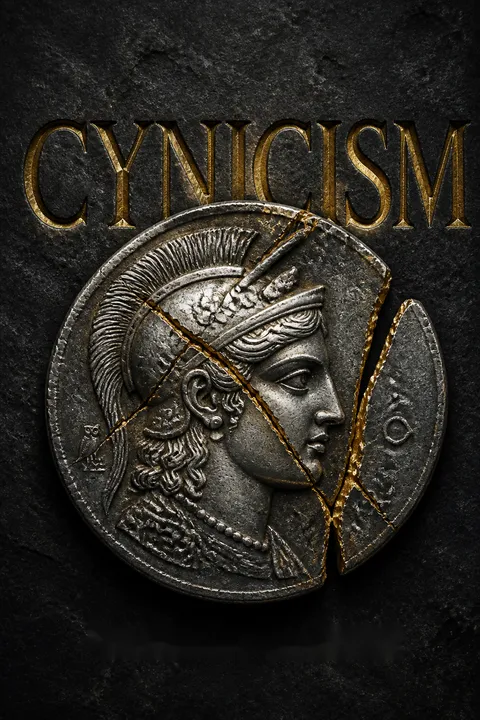
A coin became a metaphor. In an anecdote about the Delphic Oracle, Diogenes receives an instruction associated with changing the value of currency. The Greek word in the story can refer not only to money, but also to customs and laws. The story is linked to Diogenes' father, who reportedly worked at a mint, and to coins that were defaced. Allen emphasizes a more active possibility than simply destroying false currency: change its markings so that a different value can circulate.
Make the alternative tangible. The Cynic's way of life challenged familiar measures of worth, including wealth, status, refinement, and public honor. It was not a simple retreat into nature or a claim that every convention was bad. The Cynic used specific, often comic acts to expose how social values were made and maintained.
This image helps clarify the difference between critique and replacement. Exposing a value as socially constructed does not, by itself, make people abandon it. A competing practice can make another standard imaginable, but it may also be absorbed as a novelty or lifestyle. The same difficulty appears in efforts to change institutional norms: symbolic dissent can open a question, while lasting change requires people to alter the habits and incentives that keep the old measure in circulation. Allen's account is strongest when it treats Cynic conduct as an intervention, not as a complete blueprint for a new society.
Use poverty and humiliation to expose education's hidden coercion
Destitution was deliberate. Cynic poverty meant stripping life down to what seemed indispensable, sometimes even giving up an ordinary possession. Yet it could not produce complete independence: the poor Cynic relied on other people's alms. That contradiction made the dependence involved in social life impossible to ignore. Accepting public shame also challenged a culture that treated honor and self-command as marks of the free and respectable person.
Teaching turned rough. Stories show Diogenes testing would-be pupils with humiliating tasks, while another account has Crates winning a follower through a well-timed fart. Such episodes reject the idea that education is a gentle transfer of wisdom from an accomplished teacher to a grateful student. Allen argues that Cynics made visible the aggression and social discipline that more respectable educational traditions often disguise as benevolent guidance.
The account connects education to status: the authority to define proper conduct can be a form of power, even when exercised in the name of moral improvement. Cynic humiliation makes that power visible rather than pretending instruction is neutral. Still, deliberate shame is ethically risky. People with less social power are often already subjected to degradation, so a tactic that unsettles a privileged audience could harm someone else. The more durable insight is not that humiliation teaches well, but that educators and institutions should examine whose dignity their standards protect, and whose they treat as expendable.
Watch institutions sanitize dissent before they praise its wisdom
The surviving image was edited. Ancient Cynicism reaches modern readers mainly through accounts written by outsiders, often centuries after Diogenes. Stoic thinkers could present him as a model of self-control, while later writers rejected street Cynics as vulgar impostors. Emperor Julian, for example, praised an idealized, educated Cynic while condemning contemporary practitioners who insulted the powerful and mixed with ordinary crowds. Christian ascetic traditions carried forward poverty and renunciation, but often gave these practices a different spiritual meaning.
Respectability reshaped the inheritance. In late antiquity, Symeon the Fool was described as an unruly Christian ascetic whose public antics recalled Diogenes. Renaissance writers alternately praised Cynic self-restraint and condemned shamelessness. Each retelling preserved some features and discarded others. Allen's history is not a clean chain of influence; it is a story of selective borrowing, moral judgment, and repeated attempts to make Cynicism safe for respectable audiences.
This is a reminder that cultural memory is shaped by the people and institutions that preserve it. A disruptive tradition can survive precisely because its most disturbing features are filtered out, leaving a version that supports existing ideals. That possibility matters when reading any history of protest: a later celebration of a rebel may signal that the rebellion has become harmless, not that its original challenge was fully understood. At the same time, the source material cannot establish that every sanitized portrait was a deliberate act of suppression. Allen's argument is persuasive as a pattern of interpretation, not as proof of a single coordinated effort.
Notice when critique becomes a profitable excuse for complicity
Dissent could turn inward. In Diderot's dialogue about Rameau's Nephew, the nephew sees the corruption of the Parisian cultural elite and mocks its pretensions, yet adapts himself to the same world for survival and gain. His critique no longer points toward an alternative way of living; it becomes a skill for navigating the system he despises. This is a major step toward modern cynicism, where recognizing hypocrisy does not necessarily interrupt participation in it.
The Enlightenment also changed the inheritance. Rousseau attacked civilization's corruption but placed considerable hope in education and a return to nature. The Marquis de Sade pushed ideas of mastery and freedom toward a disturbing extreme, revealing how liberating claims can become instruments of domination. These writers do not represent one coherent Cynic school. Their different uses of Cynic ideas show how criticism can be redirected, softened, or made destructive.
A sharp critique can become a professional asset, a social identity, or a source of entertainment without changing the conditions it names. This is familiar in organizations that reward candor in meetings while leaving incentives untouched. Allen's example of the nephew captures the danger: insight is not the same as refusal. Yet the passage from critique to complicity is not inevitable. People sometimes work inside flawed institutions because they have limited choices or because that is where change can be made. The useful test is whether strategic participation has a credible purpose and limits, or merely renews itself as an excuse.
Treat cynicism as unfinished disenchantment, not proof that nothing matters
Distrust can follow disappointment. Allen argues that modern cynicism is not always simple selfishness or a settled belief that life is meaningless. It can arise when people continue to value ideals such as justice, education, or public service while repeatedly seeing their promises fail. The ideals remain attached to the person who distrusts them, even when that person claims to have given up.
Education illustrates the bind. Schools and universities promise improvement, fulfillment, and fairness, yet their failures are often answered with demands for more or better education. That response can turn disappointment into an endless cycle of reform. Allen also identifies a positive-sounding form of cynicism: institutions and critics may claim they must guide or rescue the public, while quietly assuming that people cannot govern themselves. Cynicism, then, can hide inside optimism as well as appear in public complaint.
This framing offers a useful alternative to treating distrust as either a character flaw or an accurate verdict on every institution. It asks what disappointed people still care about, and whether their criticism can be connected to that attachment. In organizational psychology, a sense of betrayal can coexist with strong investment in an institution; the disappointment is meaningful because expectations mattered. But Allen's account should not make every cynical attitude a disguised idealism. Some distrust is strategic, and some reflects real exclusion or exploitation. The distinction between warranted skepticism and totalizing resignation requires attention to evidence and context.
Adapt Cynic disruption to today's systems instead of reenacting Diogenes
Old gestures can lose their force. Allen's example of late Soviet society shows people performing official rituals without believing in them, while private jokes and a parallel culture quietly grew. This cynical distance helped weaken a system whose public language had lost credibility, though it was not a simple or guaranteed route to political change. The example suggests that nonparticipation can matter even when it does not look like a public protest.
Today's audience changes the tactic. Online platforms can convert outrage into attention and revenue, while authorities can classify unusual behavior as a problem to manage. A modern Diogenes repeating an ancient scandal might be mocked, monetized, or restrained rather than unsettling the order. Allen therefore proposes adapting the old Cynic impulse, not copying its familiar gestures: affirm dissatisfaction with the present order without pretending that a quick, clean solution is available.
The argument is strongest as a warning against equating visibility with resistance. Digital protest can spread a message and still feed the platforms that profit from attention; unconventional acts can be absorbed as content. The Soviet example also demands caution: everyday disengagement may erode authority, but it can leave collective organization and replacement institutions undeveloped. A productive contemporary Cynicism would need to preserve its refusal of false reassurance while finding ways to coordinate people and protect those exposed to retaliation. Allen offers a provocation more than a civic program, and that openness is both the proposal's appeal and its limit.
Analysis
Allen's central achievement is to recover Cynicism as a practice of opposition rather than a synonym for sour disbelief. The distinction between ancient Cynicism and modern cynicism supplies the book's organizing tension, but the historical narrative complicates any easy claim of descent. The ancient tradition is reconstructed through anecdotes preserved by people with their own agendas. Its afterlife is a sequence of selective inheritances: Stoic self-command, Christian renunciation, Renaissance moral examples, Enlightenment critique, and finally the modern figure who sees through hypocrisy yet often remains inside its machinery. This is less a family tree than a history of repeated translation.
The book's sharpest contribution is its focus on education. Cynic attacks on refinement challenge not only elite status, but the assumption that instruction is benign because it speaks in the language of improvement. Teachers, philosophers, and institutions can guide while also disciplining, humiliating, and reproducing social hierarchies. The Cynic's body makes those operations harder to ignore. Yet this emphasis also marks a limit: public scandal can expose a norm without specifying how a fairer arrangement should work. A tactic that unsettles one audience may injure another, and humiliation is not inherently emancipatory.
The closing proposal to intensify modern cynicism is deliberately unsettling. It resists the familiar demand that distrust be cured by renewed optimism, especially when optimism serves as a shield for institutions that have earned distrust. But intensified dissatisfaction does not automatically become collective change. The late Soviet example suggests that withdrawal from official belief can weaken a regime, while also showing the gap between quiet nonparticipation and organized alternatives. The book is most convincing when read as a diagnostic and a challenge: do not confuse knowing that a system is compromised with having escaped its influence. Its unresolved question is whether a deliberate, affirmative cynicism can sustain refusal without turning refusal into another comfortable identity or another profitable performance.
Review Summary
Cynicism receives mixed reviews, with an average rating of 3.78 out of 5. Readers appreciate its overview of cynicism's history and philosophical practice, from ancient times to modern interpretations. Some find it enlightening and approachable, while others consider it dense and academic. The book distinguishes between classical Cynicism and contemporary cynicism, exploring their implications and critiques. Reviewers commend the author's balanced approach, presenting arguments for and against cynicism. However, some criticize the book's wordiness and lack of depth in discussing modern cynicism.
People Also Read



Glossary
Ancient Cynicism
Embodied social revoltA loosely connected ancient Greek philosophical practice associated especially with Diogenes. Its practitioners used deliberate poverty, public shamelessness, blunt speech, and unconventional conduct to challenge prevailing customs and standards of worth. It was transmitted largely through lived example and anecdotes, rather than a stable school or doctrine.
Modern cynicism
Widespread resigned distrustA modern disposition that interprets human motives and institutions as fundamentally self-interested, often treating collective efforts at improvement as futile. Unlike ancient Cynicism's deliberate public challenge to convention, modern cynicism commonly operates as private grievance, political withdrawal, or accommodation to the order it distrusts.
parrhesia
Fearless truth-tellingAn ancient Greek term for frank speech that risks displeasing or angering its audience. The practice was generally associated with citizens and other socially privileged speakers. Cynics stretched its conventions by speaking from a marginal position and using insult, provocation, or public acts rather than relying on respectful dialogue.
paideia
Learned culture and formationA Greek and Roman ideal of education, cultivation, and cultural refinement. It could mark social distinction, but it also disciplined the conduct of those who possessed it by regulating speech, gesture, and public behavior. Allen treats it as a complex system that Cynic criticism could neither dismiss as mere ornament nor simply endorse.
Nihilism
Crisis of meaning and legitimacyIn Allen's discussion, nihilism is not simply the belief that nothing matters. It describes a modern crisis in which inherited sources of authority and shared standards lose credibility, while substitute ideals remain unable to provide secure meaning. People can continue to pursue ideals such as education while suffering from the gap between promised fulfillment and lived outcomes.
paternalistic cynicism
Control presented as careA form of modern cynicism in which authorities or institutions shape public conduct while claiming to benefit the people being managed. It may appear optimistic and benevolent, making it harder to recognize than openly self-serving manipulation. Its paternalism rests on distrust of the public's ability to act or govern itself.
enlightened false consciousness
Knowing complicity with ideologyA concept associated in the book with Peter Sloterdijk's account of modern cynicism. It describes people who understand that social ideals and institutions are compromised, yet continue to participate in them. Their awareness of how the system works does not necessarily free them from its habits, incentives, or underlying assumptions.
Cynic scandal of truth
Truth made visible through conductA way of understanding ancient Cynic truth as something enacted through a life that violates respectable expectations. Rather than presenting truth as an abstract doctrine, the Cynic makes a public spectacle of bodily and social conventions, provoking an audience to reveal the standards through which it judges the act.
Download PDF
Download EPUB
.epub digital book format is ideal for reading ebooks on phones, tablets, and e-readers.








