


Key Takeaways
Winning with money is 80% behavior, only 20% head knowledge
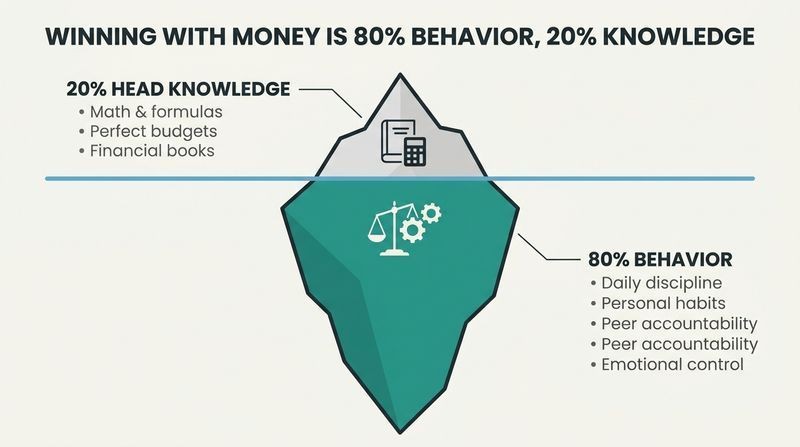
The math was never the problem. Ramsey discovered this as a young counselor when clients he had walked through perfect budgets kept filing for bankruptcy months later. They knew what to do; they just could not make themselves do it. His fix was borrowed from Weight Watchers: people lose weight not from magic food but from the accountability of stepping on a scale every Tuesday night. Group support changes behavior.
Ramsey earned this the hard way. In his twenties he built a $4 million real estate portfolio on borrowed money, then watched a bank call his loans and trigger an avalanche that wiped him out. Standing in the shower crying became his wake-up call. The principles he teaches are not clever; they are his grandmother's common sense applied with discipline.
This behavioral framing anticipates what economists like Richard Thaler formalized as behavioral economics: humans are not the rational actors classical finance assumes. Ramsey's Weight Watchers insight parallels research on commitment devices and social accountability in habit formation. The claim is largely sound, though the 80/20 split is rhetorical rather than measured. One tension worth noting: emphasizing behavior over knowledge can undersell cases where genuine information gaps (predatory loan terms, tax rules) actually do trap people. Still, the core point holds up well against evidence that financial literacy courses alone rarely change outcomes without accompanying structure and accountability.
Follow seven Baby Steps in strict order, one at a time

Focus beats simultaneous effort. Ramsey argues you cannot eat an elephant in one bite, so you attack money problems sequentially, pouring all energy into one goal before moving on. The sequence:
1. Save $1,000 starter emergency fund
2. Pay off all debt except the house using the debt snowball
3. Build three to six months of expenses in savings
4. Invest 15% of income into retirement accounts
5. Fund kids' college
6. Pay off the home early
7. Build wealth and give generously
Order is non-negotiable. He insists you stop retirement contributions during the debt payoff, even forgoing an employer match, because doing steps out of order eventually backfires. Without a full emergency fund, your 401(k) becomes your emergency fund, and cashing it out early costs roughly 40% in penalties and taxes.
The sequential design is psychologically shrewd: it reduces cognitive load and decision fatigue by giving people exactly one target. This mirrors goal-setting research showing that narrow, concrete goals outperform diffuse ambitions. The controversial move is pausing an employer 401(k) match, which is free money and mathematically costly. Financial planners frequently push back here, and they have a point for people with slow-moving debt. Ramsey's defense is behavioral, not mathematical: momentum and focus win more often than optimization. The honest reader should weigh their own discipline. If you can juggle debt payoff and capture a match without losing intensity, the rigid order may cost you.
Pay smallest debts first for momentum, not highest interest

The debt snowball defies the math. List every debt except your mortgage from smallest balance to largest, ignoring interest rates entirely. Pay minimums on all but the smallest, then throw every spare dollar at that one until it dies. Roll that payment into the next debt, and the freed-up cash grows like a snowball rolling downhill.
Why not attack the highest rate? Because personal finance is behavioral. Ramsey's retort: if you were purely rational about math, you would not have credit card debt in the first place. Quick wins on small balances deliver emotional victories that keep people going, the same way a gazelle needs an early burst of speed to escape a cheetah. Most families following this become debt-free (except the house) within about eighteen months.
Here Ramsey directly contradicts optimization, and the interesting twist is that research partly vindicates him. A 2016 Harvard Business Review study by Gal and McShane found that focusing on eliminating the number of accounts (the small-balance approach) was a better predictor of paying down debt than tackling high interest first. Motivation compounds. That said, for someone with a single massive high-interest payday loan alongside tiny debts, the interest cost of ignoring rates can be real. The snowball is a behavioral hack that trades a few dollars of efficiency for a large boost in follow-through, a trade most struggling households should happily make.
Debt is a marketed product, not a financial tool
The greatest marketing job in history. Ramsey reframes debt as something aggressively sold to you, not a service that helps you. Credit card revenue once topped $150 billion a year, more than the combined GNP of Egypt, Puerto Rico, and the Bahamas. The industry has made borrowers feel privileged to be approved, as if a platinum card confers status.
Debt is historically new. A 1910 Sears catalog declared buying on credit folly. J.C. Penney (the C stood for Cash) banned store credit while alive. In 1970 only about 15% of Americans held a credit card; by the book's writing, 77% did, averaging more than seven cards each. Ramsey debunks a stack of myths: car payments as a way of life, leasing as sophisticated, new cars as good deals (they lose 70% of value in four years), and debt consolidation as a fix.
The historical argument is genuinely illuminating and often overlooked: revolving consumer credit as a mass phenomenon is barely older than the interstate highway system. Framing debt as a product rather than a neutral tool is rhetorically powerful and mostly accurate about marketing intent. Where nuance helps: debt is not monolithic. A fixed-rate mortgage on an appreciating asset behaves very differently from a 24% store card, and Ramsey himself makes exceptions for home loans. The blanket moral framing (borrower as slave to lender) motivates behavior change but can lead some to avoid genuinely productive leverage. The myth-busting on cars and leasing, however, is financially airtight.
Give every dollar a job on paper before the month begins
A zero-based budget shows you the money. Write down income at the top, then assign every dollar to a category (including giving and saving) until income minus outgo equals exactly zero. John Maxwell's line captures it: a budget tells your money where to go instead of wondering where it went. One family discovered they were eating $1,200 a month in restaurant meals, effectively eating their retirement fund.
Expect it to fail at first. Ramsey warns the budget will not work in month one, will improve in month two, and smooths out around month three, because you are changing behavior, not doing arithmetic. He recommends the cash envelope system for problem categories like food, gas, and clothing: when the envelope is empty, spending stops. Spouses hold a monthly Budget Committee Meeting, both participating.
The zero-based approach is essentially what accountants call an assignment budget, and its power lies in eliminating the vague mental buffer where overspending hides. The envelope system exploits a well-documented neurological finding Ramsey cites: paying with cash activates the brain's pain centers in ways swiping plastic does not, and McDonald's saw average tickets jump from $4.75 to $7.11 when it began accepting cards. The three-month learning curve is honest and important; most budgeting failures are abandonment during early friction. A modern caveat: in an increasingly cashless economy, literal envelopes are harder to run, though the principle of category-capped spending translates cleanly to apps and separate accounts.
Your credit score measures debt love, not wealth
FICO is an I-love-debt rating. Ramsey attacks the cultural gospel that you need debt to build a good credit score. The score is calculated entirely from debt behavior: 35% payment history, 30% amounts owed, 15% length of credit history, 10% types of credit, 10% new credit. Income, savings, retirement accounts, and real estate count for nothing.
No score means you are winning, not losing. When Ramsey, debt-free for over two decades, tried to pull his own score, the system reported it could not generate one and noted the report showed no indication of being deceased. In other words, in a credit-addicted culture you nearly have to be dead to lack a score. He distinguishes a bad credit history from no credit history: pay bills with integrity and the score simply fades to nothing over years of not borrowing.
Factually, the FICO breakdown is accurate, and the observation that the score ignores net worth is correct and underappreciated. The rhetorical leap (that the score is therefore worthless) deserves scrutiny. In practice, landlords, insurers, and employers use credit scores as proxies, so a nonexistent score can create real friction for renters and job seekers, a cost Ramsey underweights. His counter is that a fully funded, debt-free life renders the score irrelevant, which is true once you arrive but less helpful during the transition. The deeper insight stands: optimizing your life around a metric that only tracks borrowing is optimizing for the wrong thing.
Buy term life insurance and invest the difference elsewhere
Insurance transfers risk; it is a lousy investment. Ramsey's rule: keep insurance and investing completely separate. Cash value (whole life) policies bundle a savings account into the coverage, but the returns run a weak 2-7% and, in his central example, when the policyholder dies the insurance company keeps the accumulated cash value and pays out only the face amount. A 30-year-old paying $140 a month for $125,000 of cash value could instead buy $400,000 of term for about $11 a month and invest the $130 difference into mutual funds, reaching over $1.5 million by age 70.
Cover the real risks. Get coverage worth ten times your income, insure stay-at-home parents too, and do not overlook disability insurance, the most underinsured area despite a one-in-three chance of a 90-day-plus disability before age 35.
The buy-term-and-invest-the-difference argument is mainstream among fee-only planners and is mathematically strong for most families, precisely because it unbundles two products that insurers profit from bundling. The critique from the insurance industry centers on edge cases: high-net-worth estate planning, lifelong dependents with special needs, and the behavioral reality that many people never actually invest the difference. That last point is the sharpest counter, since Ramsey's whole thesis is that behavior trumps math, yet here his plan depends on disciplined self-investing. His system resolves this by mandating the 15% retirement step, closing the loop. The disability insurance emphasis is genuinely valuable and routinely ignored advice.
Never pay retail: negotiate everything with That's not good enough
Four words save thousands. Ramsey's favorite negotiating phrase is simply That's not good enough, delivered while looking the seller in the eye, then staying silent. His Lucky Seven rules include: always tell the absolute truth, wield the emotional power of cash, keep your walk-away power, and stop talking (silence pressures the seller to cut their own price). Standing at a Jeep, saying nothing, he watched a salesman drop from $5,500 to $4,500, throw in new tires, and confess the car had been wrecked.
Aim for win-win. Negotiating is not immoral or predatory. Drawing on Getting to Yes, he tells of two women splitting one orange, only to discover one wanted the peel for baking and the other the fruit. Better communication would have given each 100% of what they needed. Patience and knowing where to look (individuals, estate sales, flea markets, pawnshops) unlock the biggest bargains.
Ramsey's negotiation playbook aligns with established research: silence and the willingness to walk away are among the most reliable sources of bargaining leverage, and cash reduces transaction uncertainty for sellers. The orange story from Fisher and Ury is the classic illustration of interest-based bargaining, distinguishing positions (I want the orange) from underlying interests (peel versus fruit). One useful extension from behavioral science: anchoring. Ramsey's That's not good enough works partly by refusing to let the seller's first number anchor the deal. A cultural note worth adding is that American discomfort with haggling is somewhat unique; in much of the world, negotiation is expected social ritual, not confrontation.
Start investing early because compound interest rewards time over amount
Ben beats Arthur despite investing less. Ben invests $2,000 a year from age 19 to 26, then stops forever, having put in just $16,000. Arthur starts at 27 and invests $2,000 every year until 65, totaling $76,000. Because of compound interest, Ben's eight-year head start pushes him past $2 million, roughly $700,000 ahead of Arthur, who invested nearly five times as much. Time, not amount, did the heavy lifting.
Keep it boringly simple. Ramsey recommends spreading long-term money evenly across four types of growth stock mutual funds (growth, growth and income, aggressive growth, and international) with track records of at least five years, ideally ten or more. He avoids single stocks (Enron vaporized $74 billion), bonds, gold (a 2.38% return over 177 years), and get-rich-quick schemes. As a billionaire told him, every time he rereads The Tortoise and the Hare, the tortoise wins.
The Ben and Arthur illustration is the single most effective teaching device for compounding ever popularized, and the underlying math is real, though it relies on an assumed 12% return that draws heavy criticism. The S&P 500's long-run nominal average is closer to 10%, and after fees and inflation, real returns are lower still, so Ramsey's projections tend to run optimistic. The diversification-through-mutual-funds advice is sound but arguably dated: low-cost index funds now typically beat the actively managed funds he favors, since most active managers underperform their benchmarks over time. The core lesson, start now and stay invested through volatility, remains among the most durable truths in personal finance.
Buy homes with a 15-year fixed mortgage capped at 25% of pay
The only debt Ramsey tolerates. If you must borrow for a house, his rule is a 15-year fixed-rate conventional mortgage, at least 10% down (20% avoids private mortgage insurance), with a payment no larger than 25% of your take-home pay. On a $225,000 loan at 6%, choosing 30 years over 15 saves $550 a month but costs an extra $143,000 in interest and fifteen more years in debt. The myth that you should keep a mortgage for the tax deduction fails basic math: you do not send a bank $10,000 in interest to avoid paying $3,000 in taxes.
Buy and sell strategically. When selling, think like a retailer: spotless presentation, curb appeal, and strong internet photos (90% of buyers shop online first). When buying, location rules, buy at the bottom of a good neighborhood's price range, and look past cosmetic flaws you can change. Avoid adjustable-rate mortgages, reverse mortgages, mobile homes, and timeshares.
The 15-year, 25%-of-income rule is conservative and would have insulated millions from the 2008 collapse that Ramsey references, when adjustable-rate and interest-only loans blew up. The tax-deduction debunking is correct arithmetic that surprises many homeowners. The constraint's weakness is accessibility: in high-cost coastal markets, a 15-year note under 25% of take-home pay is out of reach for most buyers, effectively pricing them out of ownership entirely, which carries its own long-term wealth cost given housing appreciation. The buy-low-in-the-neighborhood and cosmetic-flaw advice reflects genuine real estate expertise. His timeshare warning is unimpeachable; the secondary market for timeshares is notoriously close to worthless.
Teach kids money comes from work by paying commissions, not allowances
Commissions, not allowances. Ramsey paid his children for completed chores rather than handing out unconditional allowances, forging the emotional link between work and money early. Kids should learn four uses of money: work, save, spend, and give. For ages 6-12, a chore chart paid $1 per job, split into three envelopes labeled giving, spending, and saving.
Prepare them to launch. By the teen years, the Ramseys told their kids no free car at sixteen; instead they offered 401DAVE, matching the child's own savings dollar for dollar (with a cap). Kids got debit cards, never credit cards, and managed their own clothing and activity budgets, making mistakes while still under the roof. He warns against boomerang kids: one-third of men ages 22-34 were living with parents, and a home should be a safety net that catches you, not a tent you camp in.
The commission model reflects sound developmental psychology: linking effort to reward builds internal locus of control, a trait correlated with later financial and life outcomes. The three-envelope system is a concrete, age-appropriate way to teach the abstract concept that income must be allocated, mirroring the adult zero-based budget. Where reasonable people differ: some child development researchers argue certain chores should be unpaid contributions to family life, teaching that not everything is transactional, and Ramsey partly concedes this. The boomerang critique is more culturally loaded; rising young-adult co-residence also reflects structural factors like student debt and housing costs, not merely parental coddling, so the tough-love framing oversimplifies a genuine economic shift.
Giving unclenches the fist and makes you a manager, not an owner
The great misunderstanding. Ramsey names the false belief that having more requires holding tighter. Picture gripping $1,000 in a clenched fist: nothing escapes, but nothing new can enter either, and the clenched fist is the universal sign of anger. An open hand both gives and receives. Golda Meir's line captures it: you cannot shake hands with a clenched fist.
You are a steward, not an owner. The word steward originally meant one who manages another's wealth, like a medieval lord's estate manager who controlled everything yet owned nothing. Reframing yourself as a manager of God's resources makes giving easy, the way an accountant feels nothing writing a company check. Ramsey argues unselfish people prosper in relationships and wealth, and recommends keeping the goose (your wealth-producing capacity) while generously giving away the golden eggs, rather than giving away the goose and losing the power to help at all.
Though framed in explicitly Christian terms (this is the handbook for a faith-based course), the underlying insight is empirically supported across secular research: Dunn, Aknin, and Norton's studies show that spending on others reliably increases happiness more than spending on oneself, and generosity activates reward circuitry in the brain. The steward reframing is a cognitive reappraisal technique, loosening the psychological grip of loss aversion by shifting perceived ownership. The goose-and-eggs metaphor is a thoughtful rebuttal to naive redistribution arguments, insisting that preserving productive capacity serves the poor better than liquidating it. Readers outside the religious framing can extract the same behavioral core: habitual generosity correlates with wellbeing and, counterintuitively, with long-term prosperity.
Analysis
Dave Ramsey's Complete Guide to Money is the companion handbook to Financial Peace University, and its structure mirrors that classroom origin: thirteen thematic chapters, each closing with a real graduate testimonial, reflection questions, and key points. It is best understood not as a work of financial theory but as a behavior-change curriculum dressed in folksy Tennessee storytelling, biblical citation, and blunt moral certainty. The genre is prescriptive self-help finance, and its intended audience is the ordinary, indebted, financially anxious household rather than the sophisticated investor.
The book's intellectual spine is a single contrarian claim: that personal finance is overwhelmingly a behavioral problem, not an informational one, and that optimization (chasing the highest interest rate, capturing every employer match, maximizing tax deductions) routinely loses to focus, momentum, and psychological wins. This is where Ramsey is most original and most defensible. The debt snowball, the sequential Baby Steps, and the cash envelope system are all deliberate sacrifices of mathematical efficiency in service of follow-through, and emerging behavioral research has partly vindicated this trade.
The weaknesses are equally clear. Ramsey's assumed 12% investment returns are optimistic and have drawn sustained, legitimate criticism. His preference for actively managed mutual funds over low-cost index funds is dated. His blanket moral framing of all debt as bondage, while motivationally potent, flattens meaningful distinctions between predatory revolving credit and productive leverage. And his housing rules, sensible as insulation against 2008-style collapse, are increasingly unattainable in high-cost markets.
What endures is the psychological architecture. Ramsey understood before it was fashionable that shame, denial, spousal conflict, and impulse operate as the real machinery of money, and that a group of families sitting knee to knee changes behavior in ways a spreadsheet never will. The book's lasting value is less its specific tactics than its insistence that dignity, discipline, and generosity, not cleverness, are what actually produce financial peace.
Review Summary
Dave Ramsey's Complete Guide to Money offers practical financial advice for getting out of debt and building wealth. Readers appreciate Ramsey's straightforward approach and easy-to-understand explanations of complex topics. Many found the book life-changing, praising its budgeting tips and debt-reduction strategies. Some critics note the heavy Christian influence and simplistic view of debt. Overall, reviewers agree the book provides valuable guidance for financial success, though some caution against following all advice without considering individual circumstances.
People Also Read







FAQ
What's Dave Ramsey's Complete Guide To Money about?
- Financial Peace University Overview: The book is a manual for the principles taught in Financial Peace University, focusing on personal finance management.
- Seven Baby Steps: It introduces a step-by-step plan for getting out of debt, saving money, and building wealth.
- Behavioral Focus: Emphasizes that personal finance is 80% behavior and only 20% head knowledge, aiming to change mindsets about money and debt.
Why should I read Dave Ramsey's Complete Guide To Money?
- Transformative Financial Principles: Offers practical advice that is easy to follow and has changed the lives of millions.
- Real-Life Success Stories: Includes testimonials from individuals who have successfully applied the principles, serving as motivation.
- Comprehensive Resource: Covers everything from budgeting to investing, making it a valuable resource for improving financial situations.
What are the key takeaways of Dave Ramsey's Complete Guide To Money?
- Baby Steps Framework: Outlines seven Baby Steps, including saving an emergency fund and investing for the future.
- Importance of Saving: Advocates for a beginner emergency fund of $1,000 as a crucial step for financial stability.
- Debt is Dumb: Provides strategies for eliminating debt through the Debt Snowball method, emphasizing that debt is detrimental to financial health.
What is the "Baby Steps" method in Dave Ramsey's Complete Guide To Money?
- Seven Steps to Financial Peace: Guides individuals toward financial stability, from getting out of debt to building wealth.
- Step-by-Step Approach: Each step must be completed before moving on to the next, ensuring a solid financial foundation.
- Long-Term Financial Success: Aims to achieve financial peace and the ability to give generously.
What is the Debt Snowball method mentioned in Dave Ramsey's Complete Guide To Money?
- Pay Off Smallest Debts First: Focuses on paying off the smallest debt first to build momentum and motivation.
- Behavioral Focus: Emphasizes behavior modification over mathematical calculations, providing emotional boosts from quick wins.
- Financial Freedom: Systematically eliminates debts, freeing up income for savings and investments.
How does Dave Ramsey's Complete Guide To Money address budgeting?
- Monthly Budgeting Requirement: Stresses the importance of creating a written budget every month to track income and expenses.
- Zero-Based Budgeting: Introduces a method where every dollar is allocated to specific expenses, promoting intentional spending.
- Envelope System: Recommends using the envelope system for discretionary spending categories to control and prevent overspending.
What is the significance of having an emergency fund according to Dave Ramsey's Complete Guide To Money?
- Financial Safety Net: Allows individuals to cover unexpected expenses without resorting to debt.
- Beginner Emergency Fund: Suggests starting with $1,000, providing security as individuals work through their financial plan.
- Long-Term Security: Encourages saving three to six months' worth of expenses for long-term financial stability.
What are some common myths about debt discussed in Dave Ramsey's Complete Guide To Money?
- Debt as a Tool: Debunks the myth that debt is useful for building wealth, encouraging readers to view it as a hindrance.
- Cosigning Loans: Warns against cosigning loans, explaining the financial and relational risks involved.
- Credit Scores: Challenges the belief that a high credit score equates to financial success, focusing instead on building wealth.
How does Dave Ramsey's Complete Guide To Money suggest dealing with collectors?
- Know Your Rights: Emphasizes understanding rights under the Fair Debt Collection Practices Act (FDCPA).
- Set Priorities: Advises prioritizing basic needs over paying collectors to ensure essential needs are met.
- Pro Rata Plan: Recommends distributing available funds among creditors if unable to make minimum payments.
What are some common myths about life insurance discussed in Dave Ramsey's Complete Guide To Money?
- Cash Value Insurance: Argues that cash value life insurance is a poor investment choice compared to term life insurance.
- Life Insurance as Permanent: Explains that life insurance is not a lifelong necessity if you become self-insured.
- Insurance as an Investment: Clarifies that insurance should not be viewed as an investment vehicle.
How does Dave Ramsey's Complete Guide To Money recommend planning for retirement?
- Invest 15% of Income: Advises investing 15% of household income into retirement accounts like Roth IRAs and 401(k)s.
- Start Early: Emphasizes the importance of starting early to benefit from compound interest.
- Diversify Investments: Recommends diversifying investments across different mutual funds to minimize risk.
What are the best quotes from Dave Ramsey's Complete Guide To Money and what do they mean?
- "If you will live like no one else, later you can live like no one else.": Encourages making sacrifices now for future financial freedom.
- "The borrower is slave to the lender.": Highlights the negative impact of debt on personal freedom.
- "A budget is just telling your money where to go, instead of wondering where it went.": Underscores the importance of budgeting in managing finances.
About the Author
Other books by Dave Ramsey







Download PDF
Download EPUB
.epub digital book format is ideal for reading ebooks on phones, tablets, and e-readers.








