

Plot Summary
Night of the King's Passage
The king of Oyo has been dead for nearly a month, and the final rites require Elesin, his appointed horseman, to die so he can accompany his ruler into the ancestral world. On the evening of the passage, Elesin enters the closing market surrounded by drummers and the women who cherish him.
His Praise-Singer tests his resolve with a tale about people who deny hearing Death approach, while Elesin presents himself as ready to meet his duty. The women dress him in richly valued cloth and affirm the importance of his departure. Beneath the celebration, however, Elesin savors the market, its people, and the life he is about to leave, making his confidence feel both commanding and precarious.
The opening makes death a public obligation rather than a private crisis. Elesin's standing rests on the community's confidence that he will complete a passage on which their shared order depends. Yet his delight in food, women, and admiration complicates the image of a willing ritual figure. The Praise-Singer's warnings do not expose a clear plan to refuse; instead, they make the audience listen for the difference between declaring resolve and possessing it. The market matters because it is the living world Elesin claims to leave freely. Its warmth gives the rite emotional weight, while his appetite hints at the human attachment that may resist his ceremonial role.
The Bride's Borrowed Night
A young woman passing through the market catches Elesin's attention. Iyaloja, the market's elder, explains that the girl is promised to her own son, but Elesin asks to marry her before he undertakes the passage. Iyaloja first warns him that a traveler should consider what he leaves behind.
Then she agrees, judging that the community cannot deny the final wish of the man entrusted with its rite, even at her family's cost. The women prepare the bride, and Elesin takes her into the bridal chamber. When he emerges, he presents their union as a final joining of life and death, with a child conceived as a gift to the future. His last celebration of earthly life now carries a private, intimate claim on him.
The marriage places a personal desire inside a communal ceremony. Elesin describes the union as service to continuity, and Iyaloja accepts that reasoning because she believes the ritual's needs outrank her son's ordinary claim. Yet the bride is not simply an emblem: her body and future are drawn into a decision made by men and elders around her. The episode also sharpens the play's psychological tension. Elesin's wish for a final experience of life can be understood as ritual preparation, but it also deepens his attachment to the world he must leave. Iyaloja's warning remains present even after she yields, giving the celebration an undertow of unease.
An Arrest Ordered at Midnight
At the District Officer's residence, Simon Pilkings and his wife Jane wear confiscated egungun garments, ancestral masquerade clothing, as fancy dress for a ball honoring a visiting British prince.
Sergeant Amusa arrives with urgent news about Elesin's planned death, but the costume makes him refuse to discuss the matter in their presence. Once he has gone, the Pilkingses learn from their houseboy Joseph that the rite is meant to accompany the dead king, not murder another person.
Pilkings decides to arrest Elesin, yet continues preparing for the ball and sends instructions through Joseph. He plans to hold the horseman at the residence rather than in a local cell, believing that his authority can contain both the ritual and any public reaction.
Pilkings does not encounter Yoruba ceremony on its own terms. He treats the planned death as a legal problem and the masquerade garments as harmless entertainment, while Amusa's reverence makes the same clothing impossible for him to ignore. The mismatch is more than ignorance: Pilkings can convert a sacred object into costume because colonial power gives him control over its use, whereas Amusa risks humiliation if he violates its meaning. The ball's presence makes the intervention feel routine and self-assured. Pilkings thinks he is preventing an individual death; he does not grasp that his action enters a communal and cosmological process whose consequences cannot be confined to his study.
Women Bar the Market
Amusa and two constables reach the market to arrest Elesin, but the women block their path to the bridal chamber. They mock the officers' borrowed authority, seize their batons and hats, and drive them away without violence.
Their resistance protects the ritual from an immediate police raid, but it cannot keep Pilkings from intervening later. After the marriage, Elesin appears before the community and listens for the drums that mark the king's final passage. He begins the solemn dance that should carry him toward death.
Pilkings arrives at the chosen place, interrupts the rite, and has Elesin restrained in chains. The horseman is taken to the Residency alive, while the women's successful defiance at the market has failed to prevent the decisive colonial intervention.
The women's action shows that colonial authority is neither seamless nor universally accepted. Amusa's uniform does not command the market once its women decide he has no right to enter, and their ridicule exposes the gap between official power and local legitimacy. But this victory is bounded: they can repel the sergeant, not prevent Pilkings from reaching Elesin at the moment of transition. The sequence makes the intervention's force concrete rather than abstract. It interrupts a ceremony already underway and converts a public, spiritually charged act into police custody. The women's agency remains real, but their control over the event is constrained by the institutions surrounding them.
Olunde Returns to Mourning
Olunde, Elesin's eldest son, returns from medical studies in England after receiving news that the king has died. At the Residency ball, Jane recognizes him and speaks with him while Pilkings is away.
Olunde explains that he came home to bury his father and argues that his education abroad has not made him incapable of understanding his people's obligations. He also sees a parallel between the horseman's sacrifice and a ship's captain who died to prevent a burning vessel from killing others.
When the drums change, Olunde believes the rite has been completed and his father is dead. Then Pilkings returns with Elesin in chains. Olunde faces his living father, rejects him in shame, and walks away, leaving Pilkings and Jane to confront a rupture they cannot explain away.
Olunde unsettles the colonial assumption that education makes him an uncomplicated convert to British judgment. His medical training and experience in England give him another vocabulary for sacrifice, not a reason to abandon his community's framework. Jane's account of the ship captain lets him recognize that British society also accepts chosen death when it protects others, though it labels that act differently. The changed drums briefly lead him to believe his father has fulfilled his role. Seeing Elesin alive transforms private bereavement into moral judgment. His rejection is not presented as a simple victory over his father; it registers the cost of a failure that now implicates the family and the community.
The Cell's Unfinished Oath
In the Residency cell, Elesin tells Pilkings that the arrest has broken more than his own life: the king's passage and the community's order have been left incomplete. He admits that his desire for the bride had already made him cling to earthly life, but insists that Pilkings's intervention further shattered his resolve.
Iyaloja visits with the bride and condemns Elesin for failing the duty he had confidently accepted. She reminds him that he had been warned about leaving a child behind and accuses him of choosing the world's scraps over his people's trust. Pilkings keeps the visitors behind a marked boundary, but Iyaloja says a burden is coming. She persuades him to admit the women, who enter carrying a long, cloth-covered form.
The cell forces Elesin to face two causes at once: his own attachment to life and the colonial interruption that made his failure final. He tries to distinguish them, but Iyaloja refuses to let his explanation erase his responsibility. Her rebuke is grounded in the earlier choices he made, especially the marriage he requested after she warned him. The cell's barriers make power visible: Pilkings controls movement, while Iyaloja's authority comes from naming what his control cannot repair. The covered burden changes the scene's pressure without yet disclosing its meaning. The women bring the consequence of the failed passage into the very space designed to contain it.
A Son Carries the Passage
The women uncover the burden: Olunde's body. He has died in his father's place, preserving the family's and community's honor when Elesin did not complete the passage. Iyaloja tells Elesin that his son has borne the responsibility he abandoned. Faced with Olunde's death, Elesin uses the chain around his neck to strangle himself, but his act comes too late to restore what has been broken.
Pilkings tries to revive him; Iyaloja stops him from treating the body as an object in his custody. The bride enters the cell and gently closes Elesin's eyes with earth. Iyaloja then leads her away, directing attention from the dead toward the unborn life the bride carries.
The play's tragedy is built from conflicting accounts of what counts as duty, harm, and survival. Pilkings treats Elesin's intended death as a preventable individual loss, while the Yoruba community understands the king's passage as a link among the living, the dead, and those yet to be born. The colonial officer's intervention is therefore not neutral protection: by arresting Elesin, he disrupts a ritual whose social consequences he does not understand. Yet the play does not make Elesin a blameless symbol of tradition. His hunger for the bride and for earthly pleasure precedes the arrest, and Iyaloja insists that his own hesitation belongs in the explanation of failure.
Olunde complicates any easy opposition between African custom and Western modernity. His time in England and his medical education do not erase his allegiance to his people; instead, he recognizes that British culture also honors self-sacrifice when it serves a collective purpose. The different names given to such acts reveal how power shapes moral judgment. The colonial ball, with its borrowed ancestral clothing, sharpens this imbalance: Pilkings can turn what he does not understand into spectacle, then enforce his own interpretation of the law.
The women are not a passive chorus. They protect the market, weigh the ritual against personal claims, and carry the consequence into the cell. Iyaloja's authority rests on memory and responsibility, not official force. The ending refuses consolation: Olunde's death and Elesin's belated suicide cannot repair the disrupted passage. The bride's final act of care and Iyaloja's attention to unborn life do not erase the loss; they mark the community's difficult task of continuing after an irreversible breach.
Analysis
The play's tragedy is built from conflicting accounts of what counts as duty, harm, and survival. Pilkings treats Elesin's intended death as a preventable individual loss, while the Yoruba community understands the king's passage as a link among the living, the dead, and those yet to be born. The colonial officer's intervention is therefore not neutral protection: by arresting Elesin, he disrupts a ritual whose social consequences he does not understand. Yet the play does not make Elesin a blameless symbol of tradition. His hunger for the bride and for earthly pleasure precedes the arrest, and Iyaloja insists that his own hesitation belongs in the explanation of failure.
Olunde complicates any easy opposition between African custom and Western modernity. His time in England and his medical education do not erase his allegiance to his people; instead, he recognizes that British culture also honors self-sacrifice when it serves a collective purpose. The different names given to such acts reveal how power shapes moral judgment. The colonial ball, with its borrowed ancestral clothing, sharpens this imbalance: Pilkings can turn what he does not understand into spectacle, then enforce his own interpretation of the law.
The women are not a passive chorus. They protect the market, weigh the ritual against personal claims, and carry the consequence into the cell. Iyaloja's authority rests on memory and responsibility, not official force. The ending refuses consolation: Olunde's death and Elesin's belated suicide cannot repair the disrupted passage. The bride's final act of care and Iyaloja's attention to unborn life do not erase the loss; they mark the community's difficult task of continuing after an irreversible breach.
Review Summary
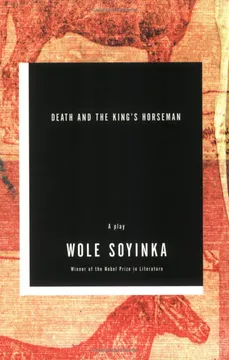
Death and the King's Horseman is a powerful play exploring Yoruba culture, colonialism, and the clash between tradition and modernity. Readers praise Soyinka's poetic language, complex characters, and exploration of themes like duty, honor, and cultural misunderstanding. Some find the dialogue challenging but appreciate the play's depth and tragic elements. Critics debate whether to focus on the cultural conflict or the broader metaphysical themes. Many recommend seeing a live performance to fully appreciate the work's impact and artistry.
People Also Read


Characters
Elesin
The king's appointed riderElesin is the king's horseman, chosen to accompany the dead ruler into the ancestral world. He is vigorous, theatrical, and deeply at home among the market women who celebrate him. His public confidence comes from being treated as a figure whose actions carry communal meaning, but his pleasure in food, admiration, and women makes him recognizably attached to ordinary life. That tension gives his certainty psychological depth: he does not approach the rite as an abstract doctrine, but as a person asked to surrender everything he enjoys. His relationship with his son and with Iyaloja is shaped by inherited duty, authority, and the expectations he has encouraged others to place on him.
Olunde
The heir educated abroadOlunde is Elesin's eldest son, studying medicine in England when the king dies. His father had opposed his departure because Olunde's place in the family carried responsibilities at home. In England, Olunde observes both medical suffering and the willingness of people to risk their lives for others. He returns thoughtful rather than dazzled, able to question British assumptions while recognizing the courage he has witnessed there. His calm manner can be mistaken for distance, but it reflects discipline and a capacity to consider death without reducing it to either spectacle or taboo. His bond with Elesin holds both filial respect and a serious disagreement about what their family owes its community.
Iyaloja
The market's moral authorityIyaloja is the senior woman of the market and a guardian of its collective interests. She speaks with the authority of someone responsible for people, trade, memory, and custom, not merely for her own household. Her willingness to yield her son's betrothed to Elesin shows how seriously she takes the ritual, but she is no unquestioning supporter: she warns him, measures his choices, and expects him to accept their consequences. Iyaloja's strength is practical as well as symbolic. She can organize the women, challenge officials, and insist on proper treatment of the dead. Her care for the community includes its future, which makes her attention to the bride and the unborn especially significant.
Simon Pilkings
The colonial district officerPilkings is the British District Officer, accustomed to treating colonial law and administration as the clearest measures of public order. He is energetic, confident, and often impatient with customs he cannot interpret. He believes he is acting responsibly when he intervenes in Elesin's ritual, but his confidence narrows his view of what the event means to the people involved. His use of egungun garments as fancy dress exposes an everyday entitlement to handle another culture's sacred objects without understanding their weight. Pilkings is not portrayed as a man without concern for others; rather, the play examines how sincere concern can become coercive when backed by political power and insulated from the knowledge of those being governed.
Jane Pilkings
The officer's questioning wifeJane accompanies Pilkings in colonial social life but is more willing than he is to question what they misunderstand. She notices Amusa's distress, worries about the consequences of arresting Elesin, and tries to mediate when Olunde returns. Her sympathy does not free her from assumptions about what is civilized or barbaric, and she initially expects Olunde's education to make him share her judgments. His arguments unsettle her because they expose the selective standards through which she and her husband interpret sacrifice. Jane's role reveals both the possibility and the limits of liberal curiosity inside a colonial household.
Praise-Singer
Elesin's ritual companionThe Praise-Singer accompanies Elesin through the market, using stories, praise, and warnings to keep the horseman's duty in view. He is more than an entertainer: his performance carries communal memory and tests whether Elesin's confidence matches the moment before him. His closeness to Elesin gives his warnings the force of a friend's concern, while his role as singer makes him responsible for telling the story of the event to others. He understands that words can honor a person but can also help sustain a dangerous illusion. His loyalty is expressed through both celebration and scrutiny.
Sergeant Amusa
The uneasy colonial constableAmusa is a Nigerian police sergeant working under the colonial administration. He accepts official duties, yet his Muslim faith and respect for ancestral masquerade leave him unable to treat the Pilkingses' egungun clothing as ordinary costume. His hesitation reveals the strain of serving a system whose authority does not cancel his own beliefs. When he tries to arrest Elesin, the market women challenge and humiliate him, showing how little his uniform can command without local consent. Amusa's predicament is not simply cowardice or hypocrisy; it is the pressure of being made an agent between competing forms of authority.
Bride
The young brideThe bride is a young woman promised to Iyaloja's son before Elesin asks to marry her on the night of his ritual. Others make the decision around her, and her place in the ceremony is shaped by expectations of marriage, fertility, and communal duty. She is mostly silent, but her presence matters: she represents a future that the living are trying to preserve even as Elesin prepares to leave. Iyaloja's concern for her and the unborn makes clear that she is not merely a symbol within the men's conflict. Her quiet actions in the final rites show care and composure without making her responsible for the choices of others.
Joseph
The Pilkingses' houseboyJoseph works in the Pilkings household and has recently converted to Christianity. He explains the purpose of Elesin's ritual when the British couple misunderstand it, but Pilkings's dismissive treatment of his faith unsettles him. His position gives him practical knowledge the officials lack, while his dependence on their household limits how freely he can challenge them.
The Resident
The empire's senior officialThe Resident oversees colonial administration in the district and worries about maintaining the appearance of imperial control, especially during the prince's visit. He urges Pilkings to keep the situation contained and avoid embarrassing the authorities. His brief presence shows how bureaucratic reputation can shape decisions even when officials lack a grasp of local events.
Aide-de-camp
The Resident's military aideThe aide-de-camp assists the colonial officials during the prince's visit and helps arrange security at the Residency. He treats Olunde with condescension when the young man arrives, reflecting the racial hierarchy of the administration. His practical role brings the threat of armed force close to the events.
The Prince
The visiting royal guestThe British prince visits the colony and attends the Residency ball, where his presence makes the officials especially anxious about public disorder. He says little and does not direct the central conflict, but the attention paid to his comfort reveals the priorities of the colonial administration.
Plot Devices
The king's passage
A communal rite of transitionThe king's death sets the play's central obligation in motion. Elesin, as the king's horseman, is expected to die in a ritual passage that connects the living community to the dead and the unborn. The rite gives individual action a public consequence: Elesin's role is not understood locally as a private choice alone. This framework explains why the market women, Iyaloja, and Olunde respond so intensely to the possibility of interruption. It also prevents the story from being reduced to a simple contest between law and custom. The ceremony carries a distinct account of continuity and responsibility, even as the play examines the human weaknesses of those charged with fulfilling it.
The changing drums
Sound marks ritual timeDrumming carries information between the ritual and the characters who cannot see it. Its rhythms signal the approaching passage and then change in a way Olunde interprets as its completion. The drums create dramatic knowledge before the characters have direct proof, allowing the audience to feel time moving across separate locations. Their role is not merely atmospheric: they guide Elesin's ceremonial state, shape Olunde's expectations, and make the interruption legible as a break in a process. Because the sound carries communal meaning that the colonial officials do not understand, the drums also dramatize the limits of Pilkings's authority. He can control bodies, but he cannot control what the community hears in the music.
Egungun clothing
A sacred object turned costumePilkings and Jane wear confiscated egungun garments to a fancy-dress ball. The clothing immediately unsettles Amusa, who cannot discuss the ritual while the garments are being worn, but the British couple regard it as amusement. This contrast establishes the gap between possession and understanding: the administration can seize the clothing, yet it cannot make its cultural meaning disappear. The costumes introduce the play's larger criticism of colonial power without requiring a speech about it. Pilkings's casual appropriation echoes the way he treats the rite itself, assuming that his own interpretation is sufficient to justify intervention.
The final marriage
Desire binds Elesin to lifeElesin's marriage to a woman already promised to Iyaloja's son occurs on the night of his expected passage. He presents the union as a means of leaving life replenished, and Iyaloja permits it because she believes the ritual's demands outweigh her family's claim. The episode binds a private appetite to a public duty. It also gives the later conflict a cause beyond Pilkings's intervention: Elesin is already negotiating with the life he says he is prepared to leave. The bride becomes part of a communal decision she did not initiate, while the birth she may carry represents a future that the play keeps in view.
The covered burden
A hidden body delivers consequenceNear the end, Iyaloja and the women arrive at the Residency with a long form concealed beneath cloth. Pilkings initially cannot identify what they have brought, while Elesin understands that it is connected to the king's passage. The delayed unveiling turns the body into a final piece of knowledge: it forces the characters and audience to confront the cost of the failed rite. The women carry the burden together, giving the revelation a communal presence rather than presenting it as a private discovery. Its concealment also reverses the colonial officer's assumption that the crisis can be managed simply by controlling who enters the cell.

Download PDF
Download EPUB
.epub digital book format is ideal for reading ebooks on phones, tablets, and e-readers.








