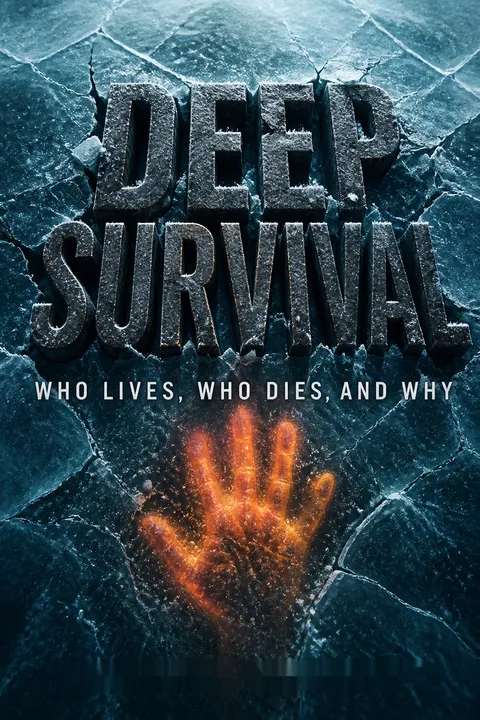


Key Takeaways
Train yourself to notice reality before trusting your gear.
The real survival tool. Gonzales begins with his father, a B-17 pilot whose plane was torn apart over Germany. His father survived a fall from 27,000 feet, but the story is not a recipe for luck. It launches a search for what lets some people respond effectively when events become terrifying. The book’s answer is not that equipment and training are useless. It is that neither can make decisions for a person whose attention and judgment have buckled.
Calm is a practiced skill. On an aircraft carrier, Gonzales watches pilots land jets on a short, moving deck. The successful pilot feels fear but keeps attending to the necessary cues. A pilot who fixates on reaching the deck can miss warnings that are directly in front of him. The book estimates that only 10 to 20 percent of people can stay calm enough to think clearly in an emergency. The practical lesson is to learn how stress changes perception before relying on your usual judgment.
What's striking is the shift from survival as a gear problem to survival as an attention problem. High-stakes professions address this with checklists and team communication, not because experts never panic, but because reliable procedures can catch errors when working memory falters. That does not make individual composure fully trainable or guarantee survival. Some disasters exceed anyone's capacity. Still, recognizing that fear narrows attention can prompt a useful habit: pause, identify the most important cue, and check whether the situation has changed.
Train your gut before danger teaches it the wrong reflex.
Feelings can steer action. Gonzales uses emotional bookmarks to describe learned bodily signals that tag a situation with a remembered outcome. A related term, somatic markers, comes from neuroscientist Antonio Damasio. Such signals help people choose quickly without consciously comparing every option. They can be useful: experienced river runners learn to float feet-first after being thrown into fast water, rather than struggling upright.
The wrong lesson persists. A frightened novice may reach up, sink lower, and become trapped. Scuba divers have sometimes removed working regulators from their mouths under an overpowering feeling of suffocation. Snowmobilers, drawn by the thrill they remembered from earlier rides, raced onto a slope despite avalanche warnings. Their bodies had learned excitement, not the danger of that particular setting. Reason may know the risk while a well-rehearsed feeling pushes toward action.
This account anticipates a central idea in skill learning: people often act from practiced, embodied knowledge before they can explain what they are doing. Rehearsal is most useful when it builds the right response under realistic pressure, as emergency drills aim to do. But instinct should not be romanticized. A familiar bodily feeling can reflect a misleading comparison, not reliable expertise. The crucial question is whether past experience resembles the current conditions closely enough to guide action.
Keep updating your inner map when the terrain changes.
Expectations filter perception. A mental model is a simplified picture of how a situation works. It lets the brain manage more information than conscious attention can handle, but it can also hide facts that do not fit. In a famous experiment described by Gonzales, people counting basketball passes often failed to notice a person in a gorilla costume crossing the scene. More than half missed the gorilla because their attention was committed to the counting task.
The old picture can mislead. Experienced river guides continued downstream after heavy rain transformed a river into a dangerous flood. Their familiar picture of the route did not match the new conditions. Similar attention failures can happen in ordinary life: a person sees what a task requires and overlooks a hazard that the task did not prepare them to expect. Survival depends on checking the world against the model, then revising the model when the two diverge.
Mental models are indispensable, not a flaw to eliminate. Expertise depends on compression: specialists notice a few meaningful patterns instead of processing every detail from scratch. The danger is premature certainty, especially when conditions shift. This makes curiosity operational rather than merely admirable. Asking what has changed, and what evidence contradicts the current explanation, can reopen attention. Yet the gorilla experiment has limits: missing an irrelevant detail in a lab task does not predict every real-world response to danger.
Treat every plan as a forecast, never as a promise.
A plan can become a trap. Three climbers set out for Cathedral Peak in Yosemite, expecting a straightforward ascent. A stolen food supply delayed them, they started late, and clouds appeared while they climbed. They pressed on, relying partly on an outdated weather forecast and the expectation that they could beat the storm. Lightning struck near the summit, injuring the climbers and killing one of their companions. Their original plan had become more persuasive than the evidence around them.
Make revision part of planning. Plans help people imagine a future and organize action, but that future is only a prediction. The more effort, money, or identity invested in a goal, the harder it can feel to abandon it. A sound plan therefore includes conditions for changing course. Set a time to turn back, identify safer alternatives, and treat new information as a reason to reassess, not an inconvenience to explain away.
The Cathedral Peak story illustrates a familiar decision trap: commitment to a goal can make contrary evidence seem negotiable. Organizations use pre-mortems, a planning exercise that asks what could make a project fail, to surface risks before momentum builds. A similar practice can help in adventure and ordinary decisions. A cutoff time or explicit bailout condition gives people permission to revise the plan without framing retreat as personal failure. No rule can foresee every change, so the plan must remain revisable.
Inspect how safety systems can multiply force instead of contain it.
A system can fail as a whole. On Mount Hood, four climbers descended a steep ridge roped together without fixed anchors. When the lead climber slipped, the rope pulled the others into the fall. They struck another climbing group and plunged into a crevasse. Three people died. A rope seems like protection, but in this arrangement it transmitted force through the team instead of stopping the fall.
Small events can cascade. Charles Perrow’s term system accidents describes failures that arise from unexpected interactions in complex, tightly connected systems. Gonzales compares them to the Sand Pile Effect: a pile can absorb many small slides, then suffer a much larger collapse from a seemingly minor change. The Accident Matrix, used in outdoor risk analysis, examines contributing conditions, acts, and judgments. The point is not to assign blame to one careless choice, but to understand how several ordinary choices combine into danger.
The systems view is powerful because it moves analysis beyond the search for one foolish person. Safety engineering similarly studies how components interact, since a safeguard can create new dependencies or transmit a failure. That perspective encourages teams to ask what happens when a protective measure fails, rather than merely whether it is present. There is a boundary to the argument: not every accident is inevitable, and calling failures normal must not excuse preventable design choices or weak safety practices.
When lost, stop, accept your location, and rebuild from real cues.
Lost is a changing state. Woods shock is the disorientation and fear that can arise when a person cannot connect their current position to a reliable mental map. Hiker Ken Killip became separated from his companion in Rocky Mountain National Park, then mistook a drainage for the route he intended to follow. Tired, cold, and thirsty, he kept moving in search of a place that matched his expectations. His worsening confusion led to a fall and injuries.
Acceptance restores options. Killip eventually stopped trying to force the landscape into his imagined route. He made a fire, improvised shelter, and stayed put until rescuers found him on the fifth day. In 229 search-and-rescue cases studied by William Syrotuck, nearly three-quarters of those who died did so within the first 48 hours after becoming lost. Gonzales’s advice is to notice the mismatch early, conserve energy, and make decisions from the place you are actually in.
This story makes orientation a psychological task as much as a navigational one. Once panic or exhaustion rises, continuing to move can feel like progress even as it worsens the problem. A deliberate stop creates space to check location, resources, and the last known point. The advice is not universal: remaining in place can be hazardous in some conditions, and a person may need to move to shelter or safety. The governing principle is to choose movement deliberately, not simply because uncertainty feels intolerable.
Make the next task small enough to do while afraid.
Shrink the problem. Solo sailor Steven Callahan spent 76 days adrift after his boat sank in the Atlantic. Rather than try to imagine surviving the entire crossing, he rationed water, recorded daily conditions, repaired equipment, and focused on manageable tasks. Mountaineer Joe Simpson, stranded with a broken leg in the Andes, used repeated movements and short goals to keep progressing. Neither could control the whole situation, but each could act on the next problem.
Purpose helps sustain effort. Sailor Debbie Kiley survived five days at sea partly by forming a watch partnership with crewmate Brad Cavanagh. Taking responsibility for another person gave both a concrete reason to stay alert. Gonzales’s broader portrait of survivors includes routine, humor, small victories, gratitude, and plans that can be revised. These are not magic protections. They help organize attention and preserve effort when fear, pain, and uncertainty threaten to consume it.
Breaking a crisis into small actions resembles behavioral activation, an approach in psychology that uses manageable activity to interrupt paralysis and restore a sense of agency. The stories also show that purpose can be relational: responsibility to someone else may help a person persist when self-preservation feels abstract. Still, purpose is not a substitute for water, shelter, or rescue, and it should not become pressure to endure needless risk. Its value is practical: it helps direct limited attention toward useful action.
Use curiosity, humor, and beauty to keep fear from owning attention.
Stay open to the world. Fighter pilots on an aircraft carrier joke before nighttime landings, where a jet must catch a deck cable in darkness. Their humor does not erase the danger. It helps them face it without letting fear take over their attention. Gonzales also describes Juliane Koepcke, who survived an airplane breakup over the Peruvian jungle at age seventeen. After waking alone, she assessed her surroundings and used what her parents had taught her about following water downhill.
Wonder can steady attention. Survivors sometimes notice beauty, play with a problem, or find humor in grim circumstances. These responses can keep the mind engaged with what is happening instead of spiraling into dread. They are not signs that the situation is harmless. Koepcke still had to walk for eleven days through dense jungle, and the pilots still had to land precisely. Emotional steadiness supports action; it does not replace skill or favorable conditions.
Humor and curiosity can work as forms of cognitive flexibility: they interrupt a single, threat-dominated interpretation and make room to notice alternatives. That is compatible with research on emotion regulation, where changing how a situation is framed can alter its emotional force. The caution is important. A joke can build solidarity, but it can also trivialize danger or silence dissent. Humor helps only when it keeps people connected to reality and to one another.
Turn back before confidence mistakes familiar conditions for safe ones.
Experience changes risk perception. Risk homeostasis is the idea that people adjust their behavior to maintain a preferred level of risk. When a situation feels safer, they may take greater chances. Gonzales describes this pattern in outdoor recreation and in responses to safety technology. Familiarity can have a similar effect: surviving earlier trips may persuade someone that skill, rather than favorable conditions, was responsible.
Build humility into preparation. Mount Hood, avalanche slopes, and dangerous river routes all punish assumptions about what a person can handle. Before setting out, learn local hazards, study accident reports, check current conditions, carry appropriate equipment, and agree on a bailout plan. If conditions change, turning back is a survival decision, not a failed adventure. Gonzales’s father survived the crash that began the book, then spent the rest of his life rebuilding and adapting. Survival is not one lucky escape; it is an ongoing practice.
Risk homeostasis offers a useful warning: adding protection does not automatically reduce danger if people respond by pushing harder. The effect varies across settings, and research does not support treating it as a universal law. Its practical value is as a question to ask: has new confidence changed behavior more than the actual hazard has changed? The closing lesson also broadens survival beyond wilderness. Preparation matters, but so does the capacity to rebuild after an event that cannot be undone.
Analysis
Deep Survival is strongest when it treats survival not as a heroic personality trait, but as a dynamic encounter among physiology, learned behavior, attention, and a changing environment. Gonzales’s recurring question, why do capable people do things that seem irrational, becomes more answerable once decisions are understood as bodily and emotional as well as deliberate. Fear can narrow perception, but it can also mobilize action. Experience can create useful automatic responses, yet it can also make an unfamiliar hazard feel familiar. A plan gives direction, then becomes dangerous when treated as evidence that conditions remain safe.
The stories make these ideas memorable because they show the same errors at different scales: a lost hiker follows a mistaken map, climbers trust a rope arrangement they have not tested under full force, and river guides rely on a familiar river after its behavior has changed. The book’s most practical contribution is a habit of noticing mismatch. Is the environment still the one the plan assumes? Is a safety measure actually stopping danger, or transmitting it? Is continued movement purposeful, or merely an escape from uncertainty?
Some of the neuroscience is presented in a cleaner, more decisive way than current science warrants. Emotion and reasoning are intertwined rather than separate systems competing for command, and stress does not impair every person or task in the same fashion. The survival accounts also cannot establish that a particular attitude caused a particular outcome. Survivors are available to tell their stories; people exposed to overwhelming hazards may do everything well and still die. These limits do not erase the book’s central insight. They refine it: mental habits improve the odds of responding well, but they do not confer control over nature or chance.
The deeper narrative is the author’s relationship to his father, whose survival after a catastrophic fall was only the beginning of a long recovery and life. That distinction gives the book emotional force. Getting through the emergency matters, but so does the difficult work of adapting afterward. In that sense, survival is not a victory over danger. It is the continued practice of meeting what is real and finding a next step.
Review Summary
Deep Survival receives mixed reviews, with some praising its fascinating survival stories and insights into human behavior under extreme circumstances. Critics appreciate the neuroscience and psychology aspects but find the writing style disorganized and self-indulgent. Many readers enjoy the real-life examples and practical advice, while others feel the author's personal anecdotes detract from the main content. The book's exploration of why some people survive while others don't in similar situations intrigues many, though some find the conclusions lacking scientific rigor.
People Also Read

Glossary
mental models
Simplified pictures of realityMental models are simplified internal representations of how a place, object, or system works. They let people interpret situations without analyzing every detail from scratch. Because they are built from past experience, they can also filter out unfamiliar evidence. A model must be revised when the actual environment changes.
emotional bookmarks
Learned bodily decision signalsEmotional bookmarks are feelings attached through experience to situations and their outcomes. They help the brain quickly favor or avoid actions without deliberate calculation. A remembered sensation of success can motivate a choice, even when present conditions differ from the earlier experience that created the feeling.
somatic markers
Body-based choice signalsSomatic markers is Antonio Damasio’s term for bodily feelings associated with possible choices and their likely outcomes. These signals help guide decisions by drawing attention toward options linked with favorable results and away from those associated with harm. Gonzales connects the idea to the quick, felt judgments that can shape survival behavior.
woods shock
Disorientation in unfamiliar terrainWoods shock describes the confusion and fear that can arise when a person loses the ability to relate their current location to known places. As the mental map and surroundings cease to match, a person may panic, move impulsively, or misread cues. Gonzales uses the concept to explain why being lost is a psychological process, not merely a point on a map.
system accidents
Failures from interacting partsSystem accidents are large failures that arise from unexpected interactions among parts of a complex, tightly connected system. Each component may seem manageable alone, while their interaction creates a rapid cascade. Charles Perrow used the concept to explain why some high-risk technologies can experience severe accidents despite ordinary operation and safety measures.
Sand Pile Effect
Small changes trigger large collapsesThe Sand Pile Effect describes a pile that grows through many small additions while undergoing small slides, until a minor disturbance triggers a much larger collapse. Gonzales uses it as an analogy for systems that appear stable for long periods but can suddenly release accumulated forces. The model illustrates why small events can have disproportionate consequences.
Accident Matrix
A framework for accident factorsThe Accident Matrix is an outdoor-risk analysis framework associated with the National Outdoor Leadership School. It organizes contributing factors under conditions, acts, and judgments. Rather than reducing an accident to one person’s mistake, it helps investigators examine how environmental hazards, actions, and decisions combine in a particular event.
risk homeostasis
Risk behavior adjusts to perceived safetyRisk homeostasis is the theory that people tend to maintain a preferred level of risk. When they perceive an activity as safer, they may behave more boldly; when it seems more dangerous, they may become more cautious. Gonzales uses the idea to explain how experience or safety technology can sometimes encourage riskier behavior.
Positive Mental Attitude
A survival-oriented mental stancePositive Mental Attitude is the phrase used in the survival training Gonzales describes for an outlook that supports persistence in a crisis. It does not mean pretending danger is absent. It means maintaining enough hope, purpose, and self-command to assess the situation and continue taking useful action.
FAQ
What's Deep Survival: Who Lives, Who Dies, and Why about?
- Survival psychology exploration: The book delves into the psychological and physiological aspects of survival in extreme situations, examining what differentiates survivors from those who perish.
- Human behavior under stress: It investigates how people react to life-threatening situations, emphasizing emotions, instincts, and decision-making processes.
- Real-life survival stories: Gonzales shares gripping accounts of survival scenarios, illustrating the principles of survival and human resilience.
Why should I read Deep Survival by Laurence Gonzales?
- Understanding human resilience: The book offers insights into human resilience and the factors contributing to survival, helping readers navigate crises.
- Practical survival insights: Gonzales provides advice and rules for survival applicable in both extreme situations and daily life.
- Engaging storytelling: Filled with riveting survival accounts, the book is both informative and entertaining, keeping readers engaged.
What are the key takeaways of Deep Survival?
- Emotional control is crucial: Maintaining emotional control during crises is vital for survival, with only a small percentage able to stay calm.
- Adaptability is essential: The ability to adapt to changing environments and circumstances is a recurring theme, emphasizing flexibility in decision-making.
- Risk assessment and management: Understanding and managing risk is key, as misjudging risks based on past experiences can lead to fatal decisions.
What are the best quotes from Deep Survival and what do they mean?
- "The farther one goes, the less one knows." This quote highlights the complexity and unpredictability of venturing into unknown territories.
- "When in doubt, don’t." It emphasizes the importance of pausing and reassessing situations before making decisions, especially in high-risk environments.
- "To survive, you must find yourself." This underscores the idea that self-awareness and understanding one's capabilities are crucial for survival.
How does Laurence Gonzales define survival in Deep Survival?
- Psychological process: Survival is defined as a complex interplay of psychological and emotional factors, not just physical endurance.
- Emotional intelligence importance: Understanding and managing emotions is crucial for effective decision-making in life-threatening situations.
- Adaptation to the environment: Survival involves adapting to the environment and recognizing danger signs, with emotions motivating behavior.
What role does the brain play in survival according to Deep Survival?
- Emotional responses drive behavior: The brain's emotional responses, particularly from the amygdala, are instinctive and crucial for survival.
- Cognitive overload hindrance: Stress can impair cognitive functions, leading to poor decision-making, with most people unable to perform complex tasks under stress.
- Memory and learning influence: Memory shapes responses to danger, with the brain creating mental maps that guide behavior in critical situations.
What survival strategies does Deep Survival recommend?
- Stay calm and focused: Maintaining composure in stressful situations allows for clearer thinking and better decision-making.
- Set small, manageable goals: Breaking down tasks into smaller steps helps maintain motivation and a sense of progress.
- Embrace the environment: Understanding and accepting surroundings can lead to better adaptation and emotional strength.
How does Deep Survival explain the role of emotions in survival?
- Emotions drive behavior: Emotions, particularly fear, can motivate individuals to take action, and recognizing these emotions can be beneficial.
- Amygdala's function: The amygdala triggers survival instincts by sending alarm signals when danger is perceived, influencing decisions.
- Balancing emotion and reason: Survivors succeed by managing emotions while remaining focused on practical solutions.
What is the significance of mental maps in Deep Survival?
- Creating a mental map: Individuals create mental maps to navigate environments, essential for understanding location and making decisions.
- Impact of stress on mapping: Stress can disrupt mental maps, leading to confusion and panic, highlighting the need for orientation.
- Being lost as a mental state: Being lost is defined as the inability to align one's mental map with the environment, emphasizing the psychological aspect.
How does Deep Survival relate to everyday life?
- Lessons for personal challenges: Survival principles can be applied to stress management and decision-making in daily life.
- Building resilience: Developing mental resilience and adaptability are valuable traits for overcoming obstacles in both survival and daily life.
- Understanding risk: The exploration of risk and decision-making helps readers make informed choices and foster a proactive approach.
What are the stages of getting lost according to Deep Survival?
- Denial and urgency: Initially, individuals deny being lost and feel an urgency to find a way out, leading to irrational decisions.
- Panic and frantic behavior: As reality sets in, panic leads to frantic actions, resulting in further disorientation.
- Resignation and acceptance: Acceptance of the situation can lead to a more rational approach to survival and finding a way back.
What is the overall message of Deep Survival?
- Survival is a mindset: Survival involves mental and emotional resilience, not just physical skills, with the right mindset essential for overcoming challenges.
- Embrace uncertainty: Accepting life's unpredictability and being prepared for unexpected situations leads to greater adaptability.
- Life as a journey: The book presents life as a continuous journey of learning and growth, with challenges leading to a richer existence.
About the Author
Other books by Laurence Gonzales
Download PDF
Download EPUB
.epub digital book format is ideal for reading ebooks on phones, tablets, and e-readers.








