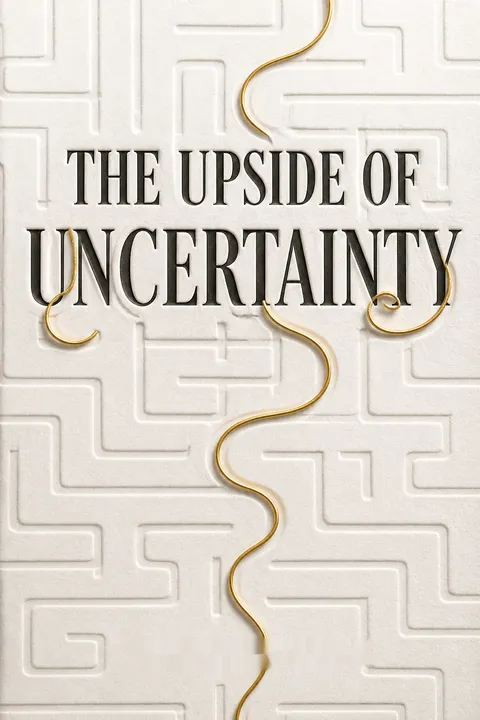


Key Takeaways
Treat uncertainty as the passage to possibility, not proof of impending loss.
Unknown is not the same as risky. Risk involves possible outcomes whose likelihoods are broadly knowable. Uncertainty is murkier: the outcomes, or even the facts that matter, may be unclear. Both can feel threatening, but the book argues that new work, relationships, and discoveries often begin in uncertainty. The authors do not claim every unknown is worth entering or that pain is secretly good.
A different frame can help. During the pandemic, Amy and Michael lost a job and saw several offers disappear. Their family faced a sudden move with no clear destination. Recasting their situation as evidence of courage, rather than personal failure, helped them tolerate the wait and consider options they wanted. The conditions remained difficult; the shame became less useful.
What's striking is the distinction between changing a situation and changing the interpretation that governs the next response. Cognitive reappraisal, the practice of examining a stressful event through another plausible lens, can widen attention beyond immediate threat. That does not make a rent bill, illness, or job loss less real. The value lies in interrupting the leap from uncertainty to self-condemnation. A useful reframe should disclose options, not pressure someone to feel grateful for harm or to ignore practical danger.
Keep uncertainty in the learning zone, not the comfort zone or panic zone.
A little novelty is useful. The authors call uncertainty a kind of reverse insurance: without surprise or change, life and work can become stale. A survey of 16,000 people changing careers found boredom was a common reason for leaving, rather than low pay or a bad boss. Organizations also need room for experiments. Strict quality-control systems can improve consistency while suppressing the mistakes and variation from which new ideas sometimes emerge.
Calibrate the temperature. The book adapts a model that distinguishes comfort, learning, and panic zones. Too little uncertainty leaves little reason to grow; too much can overwhelm judgment. When panic rises, the task is to reduce pressure and find support. When life feels overly settled, a manageable frontier can restore curiosity. The aim is not maximum uncertainty, but a workable dose.
This is a useful corrective to both risk worship and blanket risk avoidance. Learning depends on challenge, but challenge works only when people have enough safety, skill, and support to respond. That principle appears in education and training: a task far beyond current capacity can produce withdrawal rather than growth. The book's temperature metaphor makes calibration intuitive, though it is not a precise measurement. The same change can be stimulating for one person and destabilizing for another.
Search the edges of what you know for adjacent possibilities.
Look sideways, not just ahead. A frontier is the boundary between familiar and unfamiliar. The adjacent possible is a specialized term for opportunities close enough to the present to be reachable, but not yet noticed. Curiosity, attention, and recombination help reveal them. Surgeon Joseph Lister noticed that carbolic acid used on fields seemed to reduce parasites in cattle. Testing whether it could reduce infection in surgery helped lower mortality after major operations from 40 percent to less than 3 percent by 1910.
A need can reveal a new use. Barbara Alink saw that some wheelchair users wanted mobility without a device that emphasized disability. She combined available bicycle parts into the Alinker, a walking bike that lets users move at eye level. Each step into unfamiliar territory exposes further options, much like entering one room and discovering the next door.
The adjacent possible captures an important feature of discovery: imagination is not limitless in practice, because useful ideas usually build on materials, skills, or relationships already within reach. This connects creativity to recombination, the process of joining familiar elements in an unfamiliar way. It also explains why curiosity and lived experience matter: people often spot needs others overlook. Still, novelty is not automatically improvement. Alink's example is compelling because it starts from users' needs, not from the mere pleasure of inventing.
Question the rules of the game before trying harder to win it.
Roles need not define you. The book contrasts finite players, who accept a role and try to win by its rules, with infinite players, who experiment with roles and rules so the activity can continue to evolve. Eleanor Roosevelt's life illustrates the difference. After discovering her husband's affair, she gradually built a public role beyond that of wife and mother. She became a political advocate and, after his death, helped shape the Universal Declaration of Human Rights as a United States delegate to the United Nations.
Inspect the game itself. A job title, career ladder, or social expectation can feel like a natural law when it is really a convention. Asking what a role requires, which rules serve a purpose, and which merely persist can open alternatives. This does not mean rules are always foolish or easy to change. It means they deserve examination before they become the limits of a person's identity.
The distinction between finite and infinite play is powerful because it shifts attention from winning a single contest to choosing what kind of activity deserves a life. It also resonates with identity research: people who treat a role as one part of the self may be better able to adapt when it changes. Yet the freedom to rewrite rules is unevenly distributed. A worker with little security cannot simply redesign a workplace, and people challenging institutions may face real penalties. The framework is a prompt for discernment, not a guarantee of control.
Keep several options alive instead of betting your whole life at once.
Spread commitment over time. Personal real options are small, ongoing commitments that preserve a chance to pursue a possibility without requiring an immediate all-or-nothing leap. The authors recommend understanding one's risk profile across financial, social, emotional, physical, intellectual, and political domains. Someone wary of financial risk might keep a paying job while testing a business idea on the side.
A portfolio can improve learning. Nobel Prize-winning chemist Ben Feringa advised students to keep both riskier and safer projects underway. Research cited in the book found that entrepreneurs who began as hybrid entrepreneurs, keeping their jobs while starting ventures, were 33 percent less likely to fail after moving into full-time entrepreneurship than those who made the leap immediately. Small commitments can reveal whether an idea works, while savings, time, and relationships provide a runway.
This resembles real-options thinking in finance: pay a limited cost now to preserve the right, but not the obligation, to invest more when evidence improves. Applied to a career, it can protect both learning and basic security. The caution is that a portfolio can become an excuse to avoid choosing, or a way to overload an already crowded life. Options need attention and review. A side project that consumes every evening may not be a low-cost experiment in any meaningful sense.
Choose for the life you want, not only the certainty you can keep.
Ask what future-you would regret. Jeff Bezos used a regret-minimization test when deciding whether to leave a secure job to sell books online. He believed he would not regret a failed attempt nearly as much as never trying. The book adds useful checks: distinguish reversible decisions from one-way doors, consider who else is affected, and compare possible gains and losses on both paths rather than weighing known benefits against unknown dangers alone.
Use values as a sturdier measure. Goals such as wealth, status, or a specific outcome are partly outside a person's control. Values, such as learning, ethical work, or caring for others, can guide action regardless of the result. The authors' move to France brought real hardships, including lower income and difficulty settling in, but also new work, language, and family experiences they valued.
This approach combines two useful time horizons: imagine the older self looking back, then return to the present and identify what can be controlled now. It counters the status quo bias, the tendency to favor what is familiar even when alternatives may better serve one's aims. But regret is not a perfect compass. People can romanticize the path not taken, and decisions that affect dependents deserve more than an individual courage test. Values help clarify trade-offs; they do not erase them.
Learn through small tests, repeated attempts, and timely pivots.
Let action produce information. The book's 10,000 Shots idea rejects the myth that original work arrives fully formed. National Geographic photographers were described as taking tens of thousands of pictures to produce a small number for publication. In business, the practical lesson is to test the most important assumption before building everything. Traveling Spoon, a platform for meals with local hosts, first spent time understanding what hosts wanted instead of launching every feature at once.
Use what is available. Bricolage means making something useful from resources already at hand. Danish wind-energy companies built rough turbines from available parts, tested them in the field, and shared lessons, while better-funded American firms pursued more elaborate designs. Iteration is not aimless persistence: a pivot changes direction in response to what experiments reveal. Repetition without feedback can waste effort; repeated learning can make a rough idea viable.
The strongest version of this principle is not simply fail often, but design attempts so that failure teaches something cheaply. That links the book's examples to experimental science and adaptive learning: state a hypothesis, test it, update the model, and try again. The emphasis on bricolage also challenges the assumption that sophisticated tools must precede useful work. A necessary caveat is that not all failures are affordable. In high-stakes settings, experiments need safeguards, especially when health, livelihood, or other people's welfare is involved.
Care for your emotions as deliberately as you care for the project.
Distress needs care, not scolding. The authors call this emotional hygiene: noticing and tending to emotions rather than intensifying them with shame or harsh self-talk. They describe emotional waves as a normal part of change, with periods of hope and discouragement. Luca Belpietro rebuilt his Kenyan ecotourism camp after a fire destroyed it, recognizing that his despair came at a low point rather than treating that moment as the final verdict.
Pair hope with reality. Active hope means choosing to keep looking for a possible next step, not assuming that everything will turn out well. The authors' own account of a child's severe mental-health crisis makes the distinction concrete: they sought medical help, traveled for another opinion, and focused on small signs of improvement. Support from a community, a therapist, or trusted friends can help people see options that distress hides.
The section's strength is its refusal to treat emotional pain as a character defect. Naming an emotion and sharing it with someone trustworthy can create room between feeling and action, a principle shared by mindfulness-based therapies. The family's crisis also grounds the book's optimism: a positive frame cannot substitute for treatment, money, or institutional access. Support is not merely comforting; it can change the information and resources available. Severe or persistent distress calls for qualified professional care, not a demand to reframe harder.
Build a life to your measure, with familiar anchors for uncertain work.
Customize the life, not just the goal. Fait sur mesure means made to one's measure. The authors use it to describe shaping work, time, and daily life around what actually matters, rather than copying a standard script. Designer Stefan Sagmeister, for example, chose to take year-long sabbaticals during his career instead of postponing all exploration until retirement. A custom life can be carefully planned; it need not mean constant upheaval.
Give change a stable base. The book calls supportive habits, objects, rituals, and relationships uncertainty balancers. Entrepreneur Sam Yagan sought stability in family and longtime friendships while taking on ambiguity at work. Other examples include a familiar travel routine or shared family traditions. Practical anchors can reduce stress and protect time, while lowering expenses can extend the runway for a meaningful experiment.
This pairing is more subtle than it first appears. Freedom does not require eliminating structure; a dependable routine can make exploration psychologically and practically possible. The idea of a life made to measure also resists the assumption that success has one standard shape. At the same time, customization can sound easier than it is for people with limited money, time, or autonomy. The most useful application may be small: alter one routine, responsibility, or source of spending before imagining a wholesale reinvention.
Make room for serendipity by noticing, helping, and staying curious.
Chance has handles. The book's idea of magic is not a promise of supernatural rescue. It means unexpected connections, insights, and opportunities that people cannot fully control but may be better positioned to notice. The authors recount struggling with their children's school situation near Paris, then receiving an unexpected call from a school director offering an immediate opening. The offer did not eliminate the costs or stress of moving, but it made a previously unworkable path possible.
Cultivate what is here. The authors connect openness to curiosity, community, and helping others. Their examples range from sharing ideas across professional networks to treating art, literature, and ordinary sensory experiences as sources of attention and meaning. One cannot schedule a lucky call. One can build relationships, pursue interests, and stay alert to useful openings without assuming that every coincidence will become an opportunity.
Serendipity is often described as luck plus attention: an event becomes useful when someone recognizes its relevance and can act on it. This account preserves both humility and agency. The Paris school call depended on circumstances the family did not control, while their existing effort to explore alternatives made the offer actionable. The distinction matters because stories of fortunate breakthroughs can disguise unequal access to networks and resources. Openness is a practice, not a guarantee that luck will arrive on schedule.
Analysis
The book's central contribution is a change in the unit of analysis. Uncertainty is not only a hazard to be forecast or controlled; it is also the condition under which new options become visible. That claim is easy to reduce to motivational optimism, but the book's more useful argument is procedural. It moves from reframing threat, to preparing resources and support, to acting through experiments, then sustaining attention and emotion when the results disappoint. The sequence matters because courage without runway can become recklessness, while reflection without action can become rumination.
Its stories give the framework range. Entrepreneurs, artists, executives, parents, and people responding to imposed hardship show uncertainty as both chosen and involuntary. The family's account of mental illness is particularly important because it prevents possibility language from collapsing into the claim that every crisis is secretly beneficial. Some situations demand treatment, material assistance, and institutional change. A hopeful frame may help someone act, but it cannot make unjust conditions fair or guarantee recovery.
The strongest practical ideas are the ones that alter the shape of a decision: preserve options rather than going all in, compare plausible futures rather than known comfort with unknown threat, test assumptions cheaply, and treat values as more controllable than outcomes. These ideas connect personal development to entrepreneurship and decision science without assuming that life can be optimized like a spreadsheet. They also complicate popular success stories. Many celebrated outcomes involve luck, timing, networks, and resources as well as skill.
The book's breadth is also its limitation. Its many tools can feel like a menu whose items overlap, and its examples often feature people with unusually high agency or access. A reader facing structural barriers may have fewer options than a successful founder or expatriate family. The most durable reading is therefore neither do whatever scares you nor believe every uncertainty hides a gift. It is to distinguish uncertainty worth engaging from danger requiring protection, then create the best available conditions for learning, adaptation, and care.
Review Summary
The Upside of Uncertainty receives mostly positive reviews, with readers praising its practical tools for navigating uncertainty in life and business. Reviewers appreciate the authors' personal stories, scientific approach, and actionable advice. The book is seen as motivating and relevant, especially in the post-COVID era. Some readers find it dense in places, but most value its insights on reframing perspectives and embracing possibilities. The combination of theory and real-life examples resonates with many, making it a recommended read for leaders, entrepreneurs, and individuals facing change.
People Also Read





Glossary
Uncertainty ability
Navigating unknowns wellThe learned capacity to face planned and unplanned unknowns with greater skill. It includes reframing threat, preparing resources and support, acting to discover information, and sustaining effort through setbacks. The book treats this as developable, while recognizing that people's starting capacities and circumstances differ.
Transilience
Transformation through uncertaintyA leap from one state to another, beyond merely enduring a shock and returning to the previous condition. The authors use the term for change in which uncertainty becomes a route to new insight, capability, or possibility. It does not imply that every hardship produces growth or that recovery is guaranteed.
Possibility quotient
Likelihood of positive changeThe authors' term for a person's likelihood of seeing and seizing opportunities for positive change. They suggest it can be weakened by burnout, anxiety, pessimism, difficulty changing, or abandoning one's dreams. It is a reflective concept, not a validated numerical score in the book.
Adjacent possible
Nearby, undiscovered opportunitiesA term developed in evolutionary biology and used in the book for possibilities that can emerge from the present, given the resources and knowledge currently available. These opportunities may be hidden in a problem, an overlooked resource, or a new combination of existing elements. Taking one step can reveal further possibilities.
Personal real options
Small commitments preserve choicesA way of pursuing interests or projects through limited commitments that preserve the option to invest more later. Examples include testing a business idea while keeping a job, or exploring a career through conversations and short projects. The approach aims to improve learning while limiting the cost of an unsuccessful attempt.
Uncertainty balancers
Stability alongside the unknownFamiliar practices or supports that reduce the strain of facing uncertainty elsewhere. They can include routines, rituals, objects, humor, and dependable relationships. Rather than remove uncertainty, they provide stability that can make challenge more manageable. They should be adapted or dropped if they become restrictive.
Dumbo feathers
Personal sources of encouragementThe book's metaphor for people, places, memories, objects, or ideas that help someone believe they can pursue a difficult possibility. The name refers to the cartoon elephant Dumbo, who gains confidence from a feather. The related term quest destroyers describes influences that undermine confidence or consume the energy a pursuit requires.
Bricolage
Making with available resourcesA concept used in sociology and entrepreneurship to describe creating something from resources already at hand. Rather than wait for ideal funding, equipment, or expertise, a person tests and adapts with what is available. The practice can stimulate learning, though some projects still require adequate resources and safe conditions.
Uncertainty manifesto
Guiding beliefs for uncertaintyA concise personal statement of beliefs or intentions for facing unknown situations. It can remind someone what matters, what they can control, and how they want to respond when anxiety or setbacks narrow their perspective. The book recommends making it realistic and personally meaningful, rather than treating it as a claim of invulnerability.
Fait sur mesure
A life made to measureFrench for made to one's measure, used in the book to describe shaping a life around personal needs, interests, and values rather than following a standard template. This can involve changes to work, time, habits, or surroundings. It need not be extravagant or spontaneous; deliberate planning and effort are often part of the process.
Uncertainty first-aid cross
Four groups of practical toolsThe book's organizing framework for its tools: Reframe changes how uncertainty is interpreted, Prime prepares a person for what may come, Do focuses on action and learning, and Sustain supports people through setbacks. The categories overlap and are not a fixed sequence; readers are encouraged to use what fits their situation.
FAQ
What's The Upside of Uncertainty about?
- Exploring potential: The book discusses how uncertainty, often seen negatively, can be a source of opportunity and growth. It argues that innovation arises from navigating uncertainty.
- Framework for navigation: It provides tools and strategies to help individuals and organizations embrace uncertainty, leading to creativity and success.
- Personal stories and research: Enriched with anecdotes, interviews, and research, the book illustrates how embracing uncertainty can lead to transformative outcomes.
Why should I read The Upside of Uncertainty?
- Practical tools for all: Offers practical tools applicable to anyone, from entrepreneurs to parents, to navigate life's uncertainties.
- Inspiration from real-life examples: Shares inspiring stories of individuals who have successfully navigated uncertainty, motivating readers to take action.
- Framework for personal growth: Helps develop a healthier relationship with uncertainty, fostering personal growth and adaptability.
What are the key takeaways of The Upside of Uncertainty?
- Reframe your perspective: View uncertainty as a source of possibility rather than a threat, empowering risk-taking and exploration.
- Embrace a portfolio approach: Pursue multiple interests simultaneously to reduce anxiety and increase success chances.
- Utilize uncertainty balancers: Surround yourself with supportive people and routines to mitigate uncertainty anxiety.
What is the "personal real options" approach in The Upside of Uncertainty?
- Diversifying interests: Encourages pursuing multiple projects or interests, reducing pressure from a single path.
- Reducing anxiety: Having a portfolio of options alleviates fear of failure, fostering a relaxed mindset towards uncertainty.
- Learning from experiences: Engaging in various projects allows learning from different experiences, increasing adaptability.
What are "Dumbo feathers" in The Upside of Uncertainty and how do they help?
- Supportive people and things: Dumbo feathers are people, places, and objects that provide encouragement and support, boosting confidence.
- Identifying quest destroyers: Contrasts Dumbo feathers with quest destroyers, negative influences that hinder progress.
- Building a supportive network: Surrounding yourself with Dumbo feathers fosters creativity and resilience, aiding in navigating uncertainty.
How does The Upside of Uncertainty define "uncertainty balancers"?
- Creating stability amidst chaos: Habits, routines, and supportive relationships that mitigate uncertainty anxiety, providing stability.
- Examples of uncertainty balancers: Includes low-drama relationships, daily routines, and joyful rituals that ground you during uncertain times.
- Importance of community: Emphasizes building a supportive community for encouragement to take risks and embrace opportunities.
What is the "regret minimization framework" in The Upside of Uncertainty?
- Making decisions with foresight: Encourages considering future feelings about decisions, clarifying whether to pursue risky opportunities.
- Focus on potential regrets: Shifts focus from fear of failure to desire for fulfillment by asking if you'd regret not trying something.
- Real-life application: Illustrated through Jeff Bezos' story, who used it to decide to leave a stable job for Amazon, guiding decisions with purpose.
How can I reframe my perspective on uncertainty according to The Upside of Uncertainty?
- Shift from fear to possibility: View uncertainty as potential rather than a threat, empowering risk-taking and exploration.
- Practice reframing techniques: Reflect on past achievements from uncertainty and use positive affirmations to counter negative thoughts.
- Engage with your story: Consider your narrative about uncertainty and craft a more empowering story to navigate challenges.
What is the significance of "cognitive flexibility" in The Upside of Uncertainty?
- Adapting to changing circumstances: Cognitive flexibility is the ability to adjust thinking based on new information, crucial for navigating uncertainty.
- Embracing an attitude of wisdom: Recognize you may not fully understand a situation and be open to new perspectives, fostering adaptability.
- Learning from experiences: Those with cognitive flexibility learn from experiences and adjust strategies, leading to success in uncertain environments.
What is the "blind spot matrix" in The Upside of Uncertainty?
- Framework for understanding uncertainty: Helps categorize what you know and don’t know, clarifying situations and reducing anxiety.
- Four quadrants: Consists of known knowns, known unknowns, unknown knowns, and unknown unknowns, encouraging proactive learning.
- Application in decision-making: Focuses on gathering information and insights from others, leading to more informed choices.
How does The Upside of Uncertainty address the concept of learned optimism?
- Optimism as a learned skill: Explains optimism as a learned explanatory style, empowering individuals to challenge negative beliefs.
- Disputing negative beliefs: Encourages identifying and disputing negative thoughts, reframing them as temporary and changeable.
- Benefits of learned optimism: Improves resilience, creativity, and well-being, making it easier to navigate uncertainty and pursue goals.
What is the "optimization myth" discussed in The Upside of Uncertainty?
- Challenging the pursuit of perfection: Refers to the belief in a single best way to achieve success, which can hinder creativity.
- Embracing multiple paths: Encourages exploring various possibilities and approaches, allowing for greater adaptability.
- Learning from failure: Emphasizes that failure is part of the journey, providing valuable lessons and fostering experimentation and growth.
About the Author
Download PDF
Download EPUB
.epub digital book format is ideal for reading ebooks on phones, tablets, and e-readers.








