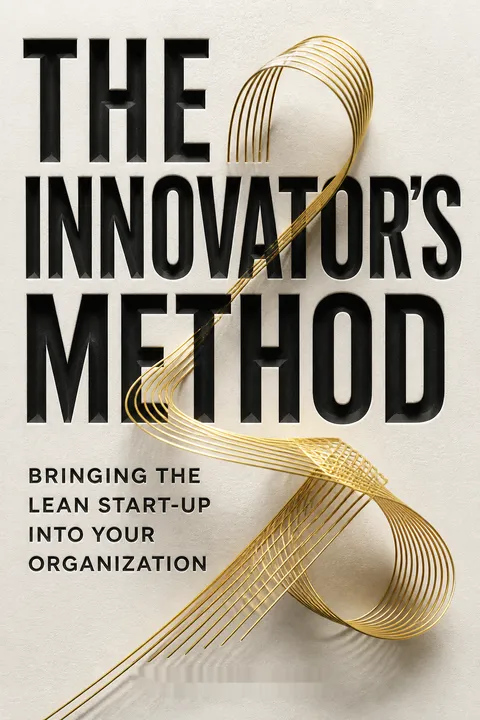


Key Takeaways
Test the assumptions before spending money to perfect the idea
Learn before building. Rent the Runway began with a hunch that women might rent designer dresses online. Instead of writing projections, founders Jenn Hyman and Jenny Fleiss tested the riskiest assumptions in stages. At Harvard, 35 percent of 140 women who viewed dresses rented one, and 51 of 53 returned theirs in good condition. A second trial showed that customers would rent without trying dresses on. A photo-based test in New York found that about 5 percent of the target audience would consider renting online, evidence that the idea deserved more investment.
Turn guesses into tests. The Innovator’s Method treats uncertain ideas as hypotheses to investigate, not forecasts to defend. Each experiment should answer a specific question, so the team learns what is true before committing to a full product or launch.
The founders’ sequence resembles disciplined scientific inquiry: isolate an assumption, design a test, and update the claim when evidence arrives. It also resembles staged investment, where each small commitment buys information before a larger one is made. The numbers did not prove that a durable company would follow, but they helped distinguish plausible demand from mere enthusiasm. That distinction matters: small trials are valuable for reducing uncertainty, not for pretending uncertainty has vanished.
Manage execution with plans, but manage uncertainty with experiments
Match the management style. Traditional planning works best when the problem and its dependencies are familiar. Innovation is different: customer demand may be unknown, the technology may not work, or both. The book calls the ratio of assumptions to established facts the uncertainty ratio. A high ratio calls for experiments; a low one makes conventional planning more useful.
Change the leader’s job. At Intuit, leaders shifted from choosing ideas by rank or presentation to helping teams test their most important assumptions. The question changed from “What is your answer?” to “How can we find out?” Intuit’s TurboTax group grew from one customer experiment in 2006 to nearly 2,500 in 2013. The authors connect this broader experimentation effort with stronger new-product results, while recognizing that experimentation does not guarantee success.
This is a contingent theory of management, not a claim that planning is obsolete. In familiar operations, standard procedures protect reliability; in uncertain work, the same procedures can lock teams into assumptions nobody has checked. Experiments also redistribute authority: evidence from users can challenge a senior person’s intuition. Yet data is only as good as the question and sample behind it. A leader still has to decide which uncertainty matters most and whether a test measures it fairly.
Treat surprises in customers’ routines as clues, not noise
Look beyond the office. Useful insights often begin with an unexpected observation: a workaround, a frustration, or a behavior that clashes with what the team assumed. Hindustan Unilever’s Project Bushfire sent more than 15,000 employees in India to visit customers in homes, shops, and workplaces. One manager learned that a health drink contained sugar, a mismatch that customers noticed immediately. Other visits exposed weak distribution and opportunities to expand what rural women sellers could offer.
Make discovery a habit. The authors describe four ways to generate insights: ask questions that unsettle assumptions, observe people doing real tasks, talk with people outside familiar circles, and try things directly. HUL’s stock price rose 34 percent in 2012, and sales rose 40 percent. Those results followed a broad organizational effort, rather than one magic observation.
Surprise can serve as an attention signal: it marks the gap between a team’s mental model and the world it is trying to serve. That makes field observation useful not only for empathy, but also for catching blind spots created by professional routines. The discipline is to investigate before declaring a surprise an opportunity. An unusual behavior may reflect a temporary constraint, a local custom, or a genuine unmet need; context determines which.
Find the job customers struggle to finish before designing the fix
Define the job. A job-to-be-done is the outcome a person is trying to achieve, including practical, social, and emotional motives. Customers seeking a wrinkle-free shirt may not need a better iron; they may need an entirely different way to remove wrinkles. This wider view can reveal solutions that feature-focused thinking misses.
Watch the work unfold. Mike Maples’s team studied help-desk calls and found that technicians spent as much as 75 percent of call time collecting information and diagnosing basic issues, not solving the technical problem. That finding changed what the team needed to build. Tools such as customer journey maps, root-cause questions, interviews, and observation help teams find the actual obstacle. The job must also be monetizable: enough customers must care, and someone must be willing and able to pay.
Focusing on the desired outcome rather than the existing product is a powerful way to escape incremental design. It also prevents a common error in research: asking people to invent the answer instead of studying the work they already do. Still, “the customer” is not always one person. In health care or enterprise software, the user, buyer, and implementer may have conflicting jobs. A clear problem definition must account for each party whose cooperation determines whether the solution can be used and funded.
Prototype cheaply, then make one narrow benefit genuinely excellent
Make learning tangible. Teams can start with a spoken concept, move to a mock-up that imitates the experience, and then test a working but incomplete version. Each prototype should answer a particular question. Google Glass began with rough demonstrations: a wearable rig tested the display, while improvised materials tested how users might control it. These quick models helped reveal what felt awkward before the team built a polished device.
Aim beyond “works.” A minimum viable prototype tests whether the core idea has value. A minimum awesome product goes further: it focuses on a small set of features and makes the most important one notably good. Intuit’s SnapTax let users photograph a W-2 and complete simple tax returns on a phone in under ten minutes. Early users abandoned the app when account setup came too soon, so the team changed the sequence rather than adding features.
A rough prototype is not merely a cheaper version of a finished product. It is an instrument for making assumptions visible, which lets users react to something more concrete than a verbal pitch. The narrow focus also guards against feature accumulation, a familiar response to mixed feedback. The risk is mistaking a delighted early tester for a representative customer. Teams need to test with the people who face the target problem, then check whether the standout feature matters enough to change behavior.
A loved product can still fail if its route to market is wrong
Test the whole business. The Business Model Snapshot is a way to track assumptions about the offer, price, customer relationships, channels, essential activities, and necessary resources. Godrej’s ChotuKool refrigerator was designed for rural Indian households with unreliable electricity and limited storage needs. But the product alone was not enough: customers needed an affordable price, financing, trusted local outreach, and a workable way to buy it. Village fairs helped the team learn that local women and post offices could support communication and distribution.
Keep commitments flexible. Webvan invested heavily in warehouses before validating order sizes and delivery costs. Its average order was smaller than expected, while delivery cost about $27 per order. The authors advise borrowing, outsourcing, or simulating resources while demand and costs remain uncertain. Variable costs may be less efficient per unit at first, but they avoid locking a company into expensive capacity too early.
A product’s viability depends on a system of connected choices, not just user appeal. ChotuKool’s channel and financing choices illustrate how local trust can be an operating resource, while Webvan shows how infrastructure can turn a shaky assumption into a large fixed liability. This is also a useful lens for public services: adoption may depend on access, intermediaries, and payment structures as much as on technical merit. Flexibility has a price, though, and should be traded for information only while the uncertainty is consequential.
Change one major assumption at a time, on a deadline
Pivot with a purpose. A pivot is a significant change to the problem, solution, or business model when evidence suggests the current approach is not working. An iteration makes a smaller adjustment after the basic direction has support. PayPal’s founders moved from security tools to payments, then from PalmPilot transfers to money sent through email and the web. Early users were scarce; eBay sellers’ unexpected interest revealed a much larger customer group.
Set a learning cycle. The authors recommend short, time-bound reviews, often two to three months, with explicit questions and measures. Teams should combine intuitive guesses, qualitative observation, and quantitative tests rather than relying on one mode. A meaningful improvement in customer interest, repeat use, recommendations, or payment can indicate pivot takeoff, a sharp rise in evidence that a direction is gaining traction.
The value of a pivot is not novelty for its own sake. Changing one major element at a time preserves the ability to interpret what the market response means. A deadline also helps prevent both endless debate and premature abandonment after one discouraging reaction. The challenge is measurement: a spike in sign-ups can conceal poor retention, as the book’s gaming example shows. Multiple signals give a more credible picture, but teams should still choose measures that fit the stage and the specific assumption being tested.
Scale only after traction, then formalize what customers repeatedly need
Recognize the transition. Early teams rely on flexible roles, informal communication, and customer discovery. As sales grow, the same habits can create inconsistent promises, slow decisions, and broken handoffs. Repeated operational pain, a solution that needs standardizing, or a team growing beyond roughly 25 people can signal that the work is changing from search to execution.
Build for the next customer group. Early adopters may tolerate gaps that mainstream buyers will not. Scaling therefore requires a more complete, reliable offering and credible reference customers who help reduce perceived risk. It also requires different measures: early teams track signs of customer love, growing businesses monitor acquisition, retention, revenue, and delivery quality, while mature operations emphasize market position and returns. Salesforce’s V2MOM organizes direction, principles, actions, obstacles, and measures so expanding teams can coordinate without losing sight of priorities.
The adolescence metaphor captures a real organizational problem: new ventures cannot remain improvised forever, but premature bureaucracy can suffocate learning. Scaling is therefore a design problem about which routines to stabilize and which uncertainties to keep open. Customer adoption also depends on legitimacy, not just product quality; a reference customer can make an unfamiliar offer feel safer to others. The warning is against treating a headcount or revenue threshold as a universal trigger. The right moment depends on recurring coordination costs and the reliability customers now expect.
Build an organization that learns faster than its rivals
Improve the learning machinery. Regeneron challenged the industry habit of concentrating resources on a single promising drug. It developed tools that let researchers investigate many biological leads and test more candidate solutions earlier. The book reports an average development cost of $736 million per approved treatment for Regeneron, compared with $4.3 billion among companies that had developed at least three treatments in the cited analysis. The point is not simply to run more tests, but to make useful tests faster and more informative.
Give radical work room. Disruptive projects may need different customers, partners, timelines, and economics from the established business. Teams should consider nonusers, parallel experiments, and autonomy when existing incentives or resources obstruct the work. Nokia’s early 3G phone illustrates that a technically capable product can still stall if complementary services and ecosystem partners are not ready.
The strongest strategic claim is that a company can build an advantage in the process of learning, not only in a particular product. Regeneron’s case makes this concrete by treating experimental capability as infrastructure. In economic terms, rapid low-cost tests preserve the option to pursue promising paths without betting everything on one forecast. But speed alone is not wisdom: in regulated science, the quality and relevance of evidence matter as much as volume. Learning faster means reducing the time to trustworthy answers, not merely increasing activity.
Analysis
The book’s central contribution is a practical distinction between managing known work and investigating unknown work. It argues that the same organization can need both: standardization and specialization help deliver a proven offer, while customer observation, prototypes, and controlled experiments help discover whether an offer should exist at all. The central question is not whether planning is good or bad, but whether the facts available justify planning as prediction.
The narrative makes this distinction memorable by moving from Rent the Runway’s modest trials to Intuit’s organizational redesign, then through customer discovery, prototyping, business models, pivots, and scale. The cases show that innovation is not a lone flash of creativity. It is a sequence of decisions about what to learn, how cheaply to learn it, and who gets to decide based on the evidence. The method’s emphasis on customer behavior also corrects a weakness of internal debate: confident executives can mistake persuasive stories for market demand.
A useful qualification is that the evidence presented is largely case-based. The reported association between adopting these practices and higher innovation premiums does not establish that the method alone caused the gains. Successful firms may have had other advantages, and failed experiments can be hidden by selective storytelling. Measures such as enthusiasm or recommendation scores are informative, but they do not replace evidence of durable retention, sound economics, safety, or broad adoption. Different domains also permit different experiments: a software mock-up is not equivalent to a clinical test. The most durable lesson is therefore not “experiment constantly.” It is to align the strength of a decision with the strength of its evidence. Use inexpensive, reversible tests when assumptions dominate; invest in reliable processes when the work is understood; preserve room for discovery when new uncertainties emerge. The method is most valuable as a disciplined way to decide what kind of management a problem requires, rather than as a universal recipe that removes uncertainty.
Review Summary
The Innovator's Method receives mostly positive reviews, with readers praising its practical approach to innovation and problem-solving. Many find the book's framework and examples helpful for managers, entrepreneurs, and established companies seeking to innovate. Some readers appreciate the connection to other innovation methodologies, while others find it repetitive or basic. The book's emphasis on experimentation, customer focus, and adapting to uncertainty is frequently highlighted. Critics note that some concepts may be familiar to those already versed in lean startup principles.
People Also Read







Glossary
The Innovator’s Method
Experiment-led innovation processAn end-to-end approach for developing ideas under uncertainty. It begins by noticing potential opportunities, investigates the customer problem, tests possible solutions with increasingly informative prototypes, and validates how the offering will reach customers and earn revenue. The method relies on explicit assumptions and repeated experiments rather than treating an early business plan as reliable evidence.
uncertainty ratio
Assumptions compared with factsThe number of important assumptions relative to the facts known about a problem or proposed business. A high ratio suggests that demand, technology, or both remain uncertain, making experiments more useful than conventional planning. A lower ratio indicates that established management tools may be appropriate because the main conditions are better understood.
job-to-be-done
Customer’s desired outcomeThe functional, social, or emotional outcome a person is trying to achieve when choosing a product or service. It shifts attention from improving an existing product to understanding the broader task or need for which customers might use a solution. Different people involved in a purchase may have different jobs, including the user, buyer, and installer.
minimum viable prototype
Small test of core valueA deliberately limited version of a proposed solution, built to test key assumptions about whether it solves a customer problem. It is a learning instrument, not necessarily a launch-ready product. Teams use it to discover which features influence customer behavior before investing in a fuller, more reliable offering.
minimum awesome product
Narrow offer with standout valueA focused solution that keeps its feature set small while delivering an unusually strong experience on the dimension customers value most. It builds on learning from earlier prototypes. The goal is not to satisfy every possible request, but to make the central benefit clear and compelling for a specific customer group.
Business Model Snapshot
Map of market-delivery assumptionsA concise record of hypotheses about how an offering will create and capture value. It covers the solution, pricing, customer relationships, distribution channels, key activities, and necessary resources. Teams use it to identify which parts of a go-to-market approach remain uncertain and need customer or operational tests.
pivot takeoff
Sharp rise in customer tractionA substantial improvement in customer response after a team changes an important element of its approach. Evidence may include more interested users, stronger repeat use, higher recommendations, or greater willingness to pay. Multiple relevant measures help distinguish durable traction from a temporary increase in attention.
V2MOM
Framework for organizational alignmentA Salesforce planning framework organized around vision, values, methods, obstacles, and measures. It turns broad direction into prioritized actions, surfaces barriers, and specifies how progress will be evaluated. Teams and departments can adapt the plan to their own work while remaining aligned with company priorities.
FAQ
What's The Innovator's Method about?
- Focus on Innovation Management: The Innovator's Method by Nathan Furr provides a structured approach to managing innovation, especially in uncertain environments. It integrates lean start-up, design thinking, and agile development principles.
- End-to-End Process: The book outlines a step-by-step process for creating, refining, and launching ideas, emphasizing testing and validation before full-scale implementation.
- Real-World Examples: It includes case studies from companies like Intuit and Rent the Runway, demonstrating practical applications of the method for successful innovation.
Why should I read The Innovator's Method?
- Practical Framework: The book offers a practical framework for managers and entrepreneurs to foster innovation, equipping them with tools to navigate uncertainty effectively.
- Learn from Success Stories: By examining successful companies, readers gain insights into effective innovation practices and common pitfalls.
- Adaptable Methods: The strategies discussed are applicable to both start-ups and established companies, making it relevant for a wide audience facing innovation challenges.
What are the key takeaways of The Innovator's Method?
- Embrace Uncertainty: Uncertainty is a natural part of innovation and should be embraced. Managers are encouraged to become "chief experimenters."
- Iterative Testing: Rapid experimentation and iteration are crucial, using prototypes to test assumptions and validate ideas before committing resources.
- Customer Needs Focus: Understanding the "job-to-be-done" for customers is essential, ensuring innovations are relevant and valuable.
What is the "innovator's method" defined in The Innovator's Method?
- Four Key Steps: The method consists of Insight, Problem, Solution, and Business Model, each addressing specific uncertainties and validating ideas.
- Savor Surprises: Innovators are encouraged to "savor surprises" for valuable insights into customer needs and potential solutions.
- Prototyping and Validation: Emphasizes prototyping solutions and validating business models through customer feedback before scaling.
How does The Innovator's Method differ from traditional management?
- Focus on Uncertainty: Unlike traditional management, which emphasizes optimization, the method prioritizes learning and adaptation in uncertain environments.
- Iterative vs. Linear: The method is iterative, allowing continuous feedback and adjustments, contrasting with the linear approach of traditional management.
- Customer Engagement: It emphasizes direct customer engagement to understand needs, unlike traditional reliance on market research.
How does The Innovator's Method suggest overcoming barriers to innovation?
- Allocate Time for Innovation: Encourages allocating time for employees to engage in innovative activities, like unstructured time or hackathons.
- Remove Organizational Barriers: Leaders should create an environment that supports experimentation and reduces the fear of failure.
- Provide Tools and Resources: Companies should equip teams with necessary tools, customer access, and support for rapid experimentation and prototyping.
What is the significance of "prototyping" in The Innovator's Method?
- Rapid Learning: Prototyping is crucial for rapid learning and testing assumptions about customer needs and preferences.
- Types of Prototypes: The book outlines theoretical, virtual, minimum viable, and minimum awesome products, each serving different purposes.
- Avoiding Over-Engineering: Advocates for simplicity in prototypes, focusing on core features that matter most to customers.
What is a Minimum Awesome Product (MAP) according to The Innovator's Method?
- Definition of MAP: A MAP is a refined version of a minimum viable product that not only meets basic functionality but also delights customers.
- Customer Feedback: Development involves gathering customer feedback to enhance features and usability, ensuring the product resonates with users.
- Emotional Connection: A MAP should create an emotional connection with customers, leading to higher loyalty and advocacy.
How can I apply the Innovator's Method in my organization?
- Start Small: Assemble a small team to explore innovation opportunities, focusing on understanding customer problems.
- Encourage Experimentation: Foster a culture where team members feel safe to test ideas and learn from failures, using rapid prototyping.
- Engage Customers: Actively involve customers in the innovation process to gather insights and feedback, aligning solutions with their needs.
How does The Innovator's Method define "jobs-to-be-done"?
- Understanding Customer Needs: Focuses on tasks customers are trying to accomplish, emphasizing functional, social, and emotional dimensions.
- Monetizable Jobs: Identifies significant needs for a large group of customers willing to pay for solutions.
- Avoiding Incrementalism: Helps companies avoid only addressing incremental problems, which often leads to limited growth.
What are some examples of successful companies mentioned in The Innovator's Method?
- Intuit: Transformed its innovation process by adopting the innovator's method, leading to successful new products and a revitalized culture.
- Rent the Runway: Used rapid experimentation to validate the business idea of renting designer dresses, achieving significant market success.
- Banco Davivienda: Showcases the importance of ethnographic research and customer insights in developing effective solutions for the unbanked population.
What are the best quotes from The Innovator's Method and what do they mean?
- "Increase the number of experiments": Emphasizes the value of experimentation in innovation, leading to more learning opportunities and breakthroughs.
- "No problem, no opportunity": Highlights the necessity of identifying real customer problems to create valuable solutions.
- "Savor the surprises": Encourages embracing unexpected insights for valuable discoveries about customer needs and potential solutions.
About the Author
Download PDF
Download EPUB
.epub digital book format is ideal for reading ebooks on phones, tablets, and e-readers.








