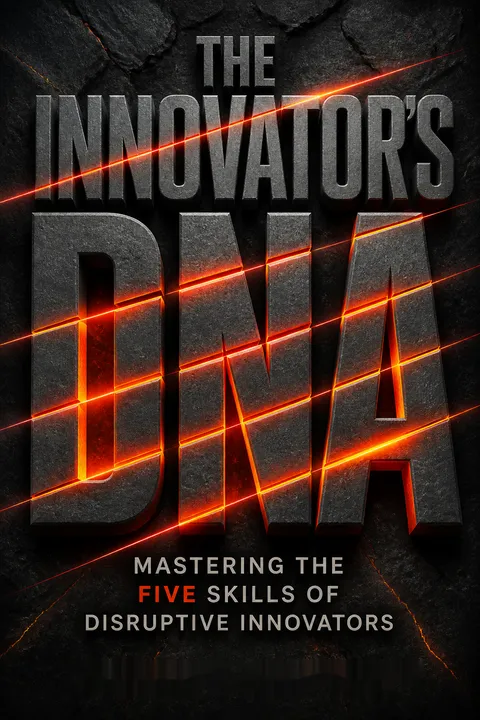


Key Takeaways
Train the behaviors that make creativity more than a genetic lottery
Creativity can be practiced. The authors’ central claim is that innovation is not simply a rare inborn gift. In a study of 117 pairs of twins, only about 30 percent of identical twins’ performance on creativity tests was attributed to genetics. The authors cite other twin studies estimating genetics at 25 to 40 percent, leaving substantial room for learning and practice. Their research compared roughly 500 innovators with 5,000 executives and identified four behaviors that feed a fifth, mental skill: questioning, observing, networking, and experimenting support associating, the linking of seemingly unrelated ideas.
Action changes thought. Innovative ideas often begin with new information gathered through these behaviors, not with solitary inspiration. The authors stress that the skills can improve, although no checklist guarantees commercial success. In their sample, about one-third of innovators’ ventures or products did not meet their success criteria.
The useful distinction is between having creative potential and reliably producing valuable ideas. A behavior-based account makes development possible, while avoiding the comforting myth that creativity belongs only to a gifted few. It also clarifies why practice needs real inputs: asking questions without listening, or collecting experiences without reflecting on them, may produce activity rather than insight. The twin findings support a role for learning, but they do not prove that every person can reach the same level of originality or that training alone overcomes unequal access to time, expertise, and resources.
Feed your mind distant ideas, then combine them into useful offers
Associations need ingredients. The book calls the ability to connect ideas across fields, problems, or experiences associating. Marc Benioff developed Salesforce.com by bringing together enterprise software and the internet-based retail models he saw at Amazon and eBay. Instead of selling software that customers installed themselves, Salesforce delivered it online as a service. The connection was novel because the software industry had treated installation as normal.
Collect across boundaries. The authors compare useful knowledge to building blocks: a broader collection creates more possible combinations. A T-shaped person has deep expertise in one area and broad familiarity with others, allowing ideas to travel in either direction. Associating also benefits from pauses. Some innovators report that ideas emerge while walking, showering, or sleeping, after active work has given the mind material to recombine.
This account makes originality less mysterious: novelty often comes from recombination, while usefulness depends on understanding the problem being recombined around. Breadth without depth can yield clever but shallow connections; narrow expertise can make familiar assumptions hard to see. The T-shaped profile addresses both risks. The practical question is not simply how many new things a person encounters, but whether those encounters are varied enough to challenge existing categories and substantial enough to be understood. Deliberate downtime can help, but it cannot replace the work of acquiring good ingredients.
Ask questions that expose the hidden assumption beneath the stated problem
Find the better question. Innovators probe what is happening, what caused it, and what might change. Orit Gadiesh helped a steel company reconsider its production methods by asking customers why they needed 350 product types. Further inquiry showed that the company could reduce the range to 30, use continuous casting, and compete more effectively. The shift came from questioning the premise that every existing product had to remain.
Make inquiry visible. QuestionStorming is a group exercise that generates questions before solutions. The authors recommend listing at least 50 questions about a challenge, then selecting the most revealing ones to investigate. The five-whys process, used in Toyota’s production system, repeatedly asks why a problem occurred to uncover its root cause. Questions become more useful when they lead to observation, conversation, or testing.
Questioning is powerful because it changes the boundaries of a problem before effort is spent solving it. The steel example shows how a customer’s stated need can differ from the need the business must serve profitably. QuestionStorming also gives quieter participants a structured way to surface doubts before a group rushes toward consensus. Still, a high question count is not a measure of insight. Questions can become theater if leaders punish answers they dislike or if teams never follow inquiry with evidence from customers and operations.
Watch people doing real jobs, especially where they invent workarounds
Observe the actual task. The job to be done is the functional, social, or emotional need a person is trying to satisfy, not necessarily the product they say they want. Ratan Tata noticed a family of four exposed to rain while riding a scooter in Mumbai. That observation inspired the Tata Nano, a low-cost car intended to make family travel safer. Later, field observation in rural markets revealed that selling a car required more than displaying one: customers also needed financing, insurance, driver training, and licensing.
Look for incomplete fixes. A workaround is a partial or improvised way someone gets a job done when existing options fall short. Such behavior can expose unmet needs that interviews miss. The authors also recommend watching for surprises, since unexpected behavior can reveal a gap between a company’s assumptions and customers’ actual experience.
Observation is especially valuable when people cannot easily articulate their own habits or frustrations. Watching the entire customer journey also prevents a common design mistake: improving the product while leaving the surrounding barriers untouched. Tata’s example makes the point vividly, because the vehicle alone did not complete the job of helping a rural buyer get on the road. Observation is not automatically objective, however. An observer can misread behavior through preconceived ideas, so notes, follow-up questions, and repeated visits help distinguish a meaningful pattern from a memorable incident.
Build idea bridges across people who rarely share the same room
Seek ideas, not just access. The book distinguishes idea networking from networking for contacts, career opportunities, or resources. Idea networkers seek people with different knowledge and perspectives. Joe Morton’s experience in Malaysia introduced him to local knowledge of mangosteen, a fruit unfamiliar to his U.S. health-products network. He then connected that knowledge with scientific research and industry contacts to launch XANGO, a mangosteen-juice business.
Cross disconnected groups. Sociologist Ron Burt’s research, discussed in the book, found that managers whose contacts reached across disconnected networks tended to produce more highly valued ideas. A useful question is who else has faced a similar problem, even in a different field. Diverse conversations can provide concepts that are ordinary in one community but valuable in another. Serendipity helps, but the habit of meeting unfamiliar people makes it more likely.
Networks function as channels for moving knowledge between communities, not merely as collections of influential names. This helps explain why an outsider’s apparently unrelated experience can be more useful than another conversation among industry insiders. The challenge is to translate what is learned: a practice that works in one setting may depend on conditions absent in another. Diversity alone does not create innovation. A team needs enough shared context to interpret outside ideas, test their relevance, and adapt them rather than copy them blindly.
Run small experiments to learn what customers will actually adopt
Test what might work. The authors describe three forms of experimentation: trying unfamiliar experiences, taking products or processes apart, and testing ideas through prototypes or pilots. PayPal’s founders first tried to create security software for handheld devices, then shifted toward transferring money between devices, and finally discovered that sending money through email reached a much larger market. Each version produced evidence that altered the business idea.
Learn before scaling. Rent the Runway tested dress rental with customers at Harvard, then tested whether customers would rent dresses without trying them on, and finally tested whether photographs alone were enough. These staged pilots reduced uncertainty about the business model. Experiments can fail, but a useful failure reveals why an idea did not work and does so before the cost becomes damaging. Amazon’s Jeff Bezos also pushed for more frequent experiments by lowering their cost.
Experiments turn debate into evidence, especially when the future cannot be inferred reliably from past data. The strongest pilots isolate a consequential uncertainty, such as whether customers will buy without trying on a product. This makes experimentation more informative than launching a rough version and hoping for a response. The book’s emphasis on learning from failure is strongest when paired with limits: not every setback is educational, and repeated tests can consume scarce resources. A clear hypothesis, a useful measure, and a decision rule help make risk genuinely smarter.
Pair discovery talent with execution before either becomes a bottleneck
Different work needs different strengths. The authors’ discovery quotient, or DQ, summarizes performance across five discovery skills. In their comparison, prominent innovative entrepreneurs averaged around the 88th percentile in discovery skills but around the 56th percentile in delivery skills, such as planning and disciplined execution. Typical executives showed the reverse pattern, averaging about the 62nd percentile in discovery and 80th in delivery.
Build complementary teams. EBay founder Pierre Omidyar relied on Jeff Skoll’s execution strengths to turn ideas into operating plans. At Microsoft, a six-person team’s members brought different strengths in questioning, observing, networking, experimenting, and associating. The needed balance also shifts over a company’s life: early ventures need discovery to find an opportunity, while growth and operations demand stronger delivery. The point is not to maximize one profile, but to cover both kinds of work.
This distinction avoids treating innovation as a contest between imaginative people and practical people. An idea that cannot be implemented has little market effect, while excellent execution can scale an offering that is no longer relevant. Complementarity is therefore a design problem: teams need ways to let exploration challenge assumptions and delivery make commitments credible. The percentile comparisons are useful descriptions of the studied groups, not hiring laws. Roles vary, and individuals can develop across both dimensions; a company should not turn a research pattern into a fixed stereotype about who can innovate.
Make innovation a company habit through people, processes, and philosophies
Build the 3P framework. The authors’ 3P framework describes organizational innovation through people, processes, and philosophies. People means hiring and promoting those who demonstrate discovery skills, while retaining the execution strengths needed to deliver. Processes means giving employees repeatable ways to question, observe customers, exchange ideas, and test concepts. Philosophies are the shared beliefs that make those behaviors legitimate, including the expectation that innovation belongs throughout the organization.
Let practices reinforce each other. Amazon’s Bezos looked for evidence that job candidates had invented something and established teams to test improvements to the website. At IDEO, project teams move from questions to field observation and interviews, then to idea generation and prototypes. Such routines make innovation less dependent on one charismatic founder. They also signal what the organization actually rewards, which may matter more to employees than a slogan about creativity.
The framework’s strength is its insistence that culture is built through mutually reinforcing choices, not posters or speeches. Hiring selects who enters, processes shape what people do, and philosophies explain which risks are acceptable. The system also has a potential trap: successful routines can harden into assumptions and suppress the very questioning they once encouraged. Organizations therefore need to examine whether their processes invite dissent and whether rewards match their stated values. An innovation culture is not simply energetic; it must keep learning about its own habits.
Fund unfamiliar markets, and give radical projects room to breathe
Balance the project portfolio. The book distinguishes derivative projects, which improve existing offerings, from platform projects that extend a business into a new category, and breakthrough projects that pursue more radical products or markets. Google used a 70-20-10 allocation: most engineering effort went to its core business, a smaller portion extended that core, and a smaller share pursued fundamentally new businesses. The exact allocation is a company choice; the principle is to reserve resources for more than incremental improvement.
Match autonomy to novelty. Small teams can explore more ideas, but radical projects may need independence from established units whose incentives and expertise favor the current business. The authors also argue for smart risk taking: failures should generate relevant learning and remain small or fast enough not to threaten the organization. Innovation requires investment, protection, and review, not simply permission to fail.
A portfolio approach recognizes that a company cannot rely indefinitely on refinements to its current products, yet it also cannot bet everything on uncertain breakthroughs. Separating project types makes trade-offs discussable and helps leaders notice when short-term metrics crowd out longer-term options. Autonomy can protect a new model from established routines, though too much separation can deprive a project of customers, infrastructure, and expertise. The design challenge is selective independence: enough distance to question the core, with enough connection to use the organization’s assets.
Put discovery on the calendar before routine crowds it out
Practice deliberately. The authors recommend treating discovery as part of the workweek, not as spare-time inspiration. They estimate that innovative founder-CEOs spend about 50 percent more time on discovery activities than other CEOs, and suggest that leaders devote at least 30 percent of their time to discovery. A practical development cycle is to choose a real challenge, write questions about it, observe users, talk with people outside the usual circle, and run a small test.
Keep the promise realistic. Repeated practice can turn discovery skills into habits, and a coach or trusted colleague can provide feedback. But the book is explicit that these behaviors do not ensure financial success. Roughly two-thirds of the innovators in its sample launched ventures or products that met the authors’ success criteria. Markets, competition, resources, and execution still shape outcomes.
Scheduling discovery counters the tendency for urgent operational work to consume every available hour. It also makes the behavior observable: a calendar can reveal whether curiosity is truly a priority or merely an aspiration. The recommended time proportions should be treated as prompts for reflection rather than universal quotas, since the right balance depends on role and business stage. The broader lesson is durable: make exploration deliberate, connect it to a consequential challenge, and use evidence to decide what deserves further investment.
Analysis
The book’s most valuable move is to relocate innovation from the mysterious interior of exceptional minds into observable behavior. That shift gives leaders something trainable and organizations something designable. The sequence is coherent: varied inputs from questions, observation, networks, and experiments create material for association; courage permits people to challenge routines; complementary execution skills help ideas reach customers. The organizational extension matters because individual creativity can be neutralized by hiring systems, incentives, or structures built only for reliable delivery.
The evidence supports a practical model more strongly than a universal causal law. The interviews reveal how successful innovators describe their own idea origins, while surveys compare self-reported behaviors across innovators and executives. Such designs can identify useful patterns, but they cannot fully separate cause from consequence. Innovators may practice discovery because they already possess traits, roles, or resources that reward it. Retrospective success stories also make messy development look more linear than it felt at the time.
The book’s innovation premium is an inventive way to study investor expectations, but it measures expectations of future value, not innovation itself. A high premium can reflect optimism that later proves mistaken; a low one does not establish that a company lacks valuable inventions. Likewise, the authors’ examples come largely from business contexts where commercial growth is the objective. Public services, scientific research, and social innovation may judge value by different outcomes.
These limits do not undercut the method. They suggest using the five skills as a disciplined search process, then evaluating ideas with domain-specific evidence and clear outcome measures. The strongest organizational lesson is not to imitate Apple or Amazon, but to align people, routines, decision rights, and incentives so that exploration has a real path to execution. Creativity is not made predictable, but the conditions that make discovery more likely can be deliberately improved.
Review Summary
The Innovator's DNA received mixed reviews. Many praised its insights on innovation skills but criticized its repetitiveness. Readers appreciated the five key skills for innovation: associating, questioning, observing, networking, and experimenting. Some found the book practical and transformative, while others felt it lacked originality. The research-based approach was commended, but the repetitive examples and anecdotes were seen as a drawback. Overall, readers valued the core concepts but felt the book could have been more concise.
People Also Read






Glossary
Innovator’s DNA
skills for generating new ideasThe authors’ metaphor for the combination of behaviors and mental abilities associated with innovative thinking. It consists of associating, the cognitive act of connecting ideas, and four discovery behaviors: questioning, observing, networking, and experimenting. The metaphor emphasizes that these capabilities can be strengthened through practice rather than treated as fixed genetic traits.
Discovery quotient
overall discovery-skill scoreA measure the authors use for a person’s performance across the five discovery skills: associating, questioning, observing, networking, and experimenting. The book reports percentile comparisons based on assessments of innovators and executives. It is intended to describe discovery capability, not general intelligence, execution ability, or a guarantee that a person’s ideas will succeed commercially.
3P framework
organizational innovation building blocksThe book’s model of innovative organizations through people, processes, and philosophies. People are selected and developed for discovery and delivery capabilities. Processes systematically support the behaviors that generate ideas. Philosophies establish shared expectations, such as innovation being everyone’s responsibility and thoughtful risk taking being acceptable. The three elements work together to make innovation an organizational capability.
QuestionStorming
generating questions before solutionsA group or individual exercise that focuses first on producing questions about a problem rather than proposing answers. The authors recommend generating at least 50 questions, then identifying the most important ones to investigate. It helps clarify assumptions and uncover dimensions of a challenge that a conventional brainstorming session focused on solutions might overlook.
job to be done
need a person seeks to satisfyA way of describing the need that a person or organization is trying to meet in a particular circumstance. The need can be functional, social, or emotional. Observing the situation helps innovators understand what outcome matters, what existing products are being used to achieve it, and where a better solution may be possible.
workaround
improvised, incomplete solutionA partial or improvised method people use to accomplish a task when available products, services, or processes do not fully meet their needs. Workarounds can reveal unmet needs because they show where users must compensate for weaknesses in an existing solution. Observing them can suggest opportunities for a more complete offering.
innovation premium
market value beyond current businessesThe authors’ estimate of the portion of a company’s market value that cannot be accounted for by projected cash flows from its existing products, services, and markets. They interpret the difference as investor expectations that the company will create profitable new offerings or markets. It reflects expectations, not proof that future innovations will occur or succeed.
five-whys process
repeated questioning for root causesA problem-solving technique associated in the book with Toyota’s production system. Rather than stop at the first explanation for a problem, a team repeatedly asks why it occurred, often for five rounds, to trace the causal chain toward a root cause. The method aims to prompt solutions that address underlying conditions instead of blaming the person closest to the incident.
FAQ
What's The Innovator's DNA about?
- Focus on Innovation: The Innovator's DNA by Jeffrey H. Dyer explores the essential skills and behaviors that drive disruptive innovation in individuals and organizations.
- Five Discovery Skills: It identifies five key discovery skills that innovators possess: associating, questioning, observing, networking, and experimenting.
- Research-Based Insights: The book is based on extensive research, including interviews with nearly a hundred successful innovators and CEOs, to uncover how they generate groundbreaking ideas and business models.
- Practical Application: It provides actionable insights and frameworks that readers can apply to enhance their own innovative capabilities and foster a culture of innovation within their organizations.
Why should I read The Innovator's DNA?
- Enhance Creativity: Reading this book can help you develop your creative thinking skills, which are vital for success in today’s fast-paced business environment.
- Learn from Innovators: The book shares stories and lessons from well-known innovators like Jeff Bezos and Steve Jobs, offering real-world examples of how they applied the five discovery skills to achieve success.
- Actionable Frameworks: It provides practical frameworks and exercises that you can implement to cultivate innovation in your personal and professional life.
What are the key takeaways of The Innovator's DNA?
- Five Discovery Skills: Emphasizes the importance of associating, questioning, observing, networking, and experimenting as critical skills for generating innovative ideas.
- Behavior Over Genetics: Challenges the notion that creativity is solely a genetic trait, arguing that anyone can develop these skills through practice and intentional behavior changes.
- Courage to Innovate: Innovators are characterized by their willingness to challenge the status quo and take smart risks, which is essential for fostering a culture of innovation.
What are the best quotes from The Innovator's DNA and what do they mean?
- “Creativity is connecting things.”: This quote by Steve Jobs highlights the essence of associational thinking, linking seemingly unrelated ideas to generate innovative solutions.
- “I want to put a ding in the universe.”: Reflects the ambition and drive of innovators to make a significant impact through their ideas and creations.
- “Question the unquestionable.”: Emphasizes the importance of questioning established norms and assumptions, a key behavior of successful innovators.
What is the Innovator's DNA model?
- Cognitive and Behavioral Skills: The model consists of a cognitive skill called associational thinking, complemented by four behavioral skills: questioning, observing, networking, and experimenting.
- Interconnectedness: These skills are interrelated; engaging in one often enhances the others, leading to a greater capacity for innovation.
- Framework for Development: Serves as a framework for individuals and organizations to assess and develop their innovative capabilities.
How can I develop my associating skills as described in The Innovator's DNA?
- Create Odd Combinations: Practice combining unrelated ideas or concepts to generate new insights through exercises like forced associating.
- Engage in Diverse Experiences: Actively seek out new experiences and knowledge across various fields to expand your mental repository of ideas.
- Practice Lego Thinking: Collect ideas and insights like Lego blocks, and experiment with different combinations to create innovative solutions.
What role does questioning play in innovation according to The Innovator's DNA?
- Catalyst for Discovery: Questioning is a fundamental behavior that drives the discovery process, helping innovators challenge the status quo and explore new possibilities.
- Types of Questions: Innovators ask a variety of questions, including “what is,” “what caused,” “why,” and “what if,” to gain deeper insights and provoke new ideas.
- Encouraging Curiosity: Emphasizes the importance of maintaining a curious mindset and being willing to ask difficult or uncomfortable questions to uncover innovative solutions.
How does observing contribute to innovation in The Innovator's DNA?
- Understanding Customer Needs: Observing customers in their natural environments allows innovators to identify unmet needs and potential improvements for products or services.
- Looking for Anomalies: Innovators are encouraged to look for surprises or anomalies in customer behavior, which can lead to valuable insights and innovative ideas.
- Engaging All Senses: Effective observation involves engaging multiple senses to gain a richer understanding of the context and experiences of customers.
What is the significance of networking in The Innovator's DNA?
- Diverse Perspectives: Networking with individuals from different backgrounds and industries can provide fresh insights and ideas that enhance creativity and innovation.
- Bridging Structural Holes: Discusses the concept of bridging gaps between social networks to access diverse information and perspectives, leading to innovative solutions.
- Building a Personal Network: Innovators are encouraged to cultivate a personal network of creative confidants who can challenge their thinking and provide new ideas.
How can I implement the principles from The Innovator's DNA in my organization?
- Foster a Culture of Innovation: Encourage behaviors that promote the five discovery skills among employees, such as questioning, observing, networking, and experimenting.
- Provide Training and Resources: Offer training programs and resources that help employees develop their innovative capabilities and apply the principles from the book.
- Create Safe Spaces for Experimentation: Establish environments where employees feel safe to experiment, take risks, and share their ideas without fear of failure.
How can I develop my discovery skills as suggested in The Innovator's DNA?
- Practice Regularly: Actively engage in questioning, observing, networking, and experimenting in your daily life to reinforce these skills.
- Seek Feedback: Collaborate with others and seek their input to enhance your understanding and application of discovery skills.
- Embrace Failure: View failures as opportunities for growth, which is essential for developing experimentation skills and fostering resilience.
How does The Innovator's DNA suggest organizations can implement innovation processes?
- Structured Processes: Develop systematic processes that encourage questioning, observing, networking, and experimenting among employees.
- Small Teams: Organize employees into small, cross-functional teams to enhance collaboration and creativity.
- Resource Allocation: Allocate sufficient resources—both time and funding—to support innovation initiatives, demonstrating a commitment to fostering a culture of innovation.
Download PDF
Download EPUB
.epub digital book format is ideal for reading ebooks on phones, tablets, and e-readers.








