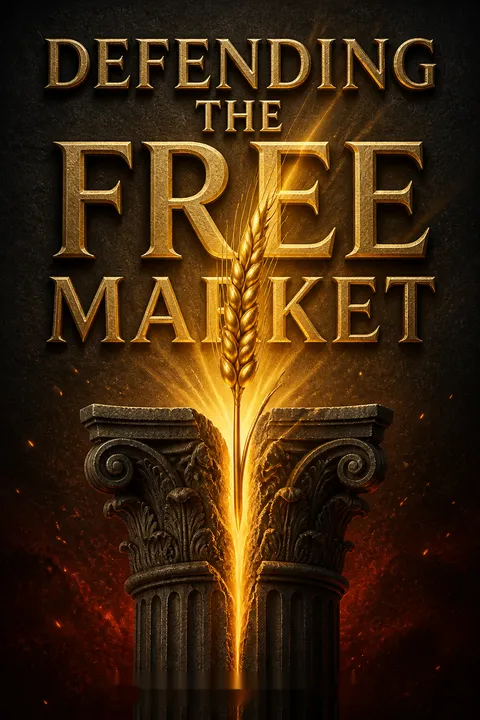


Key Takeaways
Make economic freedom serve human dignity, not merely greater consumption.
A childhood lesson. At five, Robert Sirico watched his neighbor, Mrs. Schneider, share warm pastries. He noticed the numbered tattoo on her arm. His mother explained that the numbers marked a woman whom people had treated as property, and that she had come to America for safety. The story gives the book’s argument its moral starting point: economic systems should respect people as persons, never reduce them to tools or dependents.
Freedom needs a compass. Sirico recounts moving from left-wing activism toward Catholic faith and free-market economics. He argues that markets deserve defense not only because they produce wealth, but because they give people room to create, choose, work, and take responsibility. Consumerism, by contrast, mistakes buying more for becoming more. Economic liberty still needs moral limits, since markets can also reflect cronyism and human vice.
What's striking is that the argument begins with a face and a history, not an efficiency chart. That matters: policy choices often hide their moral assumptions inside technical language. The claim also echoes the capability approach, which evaluates development by whether people gain real opportunities to act and shape their lives, not only by income. A useful question is how a plural society establishes shared standards of dignity when citizens disagree about theology. Sirico's religious foundation gives his case coherence, while public debate still needs reasons accessible across faiths.
Protect property rights because political freedoms need independent ground.
Freedom needs substance. Sirico distinguishes liberty from mere permission to do whatever one wants. He points to the Soviet Constitution, which promised freedoms of speech, religion, and assembly while the state suppressed dissent and closed places of worship. Rights on paper mean little when people lack the practical ability to publish, organize, worship, or support themselves.
Property is a human relationship. In the book’s account, owning something means being able to use, care for, exchange, or develop it under rules recognized by others. Sirico recalls the Plymouth settlers’ experiment with shared production, which he says brought disorder and poor harvests until families received plots of their own. Property rights are not absolute, however: ownership does not excuse neglecting a neighbor in immediate need.
The strongest insight is that property can distribute power beyond the state. A home, business, or independent source of income gives people practical room to speak and associate without asking official permission. Yet private ownership is not the only way communities can manage shared resources. Elinor Ostrom's research on common-pool resources documents communities that preserve them through locally designed rules, monitoring, and sanctions. That nuance sharpens rather than erases Sirico's point: the danger is not every shared arrangement, but arrangements that concentrate control while leaving responsibility unclear.
Fight poverty by opening paths to work, ownership, and enterprise.
Work creates a way out. Sirico argues that ordinary businesses, not charitable transfers alone, have been the main route out of extreme poverty. He cites the historical decline in the share of people living in dire poverty and describes Peruvian entrepreneur Aquilino Flores, who began selling T-shirts and built a company employing thousands. The larger point is that poor people bring skills and initiative, not just unmet needs.
Remove the barriers. In Hernando de Soto's experiment in Lima, students needed more than 300 days of work to register a small shirt-making business, at a cost many times the minimum monthly wage. Sirico also recounts how subsidized food and donated clothing can undercut local producers. His prescription is to open markets, simplify legal business formation, and reserve free shipments for genuine emergencies.
The chapter's shift from asking what causes poverty to asking what enables wealth is analytically useful. It directs attention toward jobs, legal access, and the ability to trade, rather than treating poverty as a permanent identity. But enterprise does not lift people out of hardship by itself: functioning courts, infrastructure, education, and public health also shape whether a business can grow. Emergency aid remains essential when people face disaster or hunger. The relevant distinction is between relief that meets an immediate crisis and policies that unintentionally crowd out local production over time.
Read profits as market signals, never as moral certificates.
Profit conveys information. Sirico defines profit as income exceeding a business's costs. In his argument, profits and losses help show whether a firm is using resources to provide goods customers value. Prices also communicate changing scarcity and demand across many people, information a single central planner cannot readily gather. This makes profit useful, but not a verdict on whether a company behaves ethically.
Greed has many outlets. Sirico defines avarice as desire that becomes unreasonable and disregards others. It can appear in business, politics, charity, or religious life. In a market, an ambitious person can pursue wealth by serving customers; under central control, Sirico argues, influence and access become more important routes to riches. He recalls tire executive François Michelin testing experimental tires himself and worrying that a competitor's product failure would damage trust across the industry.
The distinction between a signal and a moral judgment is essential. A profitable firm may be meeting demand, but prices do not automatically register pollution, worker vulnerability, or harms imposed on people outside the transaction. This is why markets need law, accountability, and ethical judgment rather than blind faith in either business or government. Sirico's Michelin anecdote makes a subtler point: commercial success can depend on trust that extends beyond one company's immediate gain. Reputation is not a substitute for regulation, but it can reinforce responsible conduct.
Let new industries replace old ones, while helping workers cross.
Change destroys and creates. Creative destruction is the process by which new technologies and businesses displace older jobs and industries while opening different opportunities. Sirico traces the transition from horses to cars: the Model T diminished demand for stable workers, farriers, and saddle makers, even as automobile production created new work and made transport more productive. Protecting every existing job would also protect every outdated method.
Support people through change. The losses are real, especially for workers who cannot retrain or move into new roles. Sirico argues for humane transitions, including advance notice, retraining, severance, and charitable help, rather than rules that prevent firms from adapting. He warns that keeping unproductive businesses alive can tie up resources that could support more valuable work.
The distinction between protecting a person and preserving a particular job is valuable. A society can help workers manage upheaval without requiring firms to maintain work that customers no longer need. The harder question is who bears the costs of transition. Workers often lose income, community ties, and status before any new opportunity appears. Public insurance, retraining, or relocation support can reduce that damage without freezing an industry in place. Sirico is strongest when he treats adaptation as a human challenge, not as a painless statistic.
Judge equality by the poverty floor, not by identical outcomes.
Equality has two meanings. Sirico defends equal human dignity and equal rights, but rejects making everyone materially the same. He estimates that confiscating all the wealth of the world's richest 1 percent would provide roughly $13,000 per person once, while doing little to create lasting income or jobs. Much of that wealth, he argues, is invested in businesses that produce goods and employ people.
Look below the ceiling. The book contrasts a wage cap with attention to the poorest people's basic conditions. Ben and Jerry's once limited top salaries to a multiple of entry-level pay, but struggled to attract a CEO with the skills to run a growing company. Sirico's test for economic policy is whether it improves the situation of poor and vulnerable people, not whether everyone ends with the same amount.
The focus on material deprivation rather than envy is a useful corrective to arguments that treat every income gap as equally urgent. Still, inequality can matter even when it does not immediately lower the poorest person's income. Concentrated wealth may translate into political influence, unequal bargaining power, or unequal access to opportunity. The distinction between a floor and a ceiling should therefore not become a reason to ignore power. A sound assessment asks both whether basic needs are met and whether institutions let people participate fairly in economic and civic life.
Deliver aid locally, where helpers can know the person behind the need.
Good intentions need judgment. While volunteering at a free soup kitchen, Sirico worried that the charity might draw customers away from a nearby fish-and-chips shop that had rent, wages, and bills to pay. The episode changed how he thought about assistance: recipients have capacities as well as needs, and help can cause harm if it ignores local circumstances.
Start close to the need. Subsidiarity is the principle that problems should be handled by the closest capable people or institutions, with larger institutions supporting them when necessary. Sirico illustrates local knowledge with Mrs. Rabinowitz, a Brooklyn neighbor whose personal ties let her calm unruly children more effectively than a distant authority could. Families, neighbors, churches, and charities can tailor help; the state, in his view, should generally be a backstop rather than the first response.
Local relationships can reveal details that broad eligibility rules miss: whether someone needs food, treatment, work, or protection from abuse. This is a strong argument for giving communities meaningful roles in care. But local charity can be inconsistent, limited in scale, or shaped by bias, and some crises exceed a neighborhood's capacity. A layered system is more robust than a contest between charity and government: nearby institutions can provide personal knowledge, while public programs help guarantee a minimum and address needs no local group can meet.
Give patients and clinicians more control over medical choices and costs.
Costs need visible signals. Sirico argues that American health care is not a simple free-market system: insurers and government often pay, leaving patients insulated from the price of routine services. He cites a 2011 comparison in which a pelvic CT scan cost $230 at one facility and $1,800 at another in the same town. By contrast, he points to services such as LASIK, which patients often pay for directly, as examples of prices falling with competition.
Markets cannot supply compassion. The book argues that third-party payment and regulation weaken incentives to compare prices and improve service. At the same time, Sirico says that personal care cannot be reduced to a transaction. He recalls Christian communities caring for the sick during ancient epidemics and argues that humane medicine needs both practical freedom and people committed to serving patients.
Price visibility can help patients and providers identify waste, but medical care differs from buying an ordinary consumer product. Patients may lack the expertise or time to compare treatments, and emergencies leave little room for shopping. Insurance also pools risk that individuals cannot reasonably manage alone. These realities complicate a simple consumer-choice model. Sirico's useful contribution is to question a system where no one sees the full cost; the challenge is to increase transparency and accountability while protecting access and recognizing that illness makes people unusually dependent on others.
Make conservation reward stewardship instead of punishing landowners for nature.
Ownership can encourage care. Sirico argues that clearly defined property rights give people reasons to maintain resources they expect to use over time. When everyone can take from a resource but no one has responsibility for it, the incentive may be to consume it before others do. He calls this the tragedy of the commons and applies the idea to endangered animals and other natural resources.
Policies can backfire. The book describes how landowners may see protected species as a liability if their presence brings restrictions on how they can use their property. Some, Sirico argues, may then damage habitats or hide evidence of the animals. He favors policies that make conservation valuable to local communities, alongside laws that protect ownership and support responsible care.
The incentive problem is real, and conservation can be more durable when local people benefit from protecting a resource. Yet many environmental harms cross property lines: air pollution, for example, affects people who never agreed to the transaction that produced it. Private ownership alone cannot resolve every spillover. Collective rules, enforcement, and negotiated local governance may all be necessary. The broader lesson is not that one tool always works, but that environmental policies should be judged by the behavior they reward, including effects that their designers did not intend.
Aim freedom at meaningful work and service, not endless consumption.
People are more than calculators. Homo economicus is the simplified economic model of a person who continually pursues self-interest and maximizes personal benefit. Sirico finds it useful for some analysis but inadequate as a full portrait: people also seek love, faith, achievement, and service. He warns that a society focused only on buying and measurable gain neglects the sources of meaning that make freedom worth having.
Work can be a calling. Sirico draws on the Christian idea that human beings reflect a Creator's capacity to create. He tells of a monk who found meaning in night prayer, while his father reminded him that parents also discover purpose in the ordinary work of caring for a child. For Sirico, legitimate work can serve others and express human creativity, whether it happens in a monastery, a home, or a business.
This closing argument gives the book a moral destination beyond prosperity. It also corrects the caricature of people as purely self-interested, a model that can predict some choices without explaining why people volunteer, care for relatives, or pursue difficult work for its own sake. The challenge is to keep vocation from becoming a demand that every job feel spiritually meaningful. Many people work under constraint or for survival. A humane economic order should respect the meaning people find in work while improving the conditions under which they do it.
Analysis
Sirico's case for the free economy is not merely that markets produce more goods. It is that economic freedom helps disperse power, makes room for initiative, and treats people as moral agents rather than objects of administration. The personal stories give that argument unusual coherence: the Holocaust survivor makes dignity concrete, the soup kitchen complicates simple charity, and the ordinary work of family life broadens the meaning of vocation. The book's most useful intellectual thread is its attention to knowledge. Prices, contracts, and local relationships transmit information that centralized plans cannot easily collect.
Its strongest claims are institutional, not absolute. Markets coordinate choices, but they do not guarantee justice, truthful information, clean environments, or compassion. Sirico acknowledges this, yet sometimes presents the choice between free markets and state control too starkly. Real economies combine markets, public rules, social insurance, and civic institutions. The key questions are how each institution handles information, incentives, accountability, and unequal power. A market price can coordinate a transaction while leaving pollution or worker vulnerability outside the calculation; public programs can protect people while also becoming rigid or politically captured.
The book's empirical examples also need careful handling. The poverty and health-care figures largely describe conditions around 2011, and correlations between business freedom and prosperity do not by themselves establish a single cause. Political stability, education, infrastructure, and public capacity matter too. Likewise, communal resource management is not inevitably state ownership or open access. Communities can build rules that preserve shared resources.
The enduring contribution is its insistence that economic arrangements carry a view of the human person. Readers need not accept Sirico's theology to take that question seriously. A defensible free economy requires more than permission to transact: it depends on law, ethical limits, institutions that prevent coercion, and a culture that recognizes human worth beyond productivity. The book is most persuasive when freedom is presented as a condition for responsibility and service, not as a guarantee that markets will make people virtuous.
Review Summary
Defending the Free Market receives mostly positive reviews, with readers praising its clear arguments for capitalism from a Christian perspective. Many appreciate Sirico's personal anecdotes and accessible explanations of economic principles. Critics argue the book lacks nuance and relies too heavily on religious arguments. Some readers find it thought-provoking, while others consider it outdated or biased. Overall, reviewers commend Sirico's defense of free markets as morally sound and beneficial for society, though opinions vary on the book's effectiveness in convincing skeptics.
People Also Read





Glossary
imago Dei
humanity made in God's imageA Christian theological teaching that human beings are made in the image of God. Sirico uses it to explain why people possess inherent dignity and why human creativity, work, and stewardship have moral significance. In his account, this dignity is not awarded by a government or earned through wealth or productivity.
homo economicus
the utility-maximizing modelA simplified model of a person who acts chiefly from self-interest and seeks to maximize personal utility. Sirico accepts that the model can help explain some economic behavior, but argues it cannot represent the full human person, whose motives also include love, faith, duty, creativity, and service.
creative destruction
renewal through economic displacementThe process by which new technologies, firms, or ways of producing replace older ones, causing some jobs and industries to disappear while new forms of work and value emerge. Sirico argues that preventing every loss can block this renewal, while insisting that displaced workers deserve humane assistance.
subsidiarity
decisions made close to needA principle that social problems should be addressed by the smallest or closest capable institution, such as a person, family, neighborhood, or local organization. Higher-level institutions should support these groups when needed, rather than automatically taking over their responsibilities or displacing their initiative.
Samaritan's dilemma
when help may worsen dependencyThe difficulty of deciding whether direct aid will genuinely help someone or unintentionally sustain harmful behavior or dependence. Sirico uses the dilemma to argue that compassion needs judgment as well as sympathy, especially when assistance is given without understanding a person's circumstances.
synoptic delusion
the illusion of complete knowledgeSirico's term for the belief that one planner, agency, or centralized system can gather enough information to understand and manage a complex society. Drawing on Hayek's critique of centralized planning, he argues that knowledge is dispersed among people and local institutions, making comprehensive social control prone to error.
tragedy of the commons
overuse of unowned resourcesA pattern in which a shared resource is depleted because individuals can benefit from using it while the costs are spread among everyone. Sirico applies the idea to wildlife and natural resources, arguing that clear responsibility and incentives for stewardship can encourage conservation.
Business as Mission
enterprise serving social and spiritual goalsAn approach in which people establish businesses, particularly in developing regions, with commitments to sound work, useful products, and moral conduct. Sirico presents such businesses as a way to create jobs and economic opportunity while expressing religious service through ordinary commercial activity.
humanophobia
viewing people as nature's threatSirico's label for treating human beings as inherently harmful to the natural world or as a burden on the planet. He contrasts this view with a stewardship ethic in which people have distinctive responsibility and creative capacity to care for the environment.
Download PDF
Download EPUB
.epub digital book format is ideal for reading ebooks on phones, tablets, and e-readers.








