

Key Takeaways
Treat insurance as a promise you cannot replace after disaster strikes.
Protection shared by many. Insurance pools premiums so a group can absorb losses that would overwhelm individuals. In 1752, Benjamin Franklin helped organize the Philadelphia Contributionship, where homeowners contributed to a common fund for members whose houses burned. Modern insurers use a much larger, more technical version of that arrangement, but the purpose remains financial security against events people cannot predict or afford alone.
A one-way door after loss. Unlike a faulty television or a contractor who fails to show, an insurance policy cannot be replaced once the fire, crash, or injury has happened. The policyholder has already paid for the covered risk. The insurer’s job is to determine what the policy owes and pay it promptly and fairly. That dependence is why claims handling is central to the promise, not a minor customer-service detail.
The book’s strongest starting point is to frame insurance as a social institution, not merely a contract. That perspective clarifies why a technically correct but inaccessible policy can still fail its practical purpose: security depends on a person being able to obtain payment when loss occurs. It also explains why claim handling warrants scrutiny beyond ordinary consumer satisfaction. A useful nuance is that pooling only works if insurers remain financially sound and investigate claims carefully. The challenge is to protect claimants without treating every disagreement as misconduct, while recognizing that the insurer controls the process and has far more information.
Watch for delay, denial, and litigation used to make valid claims cheaper.
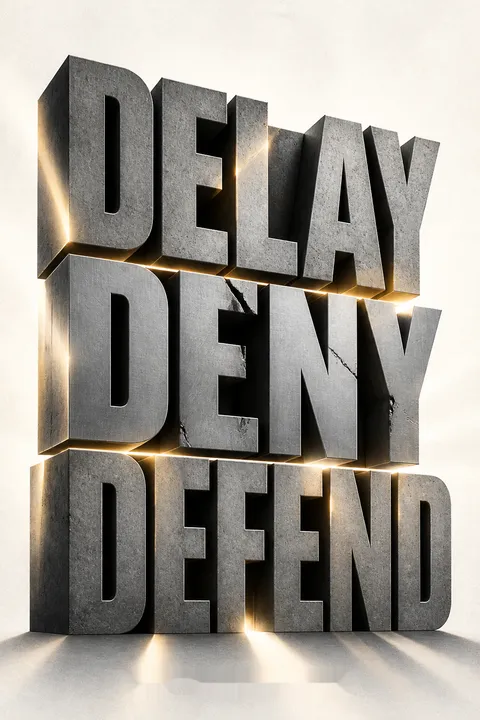
A costly sequence. The book uses “delay, deny, defend” to describe a claims strategy: postpone a decision, refuse some or all of a valid payment, then fight the claimant if they sue. Delay can earn investment income on premiums still being held, but it also creates pressure on people who need money for treatment, repairs, or lost income. Denial makes the claimant choose between accepting less and pursuing a costly dispute.
Need can become leverage. Kim Zilisch’s underinsured-motorist claim illustrates the imbalance. State Farm waited nearly a year to make an offer, despite medical evidence of permanent injury. An arbitration panel valued her claim at $387,500; the insurer then paid its $100,000 policy limit. Her case shows how time and financial vulnerability can become part of the bargaining strategy, not just an administrative inconvenience.
The important distinction is between a disputed claim and a system that profits from making dispute expensive. Insurers do need time to verify coverage, responsibility, and loss amounts. But an investigation becomes suspect when its duration or demands appear disconnected from the evidence needed to decide the claim. The claimant’s immediate need for money also changes the negotiation: a settlement accepted under pressure is not necessarily a fair measure of the loss. The book’s account therefore makes process itself a consumer-protection issue, not merely a route to the final payment.
When claims became profit centers, employee targets made underpayment easier to normalize.
A change in purpose. Traditionally, adjusters were expected to assess each claim and pay what the policy required. In the 1990s, insurers increasingly treated claims as a source of savings. McKinsey helped companies redesign claims operations around “leakage,” a term for payments judged to exceed what a claim should cost. In practice, the reviews and targets described in the book focused heavily on finding ways to pay less, rather than equally searching for underpayments.
Numbers shape decisions. Allstate, State Farm, and Farmers used programs that measured costs, average payouts, or claims closed without payment. Some adjusters described pressure to meet financial targets, with bonuses, reviews, or job consequences tied to results. The book’s point is not that every employee ignored the merits of a claim. It is that a system rewarding low payouts can gradually make an unfair result look like good performance.
This section exposes a classic measurement problem: when an organization rewards a proxy, workers learn to optimize the proxy, even when it no longer represents the public purpose of the job. Claims cost is measurable; fairness is harder to quantify. That makes low-payout targets attractive to executives and potentially corrosive to judgment. The argument is strongest when it distinguishes ordinary cost control from incentives that reward reducing valid payments. A caution is that an internal target alone does not prove a particular claim was mishandled. It does, however, identify a structural risk worth auditing.
Small injury claims can be made too expensive for victims to pursue.
The MIST category. Insurers use MIST, meaning minor impact, soft tissue, for low-speed crashes associated with injuries such as neck or back pain that may not appear on an X-ray. The book stresses that a small vehicle impact does not, by itself, establish that an injury is imaginary or insignificant. Yet such claims often involve relatively modest damages, which makes extensive litigation economically punishing for the claimant and their lawyer.
A deliberate cost imbalance. Allstate’s reported strategy for these claims included low offers, aggressive investigation, and willingness to take cases to trial. In one McKinsey study cited by Feinman, average payments on the targeted claims fell 38 percent, from $4,500 to $2,783. The logic is chillingly simple: if defending a small claim costs more than the claim is worth, the injured person may have little practical ability to challenge an unfair offer.
MIST claims reveal how access to justice depends partly on scale. A person can have a legitimate injury but lack a financially viable path to prove it. This is not unique to insurance: small disputes in housing, employment, and consumer finance face the same mismatch between the cost of legal process and the value of an individual claim. At the same time, soft-tissue injuries can be difficult to assess, and fraud does occur. The fair response is neither automatic payment nor automatic suspicion, but consistent evidence standards that do not turn litigation expense into a substitute for judging the claim.
Treat software estimates as inputs, not neutral verdicts on what you are owed.
A tool reflects its settings. Colossus is software used to estimate general damages in bodily-injury claims. It processes recorded injuries, symptoms, treatment, and other factors, then produces an evaluated amount. The system cannot assess every detail a jury might consider, and insurers can tune how its scores translate into dollars. Former adjusters described limits on offering more than the software’s range. One account of Farmers’ initial tuning says experienced adjusters’ valuations were reduced by 20 percent before being used to set benchmarks.
Property estimates have limits too. Xactimate estimates repair costs from the damage details an adjuster enters and regional price data. An incomplete inspection or a wrong description can produce a low estimate, while unusual materials or specialized labor may not fit its standard categories. A contractor’s estimate and the insurer’s software figure can therefore differ for reasons that deserve investigation, not automatic deference.
Automation can make decisions more consistent, but consistency is not the same as accuracy or fairness. A scoring system inherits the choices embedded in its data, categories, and settings, while its technical appearance can make those choices seem inevitable. The useful question is not whether software is biased by nature, but who sets its assumptions, who can override its result, and whether outcomes are checked against independent evidence. The book’s examples are a reminder that a number generated by a computer is still a human decision, with responsibility attached.
Read homeowners coverage closely: “all risks” and “replacement cost” both have limits.
Broad labels, narrow terms. A standard HO-3 homeowners policy may cover a dwelling against direct physical loss while listing many exclusions, exceptions, and exceptions to exceptions. Personal belongings may instead be covered only for named types of loss, with special dollar limits for items such as stolen jewelry. The policy’s length and technical language make it easy to mistake a broad label for comprehensive protection.
Replacement can mean less. Many policies require the home to be insured for at least 80 percent of its replacement cost to qualify for replacement-cost treatment. Yet replacement cost is often capped at the policy limit, and the insurer may initially pay only depreciated actual cash value, holding back the rest until repairs are complete. Feinman cites reports that more than two-thirds of homes are insured below replacement cost. He urges buyers to estimate rebuilding costs and consider endorsements for gaps such as building-code upgrades.
The homeowners policy illustrates a problem of communication as much as contract law. A phrase that sounds ordinary to a buyer can carry a narrow technical meaning once damage occurs. This puts a premium on clear disclosure before purchase, when the consumer can still compare coverage, rather than explanation after a loss, when alternatives have vanished. Yet no policy can eliminate every ambiguity or insure every possible expense at any price. The practical task is to make exclusions and limits legible, then let buyers decide which risks they can bear.
After catastrophe, mixed causes and obscure exclusions can leave homeowners fighting over proof.
Katrina tested the promise. Hurricane Katrina generated an estimated 1.75 million insurance claims across the region, alongside extensive losses paid by the federal flood program. Homeowners policies commonly excluded flood damage while covering wind damage. When both forces affected a home, insurers and policyholders disputed which cause produced the loss and how much of the damage belonged to each.
The burden matters. Some homes were reduced to concrete slabs, leaving little physical evidence to distinguish wind damage from water damage. Feinman describes how State Farm’s wind-water guidance was criticized for making payment depend on proof of wind damage, even though the insurer had a duty to investigate and, under the legal rule discussed in the book, to establish that an exclusion applied. The disaster exposed a gap between what “all risks” may suggest to buyers and what detailed exclusions can remove.
Catastrophes magnify ordinary information imbalances. The policyholder loses records, access, and time precisely when the insurer must process an extraordinary volume of claims. The book’s account also shows that causation is not merely a scientific question; policy wording and legal rules determine who bears uncertainty when evidence is gone. A strong system needs pre-agreed standards for mixed-cause losses and transparent documentation of decisions. Otherwise, rapid claims handling can come at the cost of accuracy, while delay can turn the claimant’s emergency into bargaining leverage.
Fraud screening can turn ordinary facts into suspicion before anyone proves wrongdoing.
A red flag is not proof. Insurers do face genuine fraud, but the book questions the scale suggested by industry campaigns. In a ten-year Massachusetts study, 17,274 suspected cases were referred by insurers, while 368 were ultimately identified as criminal fraud, roughly one proven case for every 47 referrals. Many claims were rejected before investigation or never reached prosecutors.
Screening can punish normal behavior. Company systems flagged features such as multiple injured passengers, prior claims, neck pain, or a claimant who pressed for settlement. A family traveling together and treated by one doctor could therefore look suspicious to a scoring system despite having a straightforward accident. When databases preserve allegations and link claimants, doctors, or lawyers to them, suspicion can follow people into future claims. The danger is not fraud prevention itself, but treating an indicator as a conclusion.
Fraud control is legitimate, and insurers cannot simply accept every account without verification. The difficulty lies in the base rate: when proven fraud is much rarer than flagged suspicion, even a seemingly precise screening system can burden many innocent claimants. This is a familiar problem in predictive policing and medical screening, where false positives impose real costs. The book’s strongest contribution is to ask who bears those costs and whether a person can correct a mistaken flag. Effective controls need review, documentation, and a route to challenge errors.
Document every step, challenge estimates, and escalate when the claim stops moving.
Build a record early. Keep copies of the policy, bills, photographs, repair estimates, medical records, and every letter. Note who said what and when, and send a written summary after important conversations. Provide reasonable documents the insurer needs, but do not assume its estimate or explanation is complete simply because it comes from a claims department or computer system.
Be cooperative and persistent. Ask the adjuster to explain applicable coverage, deadlines, and the basis for an offer. If the decision appears wrong, state the facts in writing and request review by a supervisor. A state insurance department may help mediate or investigate, though its powers and resources vary. For serious injuries, complex damage, or disputed policy language, consult a lawyer or public adjuster and weigh the likely benefit against the fee. The book’s practical rule is to stay polite, prompt, and persistent.
These steps turn a stressful claim into a manageable record of evidence and decisions. Written documentation reduces reliance on memory, makes inconsistencies easier to identify, and gives supervisors or regulators something concrete to review. Escalation also recognizes that a front-line adjuster may have limited authority, rather than assuming that one conversation resolves the dispute. Still, consumer diligence cannot repair a system designed badly or compensate for every resource gap. The advice is most useful as self-protection, not as a substitute for enforceable standards.
Require public claim data and real penalties for insurers that break the rules.
Make performance visible. Buyers can often compare premiums but cannot reliably compare how quickly insurers pay, how often they deny claims, or how often customers must sue. Feinman argues that regulators should require standardized reporting on claims opened, closed, denied, paid, and litigated, then publish the information so consumers can make informed choices.
Make fairness enforceable. The book also calls for clear legal duties to investigate and settle fairly, stronger regulatory powers, meaningful penalties, and effective lawsuits for people harmed by bad-faith handling. A rule that applies only after repeated violations can leave an individual claimant without a remedy. Courts and regulators should be able to account for the amount saved through wrongdoing, the harm caused by delay, and the cost of forcing a claimant to fight for payment.
This reform agenda connects consumer protection to the design of markets. Competition cannot reward better claims service if buyers cannot observe that service before choosing a policy. Public data can make performance more legible, while enforcement supplies a backstop when reputation and shopping alone fail. Measurement must be designed carefully: raw denial rates, for example, could penalize insurers that handle unusually complex claims. Useful reporting therefore needs consistent definitions and context, not just rankings. The deeper principle is accountability: the party controlling the records should not also control whether the public can see them.
Analysis
Feinman’s central argument is that claims handling is not a neutral administrative stage. It is the point where an insurer’s abstract promise becomes money, repairs, treatment, or nothing. That makes the claims department a powerful gatekeeper. The book traces how incentives, consulting-driven redesign, software, performance targets, and litigation management can align the organization around reducing payouts, even while each element is presented as efficiency, fraud prevention, or consistency.
The most persuasive mechanism is institutional rather than conspiratorial. A company need not instruct every adjuster to deny valid claims. It can define success through average payout, closure without payment, or adherence to a computer-generated range, then reward employees for those results. That design can produce unfair outcomes without requiring every participant to act maliciously. It also explains why individual stories matter but cannot, by themselves, establish the industry-wide frequency of abuse. Feinman’s argument is strongest where internal documents, testimony, and adjudicated cases reveal processes, and more tentative where the available evidence cannot quantify prevalence.
The book also exposes an accountability asymmetry. Insurers collect detailed information about customers and claims, while consumers and regulators often lack comparable data about insurer performance. That asymmetry weakens market discipline: buyers can compare prices, but cannot readily price the risk of a difficult claim. Public reporting and enforcement are therefore not add-ons to consumer choice. They are conditions for meaningful choice.
A broader institutional lesson follows: systems should be judged by what they optimize and by who bears the cost when they are wrong. Claim efficiency is not inherently suspect; fast, accurate processing benefits both sides. But speed, low cost, and fraud detection become poor proxies when they displace the duty to assess each loss on its merits. The book’s enduring value lies in asking readers to inspect the machinery behind a reassuring brand promise.
Review Summary
Delay, Deny, Defend exposes insurance companies' tactics to avoid paying claims, focusing on profit over policyholders. Readers praise Feinman's detailed research, accessible explanations, and real-world examples. Many found the book eye-opening and infuriating, highlighting systemic issues in the industry. While some felt the solutions offered were inadequate, most appreciated the consumer-focused advice. The book's relevance to recent events sparked interest, though some noted its focus on property and auto insurance rather than health insurance.
People Also Read







Glossary
Delay, deny, defend
Claim resistance strategyA pattern in which an insurer postpones payment, refuses some or all of a claim, and then vigorously contests litigation brought to obtain the benefits. Feinman argues that these tactics can increase investment income, reduce payouts, and pressure claimants who need money to accept less than they are owed.
Moral hazard
Incentive-driven risk shiftingIn insurance economics, moral hazard describes how one party’s behavior can change when another party bears some of the consequences. An insured may take fewer precautions because losses are covered. Feinman extends the concern to insurers: because a company keeps money until it pays a claim, it also faces incentives that can encourage opportunistic conduct.
leakage
Claim payments deemed excessiveA claims-management term for the difference between what an insurer paid and what it believes an accurate claim settlement should have been. Feinman emphasizes that company programs often examined potential overpayment more closely than underpayment, turning the idea into a way to identify savings through reduced claim payouts.
MIST
Minor impact, soft tissueAn insurer category for low-speed automobile collisions associated with soft-tissue injuries, such as neck and back pain that may not show clearly on standard imaging. Feinman describes how relatively small claim values can make extensive investigation and litigation especially burdensome for injured people and their lawyers.
Colossus
Bodily-injury valuation softwareA computer system used by insurers to evaluate personal-injury claims, especially general damages such as pain and suffering. It processes details entered about injuries, symptoms, treatment, and effects on daily life. The insurer determines how the system’s scores convert into dollar values, and the system cannot assess every factor relevant to a claim.
Xactimate
Property repair estimating softwareSoftware used to estimate the cost of repairing damaged homes and other property. An adjuster enters information about the damage and work required, and the program applies regional price data. Its results depend on the accuracy and completeness of the inspection, the selected repair options, and how well standard categories fit the property.
anti-concurrent causation clause
Exclusion for combined causesA policy provision intended to exclude a loss when an excluded cause contributes to the damage, even if a covered cause also contributes or acts at another point in the sequence. Feinman discusses its role in disputes over hurricane losses where wind may be covered but flood damage is excluded.
bad faith
Unfair claims handlingA legal concept used to hold an insurer responsible for unreasonable conduct in handling a claim. Depending on the state, it may cover failures such as inadequate investigation, unreasonable delay, or refusal to pay covered benefits. Feinman argues that laws should make these standards clearer and provide meaningful remedies to injured policyholders and claimants.
Download PDF
Download EPUB
.epub digital book format is ideal for reading ebooks on phones, tablets, and e-readers.








