

Key Takeaways
Notice the direction your ordinary choices are giving your life
Small choices accumulate. Tolstoy’s fictional Ivan Ilyich builds a respectable life through everyday decisions: he chooses the expected career, social circle, marriage, and home. Only when terminal illness forces him to look back does he question whether the life he assembled was truly good. His story warns that a life can drift toward a destination without anyone consciously choosing it. Joseph’s point is not that every breakfast choice carries equal weight, but that habits and repeated priorities quietly shape a person over time.
Look beyond the crossroads. When a major decision consumes attention, also ask what your daily routines are training you to value. A job matters, but so do the patterns of attention, service, and relationship that fill it.
The strength of Ivan’s story is its account of drift: people often inherit a definition of success before noticing that they have adopted it. Behavioral science similarly distinguishes deliberate choices from habits that operate with little conscious attention. Still, not every routine deserves deep scrutiny, and ordinary choices are not all morally equivalent. The useful test is directional: do repeated decisions make a person more aligned with their stated commitments, or do they quietly substitute someone else’s expectations? This keeps the lesson from turning daily life into a guilt-inducing audit.
Choose within God's revealed boundaries instead of hunting for secret signs
Separate what is known. Joseph distinguishes God’s revealed will, found in Scripture, from his hidden will, which includes future events and providential outcomes that people cannot know in advance. People may not know which job or neighborhood they will choose, but they can know duties that apply across options, such as honesty, love of neighbor, and faithfulness. The Bible also contains ceremonial, civil, and moral laws. Joseph explains that ceremonial laws point to Christ, civil laws governed ancient Israel, and moral laws continue to guide Christian conduct.
Make a faithful choice. The aim is not to decode a private message about every detail. It is to act wisely within what is clear, then trust God with what remains unseen.
This distinction directly addresses a common source of decision paralysis: treating every uncertain preference as if it concealed one uniquely correct divine answer. It also gives uncertainty a boundary. The approach depends on a Christian understanding of Scripture and will not function as a neutral method for people who reject that authority. Even within that tradition, interpretation can be difficult. The distinction is most useful when it encourages humility about predictions while still requiring careful thought about what the text actually says.
Treat decision-making as spiritual formation, not answer retrieval
The process changes you. Joseph argues that God’s purpose is not merely to deliver a correct answer, as if life were a puzzle with one hidden solution. Making decisions can develop patience, dependence, wisdom, and intimacy with God. She illustrates the point through her own career uncertainty: she considered medical school and vocational ministry, but neither became her immediate path. She first taught biology, then found a route into ministry through unexpected circumstances. Proverbs offered wisdom, not a formula that could name her career in advance.
Expect a real process. The book’s biblical examples include Jehoshaphat, who prayed and sought God when threatened by an army, and Mary, who accepted a bewildering calling with humility. Waiting is not evidence that the process has failed.
The emphasis on formation is a valuable alternative to treating choices as optimization problems. In developmental psychology, difficult tasks can build judgment when people receive feedback and have room to reflect. But a meaningful process does not guarantee that every delay contains a decipherable lesson, nor does hardship prove that a path is right. The framework is strongest when it invites patience without romanticizing uncertainty. A process can be formative even when its outcome is disappointing or its meaning remains unclear.
Own your choices while entrusting outcomes to God's sovereignty
Hold both truths. Joseph presents human responsibility and divine sovereignty as truths that coexist, rather than problems people must solve before acting. Overemphasizing responsibility can make every choice feel capable of ruining one’s future. Overemphasizing sovereignty can turn people into passive spectators who believe their actions do not matter. The book uses the puzzle of light behaving as both wave and particle to illustrate how two claims can appear incompatible without either being false.
Choices still matter. The story of Joseph gives the idea a human face. His brothers’ betrayal sends him into slavery and prison, yet the biblical narrative portrays God as bringing good from their wrongdoing. The consequences of harmful choices remain real, but they do not place a person beyond God’s care or make the wrongdoer sovereign over the future.
This balance resists two familiar distortions: the fantasy of total control and the resignation of fatalism. In practical terms, people can take responsibility for the quality of their deliberation while accepting that outcomes depend on forces beyond them. The theological claim is not a complete explanation of how divine control and human agency fit together; it is a disciplined refusal to collapse either side. Its pastoral value is clear, though it should not be used to minimize the harm caused by other people’s choices.
Audit the gauges that quietly steer your decisions
Notice hidden influences. Joseph describes a decision dashboard made up of influences that can help or distort judgment. Cultural expectations shape what seems respectable or shameful. Idols are good things treated as ultimate sources of security or worth. Desires offer relevant information, but they can become tyrannical. Urgency can crowd out what matters over time. The gospel, in Joseph’s Christian framework, restores God to the center and helps put those other influences in proportion.
Look for the pattern. She suggests examining where time, money, attention, and worry repeatedly go. Her own story shows how expectations about academic achievement and status pushed her toward medicine, even as her interests pointed elsewhere. A study by neuroscientist Antonio Damasio, as discussed in the book, found that patients with damage affecting emotion could reason but struggled to make decisions.
The dashboard is useful because it treats judgment as socially and emotionally situated, rather than as pure calculation. Research on decision-making likewise challenges the idea that reasoning works independently of emotion. The cultural categories Joseph borrows, guilt-innocence, honor-shame, and fear-power, can help name different pressures, but they are broad patterns rather than labels for every person in a society. A good audit asks how a pressure operates in a particular life instead of assuming that a category explains it.
Gather clues about your gifts, priorities, circumstances, and blind spots
Build the picture gradually. Joseph compares preparation to laying out the pieces of a jigsaw puzzle. Useful pieces include passions and abilities, priorities in the current season, and circumstances that create or close opportunities. Her mentor Dr. Wines helped her notice that teaching theology energized her more than classroom management or biology instruction. That insight came through reflection over time, not a sudden revelation.
Invite honest counsel. Joseph calls trusted advisers who ask hard questions and speak from Scripture and knowledge of the person “trusted trespassers.” Their role is to expose blind spots, not to make the decision. She also recommends prayer and, when appropriate, fasting. Her account of Stuart Briscoe emphasizes examining available opportunities rather than forcing a path open. Open doors may inform discernment, but they are not automatic proof of a calling.
This method resembles good career counseling: combine self-knowledge, external feedback, and information about real opportunities rather than relying on a single aptitude test or a passing mood. Diverse advisers can reduce blind spots, especially when they know the decision-maker well and are willing to disagree. Yet advisers can also share the same biases or social incentives. The useful standard is not the number of people who agree, but whether counsel is informed, candid, and open to correction.
Test difficult choices through Scripture, circumstances, and desire
Use three angles. John Frame’s triperspectivalism gives the book a practical way to examine a decision from three perspectives. The normative perspective asks what God’s word says. The situational perspective examines facts, constraints, and likely consequences. The existential perspective considers the decision-maker’s desires, feelings, and inner life. Joseph’s example of a couple considering marriage first asks whether the relationship fits biblical commitments, then whether their circumstances align, and finally whether each genuinely wants this particular marriage.
Triangulate, do not calculate. The perspectives are meant to correct one another, not to produce a score that mechanically selects the winner. A church decision, for example, involves beliefs and teaching, practical access and community, and whether the church supports a person’s spiritual growth. The framework helps expose missing questions without pretending that complex decisions become simple.
The framework’s central advantage is triangulation. Rules alone can miss context, circumstances alone can excuse expedience, and desire alone can rationalize impulse. Looking through distinct lenses makes those errors easier to detect. The method is not a substitute for judgment, however, because people can interpret Scripture, assess circumstances, and describe their desires selectively. Its rigor depends on letting each perspective challenge the others rather than recruiting all three to defend a preference already chosen.
Use emotions as evidence, never as the final authority
Feelings can inform. Joseph adapts Ignatius of Loyola’s distinction between consolation and desolation. Consolation describes an inward movement toward hope, faith, love, and spiritual joy; desolation describes inner turmoil, confusion, and a pull toward lesser aims. In a difficult decision between teaching at a school and leading women’s ministry, Joseph found that imagining one option brought anxiety while the other brought energy and relief. Those reactions helped clarify her preference after prayer, counsel, and reflection.
Do not confuse comfort with guidance. Joseph stresses that this is a tool, not a biblical command. Jesus’s prayer in Gethsemane shows that faithful obedience may involve anguish and a choice one would not naturally prefer. A SWOT analysis, which lists strengths, weaknesses, opportunities, and threats, can also help sort competing considerations without deciding for the person.
Emotion often carries information that a pros-and-cons list cannot capture, including attachment, fear, and a sense of fit. That makes feelings worth examining, not automatically obeying. The book’s caution matters because relief can signal alignment, but it can also reflect avoidance of risk or effort. A useful question is whether a feeling persists across time and scrutiny, and whether it remains compatible with evidence and obligations. Emotional clarity is one input, not a supernatural verdict.
Judge choices by lasting commitments, not immediate returns
Widen the time horizon. Joseph urges readers to consider decisions against an eternal horizon, rather than evaluating them only by salary, status, convenience, or near-term comfort. She connects this to the distinction between urgent tasks and important ones: a major career choice attracts attention, while daily habits may shape a life just as deeply. In the Bible’s story, Moses gives up the privileges of Pharaoh’s household to identify with his people, a choice portrayed as guided by a future beyond immediate reward.
Choose what you are building toward. Joseph recounts friends who left lucrative jobs to move near a church where they could grow spiritually. The point is not that financial stability is unimportant, but that it should not automatically outrank faith, relationships, or service. A decision’s value depends partly on the life it helps create.
A longer time horizon counters present bias, the tendency to give disproportionate weight to immediate rewards. It can help people see that a prestigious option may carry hidden costs in time, community, or purpose. But long-term language can also be misused to dismiss material needs or pressure people into sacrifice. The strongest version of the book’s counsel asks what a choice serves over time while still taking present obligations, financial realities, and dependents seriously.
After choosing, replace rumination with repentance, gratitude, and action
Do not let doubt take over. After a decision, Joseph identifies fear, regret, and fear of missing out as common sources of renewed anxiety. A person may revisit a choice endlessly, imagining a better option or worrying that one mistake has derailed everything. The book answers with a practical distinction: when a choice was unwise, admit it, learn, and seek forgiveness rather than hiding in shame. Joseph’s young son, after sending a bicycle downhill into the family car, ran to his father instead of running away. The story illustrates that consequences and love can coexist.
Remember and continue. When a choice was wise, respond with gratitude rather than self-congratulation. Practices of rest and remembrance help recall past faithfulness. Then turn attention to the next responsibility in front of you.
This is a psychologically sound alternative to endless counterfactual thinking, the habit of replaying what might have happened under another choice. Repentance and learning are more useful when an action caused harm; gratitude can keep success from becoming self-importance. Still, acceptance should not mean refusing to revise a decision when new evidence or changed circumstances warrant it. The practical distinction is between reconsidering for a concrete reason and reopening a settled choice only to seek impossible certainty.
Analysis
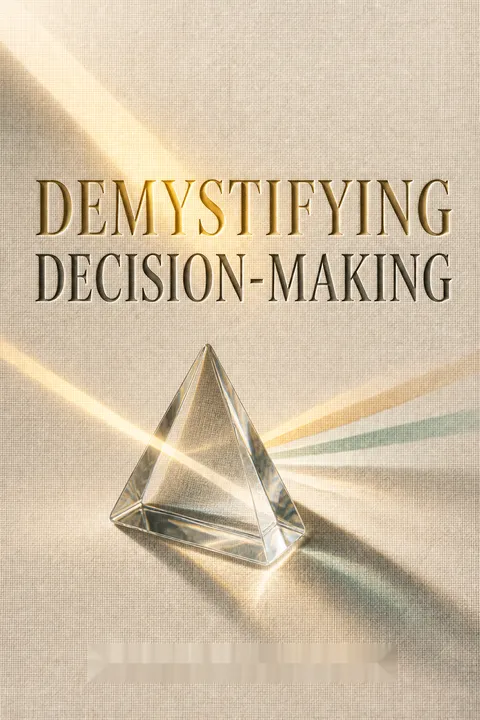
Demystifying Decision-Making is a Christian guide to judgment under uncertainty, structured as a progression from theology to practice. It begins with the emotional burden of abundant choice, then reframes decision-making as a feature of human responsibility and spiritual formation. Its practical center is not a recipe for discovering one perfect option. Instead, it teaches readers to distinguish what Scripture makes clear from what remains unknown, examine the influences shaping their judgment, gather counsel and evidence, and act without claiming control over outcomes.
The book’s strongest synthesis is its refusal to make reason, emotion, circumstances, or religious intuition the sole authority. The dashboard metaphor explains why choices are affected by culture, desire, urgency, and deeper commitments. The three-perspective method turns that insight into a usable discipline: consult norms, assess the situation, and examine the person making the choice. Together, these ideas offer a corrective to both impulsive decision-making and the fantasy that more analysis can eliminate uncertainty.
Its account of post-decision life is especially practical. Anxiety does not prove that a decision was wrong, and a poor decision does not define a person’s entire identity. The book encourages repair where needed, gratitude where appropriate, and renewed attention to present responsibilities. This makes decision-making less like a test with one answer and more like a practice of discernment over time.
The framework is explicitly grounded in Christian theology, particularly Scripture, the Holy Spirit, and divine providence. Readers who do not share those premises may still find value in its attention to habits, social influence, counsel, and emotional bias, but the theological claims will not serve as common ground. Even within its faith tradition, the tools do not remove ambiguity: Scripture requires interpretation, open doors can mislead, and advisers can share blind spots. The book’s best contribution is therefore not certainty, but a disciplined way to proceed faithfully without pretending to possess it.
Review Summary
Demystifying Decision-Making is highly praised for its biblical approach to decision-making, blending theological foundations with practical guidance. Readers appreciate Joseph's accessible writing style, personal anecdotes, and gospel-centered perspective. The book is seen as particularly valuable for young adults facing major life choices. Many reviewers highlight its emphasis on trusting God's sovereignty while taking responsible action. Some found the first half more theoretical, but overall, readers recommend it as a helpful resource for Christians seeking wisdom in decision-making processes.
People Also Read








Glossary
The dashboard of decisions
Influences shaping choicesJoseph’s metaphor for the sources of information and pressure that affect a person’s decisions. These include cultural expectations, disordered desires, urgency, and the person’s relationship with God. The dashboard invites people to notice which influences are prominent, whether they are helping or distorting judgment, and how Christian faith can put them in proportion.
God’s revealed will
What Scripture makes knownThe aspects of God’s will made known in Scripture, including commands and principles for faithful living. Joseph contrasts this with God’s hidden will, such as future events and the full meaning of providential circumstances. Revealed guidance does not necessarily identify one specific career, spouse, or location, but it sets moral boundaries and directs conduct within available choices.
God’s hidden will
God’s unknown purposesThe parts of God’s plan that people cannot know in advance, including future outcomes and the full purpose behind events. Joseph argues that people should not spend their lives trying to uncover these secrets before acting. Instead, they can follow what Scripture reveals, make a wise decision, and trust God with what remains unknown.
Triperspectivalism
Three lenses for discernmentA decision-making approach associated with theologian John Frame that examines an issue through three perspectives. The normative perspective asks what God’s word says, the situational perspective considers facts and circumstances, and the existential perspective examines personal desires and inner life. The perspectives overlap and correct one another, helping a person assess a decision without reducing it to a formula.
Consolation and desolation
Patterns in spiritual feelingA distinction Joseph draws from Ignatius of Loyola’s spiritual exercises. Consolation refers to inward movement toward hope, faith, love, and spiritual joy. Desolation refers to inner turmoil, confusion, or movement toward lesser aims. The distinction can help people examine their emotional responses, but Joseph treats it as a discernment tool rather than a rule or a guarantee that the comfortable option is right.
Trusted trespassers
Candid, trusted advisersJoseph’s term for a small group of wise people who know the decision-maker and are willing to ask difficult questions, identify blind spots, and offer honest counsel. They are not appointed to make the decision. Their value comes from combining personal knowledge, spiritual maturity, and the willingness to say more than what the decision-maker wants to hear.
Filial fear
Reverent trust in GodA term Joseph attributes to Sinclair Ferguson for the reverence and awe of a child toward a good father. In decision-making, filial fear means acting with awareness of God’s authority and presence while trusting his love. It differs from servile fear, which is the fear of a slave anticipating punishment and tends to produce bondage rather than faithful freedom.
SWOT analysis
A four-part option reviewA planning tool that organizes an option by examining its strengths, weaknesses, opportunities, and threats. Joseph uses it to help people name the practical benefits, limitations, possibilities, and risks involved in a decision. The analysis can clarify jumbled thoughts and expose concerns, but it does not determine which option is best or replace prayer, counsel, and judgment.
Download PDF
Download EPUB
.epub digital book format is ideal for reading ebooks on phones, tablets, and e-readers.








